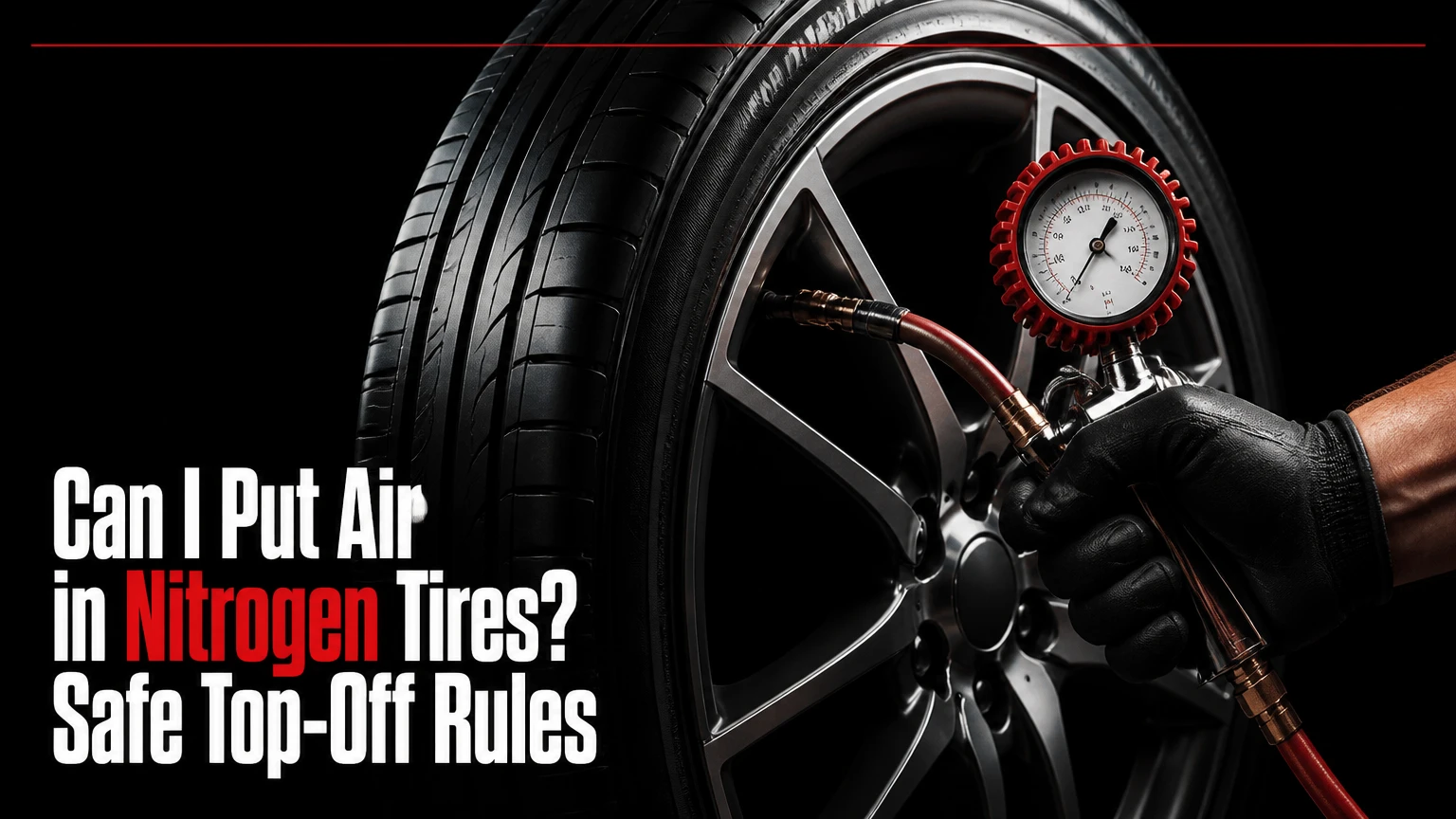
Yes, you can put regular compressed air in nitrogen-filled tires without damaging the tire, wheel, TPMS sensor, or vehicle. Air and nitrogen mix safely because atmospheric air is already about 78% nitrogen. Inflate the tire to the vehicle manufacturer’s cold-pressure specification; preserving nitrogen purity matters less than avoiding underinflation.
Key Facts at a Glance
Regular compressed air is compatible with nitrogen-filled automotive tires.
Mixing air with nitrogen does not create a harmful chemical reaction.
The driver’s door-jamb placard, not the tire sidewall maximum, specifies normal cold tire pressure.
One air top-off lowers nitrogen purity, but the exact final percentage depends on the tire’s starting pressure and fill volume.
Nitrogen does not eliminate pressure loss, punctures, valve leaks, temperature effects, or the need for monthly checks.
A recurring TPMS warning after inflation usually requires leak inspection, not a nitrogen refill.
Can I Put Air in Nitrogen Tires?
Regular compressed air is the correct emergency top-off for a nitrogen-filled tire when nitrogen is unavailable. The mixture remains chemically inert inside a normal tire, and the vehicle’s handling and safety depend far more on correct pressure, tire condition, and load than on whether the inflation gas is 95% nitrogen or ordinary air.
Nitrogen-filled tires are not a separate tire type. The same tubeless tire, valve core, wheel, bead seal, and tire-pressure monitoring system accept either gas. Green valve caps identify a nitrogen service convention at some shops, but they do not block a standard air chuck.
The practical rule is simple: if the tire is below the placard pressure, add available air before driving farther. A nitrogen refill can restore the intended gas mixture later, but driving underinflated can increase heat buildup, tread-edge wear, rolling resistance, and the risk of tire failure.
Does air ruin a nitrogen-filled tire?
Air does not ruin a nitrogen-filled tire. Ordinary air introduces oxygen and variable moisture, reducing the small pressure-retention and corrosion benefits associated with dry nitrogen, but it does not damage rubber compounds or TPMS electronics through contact.
The term “pure nitrogen tire” is also imprecise for consumer vehicles. Commercial nitrogen generators commonly deliver gas in the approximately 93%-99% purity range, depending on equipment, maintenance, purge technique, and the operator’s process. A tire that receives one air top-off becomes a mixed-gas tire, not an unsafe tire.
What Happens When Air Mixes With Nitrogen?
Air mixing with nitrogen changes composition, not compatibility. Atmospheric air contributes approximately 78% nitrogen, 21% oxygen, about 1% argon, and varying water vapor, while a nitrogen generator removes much of the oxygen and moisture before inflation.
The final mixture cannot be predicted from the top-off alone. For example, if a tire at 28 psi gauge pressure is raised to 35 psi with air, the added air represents only part of the tire’s absolute gas inventory, so the nitrogen concentration decreases but does not simply become 80% or 85%. The starting gas purity, pressure, temperature, and amount added all matter.
Pressure itself is governed primarily by gas temperature and the amount of gas in the tire. Nitrogen and air both follow the ideal-gas relationship closely under normal automotive conditions. At the same temperature and pressure, they provide nearly equivalent load support.
Is nitrogen chemically different inside a tire?
Nitrogen is less reactive than oxygen and can be supplied with very low moisture content. That difference may reduce oxidation inside the tire and wheel assembly, but the tire’s external environment remains far more influential because road salt, humidity, wheel damage, bead contamination, and age affect durability.
Oxygen does permeate through rubber, and different gases have different permeability rates. However, the common claim that oxygen always escapes 30%-40% faster than nitrogen is too broad for consumer advice. Tire construction, liner material, temperature, pressure, valve condition, bead sealing, and punctures determine actual pressure loss.
The practical conclusion is stronger than the marketing claim: dry nitrogen can slow some gas diffusion, but it cannot seal a puncture or prevent a valve-core leak.
Does Nitrogen Hold Pressure Better Than Air?
Nitrogen can reduce pressure loss and moisture-related variation under controlled conditions, but the improvement for an ordinary passenger car is usually modest. The National Highway Traffic Safety Administration and tire manufacturers consistently prioritize maintaining the recommended pressure over choosing one compatible inflation gas.
Pressure changes with temperature regardless of gas choice. A widely used field approximation is a change of about 1 psi for each 10°F, or 5.5°C, change in tire temperature, although the exact change depends on starting pressure, tire volume, casing temperature, and whether the measurement is taken before or after driving.
| Factor | Ordinary compressed air | Dry nitrogen | Practical consequence |
|---|---|---|---|
| Main gas | 78% nitrogen, 21% oxygen | Typically 93%-99% nitrogen | Both support normal tire loads |
| Water content | Variable, depending on compressor and dryer | Usually lower | Nitrogen may reduce moisture variation |
| Temperature response | Approximately 1 psi per 10°F as a field rule | Similar ideal-gas response | Cold-pressure checks remain necessary |
| Permeation | Depends on tire liner and pressure | Often somewhat slower | Possible gradual pressure-retention benefit |
| Emergency availability | Home compressor, service station, roadside pump | Nitrogen-equipped tire center | Air is usually the safer immediate choice |
| Maintenance requirement | Check at least monthly | Check at least monthly | Nitrogen does not remove inspections |
A 2012 review published in Tire Science and Technology found that nitrogen’s benefits depend heavily on pressure-maintenance practices and operating conditions. Tire Rack’s testing and technical explanations likewise distinguish controlled racing and fleet applications from ordinary road use. Those sources support a measured conclusion, not a universal monthly PSI-loss promise.
Does nitrogen prevent seasonal pressure loss?
Nitrogen does not prevent seasonal pressure loss. Cooling air lowers tire pressure because the gas temperature falls, and nitrogen experiences the same basic thermodynamic effect.
A tire that triggers a TPMS warning after a cold snap may need air even if it contains nitrogen. Measure all four tires cold, compare them with the door-placard specification, and adjust them before diagnosing gas purity.
How Do You Top Off a Nitrogen Tire With Air?
Top off a nitrogen-filled tire with a calibrated air compressor, using the vehicle placard pressure and a cold tire as the reference. The job normally takes 2-5 minutes per tire, requires a pressure gauge and compressor, and has no special compatibility requirement.
Before you start
| Requirement | Typical value | Why it matters |
|---|---|---|
| Reference pressure | Door placard, commonly 30-36 psi | Sets the vehicle’s designed cold pressure |
| Tire temperature | Parked at least 3 hours | Prevents hot-pressure readings |
| Equipment | 0-60 psi gauge, compressor | Covers normal passenger-car pressures |
| Typical time | 2-5 minutes per tire | Depends on tire size and compressor output |
| Typical cost | $0-$2 with public air | Nitrogen purity is not a safety prerequisite |
Step 1: Read the vehicle placard
Find the label on the driver’s door jamb, door edge, fuel-filler area, or owner’s manual. Use the front and rear values separately when the vehicle lists different pressures, and do not substitute the maximum pressure molded into the tire sidewall.
The placard pressure is a cold inflation target. It accounts for the vehicle’s weight distribution, suspension calibration, tire size, and approved load range.
Step 2: Inspect the tire before inflating
Look for a nail, screw, bulge, sidewall cut, separated tread, damaged valve stem, or object lodged in the tread. A tire that is visibly damaged or nearly flat should not be driven to a distant nitrogen facility.
A tire losing more than about 2 psi over several days deserves a leak test. A tire that falls several PSI overnight may have a puncture or bead, valve-core, or wheel problem.
Step 3: Measure the cold pressure
Remove the valve cap and press the gauge squarely onto the valve stem. Take the reading before driving, because friction and flexing warm the tire and temporarily increase pressure.
Record each tire’s reading. Comparing one tire with the other three often reveals a slow leak or a temperature-related change.
Step 4: Add ordinary compressed air
Attach the chuck and add air in short bursts, checking the gauge every few seconds. Stop at the placard value, reinstall the valve cap, and repeat the measurement after removing the chuck.
You will know the step worked when the tire reaches the specified cold PSI and the valve does not hiss after the chuck is removed. A green cap is not a technical requirement.
Step 5: Recheck the TPMS system
Drive according to the vehicle manual’s reset procedure if the warning remains after all tires reach specification. Some systems relearn automatically after several minutes above a minimum speed; others require a dashboard reset or scan-tool procedure.
A TPMS light that returns within hours or days points toward pressure loss, not contamination from ordinary air.
Should You Refill With Nitrogen or Leave the Air Mixture?
Leave the mixed gas in place if the tire holds pressure and nitrogen service is inconvenient. Request a nitrogen top-off during the next tire service when maintaining a dry, consistent inflation medium matters to your operation or the service is free.
A complete purge is rarely necessary for a daily-driven passenger vehicle. It becomes more reasonable after repeated air top-offs, during controlled motorsport preparation, or when a fleet has a documented pressure-maintenance program.
| Situation | Recommended action | Typical time | Typical cost |
|---|---|---|---|
| TPMS warning during a trip | Add air to placard pressure | 5-10 minutes | $0-$2 |
| One minor seasonal adjustment | Add air and monitor | 5 minutes | $0-$2 |
| Free nitrogen service nearby | Request nitrogen top-off | 5-15 minutes | $0-$5 per tire |
| Repeated air additions | Inspect for leak first | 15-45 minutes | $0-$40 inspection |
| Full four-tire nitrogen conversion | Purge and refill at a tire shop | 15-30 minutes | $20-$80 typical |
| Dealer nitrogen package | Decide before purchase | Service-dependent | $70-$200 reported add-on |
Prices vary by region, retailer, vehicle, and whether tire mounting is included. A shop may advertise nitrogen free with a tire purchase while charging for a standalone conversion.
How does a shop restore high nitrogen purity?
A shop restores a high nitrogen concentration by removing much of the existing gas, filling with nitrogen, purging, and then setting final pressure. One fill-and-release cycle improves purity, but the exact result depends on the tire’s internal volume, machine performance, and residual gas.
A typical procedure is:
- Deflate the tire to near atmospheric pressure.
- Fill it with generator nitrogen.
- Deflate it again to flush mixed gas.
- Inflate it to the vehicle’s placard pressure.
- Check the valve, bead, and TPMS reading.
Repeated purges can improve concentration further, but the process does not justify driving an underinflated tire to a shop. Pressure safety comes first.
Which Is Better for Daily Driving, Air or Nitrogen?
Regular air is the better practical choice for most daily drivers because it is available everywhere, costs little, and provides the same safety benefit when maintained at the correct pressure. Nitrogen is reasonable when a vehicle already receives convenient nitrogen service and the owner values modest pressure-retention or moisture-control benefits.
Daily city driver
Choose regular air and check pressure monthly, plus before long trips. The convenience of a home compressor or service-station pump usually outweighs the small benefit of preserving nitrogen purity.
Long-distance commuter or fleet operator
Nitrogen can make operational sense when a fleet has centralized nitrogen equipment, scheduled inspections, and high annual mileage. The business case comes from consistent pressure management and reduced service variance, not from nitrogen replacing inspections.
The U.S. Department of Energy notes that correct tire inflation improves fuel economy and reduces tire wear. That benefit comes from pressure accuracy, whether the tire contains air, nitrogen, or a mixture.
Track-day or autocross driver
Dry nitrogen can be useful for repeatable testing because controlled gas moisture reduces one source of variation during repeated heat cycles. Track drivers still need a pyrometer or reliable pressure procedure, because tire compound, camber, ambient temperature, track surface, and driving style often produce larger changes.
Nitrogen is not a substitute for setting cold pressures, measuring hot pressures, or inspecting the carcass.
Recreational vehicle or trailer owner
Pressure maintenance is especially important for trailers and vehicles that sit for weeks. Nitrogen may slow gradual diffusion, but owners should inspect for valve leaks, sun exposure, load changes, and tire age before each trip.
What Problems Can Air in Nitrogen Tires Cause?
Air in nitrogen tires causes dilution, not a mechanical fault. The meaningful disadvantages are possible additional moisture, slightly faster diffusion, and less consistency in controlled applications; ordinary road vehicles do not develop a special failure mode merely because the gases are mixed.
| Symptom or condition | Likely cause | Correct response | Do not do |
|---|---|---|---|
| TPMS light after cold weather | Temperature-related pressure drop | Measure cold PSI and inflate | Do not blame gas purity first |
| One tire loses pressure repeatedly | Puncture, valve, bead, or wheel leak | Perform leak inspection | Do not keep topping off indefinitely |
| All tires read low | Seasonal temperature change or gauge error | Check gauge and placard values | Do not inflate to sidewall maximum |
| Valve cap is green | Service identification only | Use any compatible air chuck | Do not assume air is blocked |
| Tire is hot after highway driving | Normal heat-related pressure rise | Measure again when cold | Do not bleed hot tires to placard PSI |
| Visible sidewall bulge | Structural tire damage | Stop driving and replace or inspect | Do not inflate and continue normally |
Can mixed inflation damage TPMS sensors?
Mixed inflation does not damage TPMS sensors. Direct TPMS sensors measure pressure, and some also measure temperature; they do not require a particular inflation gas to operate.
TPMS sensors can fail because of battery age, corrosion, impact, incorrect installation, or valve-hardware damage. A sensor warning should be diagnosed through pressure measurement and a scan tool when necessary.
Can a nitrogen tire go flat faster after an air top-off?
A nitrogen tire does not suddenly go flat because air was added. If pressure falls quickly after any inflation, inspect for a puncture, damaged valve core, bead leak, cracked wheel, or inaccurate gauge.
A slow leak can become more noticeable after a temperature change because the tire starts near the warning threshold. The gas mixture is rarely the immediate cause.
What Mistakes Should You Avoid?
The most expensive nitrogen mistake is delaying inflation while searching for a nitrogen source. Underinflation raises casing flex and heat, whereas ordinary air preserves the tire’s required pressure immediately.
- Using the sidewall maximum as the target. The sidewall number is a limit associated with the tire’s rated load, not necessarily the vehicle’s operating specification.
- Measuring only one tire. Compare all tires under the same cold conditions to identify a leak or uneven temperature exposure.
- Bleeding hot tires. Hot pressure is temporarily elevated after driving; adjust when the tires are cold unless a manufacturer or racing procedure specifies otherwise.
- Assuming green caps prove nitrogen purity. Valve caps are visual identifiers and can be replaced or installed incorrectly.
- Paying for a purge before finding a leak. A nitrogen refill cannot correct a punctured tread, leaking valve core, or porous wheel.
- Ignoring the spare tire. A full-size spare may also require placard-specific pressure, while a compact temporary spare often needs a much higher pressure printed on its sidewall.
A useful practitioner rule is to treat gas purity as a maintenance optimization and pressure as a safety requirement. The order should never be reversed.
When Should You Stop Driving and Get Help?
Stop driving when a tire is visibly damaged, substantially below specification, repeatedly losing pressure, or too hot to assess safely. A tire that is several PSI low may reach a repair shop cautiously only if it has no visible damage and can be inflated to the correct pressure first.
Use the spare tire or roadside assistance when the tire is flat, the sidewall is cut or bulged, the tread is separating, or the wheel is bent. Do not drive on a flat tire merely to preserve nitrogen.
A tire-pressure warning is not a nitrogen-quality warning. It is a pressure or system warning that requires measurement.
Frequently Asked Questions
Can I use a home air compressor on nitrogen-filled tires?
Yes, a home compressor can inflate a nitrogen-filled tire safely. Use a compressor rated for the tire’s required pressure, a functioning gauge, and the vehicle’s cold-pressure placard. Drain moisture from the compressor tank according to its manual, but ordinary residual humidity does not make the tire unsafe.
Do nitrogen tires need a special valve or TPMS sensor?
Nitrogen-filled tires do not need a special valve, valve core, or TPMS sensor. The same automotive valve hardware accepts compressed air and nitrogen. Some shops use green caps to identify nitrogen service, but cap color has no effect on compatibility, pressure measurement, or sealing.
How often should nitrogen-filled tires be checked?
Check nitrogen-filled tires at least monthly and before long trips, just as you would check air-filled tires. Measure them cold, because driving warms the gas and changes the reading. Check sooner after a puncture repair, wheel impact, major temperature change, or TPMS warning.
Is nitrogen worth paying for when buying tires?
Nitrogen may be worth accepting when included at no extra charge, but most daily drivers receive greater value from a good pressure gauge and regular inspections. Paid nitrogen becomes more defensible for fleets, specialty vehicles, or controlled track use where consistent service and low moisture justify the cost.
Can you mix nitrogen and air in all tire types?
Nitrogen and ordinary compressed air can be mixed in passenger-car, SUV, light-truck, and trailer tires designed for normal pneumatic inflation. Specialized aviation, industrial, mining, and motorsport applications may have separate operating procedures, so follow the equipment manufacturer’s requirements for those applications.
Should you purge air after accidentally topping off?
You do not need to purge air after an accidental top-off for normal road driving. Restore nitrogen during the next convenient tire service if purity matters, but inspect pressure and leaks first. A purge cannot improve safety if the tire remains underinflated or has a mechanical defect.
The Bottom Line
You can put air in nitrogen tires safely, and doing so is preferable to driving on low pressure. Regular air dilutes nitrogen and may reduce modest benefits related to dry-gas inflation, but it does not harm the tire, TPMS, wheel, or vehicle.
Use the door-placard PSI, measure when cold, inspect for leaks, and monitor recurring pressure loss. For most drivers, regular air is the most practical maintenance choice; nitrogen is an optional optimization, not a safety requirement.