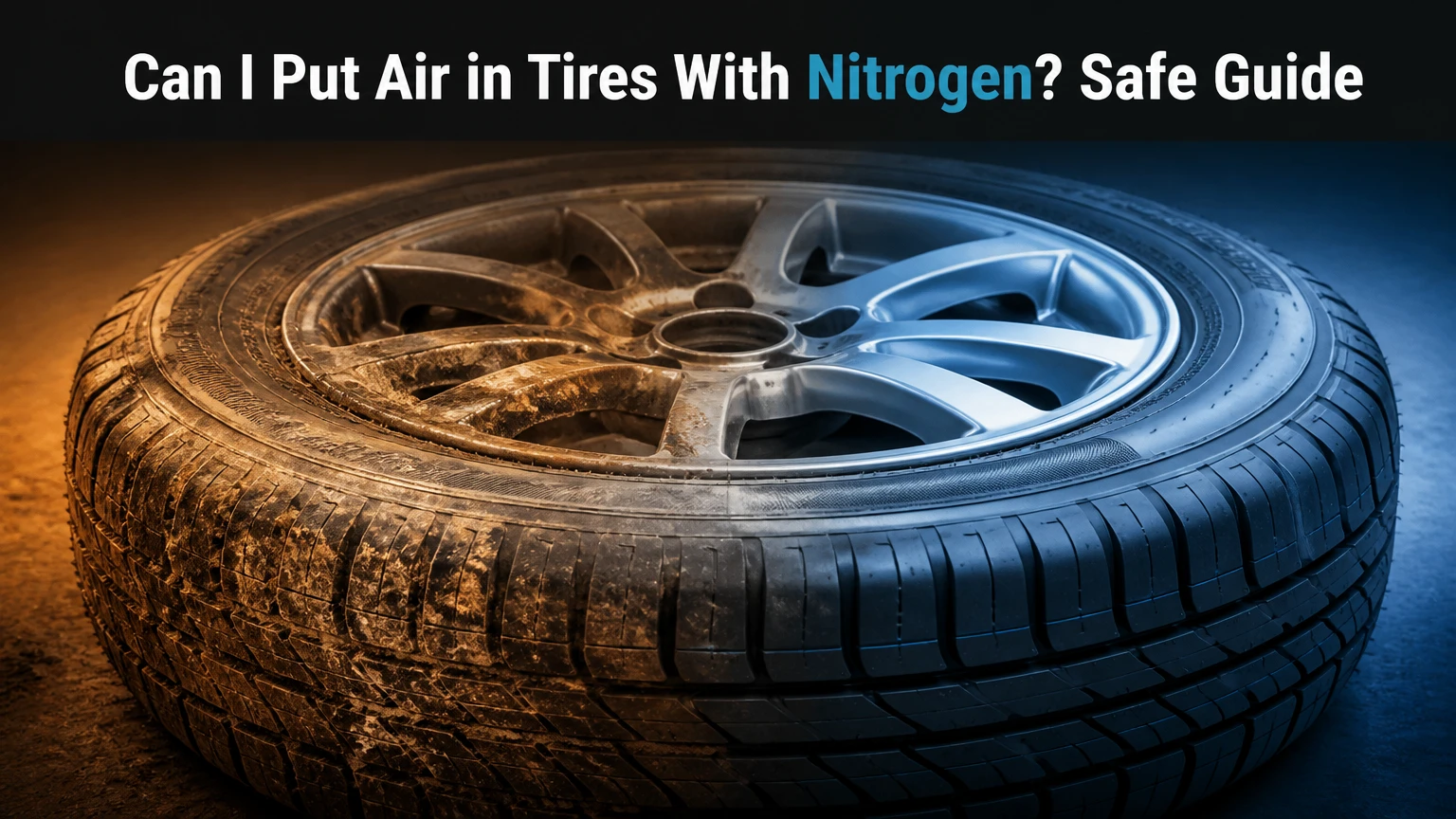
Yes, you can put regular compressed air in tires filled with nitrogen, and the mixture is safe for the tire, wheel, valve, and TPMS sensor. Regular air already contains about 78% nitrogen, so adding it does not create a dangerous chemical reaction. Inflate the tire to the vehicle manufacturer’s recommended cold pressure, even if nitrogen is unavailable.
Key Facts at a Glance
- Mixing compressed air with nitrogen does not damage a tire, wheel, valve stem, or TPMS sensor.
- Regular dry air contains approximately 78% nitrogen, 21% oxygen, and about 1% argon and other gases.
- Tire pressure depends mainly on temperature, gas quantity, and leakage, not on whether the gas is labeled air or nitrogen.
- Nitrogen may slow pressure loss when the fill is exceptionally dry, but it does not prevent punctures, valve leaks, or cold-weather pressure changes.
- A low tire is a safety problem; preserving nitrogen purity is less important than restoring the correct pressure immediately.
- Ordinary passenger vehicles usually gain more from frequent pressure checks than from paying for nitrogen service.
Can I Put Air in Tires With Nitrogen Safely?
You can add compressed air to a nitrogen-filled tire whenever the pressure is low, including during an emergency. The added air dilutes the nitrogen concentration, but the resulting gas remains nonflammable, chemically stable, and suitable for normal road use. The correct pressure is more important than maintaining a particular gas purity.
A nitrogen-filled tire is not a separate type of tire. The tire casing, wheel, valve core, bead, and tire-pressure monitoring sensor are designed to contain gas, whether that gas is ordinary air, nitrogen, or a mixture. Automotive service facilities routinely inflate tires with air during repairs and pressure adjustments.
The practical rule is simple: use nitrogen when it is convenient, but use compressed air when safety requires it. Do not drive several miles on a visibly underinflated tire to find a nitrogen station. Low pressure increases sidewall flex, heat generation, stopping distance, and the chance of irreversible tire damage.
What Happens When Air and Nitrogen Mix?
Air and nitrogen mix uniformly inside the tire, producing no harmful reaction or pressure shock. The final composition depends on the amount of air added, the tire’s existing pressure, and whether the tire was previously purged.
For example, a tire containing high-purity nitrogen may become a roughly ordinary air-and-nitrogen mixture after several top-offs. That change affects theoretical gas purity, not immediate road safety. A tire at the correct pressure with mixed gas is generally safer than a nitrogen-only tire that is 8 psi below specification.
What Is Inside a Nitrogen-Filled Tire?
A nitrogen-filled tire normally contains nitrogen with a specified purity, while a tire filled from a standard compressor contains atmospheric air. Commercial automotive nitrogen systems commonly deliver approximately 93%-99% nitrogen, although the purity depends on the generator, maintenance, separator technology, and service procedure.
| Inflation gas | Nitrogen content | Oxygen content | Typical moisture condition |
|---|---|---|---|
| Atmospheric air | 78% | 21% | Variable, dependent on humidity and dryer |
| Service-station compressed air | 77%-79% | 20%-22% | Variable, often partly dried |
| Automotive nitrogen generator output | 93%-99% | 1%-6% | Usually low, equipment-dependent |
| Laboratory or industrial nitrogen | 99.5%-99.999% | Below 0.5% | Very low when properly stored |
The green valve cap sometimes used by tire shops identifies a nitrogen service, but the cap does not prove the current gas purity. Once ordinary air is added, the tire no longer has the original nitrogen concentration unless a technician removes the mixed gas and refills it.
Does Nitrogen Prevent Normal Pressure Changes?
Nitrogen does not eliminate pressure changes caused by temperature. The ideal-gas relationship means a sealed tire’s pressure changes as its absolute temperature changes. As a practical rule, a passenger tire often changes by about 1 psi for every 10 degrees Fahrenheit change in ambient temperature, although tire construction, starting pressure, sunlight, and driving heat alter the result.
A cold-weather TPMS warning does not automatically indicate a leak or a failed nitrogen fill. Check the pressure with a reliable gauge when the tires are cold, then inflate to the placard value. The placard is usually on the driver’s doorjamb or fuel-filler door, and the number printed on the tire sidewall is the maximum permitted cold inflation pressure, not the vehicle’s target pressure.
Does Nitrogen Hold Tire Pressure Longer Than Air?
Nitrogen can reduce pressure loss through permeation when compared with wet, poorly dried compressed air, but the advantage is usually modest for ordinary passenger vehicles. Tire pressure retention depends more on punctures, valve cores, bead seals, wheel damage, ambient temperature, and maintenance frequency than on the gas name.
Oxygen and nitrogen permeate rubber at different rates, and nitrogen service usually contains less water vapor. However, the popular claim that nitrogen molecules are dramatically larger and therefore provide a universal 30%-40% improvement is too simple. Tire compounds, liner materials, temperature, pressure, and the starting moisture level all affect measured loss.
| Pressure issue | Typical symptom | Likely cause | Correct response |
|---|---|---|---|
| Slow loss, 1 psi over several months | Repeated small adjustment | Normal permeation or minor seepage | Check monthly and inspect if loss accelerates |
| Loss of 2 psi in 1-2 weeks | One tire needs frequent inflation | Valve, bead, puncture, or wheel leak | Perform a leak inspection |
| Loss of 5 psi overnight | Noticeably soft tire | Puncture, damaged valve, or bead failure | Avoid highway driving and repair promptly |
| Pressure drops on cold mornings | TPMS warning after temperature change | Lower gas temperature | Measure cold pressure and adjust to placard value |
| Pressure rises after driving | Gauge reads higher after a trip | Heat from flexing and road contact | Do not bleed a hot tire to the cold placard value |
The U.S. Department of Energy’s fueleconomy.gov explains that underinflated tires can reduce fuel economy and recommends checking tire pressure regularly. The practical benefit comes from keeping the tire at the correct pressure, whether the tire contains air, nitrogen, or a mixture.
Does Nitrogen Improve Fuel Economy or Tread Life?
Correct inflation improves fuel economy, handling, and tread wear; nitrogen does not independently create those benefits. A nitrogen program can help only if it keeps tires closer to the recommended pressure between inspections, and a driver who checks air-filled tires monthly can usually obtain the same primary benefit.
Underinflation increases rolling resistance and shoulder wear. Overinflation reduces the contact patch and can increase wear at the tread center. Tire Rack’s tire-maintenance guidance similarly emphasizes pressure checks and proper inflation rather than treating nitrogen as a substitute for routine inspection.
A useful practitioner rule is this: measure maintenance behavior before buying a gas service. If a driver rarely checks pressure, a $15-$40 digital gauge and portable compressor usually address the main risk more directly than a nitrogen conversion.
How Do I Top Off a Nitrogen-Filled Tire With Air?
To top off a nitrogen-filled tire, check the tire cold, compare the reading with the vehicle placard, add clean compressed air in short bursts, and recheck the pressure. The process normally takes 2-5 minutes for one tire and requires only an accurate pressure gauge and an inflation source.
Step 1: Find the Correct Cold Pressure
Park for at least three hours, or measure the tire before driving more than a few miles. Read the recommended front and rear pressures from the driver’s door placard because some vehicles use different pressures by axle or load condition.
Do not use the sidewall maximum as the target unless the vehicle manufacturer specifically instructs you to do so. A passenger car may require 32 psi cold while the tire sidewall lists 44 psi maximum.
Step 2: Inspect Before Adding Gas
Look for nails, screws, cuts, bulges, exposed cords, and a visibly separated bead. Remove the valve cap and listen for hissing. A tire that repeatedly loses pressure needs diagnosis, not repeated top-offs.
Step 3: Add Air Gradually
Connect the inflator securely and add air in 2-3 second bursts. Pause between bursts so the gauge can stabilize, especially when using a small portable compressor. Stop at the placard pressure, then replace the valve cap.
You will know the adjustment worked when the cold gauge reading matches the placard within the gauge’s normal accuracy, commonly about plus or minus 1 psi. The common mistake is checking only one tire or inflating a hot tire to compensate for a temporary reading.
Step 4: Recheck the TPMS System
Drive normally after correcting the pressure. Direct TPMS sensors usually report pressure automatically, while indirect systems infer pressure from wheel-speed differences and may require a reset procedure in the owner’s manual.
If the warning remains after all four tires have the correct cold pressure, inspect for a leak or sensor fault. Do not assume the warning reflects reduced nitrogen purity.
Should I Purge a Tire After Adding Regular Air?
A nitrogen purge is optional after an air top-off, not a safety requirement. Purging is worthwhile when a fleet, racing team, laboratory application, or specialist service requires a controlled dry-gas fill; it is rarely worthwhile for a daily passenger car that already contains mixed gas at the correct pressure.
A technician normally removes the valve core or deflates the tire, fills it with nitrogen, vents it, and repeats the cycle before the final inflation. One cycle does not create perfect purity because residual gas remains in the tire and hose, so service equipment and procedure determine the final result.
| Service action | Typical quantity or duration | Approximate cost | Appropriate use |
|---|---|---|---|
| Add compressed air | 1-3 minutes per tire | Free-$2 per use | Routine pressure correction |
| Add nitrogen | 1-3 minutes per tire | Free-$2 per tire | Existing nitrogen maintenance |
| Initial nitrogen fill | 15-30 minutes per vehicle | $20-$40 per set | Optional conversion |
| Purge and refill | 20-45 minutes per vehicle | $30-$80 per set | Controlled dry-gas application |
The exact price varies by region and shop policy. A dealer-installed nitrogen package costing hundreds of dollars deserves careful scrutiny because the vehicle remains fully serviceable with ordinary compressed air.
How Is a Tire Converted to Nitrogen?
A conversion usually follows this sequence:
- Measure and record the existing pressure and inspect the tire.
- Deflate the tire under controlled service conditions.
- Fill the tire with nitrogen to a temporary pressure.
- Vent the temporary fill to displace residual air and moisture.
- Repeat the purge if the required purity justifies it.
- Inflate to the manufacturer’s cold-pressure specification.
- Check the valve core, cap, bead, and TPMS operation.
A conversion does not repair a leaking tire. If pressure falls soon after the service, the technician should test the valve, bead, wheel, tread, and sensor area rather than blaming gas purity.
Is Nitrogen Better Than Regular Air?
Nitrogen is better when predictable pressure behavior, low moisture, and centralized maintenance justify the cost; regular compressed air is better for accessibility, low cost, and ordinary passenger-car service. Neither gas provides a meaningful grip, braking, or ride advantage when both are maintained at the same correct pressure.
| Decision factor | Nitrogen service | Regular compressed air | Practical winner |
|---|---|---|---|
| Typical composition | 93%-99% nitrogen | 78% nitrogen | Nitrogen |
| Availability | Tire shops, fleets, tracks | Gas stations, garages, portable compressors | Air |
| Initial service cost | $20-$80 per vehicle | $0-$10 per vehicle | Air |
| Moisture control | Low when equipment works correctly | Variable | Nitrogen |
| Emergency access | Limited in some areas | Widely available | Air |
| Daily pressure benefit | Modest if maintained | Equivalent at correct pressure | Tie |
| Track pressure repeatability | Stronger advantage | More moisture variability | Nitrogen |
| Passenger-car value | Often marginal | High convenience per dollar | Air |
Nitrogen also does not make a tire puncture-resistant. A screw through the tread, leaking valve core, bent alloy wheel, or bead corrosion can lower pressure regardless of the inflation gas.
Does Nitrogen Protect Wheels and TPMS Sensors?
Dry nitrogen can reduce the oxygen and moisture available inside a tire, which may reduce internal corrosion under certain conditions. The effect is more relevant to specialized equipment, long storage, high humidity, or wheels with existing corrosion exposure than to a healthy modern passenger-car assembly.
Aluminum wheels can corrode at the bead seat, and steel wheels can rust internally when moisture enters through damaged tires or mounting conditions. Nitrogen cannot remove corrosion already present, seal a porous wheel, or compensate for water entering during tire service.
Who Benefits Most From Nitrogen Inflation?
Track users, large commercial fleets, and vehicles requiring long-term storage benefit most from nitrogen because pressure repeatability or reduced maintenance can have operational value. Most daily commuters do not need nitrogen if they check pressures monthly and repair leaks promptly.
Track Cars and Racing Vehicles
Track drivers may value dry nitrogen because tire pressure changes during repeated high-speed laps need predictable management. Racing teams measure cold and hot pressures, record ambient and track temperatures, and adjust for a specific tire compound and vehicle setup.
That benefit applies to a controlled motorsport program, not automatically to spirited road driving. A track tire still needs the manufacturer’s or tire engineer’s operating range, and nitrogen cannot replace temperature measurements or tread inspection.
Commercial Fleets
Fleets can justify nitrogen when a standardized maintenance program covers many vehicles and records pressure, tread depth, axle load, and leak history. The economic case depends on labor savings, tire replacement rates, route conditions, and service access rather than on a universal fuel-economy percentage.
Fleet managers should compare the annual nitrogen contract with the cost of mobile air service, pressure-monitoring systems, and preventable tire failures. A documented inspection process often produces more measurable value than gas selection alone.
Stored and Classic Vehicles
Dry nitrogen may help a stored vehicle maintain pressure and reduce internal moisture exposure during months of inactivity. The owner should still place the vehicle on suitable storage supports when appropriate, protect the tires from sunlight, control humidity, and check pressure before driving.
A stored vehicle with a slow valve leak will still lose pressure. Nitrogen slows no mechanical leak.
What Are the Common Problems After Adding Air?
The most common problems after adding air are incorrect pressure, an undiagnosed leak, a hot-tire measurement, and unnecessary concern about nitrogen purity. Mixed gas itself is not a mechanical failure and does not require immediate removal.
- The TPMS light returns: Recheck all tires cold, including the spare if equipped with a sensor, then inspect the tire with the repeated loss.
- One tire loses pressure faster: Check for a puncture, valve-core leak, bead leak, wheel crack, or corrosion.
- The gauge reads higher after driving: Wait until the tire cools before adjusting; never bleed hot pressure down to the cold placard number.
- The compressor cannot reach pressure: Check the chuck seal, power supply, hose, and valve stem; a damaged valve may prevent inflation.
- A shop refuses to add air: Use another service point or a portable compressor; the tire does not require nitrogen for safe operation.
- The tire was completely flat: Do not simply inflate and drive away if the sidewall was flexed while empty; have the tire inspected internally.
Can Air Top-Offs Cause a Warranty Problem?
A normal air top-off does not ordinarily invalidate a tire or vehicle warranty because manufacturers specify pressure, load, speed, and tire dimensions rather than requiring nitrogen purity for ordinary road use. Warranty terms can differ for specialty racing tires, commercial agreements, or dealer service packages, so consult the written terms when applicable.
How Often Should Nitrogen-Filled Tires Be Checked?
Check nitrogen-filled tires at least monthly and before long trips, just as you would air-filled tires. The National Highway Traffic Safety Administration recommends monthly pressure checks when tires are cold, and seasonal temperature changes make additional checks sensible.
A pressure-monitoring system is a warning device, not a substitute for a gauge. TPMS may warn only after pressure has fallen below a programmed threshold, and it may not identify a slow leak early enough to prevent uneven wear.
Use the same maintenance schedule for mixed air-and-nitrogen tires:
- Check cold pressure monthly.
- Check before towing or carrying a heavy load.
- Inspect tread and sidewalls at every pressure check.
- Measure pressure after major temperature changes.
- Investigate repeated losses instead of resetting the warning repeatedly.
Is Nitrogen Worth Paying For?
Nitrogen is worth paying for when a controlled dry fill solves a specific operating problem, such as track pressure repeatability or high-volume fleet maintenance. For a typical privately owned car, free or inexpensive compressed air plus monthly pressure checks usually delivers the best practical value.
| Vehicle situation | Recommended gas | Maintenance priority | Reason |
|---|---|---|---|
| Daily commuter, mild climate | Compressed air | Monthly cold-pressure checks | Lowest cost and easiest access |
| Daily commuter, large seasonal swings | Air or nitrogen | Check after temperature changes | Temperature affects both gases |
| Track vehicle | Dry nitrogen if available | Record cold and hot pressures | Better repeatability under heat |
| Commercial fleet | Nitrogen when centrally managed | Pressure and tread records | Scale may justify service cost |
| Classic car stored for months | Nitrogen optional | Storage inspection and pressure checks | Dry gas may reduce moisture exposure |
| Emergency low tire | Any available safe gas | Restore placard pressure immediately | Correct pressure outranks purity |
The strongest value proposition remains maintenance discipline. Nitrogen can support that discipline, but it cannot replace it.
FAQ
Can I Put Air in Only One Nitrogen-Filled Tire?
Yes, you can add compressed air to one nitrogen-filled tire without creating a safety problem. Inflate that tire to the correct cold pressure, then check the other tires for matching pressure requirements. The vehicle will operate with different gas mixtures across its tires, although the pressure readings and tire condition still need regular monitoring.
Will Adding Air Make My Nitrogen Tire Explode?
No, ordinary compressed air does not make a nitrogen-filled tire explode. Tire failures generally involve severe underinflation, overloading, impact damage, excessive heat, mounting errors, or pre-existing structural damage. Use the vehicle placard pressure, inspect visible damage, and never exceed the tire’s marked maximum cold pressure.
Can I Use a Portable Compressor on Nitrogen Tires?
Yes, a portable compressor works normally on nitrogen-filled tires. The compressor adds ordinary atmospheric air, so the tire becomes a mixture rather than remaining at its original nitrogen purity. A compressor rated for the tire’s pressure and powered appropriately for the vehicle can restore pressure during travel or home maintenance.
Does Nitrogen Change the Correct Tire Pressure?
No, nitrogen does not change the vehicle manufacturer’s recommended tire pressure. Use the cold-pressure value printed on the driver’s door placard or owner’s manual, including separate front, rear, load, or towing specifications. Do not use the tire sidewall maximum as the everyday target unless the manufacturer directs you to do so.
Can Nitrogen Fix a Slow Tire Leak?
No, nitrogen cannot fix a puncture, leaking valve core, damaged bead, cracked wheel, or corroded rim. A tire that loses more than a small amount of pressure between monthly checks should be inspected, especially when one tire loses pressure faster than the others. Repeated inflation without repair can hide a developing safety problem.
Should I Refuse Air in an Emergency?
No, you should add regular air in an emergency if nitrogen is unavailable and the tire is underinflated. Driving on a dangerously low tire can damage the casing and reduce control, while adding air changes gas composition without creating a chemical or mechanical hazard. Arrange a nitrogen purge later only if your application genuinely needs it.
The Bottom Line
You can put air in tires with nitrogen safely. The mixture remains suitable for normal driving, and correct pressure matters far more than preserving nitrogen purity. Use nitrogen when its dryness, availability, or pressure repeatability has a measurable benefit, but use compressed air immediately when a tire needs inflation. Afterward, inspect for leaks, check cold pressure monthly, and treat TPMS warnings as maintenance signals rather than evidence that mixed gases are unsafe.