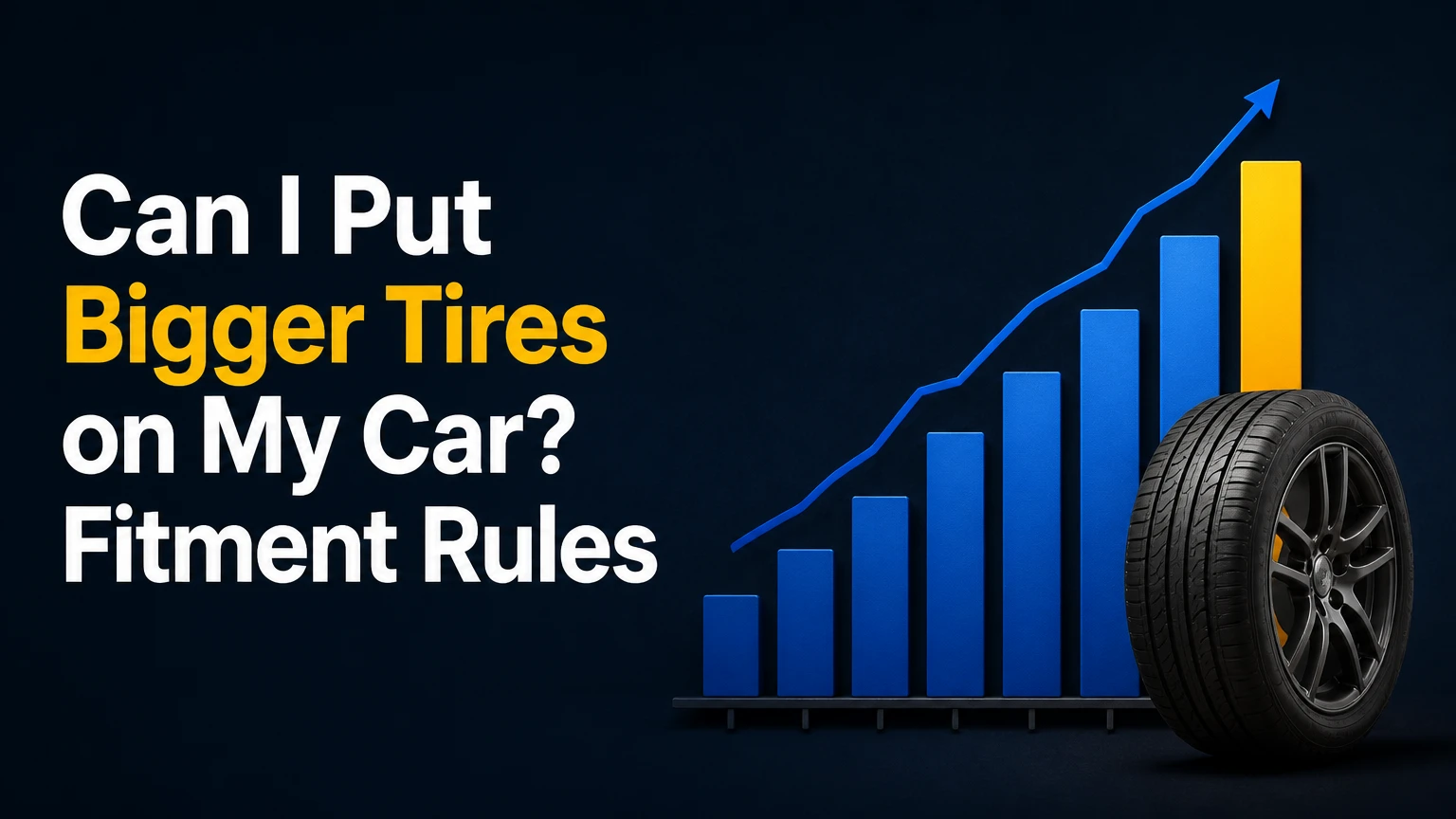
Yes, you can put bigger tires on your car if the complete tire-and-wheel package fits the manufacturer’s mechanical, load, speed, brake, and electronic requirements. The safest upgrade usually keeps the overall tire diameter close to the original size, but physical clearance and vehicle-specific approval matter more than a universal percentage rule.
Key facts at a glance
A larger tire diameter can make the speedometer read slower than the vehicle’s actual speed.
A commonly used planning limit is approximately 3% above or below the original diameter, but 3% is not a universal legal or engineering rule.
The replacement tire’s load index must meet or exceed the vehicle’s required capacity.
Wheel width, offset, brake clearance, and suspension travel determine whether a larger tire actually fits.
AWD and 4WD vehicles may require closely matched rolling circumferences on all four corners.
The driver-door placard specifies the vehicle’s cold inflation pressure and required tire size; the tire sidewall shows a maximum pressure, not a recommended operating pressure.
Can I Put Bigger Tires on My Car?
Most cars can accept a modest increase in tire width or wheel diameter, but a larger outside diameter creates more consequences than a larger rim with a shorter sidewall. A replacement tire is acceptable only when it clears the body and suspension, fits the wheel correctly, carries the required load, matches the vehicle’s speed capability, and does not disrupt drivetrain or safety-system requirements.
The first reference point is the tire information placard on the driver-door jamb, door edge, or glovebox area. The owner’s manual may list additional approved sizes for different wheel packages. A tire retailer’s fitment database can identify possibilities, but it cannot replace a physical clearance check or the vehicle manufacturer’s specifications.
The phrase “bigger tires” can mean three different changes. You might install a wider tread, a taller tire, or a larger wheel with a shorter sidewall. Each changes handling and clearance differently.
What Counts as a Bigger Tire?
A bigger tire has a greater width, outside diameter, sidewall height, or wheel diameter than the vehicle’s original-equipment package. A larger wheel is not automatically a larger tire because plus sizing often preserves the same outside diameter by reducing sidewall height.
Read a size such as 225/50R17 this way:
- 225: nominal section width in millimeters.
- 50: sidewall height as 50% of the 225 mm width.
- R: radial construction.
- 17: wheel diameter in inches.
The approximate outside diameter is:
Diameter = wheel diameter + 2 × (section width × aspect ratio)
For 225/50R17:
- Sidewall: 225 × 0.50 = 112.5 mm
- Two sidewalls: 225 mm
- Wheel diameter: 17 × 25.4 = 431.8 mm
- Approximate outside diameter: 656.8 mm, or 25.9 inches
Actual measured diameter varies by tire model, approved rim width, inflation pressure, and load. Use the manufacturer’s published dimensions for final fitment.
Which types of upsizing are common?
| Upgrade type | Example change | Main benefit | Main risk |
|---|---|---|---|
| Plus sizing | 205/55R16 to 215/45R17 | Larger wheel appearance, sharper response | Less sidewall protection |
| Wider tire | 225/50R17 to 245/45R17 | More dry-road tread width | Rubbing, heavier steering, hydroplaning |
| Taller tire | 265/70R17 to 285/70R17 | More clearance and sidewall flex | Gearing, fender, and suspension problems |
| Smaller wheel, taller sidewall | 235/55R19 to 235/60R18 | More pothole protection | Brake-caliper clearance |
A wider tire does not necessarily improve braking. Tire compound, tread design, temperature, road surface, wheel alignment, and anti-lock braking calibration can outweigh a 10 or 20 mm width increase.
How Do Bigger Tires Change Driving?
Bigger tires alter the contact patch, gearing, steering geometry, unsprung mass, and wheel-speed signal. The result can include slower acceleration, a different speedometer reading, heavier steering, altered ride quality, and additional stress on bearings or driveline components.
A taller tire has a greater rolling circumference. The engine must turn the tire through a larger distance per revolution, which acts like a taller final-drive ratio. A 5% increase in diameter reduces the effective gearing by roughly 5%, so the vehicle may need more throttle on hills and may downshift more often.
A heavier wheel-and-tire assembly also increases unsprung and rotational mass. That can reduce suspension response and acceleration even when outside diameter remains almost unchanged. Tire Rack describes the practical importance of tires with the phrase, “the tire is the only part of the vehicle that touches the road.” The wheel, tire, and air pressure therefore matter as a system.
How much speedometer error will a larger tire create?
A larger tire usually makes the speedometer and odometer under-report distance and speed because the wheel makes fewer revolutions per mile. The approximate actual speed is:
Actual speed = indicated speed × new tire diameter ÷ original tire diameter
| Original diameter | New diameter | Diameter change | Speed shown at actual 60 mph |
|---|---|---|---|
| 26.0 in | 26.5 in | 1.9% larger | About 58.9 mph |
| 26.0 in | 27.0 in | 3.8% larger | About 58.0 mph |
| 28.0 in | 29.0 in | 3.6% larger | About 58.0 mph |
| 30.0 in | 32.0 in | 6.7% larger | About 56.3 mph |
The displayed speed may not follow the simple calculation exactly because many vehicles intentionally read slightly high from the factory. A scan tool or calibration procedure can correct some vehicles, while others require a manufacturer-compatible module or software update.
Does the 3% rule guarantee safe fitment?
No. The approximately 3% diameter guideline is a useful screening threshold, not a guarantee of safety, legality, or compatibility. Some vehicles have approved replacement sizes outside that range, while a tire within 3% can still hit a strut, brake line, fender liner, or suspension component.
The 3% calculation is:
Percentage difference = (new diameter – original diameter) ÷ original diameter × 100
Use the vehicle manufacturer’s approved sizes first. Treat 3% as a conservative starting boundary, then verify load, wheel fitment, steering clearance, tire chains, electronic systems, and drivetrain requirements.
Which Tire Specifications Must Stay Within Limits?
A larger replacement tire must satisfy more than diameter. Load index, speed rating, rim-width range, construction, pressure capability, and seasonal requirements all affect safe operation.
The vehicle placard takes priority over the tire’s maximum load and pressure markings. A tire sidewall may show the pressure needed to support its maximum rated load; that number is not automatically the correct pressure for your car.
| Specification | What to check | Practical requirement |
|---|---|---|
| Load index | Number such as 94, 98, or 102 | Equal to or higher than placard requirement |
| Speed rating | Letter such as H, V, W, or Y | Meet vehicle and tire-use requirements |
| Rim-width range | Tire manufacturer data | Current wheel must fall within approved range |
| Outside diameter | Published tire dimensions | Close to original and compatible with systems |
| Construction | XL, standard load, run-flat, radial | Match vehicle design and wheel requirements |
| TPMS fitment | Direct sensor or indirect system | Sensor frequency and valve design must match |
The U.S. National Highway Traffic Safety Administration requires tire information placards to identify the original tire size and recommended cold inflation pressure. In the United States, Federal Motor Vehicle Safety Standard No. 110 also addresses tire selection and rim compatibility. Other jurisdictions use different inspection and modification rules.
Can bigger tires fit the original wheels?
A wider tire can fit an original wheel only when the tire manufacturer approves that wheel width. A 245 mm tire mounted on a wheel intended for a narrow 215 mm tire can create an unstable sidewall shape, uneven wear, poor bead seating, or wheel damage.
A tire that is too wide for the rim may look acceptable while parked. Its tread can crown, and the sidewall can flex excessively during cornering. Always compare the tire’s approved rim-width range with the wheel’s actual width, not its outside lip measurement.
How Do Wheel Offset and Brake Clearance Affect Fitment?
Wheel offset determines how far the wheel and tire sit inward or outward relative to the hub. More negative offset pushes the assembly outward, which may create fender clearance but increases scrub radius and can load wheel bearings, steering components, and suspension joints.
A wider tire may contact the inner strut with the original wheel, then clear it with a different offset. The reverse can also happen: an outward-moving wheel may clear the strut but contact the fender lip during compression.
Brake clearance sets a separate limit. A smaller wheel with a taller sidewall may improve ride comfort, but it cannot be installed if the barrel or spokes contact the brake caliper. Manufacturer-approved wheel packages are the safest reference because they account for caliper shape and steering geometry.
How Can You Check Whether Bigger Tires Will Rub?
Check tire clearance through the full range of steering and suspension movement before accepting the installation. A tire that clears while the car is parked and unloaded may rub when the steering reaches full lock, the suspension compresses, or the body rolls during a turn.
Use this inspection sequence:
- Record the original package. Write down tire size, wheel width, offset, and measured hub-to-fender clearance.
- Compare published dimensions. Calculate diameter and estimate section-width growth, but use the selected tire model’s specifications for final measurements.
- Check wheel and brake fitment. Confirm lug pattern, center bore, wheel load rating, brake clearance, and approved rim width.
- Test steering clearance. With the vehicle safely supported, turn from lock to lock and inspect the strut, tie rod, brake hose, liner, and frame.
- Test compression clearance. Compress the suspension or have a qualified technician inspect it with the wheel loaded. Check the fender lip and inner liner.
- Check rear clearance. Inspect trailing arms, shocks, inner wheel wells, and body seams, not only the visible fender.
- Check accessories. Verify clearance for tire chains, snow socks, mud flaps, and the spare tire.
- Mount, balance, and align. Perform dynamic balancing and a four-wheel alignment after installation.
- Road-test gradually. Listen during low-speed full-lock turns, braking, bumps, and moderate cornering before highway driving.
Never solve rubbing with wheel spacers, heat-gun trimming, or aggressive fender modification without checking structural, legal, and suspension consequences. A spacer changes wheel loads and scrub radius, and liner trimming can expose wiring or allow debris to reach the tire.
What Are the Advantages and Disadvantages?
The right tire size can improve a specific use case, but no upsizing change improves every vehicle attribute. Taller sidewalls usually help impact absorption, while larger wheels often reduce sidewall flex and ride comfort.
| Goal | Likely useful change | Typical advantage | Typical compromise |
|---|---|---|---|
| Pothole protection | Smaller wheel, taller sidewall | More sidewall flex and lower impact risk | Less immediate steering response |
| Dry handling | Modest width increase, same diameter | More potential mechanical grip | Heavier steering and higher cost |
| Off-road traction | Taller sidewall and suitable tread | Better airing-down capability | Lower acceleration and more rubbing risk |
| Appearance | Plus-one or plus-two wheel | Larger visual wheel presence | Harsher ride and wheel damage risk |
| Snow driving | Narrow, approved winter package | Better snow penetration in some conditions | Less dry-road footprint |
Wider tires can increase dry-road traction when the compound and pavement support the change. They can also follow road grooves, increase steering effort, and raise hydroplaning risk if tread design and water evacuation are inadequate.
Larger tires may reduce fuel economy through added mass, rolling resistance, aerodynamic exposure, and altered gearing. The effect varies widely. A 1-inch diameter increase cannot produce a reliable universal fuel-economy percentage.
How Much Do Bigger Tires Cost?
A typical four-tire upsizing project costs approximately $800-$2,400 before major suspension work, depending on tire category, wheel replacement, sensors, and alignment. Truck packages requiring a lift, trimming, re-gearing, or reinforced steering components can cost substantially more.
| Work item | Typical quantity | Typical cost range | Typical time |
|---|---|---|---|
| Passenger tires | 4 tires | $600-$1,800 | 1-2 hours |
| SUV or truck tires | 4 tires | $800-$2,400 | 1-3 hours |
| Mounting and balancing | 4 assemblies | $80-$180 | 45-90 minutes |
| Four-wheel alignment | 1 service | $100-$200 | 45-90 minutes |
| Leveling or lift kit | 1 kit | $500-$3,000 installed | 4-8 hours |
| Re-gearing a truck axle | 1 axle or pair | $1,200-$3,500 | 1-2 days |
Prices vary by region, tire brand, wheel size, vehicle platform, and whether TPMS sensors or new wheels are required. A tire quote should include disposal, valve hardware, road-force balancing if needed, alignment, and any programming charges.
Are Bigger Tires Safe on AWD and 4WD Vehicles?
AWD and 4WD vehicles require special attention to rolling circumference because small differences can keep differentials, couplings, or transfer-case components compensating continuously. The vehicle manufacturer’s tolerance is more authoritative than a generic 3% rule.
Replacing one damaged tire with a substantially different tire can be risky on an AWD system even when the nominal size printed on the sidewall appears similar. Tread depth also changes circumference. Some manufacturers specify maximum allowable tread-depth differences, so check the service manual or dealer guidance.
The temporary spare must also be considered. A compact spare is normally intended for limited distance and speed, but using a significantly different tire on an AWD vehicle can create drivetrain stress. Do not assume a full-size spare is compatible merely because it fits the wheel well.
Large truck tires can additionally expose gearing limitations. If a 30-inch tire is replaced with a 35-inch tire, effective gearing becomes about 14% taller, which can increase clutch slip, transmission heat, downshifting, and brake demands. Re-gearing may be appropriate for a heavily modified truck, but it is not a routine requirement for a modest passenger-car size change.
Should You Choose Bigger Tires for Your Driving Situation?
Choose the tire package by use case, not appearance. A daily commuter generally benefits from an approved size that preserves diameter, load capacity, winter performance, ride comfort, and replacement availability.
Daily commuter
Keep outside diameter near the original specification and avoid unnecessary width increases. A plus-one package can work when the manufacturer approves it, but the lower sidewall may increase pothole damage and replacement cost.
Performance street driver
A modestly wider tire with the original diameter can increase dry grip, but the selected compound matters more than width alone. Maintain front-to-rear compatibility, preserve brake clearance, and avoid staggered fitment if the vehicle’s rotation pattern requires square tires.
Winter driver
Use a manufacturer-approved winter size, often with a smaller wheel and taller sidewall. Do not fit a wide summer tire simply because it has a larger contact patch; snow traction depends on tread design, compound temperature range, pressure, and road conditions.
Off-road truck or SUV owner
Taller tires can improve clearance and sidewall performance, but the vehicle may require a lift, liner modification, different offset, stronger steering components, or re-gearing. Verify full compression and steering clearance with the exact tire model because two tires carrying the same nominal size can have different measured widths.
Electric vehicle owner
EVs are sensitive to rolling resistance, mass, load capacity, and tire noise. Use an EV-approved or manufacturer-approved tire where available, because a heavier or higher-rolling-resistance tire can reduce range and increase suspension loads.
What Problems Do Larger Tires Cause?
The most common problems are rubbing, vibration, uneven wear, warning lights, reduced acceleration, altered braking feel, and premature component wear. Most failures result from treating nominal size as proof of fitment.
| Symptom | Likely cause | Correct response |
|---|---|---|
| Rub at full lock | Width, offset, or liner interference | Stop repeated testing; inspect and correct fitment |
| Rub over bumps | Insufficient compression clearance | Use approved size or engineered suspension changes |
| Steering vibration | Imbalance, radial-force variation, bent wheel | Rebalance, request road-force measurement, inspect wheel |
| ABS or stability light | Mismatched circumference or sensor issue | Scan codes and verify all tire sizes |
| Pulling after installation | Alignment, tire conicity, or pressure mismatch | Check cold pressures, rotate test positions, align |
| Fast center wear | Excessive inflation or wrong rim width | Reset pressure to vehicle guidance and verify wheel fit |
| Frequent downshifting | Taller effective gearing | Revert size or evaluate gearing changes |
A tire that does not rub when parked is not proven safe. Suspension compression, steering lock, body roll, and underbody movement create conditions the driveway test cannot reproduce.
Do not automatically increase inflation pressure because a new tire has a higher load rating. Use the vehicle placard unless a qualified tire professional calculates a different pressure for a specific replacement package. The placard pressure is designed around the vehicle’s axle loads, handling balance, and tire specification.
What Should You Verify Before Buying?
Verify the complete wheel-and-tire package, not only the tire’s printed size. The following checklist prevents most expensive fitment mistakes:
- Vehicle year, make, model, trim, engine, and drivetrain
- Original tire size and cold pressure from the placard
- Manufacturer-approved alternate sizes
- Tire load index and speed rating
- Tire model’s measured diameter and section width
- Current or proposed wheel width, diameter, offset, and load rating
- Lug pattern, center bore, and fastener seat
- Brake-caliper clearance
- Full steering and suspension clearance
- TPMS sensor compatibility
- ABS, stability-control, and speedometer implications
- Tire-chain and snow-equipment clearance
- Spare-tire compatibility
- Local inspection, modification, and insurance requirements
- Alignment and balancing requirements after installation
A tire shop should be able to identify the approved rim width, explain the load-index choice, confirm the wheel offset, and inspect for contact after mounting. If a shop says a tire fits because “the bolt pattern matches,” that answer is incomplete.
Frequently Asked Questions
Will bigger tires make my car ride smoother?
Bigger outside diameter does not automatically improve ride quality. A taller sidewall can absorb sharp impacts more effectively, but plus-sizing to a larger wheel usually reduces sidewall height and can make the ride harsher. Tire construction, pressure, wheel mass, and suspension tuning also affect comfort.
Do wider tires improve braking?
Wider tires can improve dry-road braking when the tire compound, tread, pavement, and temperature are suitable, but width alone does not guarantee shorter stopping distances. Wet braking may worsen if the new tread evacuates water poorly. Choose a high-quality tire in an approved size rather than maximizing section width.
Do I need an alignment after installing larger tires?
An alignment is advisable when new wheels, offset, suspension parts, or a lift change geometry, and it can identify existing problems that cause uneven wear. A tire-only change at the same size does not always require alignment, but a technician should inspect alignment angles and steering-wheel position.
Can bigger tires void my car warranty?
An aftermarket tire does not automatically void an entire vehicle warranty, but damage caused by an incompatible size or modification may be excluded. Warranty decisions depend on the failed component and the documented cause. Keep the original wheels and confirm approved sizes before modifying suspension or drivetrain parts.
Can I put tire chains on bigger tires?
Only if the vehicle manufacturer and chain manufacturer approve the combination. Larger tires can reduce clearance to struts, brake lines, fenders, and wheel wells, so a chain that fit the original size may contact the vehicle. Check the owner’s manual before buying chains.
What is the safest way to get a more aggressive look?
Use a manufacturer-approved wheel and tire package that keeps the original outside diameter, meets the placard load requirement, preserves brake and suspension clearance, and retains a compatible spare. Appearance-focused width or offset changes create more risk than a carefully selected plus-one package.
The Bottom Line
You can put bigger tires on your car, but the safe answer depends on diameter, width, wheel dimensions, offset, load index, speed rating, brakes, electronics, drivetrain, and full-motion clearance. Start with the door-placard size and manufacturer-approved alternatives, use the approximately 3% diameter guideline only as a screening tool, and confirm the exact tire model before purchase. A tire that mounts on the wheel is not necessarily a tire package that fits, handles, stops, and remains reliable on the road.