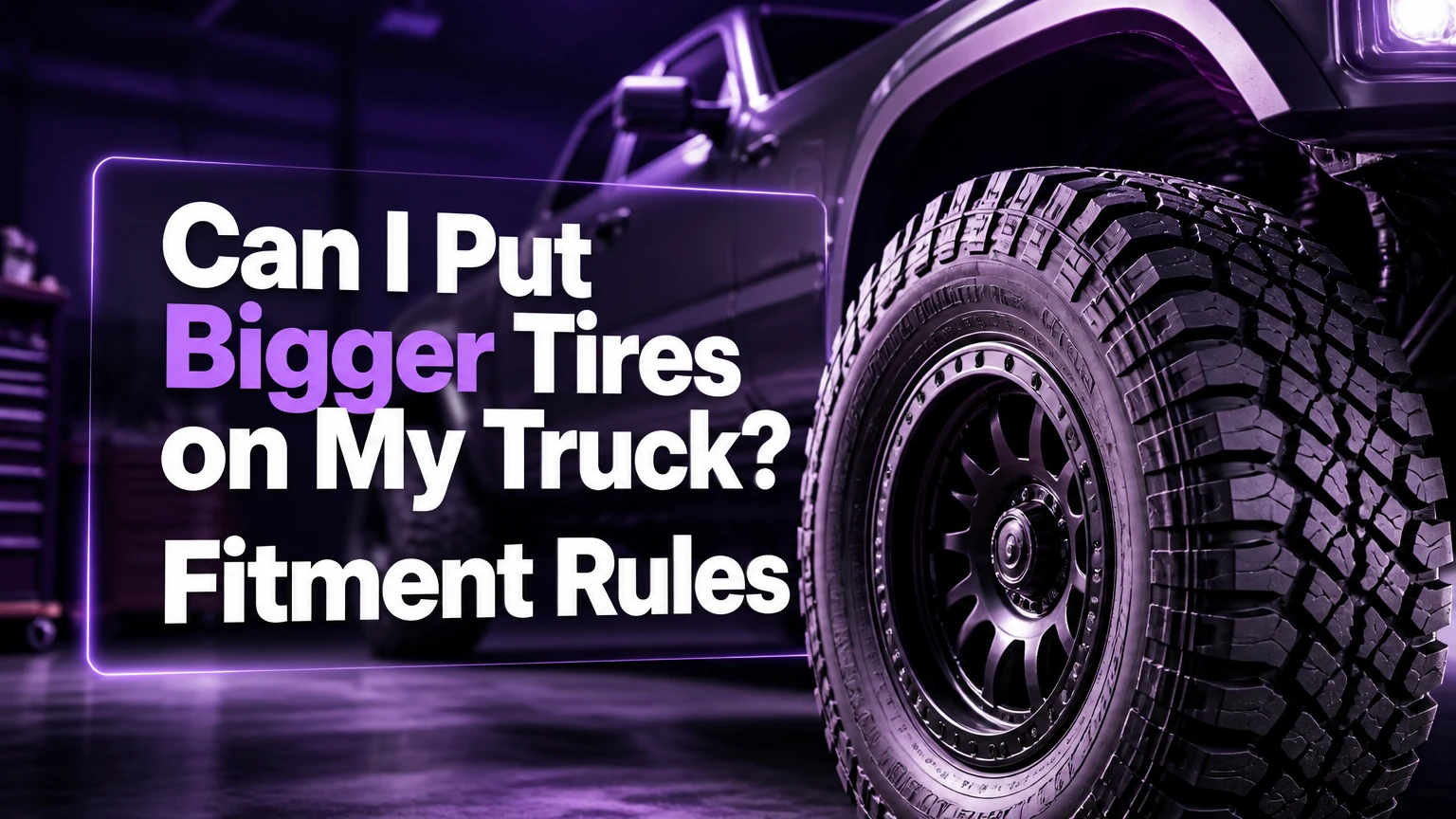
Yes, you can put bigger tires on your truck, but the safe limit depends on tire diameter, section width, wheel offset, suspension travel, load rating, and drivetrain capacity. A modest increase may fit on factory suspension, while a larger change can require wheels, trimming, lift components, alignment, speedometer calibration, or differential re-gearing.
Key Facts at a Glance
- A tire that is 2 inches larger in diameter raises the truck’s axle housing approximately 1 inch.
- Tire width and wheel offset often cause rubbing before tire diameter becomes the limiting measurement.
- A larger tire lowers effective gearing by the ratio of the original diameter to the new diameter.
- A tire within 3% of the original diameter often needs fewer electronic and drivetrain changes, but 3% is a guideline, not a universal fitment rule.
- A lift kit creates space, but it does not automatically increase payload, braking capacity, axle rating, or wheel-bearing strength.
- The owner’s manual, tire placard, wheel specifications, and a full-lock, full-compression inspection outrank generic internet fitment charts.
What Counts as a Bigger Tire?
A bigger truck tire can mean greater diameter, greater width, a larger wheel diameter, or a combination of those changes. The tire code identifies each dimension: in 275/65R18, 275 is the nominal section width in millimeters, 65 is the aspect ratio, R identifies radial construction, and 18 is the wheel diameter in inches.
Approximate tire diameter can be calculated as:
Diameter = wheel diameter + 2 × (section width × aspect ratio ÷ 25.4)
For a 275/65R18 tire, the sidewall is approximately 7.05 inches, producing a calculated diameter near 32.1 inches. Published tire dimensions vary by manufacturer, tread design, approved wheel width, and inflation pressure, so catalog numbers should not replace a physical measurement.
| Tire size | Approximate diameter | Approximate width | Change from 265/65R17 |
|---|---|---|---|
| 265/65R17 | 30.6 in | 10.4 in | Baseline |
| 275/65R18 | 32.1 in | 10.8 in | +1.5 in diameter |
| 285/65R18 | 32.6 in | 11.2 in | +2.0 in diameter |
| 35×12.50R17 | About 35.0 in | About 12.5 in | +4.4 in diameter |
Tire size labels are not precise outside the approved measuring conditions. A nominal 35-inch mud-terrain tire may measure 34.5 inches on one wheel and 35.2 inches on another, while aggressive shoulder lugs can increase rubbing even when the sidewall width appears acceptable.
How Much Larger Is Reasonable?
For a daily-driven truck, a diameter increase of about 1-2 inches is usually easier to accommodate than a 4-inch increase. The correct limit still depends on the specific year, cab configuration, axle, brake package, factory wheel, and four-wheel-drive system.
A 3% diameter increase changes speedometer readings and gearing modestly. A 31-inch tire replaced by a 33-inch tire is approximately 6.5% larger, which is a meaningful mechanical change even if the tire physically fits. A 35-inch tire on a truck designed around a 31-inch tire is a much more demanding conversion.
Can I Put Bigger Tires on My Truck Without a Lift?
Many trucks can accept a slightly larger tire without a lift, but the answer is vehicle-specific and depends heavily on wheel offset, steering angle, and suspension compression. A stock truck may clear a taller, narrow tire while rubbing with a shorter, wider tire mounted on a wheel with less backspacing.
Factory fitment is the safest starting point because the original wheel, tire, brake clearance, steering stops, and suspension geometry were validated together. Tire manufacturers such as BFGoodrich and Goodyear publish measured dimensions, but they do not certify that a particular tire will clear every truck application.
Check these conditions before buying:
- Compare the proposed tire’s measured diameter and width with the original tire.
- Confirm that the wheel’s diameter, width, bolt pattern, center bore, and load rating match the truck.
- Verify clearance from the upper control arm, tie rod, sway-bar link, strut, brake caliper, and inner fender.
- Turn the steering from lock to lock, then inspect the tire at normal ride height and with the suspension compressed.
- Check the rear wheel wells, where a wider tire can contact the leaf spring, inner bed, or bump-stop area.
A tire that clears while parked can rub during a pothole, suspension articulation, or loaded corner. Static clearance is evidence, not proof.
What Changes Mechanically With Larger Tires?
Larger tires change ground clearance, rolling circumference, effective gearing, steering loads, unsprung mass, and the accuracy of the speedometer and odometer. The effects become more noticeable as diameter, width, tread depth, wheel weight, and load range increase.
Axle clearance rises by half the tire-diameter increase. Replacing a 31-inch tire with a 33-inch tire raises the axle approximately 1 inch, but it does not raise the frame by 1 inch. A body lift raises the body relative to the frame and therefore does not increase differential or frame clearance.
The rolling-circumference change can be estimated with:
New effective gear ratio = original gear ratio × original tire diameter ÷ new tire diameter
A truck with 3.73:1 axle gearing and 31-inch tires effectively behaves near 3.50:1 after installing 33-inch tires. The same truck on 35-inch tires behaves near 3.30:1. These are approximations, because actual loaded tire diameter differs from the nominal measurement.
How Do Bigger Tires Affect Driving?
Bigger tires typically reduce acceleration, increase steering effort, add rotational mass, and reduce fuel economy, although the result depends on tread design, inflation pressure, vehicle weight, and driving conditions. A heavy 35-inch mud-terrain tire can change the truck more than a lightly built 33-inch all-terrain tire.
The National Highway Traffic Safety Administration recommends maintaining the tire size and load information specified on the vehicle’s certification label unless a qualified professional confirms that a replacement configuration remains appropriate. NHTSA also advises checking tire pressure when tires are cold, because pressure changes alter handling, load capacity, and tread wear.
Expect these practical effects:
- Speedometer: If the new tire is 6% larger, an indicated 60 mph may represent approximately 63.6 mph.
- Odometer: The odometer records fewer revolutions per mile and may undercount distance by a similar percentage.
- Fuel economy: A typical decrease is 1-4 mpg when heavier wheels, wider tread, and aggressive tires are added.
- Braking: Heavier rotating mass can increase stopping distance and brake heat, especially on downhill roads.
- Transmission behavior: Automatic transmissions may downshift more often because the engine produces less wheel torque.
- Steering and suspension wear: Larger tires increase leverage on wheel bearings, ball joints, tie rods, and steering components.
The tire’s load index must meet or exceed the original specification on every axle. Increasing load range from a passenger-rated tire to an LT Load Range E tire can improve durability under work loads, but it usually adds sidewall stiffness, weight, noise, and ride harshness.
How Do Wheel Offset and Backspacing Change Fitment?
Wheel offset determines where the tire sits relative to the hub, and backspacing measures the distance from the wheel’s mounting face to its inner rim edge. Moving the tire outward can prevent inner suspension contact while increasing fender, bearing, steering, and bodywork demands.
A wheel with more negative offset places the tire farther outward. A wheel with less backspacing usually does the same. Neither solution creates unlimited clearance, and a wheel spacer should be used only when its hub-centric design, stud engagement, torque procedure, and manufacturer approval are clear.
| Fitment variable | Typical change | Clearance gained | New risk |
|---|---|---|---|
| Wheel width | +1.0 in | About 0.5 in inward and outward | More sidewall and fender interference |
| Offset | 0 to -12 mm | About 0.5 in outward from +12 mm | Greater bearing and steering load |
| Backspacing | 5.5 to 4.5 in | About 1.0 in outward | Increased scrub radius |
| Wheel spacer | 1.0 to 1.5 in | 1.0-1.5 in inner clearance | Stud, hub, torque, and legal concerns |
Practitioner rule: solve the smallest interference first. If a 285 tire barely touches a plastic liner, trimming the liner may be safer than moving the entire tire outward with a low-offset wheel. If the tire contacts a control arm or brake component, trimming plastic cannot solve the problem.
Which Modification Creates Clearance?
A leveling kit raises the front of a truck, a suspension lift increases suspension and chassis height, and a body lift raises the body above the frame. These modifications do not provide the same type of clearance or preserve the same geometry.
| Modification | Typical height | Main clearance gained | Main limitation |
|---|---|---|---|
| Front leveling kit | 1.5-2.5 in | Front fender and bumper space | Rear clearance remains unchanged |
| Suspension lift | 3-6+ in | Tire travel and body-to-axle space | Alters geometry, ride, and center of gravity |
| Body lift | 1-3 in | Body and fender opening space | Frame, differential, and suspension stay low |
| Fender trimming | 0.5-2.0 in | Local liner or arch clearance | Can expose metal or reduce corrosion protection |
A leveling kit is generally suited to a modest diameter increase and street use. A suspension lift is appropriate when suspension travel, approach angle, and off-road articulation matter. A body lift can create a larger visual opening without changing suspension geometry, but it does not improve underbody clearance.
Lift height is not a tire-size guarantee. A truck can still rub because the wheel is too wide, the offset is wrong, the control arm design differs, or the suspension compresses farther than expected.
How Do You Check Fitment Before Installation?
The most reliable fitment check combines manufacturer dimensions, wheel measurements, and a physical clearance test at steering lock and suspension compression. A retailer’s “fits your truck” filter is useful for shortlisting products, but it cannot account for aftermarket bumpers, leveling kits, worn suspension parts, or individual wheel alignment.
Use this sequence:
- Record the original setup. Write down the tire size, wheel width, offset, backspacing, load index, and actual tread width.
- Measure the proposed tire. Use the tire manufacturer’s approved measuring rim data when available, not only the sidewall label.
- Inspect wheel capacity. Confirm the wheel load rating, bolt pattern, center bore, lug-seat type, and brake-caliper clearance.
- Test steering clearance. With the truck on level ground, turn fully left and right and inspect both front tires.
- Test compression. Use a professional lift or controlled suspension-compression method to check the tire at bump-stop contact.
- Inspect articulation. On a four-wheel-drive truck, check opposite-corner suspension movement because off-road travel changes the clearance envelope.
- Check accessories. Test mud flaps, running boards, fender liners, tire chains, and the full-size spare.
- Complete the installation. Torque lug nuts to the vehicle manufacturer’s specification, reset TPMS, and obtain an alignment.
After the first drive, inspect for fresh scuff marks on the inner sidewall and tread shoulder. Rubbing rubber creates heat and structural damage, even when the contact sound seems minor.
Can 33-Inch or 35-Inch Tires Fit?
Thirty-three-inch tires often fit half-ton trucks with modest changes, while 35-inch tires usually require a carefully matched lift, wheel offset, trimming, and attention to gearing. The exact answer changes between independent-front-suspension trucks, solid-axle trucks, heavy-duty models, and vehicles with different factory wheel packages.
| Target tire | Common vehicle situation | Typical supporting changes | Drivetrain concern |
|---|---|---|---|
| 31-32 in | Stock compact or half-ton truck | Factory wheels, fitment check | Usually minor |
| 33 in | Many half-ton 4×4 trucks | Leveling kit or mild lift, possible liner trim | Noticeable power loss |
| 34 in | Half-ton or three-quarter-ton build | 2.5-4 in lift, wheel-offset planning | Re-gearing may help |
| 35 in | Purpose-built half-ton or HD truck | 4-6 in lift, trimming, stronger components | Re-gearing often beneficial |
| 37 in | Dedicated off-road build | 6+ in lift, axle and brake evaluation | Re-gearing and durability work expected |
A 33-inch tire is not a universal upgrade size. On one truck it may clear the sway bar at full lock; on another, the same nominal tire can hit the upper control arm because the wheel offset differs by 20 millimeters.
When Is Re-Gearing Needed?
Re-gearing becomes worth considering when larger tires make the truck sluggish, cause frequent transmission hunting, reduce low-speed control, or materially increase towing heat. Tire diameter increases of roughly 8-12% often justify a gearing discussion, although engine torque, transmission ratios, axle ratio, payload, terrain, and driving speed determine the final decision.
A larger tire reduces the mechanical advantage at the wheels. Re-gearing the differentials restores that lost leverage by installing a numerically higher ring-and-pinion ratio, such as moving from 3.55 to 4.10 or from 3.73 to 4.56.
Re-gearing does not correct every problem. It cannot restore the original braking feel, reduce tire weight, repair poor offset, or make an overloaded axle safe. Four-wheel-drive vehicles also require front and rear axle ratios to match exactly.
A typical re-gear job costs approximately $1,500-$3,500 for parts and labor on both axles, with variation by axle design, gear brand, bearing condition, and differential locker. Gear break-in procedures usually include short drives with cool-down periods and a fluid change after the manufacturer’s specified interval.
Are Bigger Tires Suitable for Towing?
Bigger tires can work for towing when the tire load index, wheel rating, axle ratings, hitch rating, and combined vehicle weight remain within specification. A taller tire can reduce launch torque and transmission shift quality, so a truck that feels acceptable empty may struggle with a trailer.
Before towing, verify:
- Tire load capacity at the actual cold inflation pressure.
- Rear-axle weight with the trailer attached.
- Gross vehicle weight rating and gross combined weight rating.
- Trailer brake operation and controller adjustment.
- Spare-tire load rating and physical fit.
- Transmission temperature during sustained grades.
A Load Range E tire does not increase the truck’s legal payload or gross vehicle weight rating. It only describes the tire’s construction and rated carrying capability at specified pressure. Towing capacity comes from the vehicle manufacturer’s ratings and the complete combination of truck, passengers, cargo, hitch, and trailer.
For frequent towing, a moderate all-terrain tire with an appropriate load index is often more functional than a heavy mud-terrain tire. The heavier tire consumes power and can make braking and suspension response less predictable.
What Does the Upgrade Cost?
A modest tire upsizing commonly costs $1,000-$2,500, while a complete 35-inch setup with wheels, lift components, alignment, calibration, and drivetrain work can exceed $8,000. Installation labor and required supporting parts determine the final bill more than the tire diameter alone.
| Upgrade path | Parts cost | Labor and services | Typical total |
|---|---|---|---|
| Stock wheels, 1-2 in larger tires | $800-$2,000 | $150-$350 mounting and balance | $950-$2,350 |
| Leveling kit and 33-inch tires | $1,000-$2,800 | $500-$1,000 installation and alignment | $1,500-$3,800 |
| 3-4 in suspension lift and 33-35s | $2,500-$6,000 | $1,000-$2,500 installation and alignment | $3,500-$8,500 |
| 35-37 in build with re-gearing | $4,000-$9,000 | $2,500-$5,000 drivetrain and setup | $6,500-$14,000 |
Additional costs can include upgraded upper control arms, longer brake lines, bump stops, spare-tire relocation, fender repair, TPMS sensors, speedometer calibration, and replacement wheel bearings. Budget for those items before purchasing tires.
Installation often takes 2-4 hours for tires and a basic leveling kit, one full day for a straightforward suspension lift, and several days when re-gearing, alignment corrections, trimming, or fabrication is involved.
What Problems Occur After Upsizing?
The most common failures are rubbing, uneven tire wear, inaccurate speed readings, premature component wear, and an upgrade that no longer meets the truck’s intended load or towing requirements. Each problem has a different cause, so adding more lift is not always the correct repair.
| Symptom | Likely contact or cause | Correct response | Do not do |
|---|---|---|---|
| Rubs at full steering lock | Sway bar, tie rod, control arm | Recheck offset and steering clearance | Ignore repeated contact |
| Rubs over bumps | Fender liner, bumper, pinch weld | Trim or reshape approved areas | Cut structural metal casually |
| Pulls after installation | Alignment or tire conicity | Align and rotate tires | Drive until tread is destroyed |
| Speed reads low | Larger rolling circumference | Recalibrate vehicle electronics | Assume GPS fixes the odometer |
| Transmission hunts | Reduced effective gearing | Evaluate re-gearing and load | Tow beyond rated capacity |
| Vibration at highway speed | Balance, bent wheel, tire uniformity | Road-force balance and inspect | Add random spacers |
Alignment is mandatory after a suspension lift or geometry change. Camber, caster, and toe must be measured against the truck’s specifications, and a steering-wheel-centered alignment prevents rapid shoulder wear.
What Should You Do If Tires Rub?
Identify the exact contact point before changing parts. Rubbing at full lock usually indicates an inner clearance or offset problem, while rubbing only during compression usually indicates fender, bumper, liner, or pinch-weld interference.
Apply removable chalk or painter’s tape to suspected areas, drive slowly through the condition that causes contact, and inspect the transfer mark. Minor plastic liner contact may permit controlled trimming, but contact with a brake hose, suspension joint, or metal body structure requires immediate correction.
Wheel spacers are not a universal fix. They increase scrub radius and place additional leverage on wheel bearings, while inadequate hub engagement or improper lug-nut seating can create a serious wheel-retention hazard.
Which Setup Fits Your Use?
The best setup depends on whether the truck’s priority is commuting, towing, appearance, or repeated off-road articulation. A commuter usually benefits from a lighter tire close to the original diameter, while a dedicated trail truck can justify larger tires after budgeting for gearing, brakes, and suspension durability.
Daily Commuter
Choose a tire approximately 1-1.5 inches larger than stock, preferably an all-terrain design with a load index that matches the door-placard requirement. A 1.5-2 inch leveling kit may provide the needed front clearance, but the truck still needs a full-lock and compression inspection.
This route preserves the most predictable road manners and usually avoids re-gearing. It is not the best choice for maximum rock clearance because a mild leveling kit leaves the frame and rear differential at nearly original height.
Overlander or Weekend Tow Vehicle
Choose a 2.5-3.5 inch suspension system with compatible shocks, corrected alignment geometry, and a 33-34 inch all-terrain or hybrid tire. Confirm rear-axle load, trailer weight, spare-tire clearance, and transmission behavior before committing to a heavier Load Range E tire.
A hybrid tire can balance gravel traction, highway noise, tread life, and sidewall strength. A heavy mud-terrain tire is often a poor match for long highway trips and frequent towing.
Dedicated Off-Road Truck
A 4-6 inch suspension system with 35-inch tires can improve obstacle clearance and approach angles, but the build requires more than lift height. Check driveshaft angles, steering linkage, brake capacity, axle shafts, differential gears, wheel bearings, and fender clearance at full articulation.
Thirty-seven-inch tires increase stress sharply. They may require axle upgrades, hydraulic steering assistance, stronger brakes, and numerical gearing such as 4.56 or 4.88, depending on the original ratio and engine-transmission combination.
When Is a Different Tire Better Than a Bigger Tire?
A different tread design, stronger sidewall, or correct load rating can improve performance more safely than increasing diameter. Larger tires are a poor substitute for recovery equipment, proper tire pressure, functional shocks, or a limited-slip differential.
Consider staying near the original size when:
- The truck frequently carries maximum payload.
- The vehicle has marginal brake, steering, or suspension components.
- The truck must fit a low garage or parking structure.
- Tire chains are required in the operating region.
- The original spare tire must remain under the bed.
- Fuel economy and highway acceleration matter more than clearance.
An all-terrain tire can provide better gravel and snow performance without the rolling resistance of a large mud-terrain tire. A narrower tire may also cut through snow more effectively than a wide tire that floats on top, although compound, tread pattern, temperature, and pressure remain important.
FAQ
Will Bigger Tires Void My Truck Warranty?
Bigger tires do not automatically void an entire vehicle warranty, but a manufacturer or dealer may dispute a repair if the modification plausibly caused the failure. Keep receipts, use correctly rated components, retain the original wheels, and check the warranty terms before installing non-factory parts.
Do Bigger Tires Make a Truck Safer?
Bigger tires do not automatically make a truck safer. Increased ground clearance may help off-road obstacle clearance, but added mass can reduce acceleration, increase braking demands, and change steering response. Safety depends on load rating, pressure, alignment, wheel fitment, brake condition, and the truck’s certified weight limits.
Can I Keep the Original Spare Tire?
You can keep the original spare only as a temporary emergency tire if its diameter is close enough for the vehicle’s drivetrain and the manufacturer permits that use. Four-wheel-drive systems can experience driveline stress when axle tire diameters differ substantially, so check the owner’s manual before using a mismatched spare.
Do Bigger Tires Need Different Air Pressure?
Bigger tires do not have one universal replacement pressure. Use the vehicle manufacturer’s placard as the starting point, then confirm that the replacement tire’s load capacity at that pressure meets the axle requirement. An LT tire may require a different pressure strategy, but maximum sidewall pressure is not the correct target.
Do Larger Tires Affect TPMS?
Larger tires do not usually prevent tire-pressure monitoring sensors from working, but new wheels may require compatible sensors, valve stems, or sensor relearning. After installation, confirm that every tire reports pressure and that the warning lamp turns off after the vehicle completes its relearn process.
Are Bigger Tires Legal Everywhere?
Local rules may restrict tire coverage, fender height, bumper height, wheel spacers, lighting, or suspension lift height. Check state or provincial vehicle-equipment rules, inspection requirements, and insurance conditions before installation, especially when the tread extends beyond the fender.
The Bottom Line
Can I put bigger tires on my truck? Usually, yes, if the tire, wheel, suspension, brakes, drivetrain, load ratings, and legal requirements are evaluated as one system. For most daily trucks, a modest 1-2 inch diameter increase with verified offset and a professional alignment is the lowest-risk path. Larger 33-inch, 35-inch, or 37-inch setups require progressively more clearance testing, trimming, calibration, gearing, and component inspection.