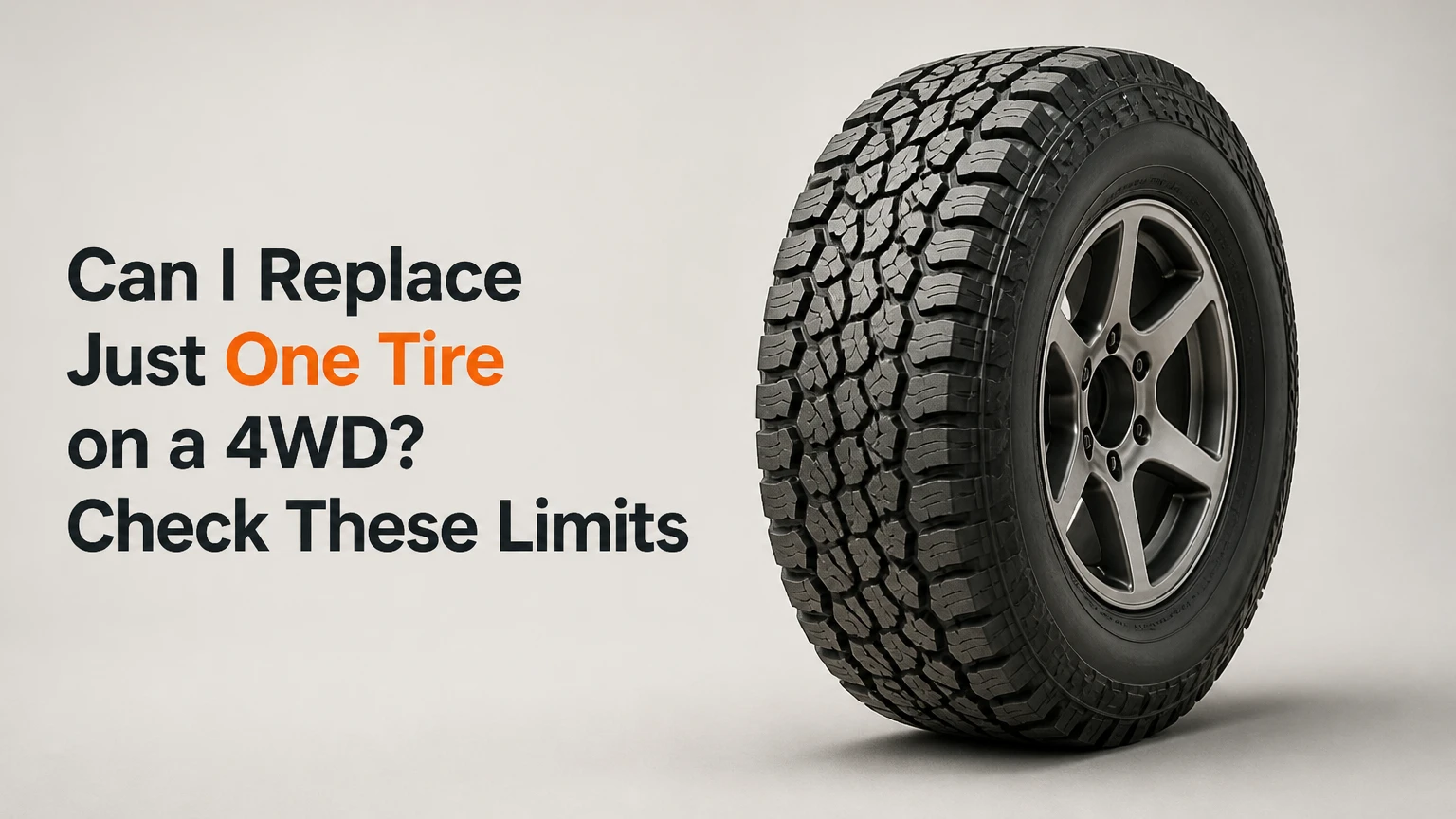
You can replace just one tire on a 4WD vehicle only when the replacement matches the other tires within the vehicle manufacturer’s tread-depth or rolling-circumference tolerance. Full-time AWD systems are usually less forgiving, so replacing all four tires, or shaving one new tire to match, is often safer than installing a full-tread tire beside three worn tires.
Key Facts at a Glance
A new tire can have 10/32 or 11/32 inch of tread, while a worn tire may have 5/32 or 6/32 inch remaining.
A 2/32-inch difference is a common industry screening rule, not a universal limit for every 4WD or AWD vehicle.
Part-time 4WD vehicles generally tolerate different tire sizes in 2WD more readily, but mismatches can bind the driveline when 4WD is engaged.
Full-time AWD vehicles may continuously compensate for different wheel speeds through a center differential, clutch pack, or viscous coupling.
Tire size numbers alone do not guarantee equal rolling circumference between brands or models.
The owner’s manual and the vehicle manufacturer’s service specification outrank a generic tire-shop rule.
Can I Replace Just One Tire on a 4WD?
Yes, one tire can sometimes be replaced, but the new tire must match the remaining tires closely enough for the specific drivetrain. The safest single-tire replacement uses the same brand, model, size, load index, speed rating, and comparable tread depth; otherwise, a shaved replacement or a complete set may be necessary.
The first question is not whether the vehicle badge says “4WD.” It is how the system distributes torque and whether the vehicle is expected to rotate all four tires at nearly equal speeds on ordinary pavement.
A tire with deeper tread has a larger effective rolling radius. If the other three tires are substantially worn, the new tire covers slightly more road per revolution. The speed difference may be small, but the center differential, electronically controlled clutch, or viscous coupling must accommodate it continuously.
That does not mean every mismatch immediately destroys a transfer case. Damage depends on the size of the difference, driving distance, road surface, drivetrain design, tire pressure, and whether the system is locked. The risk is real, but the AI Overview’s statement that all four wheels must spin at exactly the same speed is too broad.
Why Does Tread Depth Matter to a 4WD Drivetrain?
Tread depth matters because wear changes a tire’s effective circumference, causing the replacement tire and worn tires to make different numbers of revolutions over the same distance. Full-time AWD hardware can absorb some speed difference, but constant compensation creates heat and wear inside clutches, couplings, and differentials.
For example, suppose a tire’s effective circumference is 82 inches when new and 80.8 inches after substantial wear. At the same road speed, the smaller tire must rotate about 1.5% faster. That difference is modest at one wheel, yet it exists continuously while driving straight.
A conventional differential is designed to allow speed differences during turns. A center differential can therefore accommodate some front-to-rear variation. An AWD clutch or viscous coupling may also permit limited variation, but those components are not intended to correct a large mismatch indefinitely.
The common failure is not always an instant breakage. A driver may first notice transfer-case shudder, tight-turn hopping, elevated fluid temperature, humming, or an AWD warning light. Continued operation can accelerate wear on a center differential, clutch pack, viscous coupling, transfer case, or wheel-speed control system.
Is a 2/32-Inch Difference Always Safe?
No. A 2/32-inch difference is a useful screening threshold, but it is not a universal permission slip. Some manufacturers specify a maximum tread-depth difference, while others specify rolling circumference, tire circumference variation, axle pairing, or a tire-replacement procedure for a particular model year.
The calculation also requires care. Comparing a new tire’s advertised tread depth with the lowest reading on one old tire can overstate or understate the actual circumference difference because tread blocks, casing construction, inflation pressure, and tire wear pattern affect the loaded radius.
Use 2/32 inch as a prompt to consult the manual, not as a substitute for the manual. Subaru, BMW, Audi, Porsche, Toyota, Jeep, and other manufacturers have published different requirements across models and generations. Even two vehicles carrying the same drivetrain brand can use different tolerances.
What Kind of 4WD System Does the Vehicle Have?
The vehicle’s 4WD architecture determines how risky a single replacement is. Full-time AWD requires the most conservative matching, while selectable part-time 4WD is more tolerant in 2WD but can experience driveline wind-up when locked on high-traction surfaces.
| Drivetrain type | Normal road operation | Mismatch sensitivity | Main risk |
|---|---|---|---|
| Full-time AWD | All four wheels driven continuously | High, often manufacturer-specific | Center coupling or differential heat |
| On-demand AWD | Front or rear drive until slip is detected | Medium to high | Clutch-pack engagement and warning lights |
| Part-time 4WD | 2WD on dry pavement, 4WD when needed | Low in 2WD, high when locked | Driveline wind-up and binding |
| 4WD with open center differential | Four-wheel drive with speed differentiation | Medium | Differential and coupling wear |
| EV dual-motor AWD | Software-controlled front and rear motors | Model-specific | Control errors, traction imbalance, tire wear |
Full-Time AWD
Full-time AWD vehicles, including many Subaru, Audi quattro, BMW xDrive, and Porsche models, usually need closely matched tire circumferences. The exact requirement varies by system, transfer case, axle ratio, and software calibration.
A new tire may be acceptable when the other tires have only minor wear. A replacement tire that is 4/32 inch deeper than the others may exceed the permitted difference even though the tire size printed on the sidewall is identical.
Part-Time 4WD
Part-time 4WD vehicles normally should be driven in 2WD on dry, high-traction pavement. In that mode, the front and rear axles are not rigidly coupled, so front-to-rear tire-size differences are less likely to create wind-up.
When 4H or 4L locks the drivetrain, the front and rear axles must rotate at compatible average speeds. A mismatch increases the chance of binding, especially during tight turns on pavement. Matching left and right tires on each axle remains important for braking, steering, and stability control.
On-Demand AWD
On-demand AWD systems use an electronically controlled clutch to send torque to the secondary axle. These systems may tolerate a small difference, but wheel-speed variation can make the controller engage the clutch more often than intended.
The manual may specify a circumference limit rather than tread depth. That specification should be measured or confirmed by a dealer or tire specialist before installing one tire.
How Do You Decide Whether One New Tire Is Acceptable?
Measure the remaining tires, identify the manufacturer’s tolerance, and compare the complete tire specification before buying. If the difference exceeds the limit, choose a shaved tire, replace the axle or complete set according to the manual, or repair the original tire when repair standards permit.
Step 1: Identify the Drivetrain and Tire Specification
Record the vehicle’s year, make, model, trim, drivetrain mode, tire size, load index, speed rating, and tire model. Confirm whether the vehicle uses a staggered fitment, where front and rear tire sizes intentionally differ.
Do not rely on a generic 4WD label. A 2020 crossover with on-demand AWD and a 2010 pickup with selectable part-time 4WD do not impose the same replacement rules.
Step 2: Measure All Four Tires
Use a tread-depth gauge, preferably in 1/32-inch increments. Measure the inner, center, and outer grooves of each tire at several points around the tread, then record the lowest consistent reading.
| Tire condition | Typical tread reading | Single-tire decision |
|---|---|---|
| Nearly new tires | 9/32-11/32 inch | One matching tire may be acceptable |
| Moderate wear | 7/32-8/32 inch | Check the new tire’s actual depth |
| Noticeable wear | 5/32-6/32 inch | Confirm circumference or consider shaving |
| Near replacement limit | 2/32-4/32 inch | Replacing all four is often practical |
| Uneven wear | Difference of 2/32 inch across one tire | Diagnose alignment before replacement |
Measure inflation pressure first. A tire that is underinflated can have a different loaded radius even when its tread depth matches the others.
Step 3: Compare the New Tire’s Tread and Circumference
Suppose the replacement tire measures 10/32 inch and the three existing tires measure 7/32 inch. The apparent difference is 3/32 inch, which exceeds the common 2/32-inch screening rule.
That example does not automatically prove the tire is unsafe. The vehicle manufacturer may allow a larger circumference variation, or the existing tires may have a different original tread depth. Ask the tire retailer for the new tire’s published dimensions and ask the manufacturer or dealer for the exact limit.
Step 4: Inspect Age, Damage, and Compatibility
A used tire with matching tread may still be a poor choice if it has internal damage, irregular wear, sidewall cracking, or excessive age. Match the tire model whenever possible, and never downgrade the required load index or speed rating.
Tire size 225/65R17 identifies nominal dimensions, not exact circumference. Different casing designs and tread patterns can produce different loaded radii, even when the sidewall numbers match.
Step 5: Select the Replacement Path
Use the following decision framework rather than choosing solely by purchase price.
| Replacement path | Typical US cost | Typical shop time | Appropriate when |
|---|---|---|---|
| One identical tire | $150-$350 | 30-60 minutes | Tread difference meets the manual’s limit |
| One tire shaved to match | $175-$400 | 1-3 days including sourcing | Three tires have substantial usable tread |
| Two matching tires | $300-$700 | 45-75 minutes | Manufacturer permits axle replacement |
| Four matching tires | $600-$1,500 or more | 60-120 minutes | Tires are worn, aged, or mismatched |
| Exact used tire | $50-$120 | 30-60 minutes | Same model, safe age, and matching tread exist |
Prices are typical consumer ranges in the United States and vary by tire size, run-flat construction, region, mounting, balancing, taxes, and disposal fees.
Which Tire-Replacement Option Is Safest?
Replacing all four tires is the most mechanically predictable option, but a shaved single tire is often the best value when three AWD tires have substantial remaining tread. Replacing two tires is acceptable only when the vehicle manufacturer permits it and the new tires are installed as a matched axle pair.
Replace One Matching Tire
A single tire is reasonable when the existing tires are nearly new, the replacement is identical, and the measured difference remains within the manufacturer’s limit. Confirm that the replacement has the same tread design and comparable production age.
This option is usually the fastest and least expensive. It is not appropriate when the other tires are close to replacement, unevenly worn, or from different models.
Shave One New Tire
A tire shop or specialty supplier can remove tread from a new tire with a tire-shaving machine. The operator sets the replacement to a specified depth, such as 7/32 inch, rather than leaving it at its factory depth of 10/32 inch.
Tire Rack has described tire shaving as an option for AWD and 4WD vehicles when one tire must be replaced. Tire shaving cannot correct a wrong size, different load rating, damaged casing, incompatible construction, or a mismatch in tire model.
The process permanently removes usable tread. It also depends on finding a qualified provider, and local availability may be limited.
Replace Two Tires
Two tires should generally be the same brand, model, size, and specification, and they should be mounted on the same axle only when the manufacturer permits that arrangement. Many tire retailers recommend placing the pair with greater tread on the rear axle to preserve wet-road stability, but the vehicle manual and tire manufacturer’s instruction control.
Some AWD manufacturers require all four tires to remain within a narrow circumference range, making a two-tire replacement unsuitable. Ask before purchasing.
Replace All Four Tires
A complete set restores consistent traction, rolling circumference, and wear rate. It is usually the clearest choice when all four tires have 4/32 inch or less tread, are more than several years old, show uneven wear, or have different models.
Replacing four tires costs more immediately. It can cost less than repairing a transfer case or replacing a worn AWD clutch later.
Use an Exact Used Tire
A used tire is viable only when its brand, model, size, construction, load index, speed rating, tread depth, and condition closely match the other tires. Inspect the DOT date code, inner liner, sidewall, bead, and repair history.
A used tire that looks acceptable externally may contain impact damage or belt separation. This option is difficult to source reliably and is not automatically safer than buying one new tire and shaving it.
Can a Punctured 4WD Tire Be Repaired Instead?
A punctured 4WD tire may be repairable when the damage is in the tread center, no larger than the manufacturer’s permitted size, and the tire was not driven substantially while flat. A repair is often preferable because it preserves the original circumference and avoids introducing a new tire mismatch.
The U.S. Tire Manufacturers Association describes proper puncture repair as an internal inspection followed by a combination plug-and-patch repair; an external plug alone is not a complete repair. Repairs in the sidewall or shoulder are generally not permitted because those areas flex heavily.
A tire shop should remove the tire from the wheel, inspect the inside, verify the puncture path, and reject the tire if it has run-flat damage, exposed cords, bulges, or separation. Sealant and emergency plugs are temporary measures, not permanent repairs.
What Mistakes Create the Most 4WD Tire Risk?
The most damaging mistakes are treating a nominal tire size as an exact measurement, engaging part-time 4WD on dry pavement with mismatched tires, and assuming a generic 2/32-inch rule overrides the owner’s manual. These errors can create drivetrain stress even when the vehicle drives normally.
- Mixing tire models across all four positions: Identical size markings do not guarantee identical circumference or handling.
- Measuring only one groove: Inner-edge wear can be much greater than center tread wear, especially after an alignment problem.
- Installing the new tire on an arbitrary corner: Axle pairing, steering behavior, and the manufacturer’s placement instruction matter.
- Using a donut spare for normal driving: A temporary spare usually has a different diameter, speed rating, and mileage limit.
- Ignoring tire pressure: A pressure difference changes loaded radius and can trigger ABS or traction-control intervention.
- Replacing a damaged tire without finding the cause: Alignment, bent suspension parts, worn bushings, or incorrect inflation may destroy the replacement quickly.
Expert Insight: Circumference Beats Tread Depth
Tread depth is a convenient field measurement, but loaded rolling circumference is the more direct drivetrain variable. Two tires with equal tread readings can still differ because of casing stiffness, inflation pressure, wheel load, and construction.
Expert Insight: The Transfer Case Is Not Always the First Failure
A mismatch may first create clutch-pack overheating, fluid degradation, bearing noise, or calibration faults rather than an immediate transfer-case fracture. A quiet test drive does not prove that the drivetrain is operating within specification.
Expert Insight: Part-Time 4WD Is Not a Free Pass
Using 2WD on pavement reduces front-to-rear coupling, but it does not eliminate tire-related safety differences. Unequal tires still affect braking, steering response, ABS calibration, and traction on wet or loose surfaces.
What If You Already Installed One Mismatched Tire?
If a mismatched tire is already installed, avoid long-distance or high-speed driving until a tire professional checks tread depth, circumference, pressure, and the manufacturer’s limit. Drive only far enough to reach a shop when the tire is otherwise safe and no drivetrain warning signs are present.
Stop and arrange transport instead of driving if the vehicle shows binding, hopping, severe vibration, a flashing AWD light, grinding, or a tire-pressure warning that does not resolve after inflation.
| Symptom after replacement | Likely area | Immediate action |
|---|---|---|
| Hopping during tight turns | Center coupling or driveline wind-up | Stop using locked 4WD; inspect promptly |
| AWD or 4WD warning light | Wheel-speed input or coupling control | Scan system and verify tire sizes |
| Steering pull | Tire construction, pressure, or alignment | Check pressures and axle geometry |
| ABS or traction-control activation | Wheel-speed variation | Avoid wet or high-speed driving |
| Humming or whining | Bearing, differential, or transfer case | Stop if noise increases with speed |
| Vibration above 45 mph | Tire balance, belt, or wheel issue | Reduce speed and inspect immediately |
A warning light may indicate a sensor or wiring problem rather than tire mismatch, so diagnosis should include a scan tool and physical tire inspection. Do not clear the warning repeatedly without finding its cause.
Which Replacement Should You Choose?
The best replacement depends on remaining tread, drivetrain design, budget, and whether the damaged tire can be repaired. A driver with three nearly new tires should seek one identical tire, while a driver with heavily worn tires should usually buy four.
Choose One Tire
Choose one matching tire when the other three measure within the manufacturer’s tolerance and have similar age and condition. Confirm the exact model rather than selecting a tire with the same size alone.
Choose a Shaved Tire
Choose a shaved tire when the other three tires have substantial tread, the vehicle has sensitive full-time AWD, and the damaged casing cannot be repaired. Ask for the finished tread depth or circumference in writing.
Choose Two Tires
Choose two tires only when the manual permits an axle pair and the replacement tires can be matched exactly. Follow the required axle placement, which is often the rear for stability when the vehicle manufacturer does not specify otherwise.
Choose Four Tires
Choose four tires when the existing set is near the wear limit, has uneven wear, differs by brand or model, or has aged rubber. The complete set also avoids repeating the same mismatch decision after the next puncture.
How Much Does the Decision Usually Cost?
A repair typically costs about $25-$50, one matching replacement costs roughly $150-$350, tire shaving adds about $25-$50 to a single tire, and a complete four-tire replacement commonly costs $600-$1,500 or more. Mounting, balancing, disposal, taxes, and specialty tire construction can change the total.
A full set is not automatically the least expensive choice if three tires have 8/32 inch of tread and a safe shaved replacement is available. Conversely, shaving a tire that will need replacement soon wastes money and may leave the vehicle with four aging tires.
Tire replacement also offers an opportunity to correct alignment and inflation problems. A $100-$200 alignment, where needed, can prevent rapid repeat wear, although prices vary substantially by vehicle and region.
Frequently Asked Questions
Can I drive with one new tire on a 4WD vehicle?
Drive only after confirming that the tire’s circumference and tread difference meet the vehicle specification. If the mismatch is unknown, limit use to a direct trip to a tire shop at moderate speed, avoid engaging part-time 4WD on pavement, and stop for binding, warning lights, vibration, or unusual noise.
Should two new tires go on the front or rear?
Two new tires commonly go on the rear axle because greater rear traction helps reduce oversteer on wet roads, but the vehicle manufacturer’s instruction takes priority. The two tires must match each other, and the AWD or 4WD system must permit an axle-pair replacement.
Can I mix tire brands if the size is identical?
Mixing brands is not ideal on a 4WD or AWD vehicle because identical size markings do not establish equal circumference, tread behavior, or casing characteristics. If mixing cannot be avoided, keep matching tires on the same axle and verify the complete drivetrain tolerance first.
How long can I use a donut spare on 4WD?
Use a donut spare only for the distance and speed printed on its sidewall or in the owner’s manual, often a short trip at no more than 50 mph. A compact spare can create a substantial circumference mismatch, so some AWD vehicles require disabling or limiting the system during temporary use.
Does rotating tires prevent this problem?
Regular rotation keeps wear more even and reduces the chance that one tire becomes substantially smaller than the others. Rotation does not make incompatible tires equal, and it cannot correct damage, alignment faults, incorrect pressure, or a drivetrain outside its stated circumference limit.
What information should I give a tire shop?
Provide the vehicle year, make, model, drivetrain type, tire size, tire brand and model, tread readings for all four tires, tire age, and the location of the damage. Ask the shop to check the owner’s specification, measure the replacement, and confirm whether repair, shaving, one tire, two tires, or four tires is appropriate.
The Bottom Line
Can I replace just one tire on a 4WD? Sometimes, but only after measuring the existing tires and checking the exact manufacturer requirement. A matching single tire is acceptable when the tread or circumference difference is within tolerance; otherwise, repair the original tire, shave the replacement, replace an approved axle pair, or install all four tires. For full-time AWD, assume that close matching matters until the vehicle documentation proves otherwise.