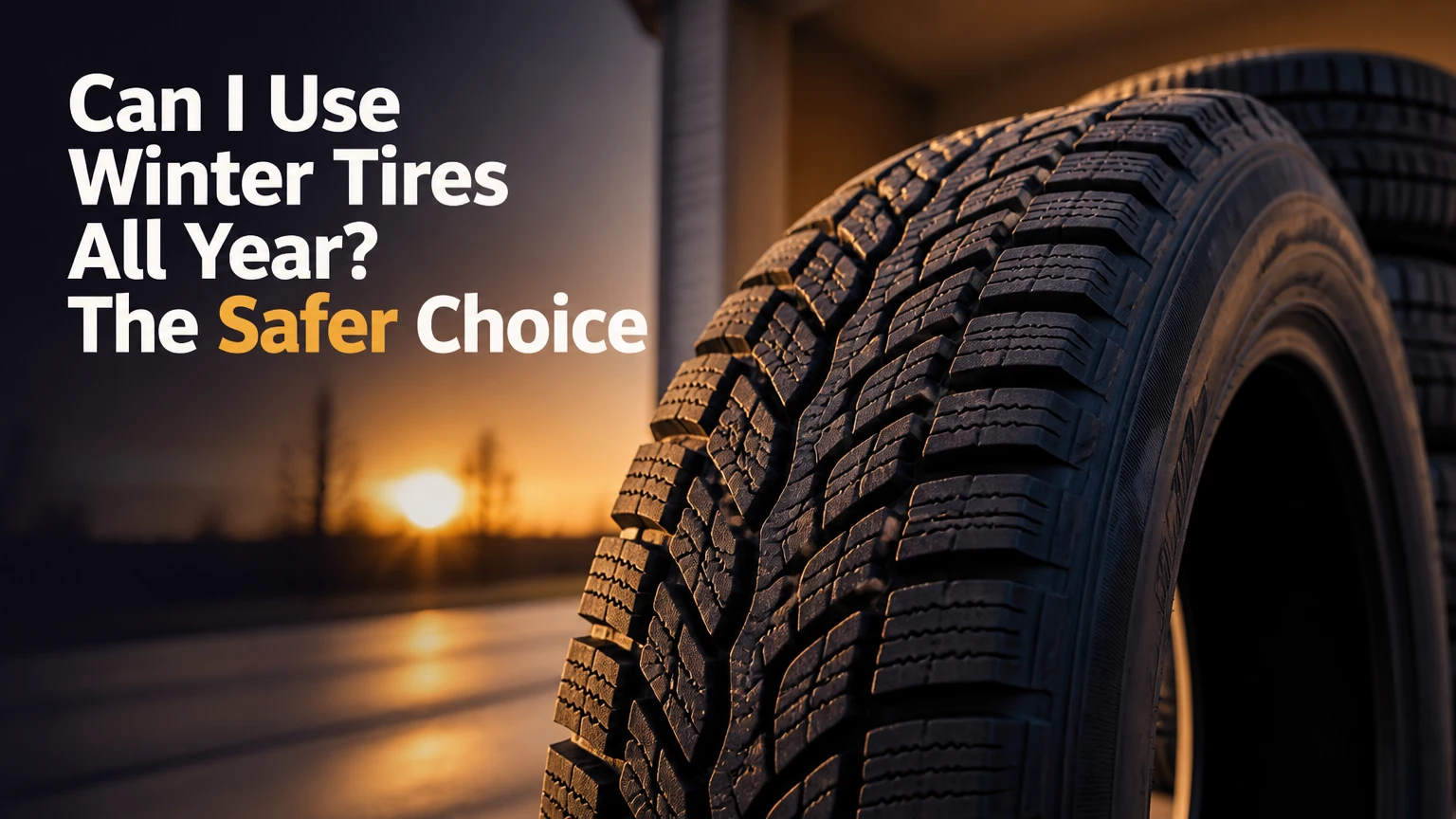
You can use winter tires all year technically, but tire manufacturers and safety specialists generally advise against it. Warm pavement makes winter compounds wear faster, tread blocks flex during braking and cornering, and wet or dry handling becomes less precise. For one tire set, choose an all-weather tire; for severe winters, use dedicated winter and warm-season tires.
Key Facts at a Glance
- Winter tires are designed to remain flexible below about 45°F (7°C), while warm-weather pavement accelerates tread wear and reduces handling precision.
- The Three-Peak Mountain Snowflake (3PMSF) symbol confirms a tire meets a severe-snow performance test; it does not make a tire ideal for summer.
- Winter tires can increase road noise, rolling resistance, and steering softness on warm, dry pavement.
- All-wheel drive improves acceleration on snow but does not shorten braking distances or restore cornering control.
- A two-set tire strategy costs more initially but usually preserves tread by dividing annual mileage between winter and warm-season tires.
- A 3PMSF all-weather tire is the practical one-set option for drivers who face occasional snow but do not need maximum ice performance.
Can I Use Winter Tires All Year?
Yes, a vehicle can operate on winter tires throughout the year, but year-round use is usually a poor safety and cost decision. Winter tires are optimized for cold temperatures, snow, and ice; summer heat softens their tread, increases block movement, and can reduce dry and wet-road control compared with tires designed for warm conditions.
The important distinction is between “can” and “should.” Most jurisdictions do not universally prohibit studless winter tires in summer, but local laws, tire-load requirements, vehicle manufacturer instructions, and insurance rules can differ. Studded tires commonly have seasonal restrictions because studs can damage pavement and provide limited benefit on clear roads.
A winter tire used briefly in warm weather is not automatically ruined. The problem is repeated exposure to high temperatures, highway speeds, heavy loads, aggressive cornering, and hot pavement. Those conditions consume the tread that the driver will need when snow and ice return.
What Counts as a Winter Tire?
A winter tire uses a cold-weather rubber compound, dense siping, and a tread pattern designed to maintain traction on snow, slush, and ice. The sidewall may carry the 3PMSF symbol, which shows that the tire passed a standardized severe-snow traction test under specified conditions.
The 3PMSF marking is different from the M+S marking. M+S means mud and snow in a broad tread-design sense, while 3PMSF represents a defined snow-performance requirement. Neither marking promises equal performance on ice, wet pavement, or hot asphalt.
Why Winter Tires Behave Poorly in Warm Weather
Winter tires behave poorly in warm weather because their flexible compound and highly segmented tread move more under load than warm-season designs. The same flexibility that helps a winter tire conform to cold, uneven surfaces can produce slower steering response, less stable tread blocks, and faster wear on dry pavement.
Three design features explain most of the difference:
- Cold-weather compound: Winter rubber is formulated to stay pliable as temperatures fall. Above the tire’s intended operating range, the tread can feel soft and less supported during hard braking or rapid lane changes.
- High sipe density: Sipes create biting edges and help evacuate thin water films on ice. On warm pavement, the many cuts allow tread blocks to flex, which can make steering feel vague.
- Open tread pattern: Wide grooves help move slush and packed snow. On clear roads, larger voids and flexible blocks can create more noise and rolling resistance than touring or summer tires.
The effect is not identical across every model. A performance winter tire may feel more controlled than a heavily siped ice tire, but it remains a winter product. Tire Rack testing has repeatedly shown that tire category and temperature can materially change braking and handling results, so a single universal figure, such as a guaranteed 26-foot braking penalty, should not be treated as applicable to every car or tire.
Does Warm Weather Make Winter Tires Unsafe Immediately?
Warm weather does not create an instant safety failure, but risk rises as temperature, speed, load, and tread wear increase. A short drive at 50°F (10°C) is different from a fully loaded highway trip across pavement heated well above the surrounding air temperature.
Drivers should be especially cautious when winter tires feel greasy, the steering response becomes delayed, or the vehicle requires more correction during lane changes. Those are practical signs that the tire is operating outside its strongest range.
When Should Winter Tires Be Installed?
Install winter tires when temperatures consistently approach 45°F (7°C), especially during the times you normally drive, and remove them when sustained spring temperatures remain above that threshold. The 7°C rule is a useful seasonal guideline, not a command to change tires whenever one afternoon crosses 45°F.
Forecasts and road conditions matter. A driver in Toronto, Minneapolis, or Denver may install winter tires before the first snowfall because overnight temperatures and early-morning roads become cold before daytime highs do. A driver in Seattle or Washington, D.C., may choose all-weather tires instead if snow is infrequent and wet-road performance matters more throughout the year.
The installation decision should consider:
- Overnight and morning temperatures, not only afternoon highs.
- The first likely snow or freezing-rain event.
- Driving elevation and mountain travel.
- Whether the vehicle is parked outdoors.
- Appointment availability before seasonal demand peaks.
- Local rules for studded tires and winter equipment.
A practical rule is to schedule the change before regular morning temperatures settle near 45°F, then reverse the process after spring temperatures stay above that range for most driving days.
How Quickly Do Winter Tires Wear in Summer?
Winter tires can wear substantially faster in summer, but no reliable universal mileage figure applies to every tire. Typical service life is about four to six winter seasons when annual mileage, alignment, storage, inflation, and tread depth are favorable; continuous hot-weather use can reduce that life sharply, sometimes to roughly one or two years for high-mileage drivers.
A claim that every winter tire becomes bald within 10,000 miles is too absolute. A lightly driven car in a cool coastal climate may wear more slowly, while a heavy SUV driven 15,000 highway miles through hot summers may consume a winter set rapidly.
| Operating pattern | Typical annual mileage | Likely consequence | Practical inspection |
|---|---|---|---|
| Dedicated winter use | 3,000-6,000 miles | 4-6 seasons may be possible | Measure tread each spring |
| Mixed cold and warm use | 6,000-10,000 miles | Noticeable summer wear | Check before next winter |
| Year-round moderate climate | 10,000-15,000 miles | Replacement may arrive in 1-3 years | Inspect every 5,000 miles |
| Hot summer, heavy vehicle | 15,000+ miles | Rapid shoulder and block wear | Inspect monthly in heat |
Tread depth is only one measurement. A winter tire can retain legal tread yet lose winter usefulness because its sipes are worn, the compound has aged, or the tread blocks have become irregular. Inspect for cupping, cracking, bulges, exposed cords, uneven shoulders, and damage after pothole impacts.
Is One Set Cheaper Over Five Years?
One set of winter tires may cost less initially, but it is not usually the lowest total-cost strategy for a driver who needs serious winter traction. A two-set system divides mileage between winter and warm-season tires, although the calculation changes with tire prices, mounting fees, wheel storage, annual mileage, and vehicle size.
Typical North American costs are shown below. Prices vary by tire dimension, brand, retailer, and region.
| Strategy | Initial tire cost | Other five-year costs | Typical five-year total |
|---|---|---|---|
| Winter tires used year-round | $600-$1,200 | $600-$2,400 replacement and mounting | $1,200-$3,600 |
| Premium all-season set | $600-$1,000 | $0-$300 rotation and repairs | $600-$1,300 |
| All-weather 3PMSF set | $700-$1,300 | $0-$300 rotation and repairs | $700-$1,600 |
| Winter plus all-season sets | $1,200-$2,200 | $600-$1,500 mounting, storage, wheels | $1,800-$3,700 |
These are typical planning ranges, not guaranteed ownership costs. A second wheel set may cost approximately $300-$800, while seasonal mounting and balancing may cost roughly $80-$200 per year. Tire pressure monitoring system sensors can add another $100-$300 when a second wheel set requires them.
Fuel use also deserves a realistic treatment. Winter tires may reduce fuel economy by a few percent in some vehicles because of tread design and rolling resistance, but a fixed 5%-8% penalty is not universal. Vehicle weight, speed, tire pressure, alignment, temperature, and tire model can produce a larger effect than the tire category alone.
Which Tire Type Works Best Across the Year?
All-weather tires are the strongest single-set compromise for drivers who need dependable snow traction but also drive through warm summers. Conventional all-season tires are quieter and often longer-lasting in warm conditions, while dedicated winter tires remain the best choice for frequent ice, deep snow, and sustained cold.
| Tire category | Snow and ice capability | Warm-road behavior | Typical tread warranty | Best use |
|---|---|---|---|---|
| Studless winter | High snow, high ice | Soft, noisy, faster wear | 0-40,000 miles | Frequent severe winter |
| Studded winter | Very high ice | Seasonal restrictions, noisy | 0-40,000 miles | Glare ice where legal |
| All-weather 3PMSF | Moderate-high snow | Stable year-round compromise | 50,000-60,000 miles | One set, variable climate |
| Conventional all-season | Moderate snow | Quiet, efficient, durable | 50,000-80,000 miles | Mild winters |
| Summer performance | Low snow and ice | Best warm dry handling | 20,000-40,000 miles | Warm climates only |
Examples of all-weather products include the Michelin CrossClimate 2 and Bridgestone WeatherPeak, although the correct choice depends on the vehicle’s required size, load index, speed rating, and regional testing. A conventional all-season tire with M+S marking is not automatically equivalent to a 3PMSF all-weather tire.
Are All-Weather Tires the Same as All-Season Tires?
All-weather tires and conventional all-season tires are related but not identical categories. All-weather tires typically use more winter-oriented tread features and often carry the 3PMSF symbol, while conventional all-season tires prioritize quiet warm-road operation and long tread life.
The trade-off is measurable in feel and use. An all-weather tire can produce more noise and rolling resistance than a touring all-season tire, but it generally offers stronger snow traction. Neither single-set option equals a dedicated winter tire on polished ice or repeated mountain-snow travel.
Are Winter Tires Legal in Summer?
Studless winter tires are legal in summer in many jurisdictions, but legality is location-specific and does not establish that they are the safest choice. Studded tire rules are more restrictive, with some regions limiting use to dates such as late fall through early spring or banning studs on particular roads.
Before using winter tires outside their normal season, verify:
- Provincial, state, or national stud restrictions.
- Minimum tread-depth rules.
- Required load and speed ratings.
- Lease, fleet, or commercial-vehicle requirements.
- Insurance policy conditions after a collision.
- Vehicle manufacturer recommendations.
Insurance companies do not automatically deny a claim because a driver used studless winter tires in warm weather. However, investigators can consider tire condition, maintenance, speed, and equipment suitability when assessing a collision. Legal use is not a substitute for appropriate performance.
Does AWD Make Year-Round Winter Tires Safe?
All-wheel drive does not make year-round winter tires safe on warm pavement because AWD primarily helps transmit engine power during acceleration. Braking and cornering still depend on the tire’s contact patch, tread stability, compound, suspension, and road surface.
A vehicle with AWD and winter tires may pull away effectively on snow while still taking too long to stop on dry summer pavement. The same vehicle can also lose cornering control when soft tread blocks deform during an evasive maneuver. This is why vehicle manufacturers and tire specialists treat traction, braking, and steering as separate performance tasks.
AWD also adds weight, which can increase heat and wear in the tires. Drivers of SUVs and pickup trucks should follow the tire’s load index and maintain inflation pressure according to the vehicle placard, not the maximum pressure molded into the sidewall.
What If Summer Arrives Before I Can Swap Them?
If winter tires remain installed for a short period after spring arrives, drive conservatively and arrange replacement or removal promptly. Avoid high speeds, heavy loading, abrupt lane changes, hard cornering, and repeated emergency braking while the tires operate in warm conditions.
Check tire pressure when the tires are cold, because heat changes pressure readings and underinflation increases flex and temperature. Inspect tread for uneven wear and confirm that no tire has cracks, bulges, exposed cords, or a damaged sidewall.
Do not deliberately “finish off” old winter tires through summer if they are already near the end of their winter life. A tire with 4/32 inch of tread may be unsuitable for snow even before it becomes legally worn, and summer heat can expose existing structural weakness.
Can I Use Worn Winter Tires as Summer Tires?
Using worn winter tires as summer tires is a false economy when the tires have low tread, damaged blocks, cracking, or severe uneven wear. Winter tires lose their snow advantage before reaching the legal replacement limit, so a tire that cannot safely serve next winter may still be unsuitable for high-speed summer travel.
Replace tires when tread indicators are reached, damage appears, the tire is too old according to manufacturer guidance, or performance changes noticeably. Rotate tires at the vehicle manufacturer’s interval, commonly every 5,000-8,000 miles, and correct alignment problems that cause shoulder wear.
Which Strategy Fits Your Driving?
The correct tire strategy depends more on climate, road exposure, and annual mileage than on whether the vehicle has AWD. The recommendations below separate the major use cases.
| Driver situation | Annual mileage | Winter exposure | Recommended setup | Main reason |
|---|---|---|---|---|
| Mountain commuter | 12,000-20,000 miles | Frequent snow and ice | Winter plus all-season or summer | Maximum seasonal traction |
| Mild-city driver | 8,000-15,000 miles | Occasional light snow | Premium all-season | Better warm-road comfort |
| Variable-climate traveler | 10,000-18,000 miles | Snow several times yearly | 3PMSF all-weather | One-set convenience |
| Low-mileage rural driver | Under 8,000 miles | Severe storms possible | Winter plus warm-season set | Preserves cold-weather capability |
| Hot-climate driver | 10,000-20,000 miles | Rare freezing conditions | Summer or all-season | Winter tread offers little benefit |
Severe-Winter Commuter
Choose dedicated winter tires if regular driving includes packed snow, freezing rain, steep grades, or temperatures well below freezing. Keep a separate all-season or summer set for spring through fall, ideally on a second wheel set to reduce mounting costs and bead wear.
Mild-Winter Urban Driver
Choose a premium conventional all-season tire when snow is rare, roads are quickly cleared, and wet pavement is the dominant hazard. Drivers who must travel during occasional snowstorms should move up to an all-weather 3PMSF tire rather than relying on a standard M+S marking alone.
One-Set Budget Driver
Choose an all-weather 3PMSF tire when storage, seasonal appointments, or a second wheel set make two sets impractical. The compromise is higher purchase cost than some all-season tires and potentially more noise, but the tire avoids the worst summer-wear problem of a dedicated winter compound.
Expert Rules That Prevent Expensive Mistakes
A temperature rule is not a calendar rule. A driver in a high-elevation region may need winter capability while daytime weather still feels mild, whereas a coastal driver may experience warmer pavement and little snow throughout winter.
Tread depth does not equal winter performance. Sipe geometry, compound age, and block stiffness determine whether a tire can grip ice. Measure tread, but also inspect the wear pattern and follow the tire manufacturer’s replacement guidance.
The whole vehicle needs a matched set. Installing winter tires on only the drive axle can create a dangerous handling imbalance, especially during braking or cornering. Most passenger vehicles should use four matching winter tires with compatible size, load index, and speed rating.
A second wheel set can reduce hidden labor. Seasonal mounting is not merely a convenience fee. Repeatedly removing and installing tires can stress beads and wheels, while a complete mounted set makes pressure checks and seasonal changes simpler.
The best one-set tire is not the most winter-focused tire. A deeply siped winter tire may win on ice but lose too much warm-weather stability and service life for year-round use. The correct compromise is designed for both temperature ranges.
FAQ
Can winter tires damage my car in summer?
Winter tires normally do not damage the vehicle itself, but their softer tread can increase tire wear, rolling resistance, road noise, and steering movement in warm conditions. Incorrect load or speed ratings, severe underinflation, or damaged tires create greater mechanical risk than the winter label alone.
Are winter tires worth buying if it rarely snows?
Winter tires are usually not worth buying in a climate with rare snow, warm winters, and well-cleared roads. A 3PMSF all-weather tire may be the better purchase when occasional snow matters, while a high-quality all-season tire may suit drivers who can avoid travel during storms.
Can I drive 100 miles on winter tires in warm weather?
A 100-mile trip on winter tires in warm weather is generally less concerning than leaving them installed for an entire hot season, provided the tires are correctly inflated, undamaged, and properly rated. Reduce aggressive driving and inspect them afterward if pavement temperatures were high or the vehicle was heavily loaded.
Do winter tires reduce stopping distance on wet roads?
Winter tires can improve braking on cold, wet, slushy, or snowy roads, but they may require more distance than warm-season tires on warm, wet pavement. The result depends on temperature, water depth, tire model, vehicle, and speed, so no single wet-road distance applies universally.
Should I replace all four winter tires at once?
Replace all four winter tires together when possible because matching tread and compound maintain predictable braking and cornering. Replacing only one or two can create grip differences between axles; if only two tires are replaced, follow the vehicle and tire retailer’s placement guidance.
How should winter tires be stored in summer?
Store winter tires clean, dry, cool, and away from direct sunlight, ozone-producing electrical equipment, petroleum products, and standing moisture. Bagging clean tires and keeping them off a hot garage floor helps, while mounted tires should be stored according to the tire manufacturer’s orientation guidance.
The Bottom Line
Can I use winter tires all year? Yes, but year-round winter-tire use is usually inferior to the correct alternative for the climate. Choose dedicated winter and warm-season tires for frequent snow and ice, a 3PMSF all-weather set for one-set convenience, or premium all-season tires for mild winters. The safer decision is the tire strategy that matches both winter conditions and summer pavement.