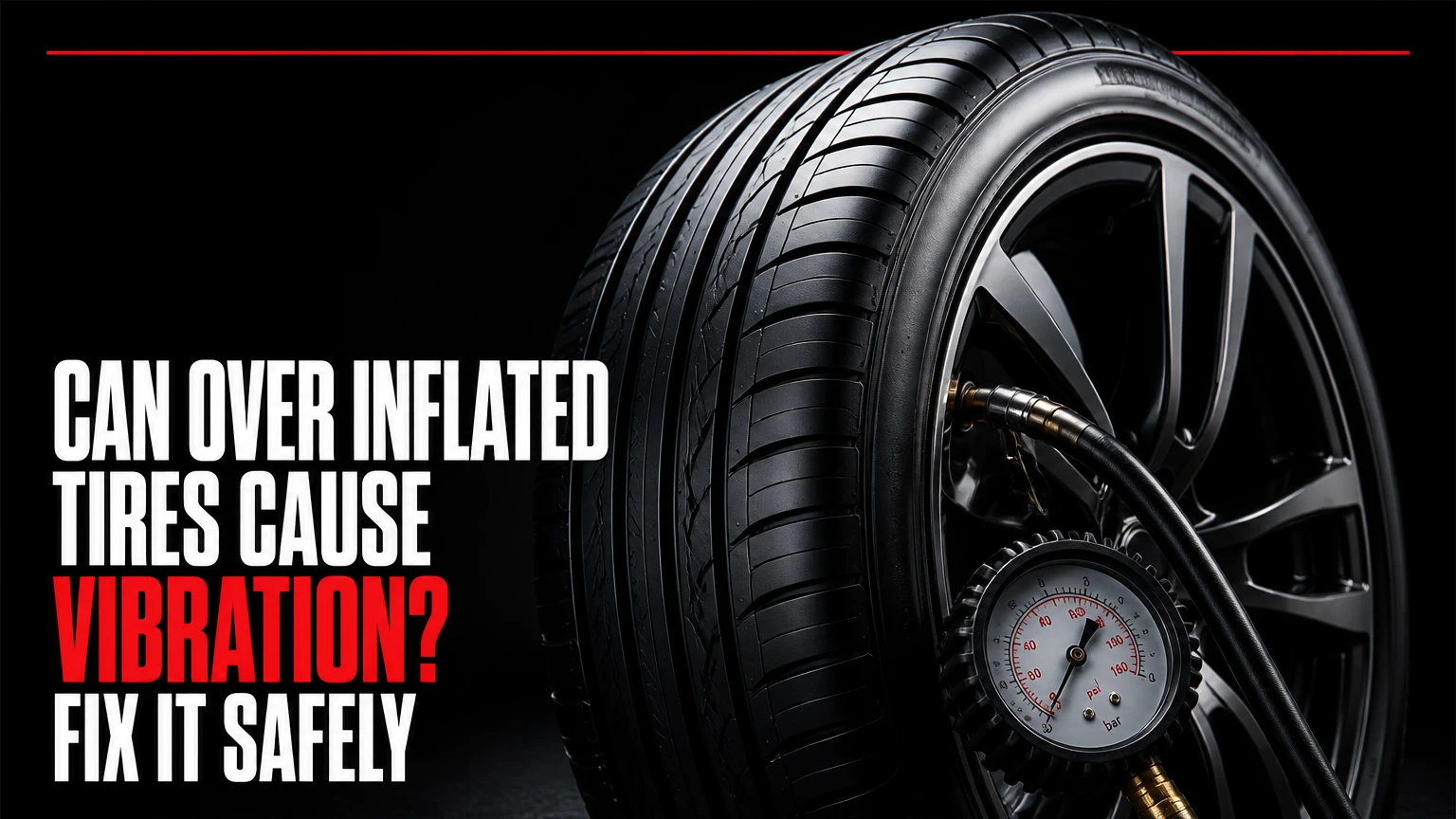
Over-inflated tires can cause or amplify vehicle vibration because excessive air pressure makes the tire less compliant and reduces its effective contact with the road. However, pronounced steering-wheel shaking usually points to wheel imbalance, tire runout, a bent rim, or tire damage that high pressure has made more noticeable. Correct cold pressure first, then inspect the wheel assembly.
Key Facts at a Glance
- The correct pressure is the vehicle manufacturer’s cold inflation pressure on the driver’s door-jamb placard, not the tire sidewall maximum.
- Overinflation can make a vehicle feel harsh and transmit road impacts, but it does not normally create a major imbalance.
- A vibration that peaks at a repeatable highway speed commonly requires wheel balancing or runout inspection.
- Tire pressure rises as the tire warms; do not bleed a hot tire to the cold placard value.
- A visible bulge, tread separation, exposed cord, sudden pressure loss, or violent shaking requires stopping safely and arranging inspection.
- Passenger-car tire pressure often falls around 30-36 PSI, but the placard value for the specific vehicle is authoritative.
Can Over Inflated Tires Cause Vibration?
Yes, over inflated tires can cause a harsh, buzzy, or road-sensitive vibration, especially when the pressure is substantially above the vehicle placard value. High pressure stiffens the tire’s sidewall and tread, so small pavement irregularities reach the suspension and steering wheel with less damping.
The effect is often mistaken for a wheel-balance fault because both conditions become more obvious at speed. The distinction matters: reducing pressure can correct pressure-induced harshness, but it cannot repair a missing wheel weight, bent wheel, separated belt, or defective tire.
A mild pressure difference of 1-2 PSI rarely explains severe shaking. A tire that is 8-15 PSI above its specified cold pressure may feel noticeably hard and lose useful contact over uneven pavement, yet a strong rhythmic vibration still deserves a wheel and tire inspection.
Why Does High Pressure Change Ride Quality?
High tire pressure changes ride quality by reducing the tire’s vertical flexibility and altering the tread’s footprint. The tire normally acts as the first spring in the vehicle, absorbing small impacts before they reach the wheel, bushings, dampers, and steering system.
When pressure is excessive, the tread can carry more load through its center and the sidewall deflects less. The contact patch may become shorter or narrower, depending on tire construction, load, and tread design. That change can reduce grip on irregular pavement and make the vehicle skip or chatter across ridges.
The sequence is straightforward:
- Excess pressure increases casing tension.
- Sidewall deflection decreases.
- The tire absorbs less fine road movement.
- More impact reaches suspension components.
- Existing imbalance, wheel runout, or worn bushings becomes easier to feel.
Tire construction changes the result. A stiff performance tire at 3 PSI over placard pressure may feel harsher than a flexible touring tire at the same difference.
Which Tire Pressure Should You Use?
Use the manufacturer’s recommended cold inflation pressure printed on the driver’s door-jamb placard, fuel-door label, or owner’s manual. The number may differ between front and rear axles and may include a separate setting for maximum passenger or cargo load.
| Pressure marking | Typical location | What the number means | Correct use |
|---|---|---|---|
| Vehicle placard cold PSI | Driver’s door jamb | Required pressure for that vehicle and load condition | Primary daily setting |
| Tire sidewall maximum PSI | Tire sidewall | Maximum permitted inflation pressure for the tire | Not the normal vehicle setting |
| Temporary spare PSI | Spare-tire sidewall or placard | Required pressure for the compact spare | Check separately, often 60 PSI |
| Load or towing pressure | Owner’s manual or placard | Vehicle-specific setting for heavy load | Use only for the stated load |
| TPMS warning threshold | Vehicle software | Pressure level that triggers a warning | Not a target pressure |
The sidewall maximum is a tire limit, not a ride or handling recommendation. For example, a tire marked “Max Press 44 PSI” may be fitted to a vehicle whose placard specifies 35 PSI.
The U.S. National Highway Traffic Safety Administration advises checking tire pressure when tires are cold and following the vehicle placard. That approach prevents a common error: setting every vehicle to a generic internet recommendation such as 32 or 35 PSI.
Where Do You Feel the Vibration?
The location of the vibration provides a useful first diagnostic clue, although it does not identify the fault with certainty. Front-wheel problems usually communicate through the steering wheel, while rear-wheel problems more often travel through the seat or floor.
| Sensation and condition | More likely causes | First inspection | Typical next action |
|---|---|---|---|
| Steering wheel shakes at 55-75 mph | Front imbalance, radial runout, tire defect | Front wheels and tire uniformity | Balance and measure runout |
| Seat or floor shakes at 55-75 mph | Rear imbalance, bent rear wheel | Rear wheel assemblies | Rear balance and wheel inspection |
| Harshness on every road surface | Excess pressure, stiff tire, worn dampers | Cold PSI and tire specification | Correct pressure, then road-test |
| Vibration only while braking | Rotor thickness variation, caliper issue | Brake rotors and pads | Brake measurement and service |
| Vibration during acceleration | Inner CV joint, driveshaft, engine mount | Driveline components | Professional driveline diagnosis |
| Vibration over bumps at 25-45 mph | Suspension joint, bushing, tire damage | Ball joints, tie rods, bushings | Lift inspection and repair |
A pressure-related sensation tends to follow pavement texture and may improve on smooth asphalt. An imbalance usually has a repeatable speed band, even when the road surface changes.
How Can You Separate Pressure From Balance Problems?
Correcting cold pressure is the fastest screening test, but a persistent speed-specific shake should be treated as a balance, runout, or tire-uniformity problem. Pressure affects how a fault feels; it does not normally change the mass distribution of the wheel assembly.
Use this sequence:
- Record all four cold pressures before adjustment.
- Compare each reading with the door-placard value.
- Inspect tread and sidewalls for bulges, cuts, cords, and uneven wear.
- Set pressure with a reliable gauge.
- Drive briefly on a smooth road at the speed where symptoms normally begin.
- If vibration remains, request dynamic balancing and runout measurement.
A conventional dynamic balance corrects unequal mass around the rotating assembly. A road-force balancer applies load to the tire while measuring force variation, which can identify a stiff spot, tire uniformity problem, or wheel-tire match issue that ordinary balancing may miss.
Expert insight: do not approve repeated balancing without asking whether the technician measured wheel lateral runout, radial runout, and tire uniformity. A machine can balance a damaged assembly numerically while the assembly still produces a road-speed vibration.
What Damage Can Excess Pressure Cause?
Excess pressure can reduce wet and uneven-road grip, increase center-tread wear, and make impact damage more severe. The risk depends on how far pressure exceeds specification, the vehicle load, road surface, tire age, and tire construction.
| Condition | Common pressure effect | Observable symptom | Potential consequence |
|---|---|---|---|
| 2-4 PSI above placard | Firmer response and harsher ride | More impact feel | Usually correctable by pressure adjustment |
| 5-8 PSI above placard | Reduced compliance and smaller effective footprint | Chatter over rough pavement | Less uneven-road grip and faster center wear |
| 9-15 PSI above placard | Severe stiffness | Noticeable harshness and impact transmission | Increased risk of impact damage and poor contact |
| Sidewall maximum used as target | Vehicle setup no longer follows placard | Skittish handling or abnormal wear | Incorrect load and handling balance |
| Overpressure with heavy impact | Tire casing absorbs less deformation | Bulge, cut, or sudden pressure loss | Immediate tire replacement may be necessary |
Center wear is a clue, not proof. Alignment, excessive toe, worn suspension, tire age, incorrect wheel width, and long-term highway driving can create similar patterns. Measure tread depth across the inner, center, and outer ribs before assigning pressure as the cause.
The Tire Industry Association treats correct inflation, load, inspection, and maintenance as connected safety factors. No pressure adjustment can make an overloaded, damaged, or improperly mounted tire safe.
How Does Temperature Change Tire Pressure?
A passenger-car tire commonly changes by about 1 PSI for each 10°F, or 5.6°C, change in tire temperature, although the actual change varies with starting pressure, air temperature, sunlight, speed, and tire construction. Pressure does not rise by 10 percent for every 10°F increase.
That correction is important. A tire at 35 PSI cold may read several PSI higher after a highway drive, and the warm reading is not a valid reason to release air. Wait until the tire has been parked for roughly three hours, or measure it before driving.
| Situation | Approximate reading change | Correct response |
|---|---|---|
| Overnight cold tire | Baseline | Set to placard PSI |
| 20°F ambient increase | About 2 PSI | Recheck cold, do not compensate casually |
| 60-minute highway drive | Often 3-7 PSI higher | Do not bleed while hot |
| Direct sunlight on one tire | Unequal temporary rise | Compare after cooling |
| Cold-weather pressure drop | About 1 PSI per 10°F drop | Restore cold placard pressure |
The tire pressure monitoring system may warn after pressure changes, but TPMS is a warning device rather than a precision gauge. Many systems do not display the actual pressure, and some require recalibration after adjustment.
How Should You Check and Correct Pressure?
Check and correct tire pressure in about 10 minutes when the tires are cold. You need a calibrated tire-pressure gauge, an air source, the vehicle placard, and a valve-cap tool only if a cap is damaged.
Step 1: Park the vehicle cold
Park out of direct sunlight on level ground and allow the vehicle to sit for at least three hours after driving. If an immediate check is unavoidable, record the warm values and confirm them later when cold.
You will know the condition is suitable when all tires have cooled and no tire has been driven recently. The common mistake is adjusting one warm tire against three cold readings.
Step 2: Measure every tire
Remove each valve cap, press the gauge squarely onto the valve stem, and record the reading to the nearest 0.5 or 1 PSI. Include the spare if it is part of the vehicle’s emergency plan.
A hissing sound during a brief measurement is normal. Continuous leakage after the gauge is removed suggests a valve-core, stem, or puncture problem.
Step 3: Compare with the placard
Use the front and rear values separately if the placard lists different pressures. Do not substitute the tire sidewall maximum, a fuel-economy recommendation, or the pressure from another vehicle.
The correct checkpoint is a cold reading that matches the placard within the gauge’s practical accuracy, commonly plus or minus 1 PSI.
Step 4: Release or add air gradually
If pressure is high, press the gauge release valve for one second at a time and measure again. If pressure is low, add air in short bursts until the target is reached.
The common mistake is releasing 5 PSI at once and overshooting. A tire that is more than 10 PSI above placard pressure should be corrected before normal driving.
Step 5: Inspect and road-test
Replace valve caps, check for visible damage, and drive on a smooth road at moderate speed before testing the original vibration range. Stop if the vehicle pulls sharply, the tire thumps, or shaking becomes violent.
If the vibration remains after pressure correction, arrange balancing and tire inspection rather than continuing to bleed air.
How Does Overinflation Compare With Underinflation?
Overinflation generally produces a hard, nervous ride and can reduce contact on rough surfaces, while underinflation produces more sidewall flex, heat, steering delay, and shoulder wear. Neither condition is a safe substitute for the vehicle placard pressure.
| Factor | Overinflation | Correct placard pressure | Underinflation |
|---|---|---|---|
| Ride feel | Hard, sharp impacts | Controlled compliance | Soft, vague response |
| Tread wear tendency | Center wear | Even wear when aligned | Shoulder wear |
| Steering response | Quick but nervous | Designed balance | Slower and heavier |
| Heat generation | Lower flex heat, higher impact sensitivity | Intended operating range | Higher flex heat |
| Rough-road grip | Can skip over irregularities | Best compromise | May deform excessively |
| Fuel economy | Possible small gain | Manufacturer baseline | Usually reduced |
The U.S. Department of Energy reports that properly inflated tires can improve fuel economy compared with significantly underinflated tires, but that finding does not justify exceeding the placard pressure. Fuel savings from overinflation are usually small compared with the safety and wear trade-offs.
Performance drivers sometimes adjust pressure at a racetrack because tire temperature and load differ from street use. Those settings require tire-temperature measurement, manufacturer guidance, and controlled conditions. They are not appropriate for ordinary commuting.
What Tire and Wheel Faults Mimic Overinflation?
Tire and wheel faults frequently mimic pressure-induced vibration, and several require prompt inspection. A separated belt, bent wheel, flat spot, or severe radial-force variation can produce shaking even when all pressures are correct.
| Fault | Typical onset | Distinguishing clue | Usual repair |
|---|---|---|---|
| Missing balance weight | 45-75 mph | Repeatable speed-specific shake | Dynamic rebalance |
| Bent wheel | 25-70 mph | Visible radial or lateral wobble | Wheel repair or replacement |
| Tire belt separation | Any speed, often worsening | Bulge, lump, tread wave, pull | Replace tire |
| Temporary flat spot | First 5-20 minutes after parking | Improves as tire warms | Monitor or replace if persistent |
| Road-force variation | 45-75 mph | Balance appears acceptable | Road-force balance or tire replacement |
| Worn suspension bushing | Bumps and braking | Clunk, wandering, uneven wear | Replace failed component |
| Brake rotor variation | Braking from speed | Pulsation only under braking | Measure and service brakes |
New tires do not guarantee a smooth result. Mounting errors, a bent wheel inherited from the previous tire, bead seating problems, or a tire with excessive uniformity variation can all create vibration immediately after installation.
Expert insight: if the vibration began directly after tire replacement, return to the installer and request a recheck of lug torque, bead seating, balance weights, wheel runout, and tire position before replacing suspension parts.
What Will Diagnosis and Repair Cost?
Pressure correction is usually free or costs less than $10, while professional diagnosis ranges from about $20 to $150 depending on the shop and the required measurements. Prices vary by country, wheel size, vehicle type, and whether the shop performs road-force testing.
| Service | Typical time | Typical U.S. price | What it determines |
|---|---|---|---|
| Pressure check and adjustment | 5-10 minutes | $0-$10 | Whether PSI is outside placard value |
| Four-wheel dynamic balance | 30-60 minutes | $60-$140 | Unequal rotating mass |
| Road-force balance | 45-90 minutes | $100-$200 | Tire uniformity and wheel-tire match |
| Wheel runout inspection | 30-60 minutes | $30-$100 | Bent or distorted wheel |
| Tire replacement | 30-90 minutes | $100-$400 per tire | Damaged or defective tire |
| Suspension diagnosis | 45-120 minutes | $50-$180 | Worn joints, bushings, or dampers |
These are typical consumer ranges, not fixed prices. A shop may waive inspection charges when it performs the repair, while dealership labor rates can exceed independent-shop rates.
Do not pay for balancing first if a tire has a visible bulge, tread separation, or a rapidly falling pressure reading. Those conditions require tire replacement or puncture repair assessment.
When Should You Stop Driving?
Stop driving and arrange roadside assistance when vibration is sudden or violent, the tire has a bulge or exposed cord, pressure drops repeatedly, the vehicle pulls sharply, or a tread section appears lifted. These symptoms can indicate structural tire failure rather than a pressure setting.
Drive only a short distance to a safe location when the vibration is mild, pressure is stable, and no damage is visible. Avoid highway speed until the cause is known.
A professional inspection is especially important after a pothole strike, curb impact, collision, or prolonged driving with low pressure. Wheel damage and internal tire damage may not be visible from the outside, and increasing or decreasing PSI will not repair either defect.
How Should You Diagnose Common Situations?
Vibration starts after adding air
Measure all tires cold and compare them with the placard. If one tire is several PSI high, correct it and retest; if all tires match but the vibration persists, inspect balance and runout.
Vibration appears only above 60 mph
A repeatable highway-speed vibration most often warrants dynamic balance, road-force measurement, and wheel inspection. High pressure may intensify the sensation, but speed-specific shaking is not proof of overinflation.
Steering wheel shakes after a pothole
Inspect the front tire sidewalls, wheel lips, and alignment symptoms before driving quickly. A bent rim or internal belt injury can follow an impact even when pressure remains normal.
The vehicle feels harsh but does not shake
Check pressure, tire type, tire age, and suspension damping. A stiff low-profile tire, high-pressure setting, or worn damper can create harshness without a rotating imbalance.
Vibration occurs only during braking
Pressure is unlikely to be the primary cause. Measure brake rotor variation, inspect caliper operation, and check wheel torque, because brake-related pulsation follows pedal application rather than vehicle speed alone.
FAQ
Can 5 PSI over cause a tire vibration?
Five PSI above the placard can make a tire feel noticeably firmer and can amplify road harshness, particularly on low-profile or performance tires. It does not reliably cause a severe rhythmic shake. Correct the pressure cold, then inspect balance if vibration remains at a repeatable speed.
Is 40 PSI too high for a car tire?
Forty PSI is too high when the vehicle placard specifies a lower cold pressure, but it may be correct for another vehicle or a temporary spare. Compare 40 PSI with the placard, not with the tire’s maximum sidewall rating, before deciding.
Can overinflated tires cause a car to pull?
Overinflated tires can alter steering response and make a vehicle feel nervous, but a consistent pull usually points to alignment, unequal pressure, tire conicity, road crown, or a brake problem. Check left-to-right cold pressure first and seek inspection if the pull persists.
Does TPMS tell you if tires are overinflated?
Some direct TPMS systems display individual pressure readings, but many only provide a low-pressure warning. TPMS thresholds and displayed values are not a replacement for a manual gauge and the vehicle placard. Check pressure cold, especially after seasonal temperature changes.
Can tire pressure cause vibration at low speed?
Pressure alone usually causes harshness rather than a strong low-speed vibration. Low-speed shaking can indicate a tire bulge, out-of-round tire, bent wheel, mud or snow packed inside a wheel, or a flat spot that does not disappear after warming.
Should you balance tires after correcting pressure?
Balance the tires if vibration remains after cold pressure is corrected, particularly when the shake appears in a repeatable speed range. Request dynamic balancing and ask whether the technician checked wheel runout and tire uniformity when ordinary balancing does not solve the problem.
The Bottom Line
Can over inflated tires cause vibration? Yes, excessive pressure can stiffen the tire, reduce compliance, and amplify road vibration, but major shaking usually requires a second fault such as imbalance, runout, tire damage, or worn suspension. Set every tire to the vehicle placard’s cold PSI, road-test cautiously, and escalate to a tire and wheel inspection when the symptom remains.