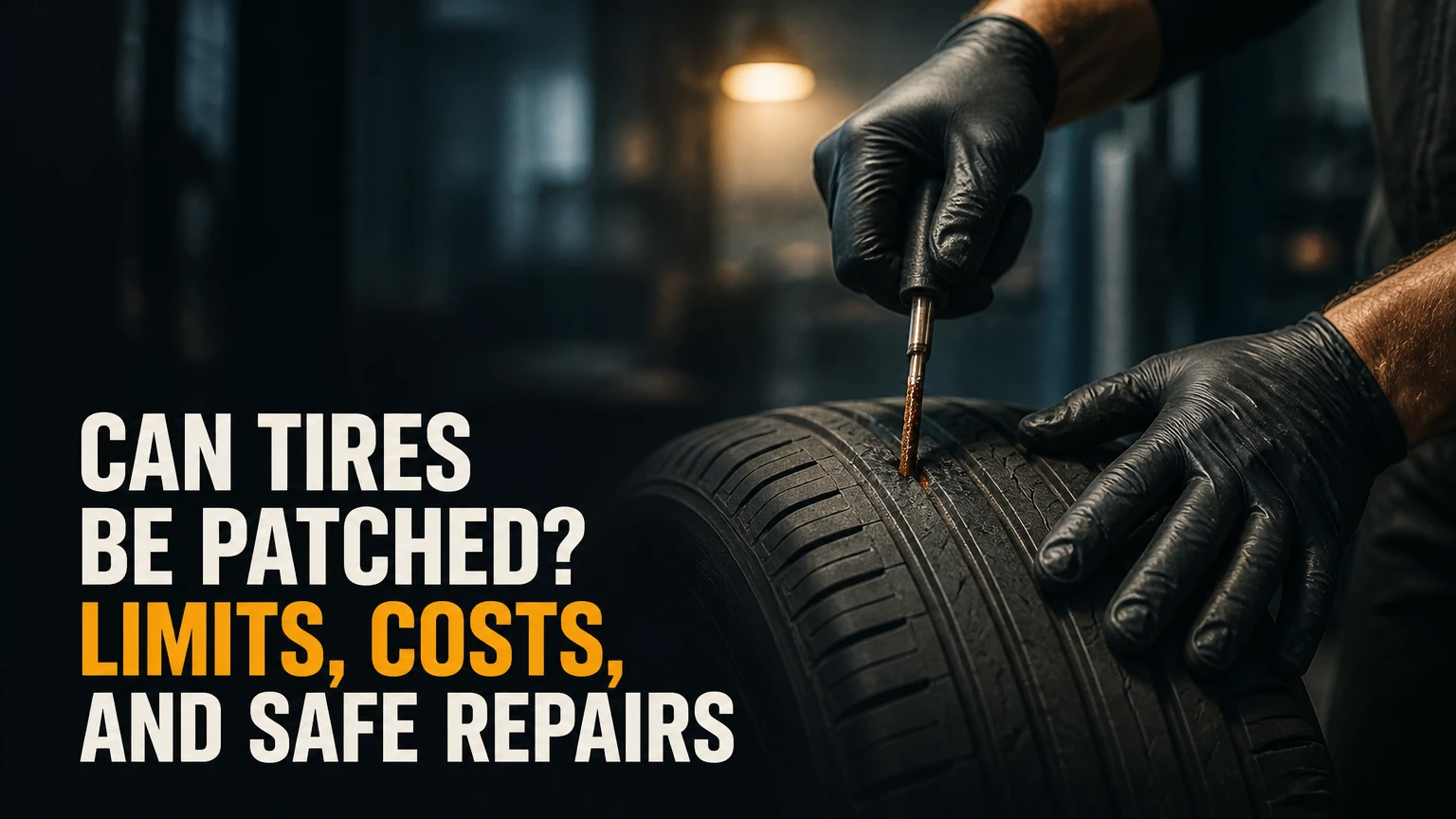
Yes, car tires can be patched when a small puncture lies in the repairable tread area, the tire has not suffered internal damage, and the tire manufacturer permits repair. A professional normally installs a combination patch-plug from inside the dismounted tire. Sidewall, shoulder, large, overlapping, or heat-damaged injuries usually require tire replacement.
Key Facts at a Glance
A repairable puncture is generally no larger than 1/4 inch, or 6 mm, in diameter.
The puncture must be in the central tread area, not the sidewall or shoulder.
A permanent repair seals the inner liner and fills the puncture channel.
A professional must remove the tire from the wheel to inspect hidden damage.
An outside string plug is a temporary roadside measure, not the preferred permanent repair.
Typical professional repair costs range from $20-$45 and take about 30-45 minutes.
Can Tires Be Patched Safely?
A tire can be patched safely when the injury is a small, isolated tread puncture and an internal inspection finds no casing, belt, liner, bead, or heat damage. The repair must use materials and procedures compatible with the tire, and a qualified technician must follow the tire maker’s instructions.
The U.S. Tire Manufacturers Association, or USTMA, publishes the widely used 1/4-inch, 6 mm maximum injury limit. USTMA’s consumer guidance states, “Never repair a tire with a puncture larger than 1/4 inch (6 mm),” while its technical guidance also limits repairs to the tread area and requires internal inspection.
The Tire Industry Association, or TIA, trains technicians in tire service and repair procedures. A TIA credential does not override a tire manufacturer’s policy, however. Michelin, Bridgestone, Goodyear, Continental, and other manufacturers can impose stricter rules for particular tire families.
A repair is not automatically safe because the tire holds air after a patch is applied. Internal separation, a cut belt, or creasing from driving while flat can remain invisible from the outside.
Which Tire Damage Can Be Repaired?
A round nail or screw hole in the central tread is the typical repair candidate. A puncture must be assessed by its actual injury path, because an angled screw can create a longer or wider channel than its entry point suggests.
| Damage condition | Typical repair decision | Reason |
|---|---|---|
| Nail in central tread, 3 mm hole | Repairable after inspection | Small, isolated puncture |
| Screw in central tread, 6 mm hole | Borderline maximum | Must meet manufacturer and shop limits |
| Nail 10 mm from shoulder | Usually replace | Too close to high-flex shoulder area |
| Sidewall cut, 4 mm long | Replace | Sidewall flex prevents safe permanent repair |
| Pothole bulge, 25 mm diameter | Replace | Structural casing damage is likely |
| Tire driven flat for 3 miles | Inspect and often replace | Heat and flex damage may be hidden |
A puncture near the tread shoulder is unsafe even when the hole is small. Many repair systems use a boundary around the belt package, and shops commonly reject injuries within approximately 1/2 inch, or 13 mm, of the shoulder transition; the exact boundary depends on the tire construction and manufacturer instructions.
What Does the Repairable Zone Mean?
The repairable zone is the central tread area supported by the tire’s main belt package. The shoulder marks the curved transition from tread to sidewall, while the sidewall carries substantial flexing without the same puncture-repair conditions as the tread.
Tread grooves can make location confusing. A puncture in an outer tread rib may still be repairable if it remains inside the manufacturer’s permitted tread area. A hole on the curved shoulder is not made safe by a large patch or extra cement.
Technicians should mark the injury location before removing the object. That record helps them locate the channel after dismounting and prevents an apparently central puncture from being misclassified.
What Size Puncture Can Be Patched?
The commonly accepted maximum puncture diameter is 1/4 inch, or 6 mm, but the measurement applies to the injury channel rather than merely the nail’s visible width. A technician must probe and prepare the hole before determining whether the casing remains suitable for repair.
| Measurement or condition | Practical threshold | Decision impact |
|---|---|---|
| Maximum injury diameter | 1/4 in, 6 mm | Common industry limit |
| Typical small nail hole | 2-4 mm | Often repairable in central tread |
| Minimum shoulder clearance used by many shops | About 1/2 in, 13 mm | Manufacturer rules control |
| Normal passenger-tire pressure | 30-35 psi typical | Use vehicle placard, not tire sidewall maximum |
| Typical repair inspection time | 20-30 minutes | Includes dismounting and internal checks |
An oval, torn, or jagged hole can fail the limit even when a ruler shows less than 6 mm at its narrowest point. Steel-belt fragments can also enlarge the channel during preparation.
Vehicle placard pressure matters after repair. The 30-35 psi range is a common passenger-car operating range, not a universal specification; SUVs, trucks, trailers, and commercial vehicles may require substantially different pressures.
How Does a Professional Tire Patch Work?
A permanent tire repair combines an injury-sealing stem with an inner-liner patch. The stem fills and seals the puncture path, while the patch bonds to the inside of the tire and prevents air from escaping through the inner liner.
The combination unit must remain airtight while the tire flexes, heats, and rotates at highway speed. A patch that covers only the inside surface can seal the liner but leave the puncture channel open to water, oxygen, and road debris.
A professional repair normally follows these steps:
- Remove the wheel and dismount the tire.
- Inspect the inner liner, belts, bead, and casing.
- Measure and probe the puncture path.
- Prepare the channel with the approved reaming tool.
- Clean and buff the inner-liner repair area.
- Apply the correct vulcanizing cement.
- Install and roll the combination patch-plug.
- Seal the repair, trim the stem, inflate, leak-test, and rebalance.
The exact material, buffing texture, cement, and installation method come from the repair-material manufacturer and tire-service training. Over-buffing can weaken the liner, while under-buffing can prevent adhesion.
What Should the Technician Inspect Inside?
The inner inspection should look for abrasion, exposed cords, liner separation, pinched areas, discoloration, and circumferential wrinkles. A tire that ran at very low pressure can develop heat damage before the driver notices a warning.
Run-flat tires require particular caution. Some manufacturers allow repair only when the tire has not been driven beyond specified speed or distance limits, while others prohibit repair after a low-pressure event because internal damage cannot be reliably ruled out.
A technician should also inspect the wheel for a bent flange or corrosion. A sound patch cannot correct a leaking bead seat or a cracked alloy wheel.
Patch, Plug, or Combination Repair: Which Is Best?
For a normal passenger-car puncture, an internally installed combination patch-plug is the preferred permanent repair. An external string plug is useful for emergency mobility, while a patch-only repair does not fill the injury channel and is not the standard choice for a modern radial tire.
| Repair method | Installation location | Typical use | Main limitation |
|---|---|---|---|
| Combination patch-plug | Stem through tread, patch inside | Permanent approved repair | Requires tire dismounting |
| External string plug | Inserted from outside | Roadside emergency | Internal liner and channel need inspection |
| Patch only | Flat patch inside | Limited repair systems | Does not fill puncture path |
| Liquid sealant | Fluid inside tire | Temporary leak reduction | Can complicate TPMS and cleanup |
A plug-only repair is not equivalent to a patch-plug. The external plug may stop visible leakage, but it does not let the technician inspect the inside or repair damage caused by driving underinflated.
A patch-only repair can create an airtight inner-liner surface without blocking the channel through the tread and belt package. Water can enter that path, and the repair can lose reliability as the tire flexes.
The Tire Industry Association and USTMA repair model centers on a combination repair because it addresses both air retention and injury-channel sealing.
Is a Tire Plug a Permanent Repair?
An outside string plug should be treated as temporary unless the specific tire manufacturer and repair system expressly permit otherwise. The plug may hold air for days or months, but duration does not prove that the tire has been inspected or permanently repaired.
A roadside plug is valuable when a driver is stranded with a simple tread puncture. Use a plug kit only to reach a tire professional, drive conservatively, and check pressure frequently.
External plugs are poor choices for sidewall damage, large tears, multiple intersecting injuries, or tires that have been driven flat. Plugging those conditions can hide a structural failure rather than restore the casing.
When Is a DIY Plug Reasonable?
A DIY plug is reasonable as an emergency measure when the object is in the central tread, the puncture is visibly small, the tire still has enough structure to inflate, and professional help is not immediately available. Carry a pressure gauge, compressor, pliers, reamer, insertion tool, and correctly sized plugs.
Do not remove a large object beside traffic merely to attempt a repair. Inflate the tire only to the vehicle placard pressure, never to the maximum molded sidewall pressure, and stop if the tire will not hold air.
A portable plug cannot identify internal belt damage. Replace or professionally inspect the tire as soon as practical.
How Much Does Tire Patching Cost?
A typical professional tire repair costs about $20-$45 per tire in the United States, although some shops repair tires free for existing customers and others charge more for oversized vehicles, roadside service, or specialty tires. The price commonly includes dismounting, repair, remounting, leak testing, and balancing.
| Service situation | Typical price | Typical time | What usually happens |
|---|---|---|---|
| Shop combination repair | $20-$45 | 30-45 min | Dismount, inspect, repair, rebalance |
| Basic external plug kit | $5-$15 | 5-10 min | Temporary roadside insertion |
| Mobile roadside plug | $50-$120 | 20-45 min | Travel and emergency labor included |
| Tire replacement, standard passenger tire | $100-$250 | 45-90 min | Tire, mounting, balancing, disposal |
| Performance or run-flat replacement | $180-$450+ | 60-120 min | Specialty casing and labor |
Prices vary by city, tire size, wheel design, and whether the vehicle has a tire-pressure monitoring sensor. A shop may recommend replacement instead of repair when tread depth is low, the tire is old, or the same axle has mismatched tires.
Ask whether the quoted repair includes a balance check. Removing and reinstalling a tire does not always require a full rebalance, but vibration after service deserves inspection.
How Long Does a Tire Patch Last?
A correctly installed, manufacturer-approved combination repair can last for the remaining usable life of the tire. The repair does not restore tread depth, aging rubber, worn belts, or damage caused by a previous underinflation event.
Replacement becomes appropriate when the tread reaches the legal or manufacturer wear limit, the tire develops cracks or bulges, the repair leaks, or the casing shows separation. A repaired tire still needs monthly pressure checks and inspection before long trips.
Tire age also matters. The USTMA and major manufacturers advise examining older tires carefully, while some manufacturers recommend replacement at a specified age regardless of tread. Find the date code on the sidewall and follow the tire maker’s policy.
A patch is not a lifetime warranty. Temperature, load, inflation, road hazards, and prior damage determine the tire’s remaining service life.
Can a Sidewall, Shoulder, or Run-Flat Tire Be Patched?
A sidewall or shoulder puncture generally cannot be safely patched, and a run-flat tire may be repairable only under the manufacturer’s exact conditions. Sidewalls flex more than the central tread, so a patch in that area can fatigue and fail.
| Tire or damage type | Repair expectation | Required next action |
|---|---|---|
| Central tread puncture, under 6 mm | Often repairable | Internal inspection |
| Shoulder puncture | Usually not repairable | Replace tire |
| Sidewall puncture or cut | Not a permanent repair candidate | Replace tire |
| Run-flat with no low-pressure driving | Manufacturer dependent | Check tire-specific policy |
| Run-flat driven while deflated | Often replacement | Internal damage assessment |
| Self-sealing tire puncture | Manufacturer dependent | Follow tire maker procedure |
A sidewall bulge is not a puncture repair problem. It usually indicates broken internal cords from impact, and the tire should be replaced immediately.
Self-sealing tires contain a sealant layer beneath the tread. That layer changes the inspection and repair process, so a generic plug or patch kit may be unsuitable.
Can a Tire With Multiple Punctures Be Repaired?
A tire with multiple punctures may be repairable only when each injury independently meets the location and size rules and the repairs do not overlap. Two small holes can still make a tire unsafe if they weaken the same belt area or sit too close together.
Technicians assess the distance between injuries, the condition of the liner, the casing’s age, and the manufacturer’s repair limit. Do not assume that two repairs are safe simply because each hole is smaller than 6 mm.
The following conditions usually favor replacement:
- Repairs overlap or intersect.
- A puncture lies in the shoulder or sidewall.
- The tire has already received an unapproved repair.
- The tire has been driven underinflated.
- A cut exposes cords or shows belt separation.
- Tread depth or age makes replacement economically sensible.
Some shops refuse a tire with any prior repair because they cannot verify the earlier material or preparation. That policy is conservative and reasonable.
Does Patching Affect Speed Rating?
Tire repair does not have one universal speed-rating rule. The tire manufacturer’s service guidance controls, and performance, run-flat, ultra-high-performance, and track tires may carry stricter restrictions than ordinary touring tires.
A patched street tire should not be treated as suitable for racing or sustained high-speed track use unless the manufacturer explicitly approves that application. Heat cycles and lateral loads exceed normal road conditions.
Some manufacturers permit a properly repaired tire to retain its original road-use rating. Others limit repairability or exclude specific speed-rated products. Ask for the policy for the exact brand, model, size, and load index.
Never use a repaired tire to justify exceeding the vehicle’s speed, load, or pressure limits. The repair decision and the vehicle’s operating envelope are separate safety questions.
Why Does a Patched Tire Keep Losing Air?
A repaired tire that continues losing pressure may have an incompletely sealed patch, a second puncture, a leaking valve, bead damage, wheel corrosion, or internal casing failure. The tire should be removed and inspected again rather than repeatedly inflated.
| Symptom after repair | Likely cause | Safe response |
|---|---|---|
| Pressure drops overnight | Patch edge, valve, bead, or second hole | Return for leak test |
| Bubble near repair | Internal air migration or separation | Stop driving and replace |
| Steering vibration | Balance, wheel, or tire seating issue | Inspect and rebalance |
| TPMS warning returns | Ongoing leak or sensor issue | Check cold pressure immediately |
| Hot rubber smell | Underinflation or casing damage | Stop and inspect |
| Visible tread split | Enlarged injury or belt failure | Replace tire |
A soap-and-water test can locate an external leak, but no driveway test can rule out internal damage. A tire professional should inspect the repair and wheel assembly.
If a repaired tire loses pressure rapidly, do not drive on it. Install the spare or arrange roadside assistance.
When Should You Replace the Tire Instead?
Replace the tire when damage reaches the sidewall or shoulder, exceeds 1/4 inch, involves a cut or bulge, follows a run-flat event, or reveals internal heat and casing damage. Replacement is also sensible when tread wear, age, cracking, or repeated repairs reduce the tire’s safety margin.
A new tire can create handling differences if it has substantially more tread than the tire on the same axle. On AWD vehicles, consult the owner’s manual because some drivetrains specify a maximum circumference difference among tires.
For a single replacement, match the original tire’s size, load index, speed symbol, construction, and seasonal type. A dealer or tire specialist can measure tread-depth difference and advise whether the replacement belongs on the front or rear axle.
Do not repair a tire merely because repair costs less. The repair is appropriate only when the casing remains structurally sound.
What Should You Do After a Tire Is Repaired?
After repair, set all tires to the vehicle placard pressure, confirm the valve stem does not leak, and ask the shop to verify the TPMS system. Drive normally at first, then recheck pressure when the tires are cold after 24 hours.
Use this inspection sequence:
- Confirm the repair lies in the central tread.
- Check the cold pressure against the door-jamb label.
- Look for a new bulge, split, or exposed stem.
- Note steering vibration or pulling.
- Recheck pressure after one day and one week.
- Return immediately if pressure falls again.
Cold pressure changes with temperature, so a winter morning reading can differ from a warm afternoon reading without a leak. The correct target remains the vehicle manufacturer’s placard value.
A repaired tire requires the same maintenance as an unrepaired tire, with added attention after the first few drives.
FAQ
Can a tire be patched without removing it from the wheel?
A permanent combination patch-plug requires the tire to be removed from the wheel so the technician can inspect and prepare the inner liner. An external string plug can be installed without dismounting, but that method is best reserved for temporary roadside mobility until an internal inspection is completed.
Can tires be patched after driving while flat?
A tire driven while flat or severely underinflated may have hidden heat and flex damage, even when the puncture is small. A technician must inspect the inner liner and sidewalls after dismounting. If wrinkling, abrasion, discoloration, or exposed cords appear, replacement is safer than patching.
Is a tire patch stronger than a plug?
A combination patch-plug is safer and more complete than a plug alone because the stem fills the injury channel while the inner patch seals the liner. An external plug can stop a leak temporarily, but it does not inspect or protect the internal casing from damage.
Can a tire with low tread still be patched?
A low-tread tire may technically accept a repair, but replacement is usually the better decision when tread is near its wear limit. A patch cannot restore wet-road grip, improve aging rubber, or correct uneven wear, and paying for a repair shortly before replacement adds little value.
Should a patched tire go on the front or rear?
Follow the tire manufacturer and vehicle manufacturer’s placement guidance. When replacing fewer than four tires, many manufacturers prefer the tires with greater tread depth on the rear axle for wet-road stability, but AWD systems and directional tires can require different handling.
Can tire sealant replace a patch?
Liquid sealant is not a substitute for a permanent internal tire repair. Sealant may provide temporary mobility for a small tread puncture, but it can complicate TPMS service, contaminate the wheel, and conceal a second injury. Tell the technician which product and quantity entered the tire.
The Bottom Line
Can tires be patched? Yes, a small, isolated puncture in the central tread can often receive a permanent combination patch-plug after professional inspection. The usual limits are a 1/4-inch, 6 mm injury and no internal damage, while sidewall, shoulder, large, overlapping, or heat-damaged injuries call for replacement. A roadside plug can help you reach a shop, but it is not a substitute for a properly inspected repair.