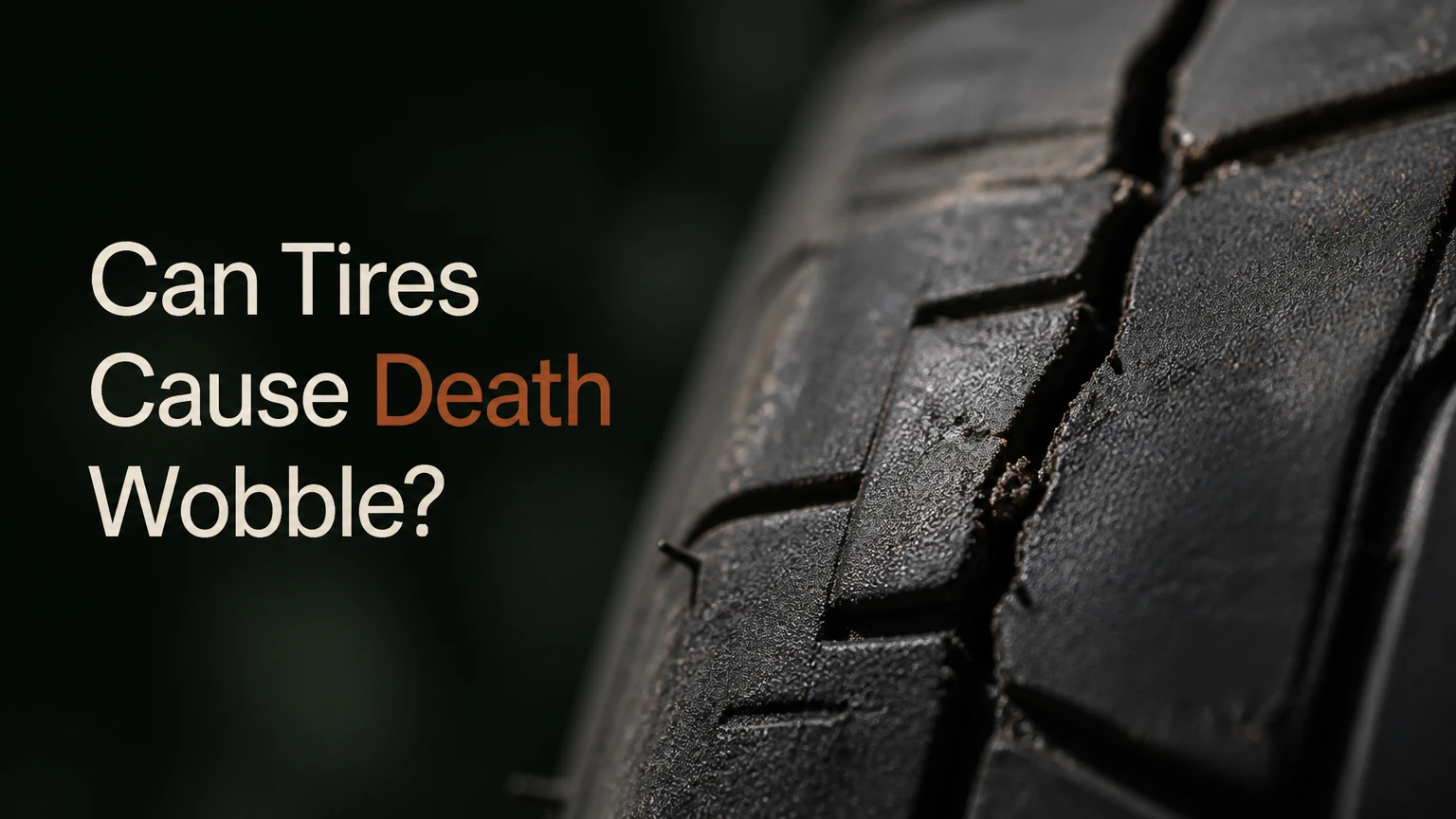
Yes, tires can trigger or intensify death wobble, but a tire is rarely the only underlying cause. An imbalance, radial force variation, bent wheel, uneven wear, or internal tire failure can initiate the shaking, while looseness in a track bar, ball joint, tie rod, drag link, or wheel bearing allows the oscillation to grow. Death wobble requires immediate diagnosis.
Key Facts at a Glance
- Death wobble is a violent side-to-side oscillation of a vehicle’s steering axle, most commonly on solid-front-axle vehicles.
- A damaged or imbalanced tire can provide the initial force, but worn steering or suspension parts usually determine whether the motion becomes uncontrollable.
- A normal spin balance does not always identify radial force variation, tire uniformity problems, or a bent wheel.
- A steering stabilizer reduces vibration through damping, but it cannot remove looseness, incorrect geometry, or a defective tire.
- Drivers should slow smoothly without abrupt steering or braking, then stop and arrange an inspection if death wobble occurs.
- Manufacturer runout and torque specifications take priority over generic limits because axle, wheel, and tire designs differ.
What Does Death Wobble Actually Mean?
Death wobble is a rapidly repeating steering oscillation in which the front wheels move alternately left and right after a bump, seam, pothole, or other disturbance. The driver may feel violent steering-wheel movement, shaking through the body, and repeated impacts from the front axle until the vehicle slows substantially.
The term most accurately describes a solid-axle steering system, such as a Jeep Wrangler, Jeep Gladiator, Ford Super Duty, Ram 2500, or similar truck. A front-wheel-drive car with independent suspension can suffer severe wheel shake, shimmy, or tramlining, but those symptoms are not automatically death wobble.
The speed threshold is not fixed. Many reports occur above roughly 40-50 mph because tire and suspension forces increase with speed, but an unsafe oscillation can begin at lower speeds when a component has significant play. A bump often initiates the event; the bump is not necessarily the root cause.
How is tire shake different from death wobble?
Tire shake usually produces a steady vibration linked to road speed or wheel rotation. Death wobble normally begins after a disturbance and creates a self-reinforcing steering oscillation that can continue until speed falls or the vehicle stops.
| Symptom | Likely pattern | Common causes | Immediate concern |
|---|---|---|---|
| Steering-wheel vibration at 55-70 mph | Smooth, speed-related shake | Wheel imbalance, RFV, bent rim | Inspect soon |
| Steering pull during braking | Vehicle deviates under pedal pressure | Brake rotor variation, seized caliper, alignment | Inspect promptly |
| Repeated side-to-side front axle movement | Violent oscillation after bump | Track bar play, worn joints, tire or wheel trigger | Stop driving at speed |
| Thumping that changes each rotation | Rhythmic impact or hop | Tread separation, flat spot, carcass damage | Stop and inspect immediately |
| Cupped tire noise and vibration | Repeating hum with scalloped tread | Poor damping, alignment, imbalance | Replace or correct cause |
How Can Tires Trigger Death Wobble?
Tires trigger death wobble by injecting a periodic vertical or lateral force into steering geometry that has insufficient control or damping. A heavy spot, hard section, bent wheel, or separated belt can deflect the tire and wheel; looseness in the track bar or steering joints then permits the front axle to move repeatedly instead of returning cleanly to center.
A solid front axle links the two steering knuckles through steering linkage and suspension geometry. The track bar controls lateral axle movement, while ball joints, tie-rod ends, drag-link ends, wheel bearings, and control-arm bushings constrain rotation and alignment. No single component “absorbs” all vibration, but excessive clearance lets a small disturbance become a large oscillation.
The process is better understood as feedback than as a simple tire-to-tire transfer. Tire force moves the wheel, loose joints change the wheel angle, altered tire angle generates another lateral force, and the cycle repeats. A healthy system can experience a tire disturbance without producing violent wobble.
Which tire defects can initiate the problem?
Several tire and wheel conditions can create the trigger, although they do not prove that the tire is the root cause.
| Tire or wheel condition | Typical symptom | Useful confirmation | Corrective action |
|---|---|---|---|
| Dynamic imbalance | Vibration that rises with speed | Balance measurement and weight inspection | Rebalance or replace tire |
| Radial force variation | Hop or shake under load | Road-force balancer reading | Match-mount or replace tire |
| Lateral runout | Steering pull or rhythmic side movement | Dial indicator measurement | Correct wheel, bead, or tire |
| Cupping or feathering | Repeating vibration and tire noise | Tread inspection by hand and sight | Correct suspension cause and replace if severe |
| Tread or belt separation | Bulge, thump, wobble, or sudden instability | Internal inspection and carcass examination | Replace tire immediately |
| Flat spotting | Temporary shake after parking or storage | Vibration that decreases as tire warms | Replace if permanent |
| Incorrect pressure | Wandering, harsh response, or uneven loading | Cold-pressure gauge and TPMS comparison | Set pressure to placard specification |
A missing wheel weight can explain a new vibration, but replacing the weight does not establish that the front end is safe. A tire may pass a basic balance test while a worn track-bar bushing remains the factor that allows the oscillation.
Which Suspension Components Must Be Inspected?
The track bar deserves priority on a solid-axle vehicle because its bushings and mounting bolts control lateral axle position. A loose track-bar bolt, oval mounting hole, cracked bushing, or bent bar can permit axle movement that changes steering geometry during a bump.
Ball joints, tie-rod ends, drag-link ends, wheel bearings, control-arm bushings, and steering-box mounts also require inspection. The exact weak point differs by vehicle, mileage, lift height, wheel offset, and previous repairs.
| Component | Failure indication | Inspection method | Why it matters |
|---|---|---|---|
| Track bar and mounts | Axle shifts or joint pops | Assistant turns steering while observer watches | Controls lateral axle location |
| Upper and lower ball joints | Knuckle movement or clunk | Proper lifted-wheel play test | Controls steering knuckle pivot |
| Tie rod and drag link | Joint movement or steering delay | Observe each stud and socket under load | Transfers steering input |
| Unit bearing or wheel bearing | Hub play, growl, rough rotation | Manufacturer-approved hub test | Allows wheel angle and runout changes |
| Control-arm bushings | Cracks, displacement, wandering | Visual and pry-bar inspection | Controls axle fore-aft movement |
| Steering-box mounts | Box shifts on frame | Watch mounting points during steering input | Converts input into unwanted motion |
| Shock absorbers | Oil leakage, weak damping, tire cupping | Visual inspection and bounce response | Poor damping promotes uneven wear |
The dry steering test can reveal movement, but it is not a complete diagnosis. With the vehicle on the ground, an assistant turns the steering wheel through a small range while a technician watches each joint, bar, bracket, and mounting point for movement that occurs before the wheel responds.
Never place hands near pinch points during the test. A technician should use the vehicle’s service procedure for lifting and supporting the axle.
Can Tires Cause Death Wobble Without Worn Suspension Parts?
A tire can create severe vibration without worn suspension components, but a true sustained death-wobble event is less likely when every steering and suspension joint is tight and correctly torqued. A defective tire can still create a dangerous loss of control, especially if it has belt separation, a sidewall bulge, or major runout.
This distinction matters because tire replacement may stop the symptom while leaving a marginal track bar or ball joint undiscovered. Conversely, replacing suspension parts will not correct a tire with structural damage. Diagnosis must evaluate both systems.
Can tire pressure cause death wobble?
Incorrect tire pressure can aggravate steering instability and uneven wear, but pressure alone is not a typical standalone cause of true death wobble. Underinflation increases sidewall flex and heat, while overinflation reduces the tire’s contact patch and can make steering reactions sharper.
Check pressure when tires are cold and use the vehicle placard inside the driver’s door, not the maximum pressure molded into the sidewall. On modified vehicles with non-original tire sizes, a tire professional should confirm a suitable pressure using load requirements, tire construction, and wear patterns.
How Do You Diagnose a Tire-Related Trigger?
A reliable diagnosis starts with safety and proceeds from visible evidence to measured tire and wheel conditions, then to steering and suspension play. The most useful sequence is inspection, controlled play testing, wheel and tire measurement, and a carefully documented road test performed only after the vehicle passes its safety checks.
A practical diagnostic sequence
- Stop driving if the event was violent. Do not reproduce death wobble intentionally on a public road. Arrange a tow if the steering remains loose, a tire has a bulge, or the vehicle cannot be controlled confidently.
- Inspect all four tires and wheels. Look for missing weights, exposed cords, bulges, tread blocks with scalloping, sidewall cuts, mud packed inside a wheel, and a bead that does not sit evenly.
- Check cold tire pressure. Record each reading and compare it with the door-placard value. A TPMS warning confirms pressure loss but does not identify imbalance, runout, or structural damage.
- Inspect steering and suspension movement. Use a dry steering test and appropriate wheel-play tests. Watch the track bar mounts first on a solid axle, then examine ball joints, tie-rod ends, drag-link ends, bearings, and steering-box mounts.
- Measure wheel and tire runout. A dial indicator can identify radial or lateral variation, but the service manual’s limit controls. A generic 0.050-inch to 0.060-inch threshold is a screening figure, not a universal replacement rule.
- Request road-force balancing. Road-force equipment presses a roller against the loaded tire and measures uniformity as well as imbalance. Ask for the force reading, wheel runout result, and whether match-mounting was attempted.
- Rotate only as a controlled diagnostic. Moving front tires to the rear may change a front steering vibration, but it is unsafe if a tire has structural damage and does not prove the suspension is healthy.
- Road-test after repairs. A technician should verify that the original trigger is gone, steering remains centered, and no new vibration appears across the reported speed range.
Which tire test identifies which fault?
| Test | Typical shop time | Detects well | Does not prove |
|---|---|---|---|
| Standard spin balance | 30-45 minutes for four wheels | Imbalance and missing weight | Structural uniformity under load |
| Road-force balance | 60-90 minutes for four wheels | RFV, match-mount need, loaded variation | Loose track bar or ball joint |
| Dial indicator check | 30-60 minutes | Rim and tire radial or lateral runout | Internal belt condition by itself |
| Front-to-rear rotation | 20-40 minutes | Whether symptom location changes | Safe operation with damaged tire |
| Dry steering inspection | 20-45 minutes | Visible joint and bracket movement | Every load-dependent failure |
| Alignment measurement | 30-90 minutes | Toe, camber, caster readings | Tire imbalance or loose joints |
Does Wheel Alignment Fix Death Wobble?
Wheel alignment can correct toe, caster, camber, and thrust-angle problems, but alignment alone rarely repairs true death wobble when a tire, wheel, or steering component is loose or damaged. Alignment should follow mechanical repairs because worn joints can make alignment readings unstable.
Lifted solid-axle vehicles often need particular attention to caster, toe, track-bar length, and axle centering. A lift can alter geometry, but aftermarket parts are not automatically the solution. A technician should measure actual angles and inspect mounting strength before installing adjustable components.
Tire wear can also be the consequence rather than the cause. Feathering and cupping may result from incorrect toe, weak dampers, loose joints, or poor rotation intervals, so replacing worn tires without correcting the wear mechanism can recreate the vibration.
What Repairs Actually Work?
The correct repair matches the confirmed fault: balance or replace a defective tire, straighten or replace a damaged wheel, repair loose steering hardware, replace worn joints or bushings, and align the vehicle afterward. A steering stabilizer may reduce residual kickback, but it should never be the primary repair for death wobble.
| Confirmed fault | Appropriate repair | Typical parts and labor cost | Typical time |
|---|---|---|---|
| Wheel imbalance | Standard balance | $40-$80 per set of four | 30-45 minutes |
| High RFV tire | Match-mount or replace tire | $80-$250, excluding premium tire | 1-2 hours |
| Bent steel or alloy wheel | Straighten if approved, otherwise replace | $100-$500 per wheel | 1-3 hours |
| Worn track-bar joint or bushing | Replace component and torque hardware | $150-$600 | 1-3 hours |
| Ball-joint wear | Replace affected joints, then align | $500-$1,500 | 3-8 hours |
| Damaged tie rod or drag link | Replace part and align | $250-$900 | 2-5 hours |
| Four replacement tires | Install, balance, and align as needed | $700-$1,900 | 1.5-3 hours |
These are typical United States repair ranges, not guaranteed quotes. Labor rates, tire size, corrosion, aftermarket suspension parts, and vehicle access can change the final price substantially.
Can a steering stabilizer fix the problem?
A steering stabilizer can damp steering kickback and reduce small vibrations, but it cannot tighten a loose joint, restore a separated tire, correct axle geometry, or repair a bent wheel. Installing a heavier stabilizer before finding the fault can make the vehicle feel improved while the unsafe movement continues.
The same limitation applies to dual stabilizers. They may suit a vehicle with large tires and high steering loads after the front end is mechanically sound, but additional damping is not a substitute for correct track-bar torque, sound bushings, and proper alignment.
Are balancing beads a reliable solution?
Internal balancing beads can reduce dynamic imbalance in some large off-road tire applications, but they do not correct radial runout, lateral runout, a bent wheel, belt separation, or loose steering parts. Moisture contamination, incorrect bead quantity, and tire pressure changes can also affect their performance.
Road-force balancing is generally the better first diagnostic choice because it produces a measurable tire-and-wheel assembly result. Beads are a maintenance preference for some off-road users, not a safety repair for an unexplained wobble.
What Should You Do Immediately During Death Wobble?
During death wobble, hold the steering wheel firmly, release the accelerator smoothly, avoid abrupt braking or steering input, and allow the vehicle to slow while keeping it pointed in a safe direction. Once stopped, inspect the tires only from a safe position and arrange professional assistance if the cause is not obvious.
Do not accelerate to “drive through” the oscillation. Do not repeatedly brake hard while the front axle is shaking, and do not continue at highway speed because the event stopped once speed fell.
The United States National Highway Traffic Safety Administration advises drivers to inspect tires for damage and maintain recommended inflation, but a tire inspection cannot replace a mechanical examination after a violent steering event. A roadside tire change is appropriate only when the vehicle is stable, traffic conditions are safe, and the damaged tire is clearly identified.
How Can You Prevent a Recurrence?
Prevent recurrence by maintaining cold pressure, rotating tires according to the tire and vehicle manufacturer’s schedules, checking wheel torque after wheel installation, and inspecting solid-axle steering hardware during routine service. Modified vehicles require shorter inspection intervals because larger tires and altered offsets increase loads on bearings, ball joints, and track-bar mounts.
Use the correct load range and speed rating for the vehicle. Check the DOT tire identification date and replace tires that are aged, damaged, or worn to the manufacturer’s limit, even when tread depth appears acceptable.
A practical maintenance schedule for a typical daily-driven truck includes pressure checks at least monthly, rotation around every 5,000-8,000 miles when the manufacturer does not specify otherwise, and a steering inspection whenever cupping, wandering, clunks, or a new vibration appears.
What changes on lifted or oversized-tire vehicles?
Lifted vehicles and vehicles with 33-inch, 35-inch, or larger tires can develop steering instability more readily because tire mass, leverage, wheel offset, and altered suspension angles increase stress. A lift does not automatically cause death wobble, but an incorrect track-bar angle, poor caster, weak mounting bracket, or worn factory joint can reduce stability margins.
| Vehicle setup | Main risk factor | Recommended priority | Typical inspection interval |
|---|---|---|---|
| Stock SUV with original-size tires | Normal wear and imbalance | Factory pressure, rotation, joint inspection | 5,000-8,000 miles |
| Lifted Jeep with 33-35-inch tires | Geometry and added tire mass | Caster, toe, track bar, road-force balance | Every service visit |
| Heavy-duty truck with 35-inch tires | Wheel offset and bearing load | Hub play, lug torque, tire uniformity | Every 3,000-5,000 miles |
| Rock crawler with 37-inch-plus tires | High impact and joint loading | Mounts, steering linkage, bead seating | After major trail use |
| Vehicle with beadlock wheels | Installation and balance variation | Bead torque, ring seating, runout | After tire service |
Aftermarket steering stabilizers and heavy-duty track bars can be useful only when their design matches the vehicle and the underlying geometry is correct. A stronger component installed on a cracked or poorly reinforced mount can transfer stress into the bracket instead of solving the failure.
When Should You Replace the Tire Rather Than Balance It?
Replace a tire when it has a bulge, exposed cord, visible belt separation, persistent high radial-force variation, severe irregular wear, bead damage, or a vibration that remains after correct mounting and balancing. A tire with internal structural damage cannot be made safe by adding wheel weights.
A tire professional may be able to match-mount a tire by rotating its low spot against the wheel’s high spot. That procedure can reduce assembly variation, but it cannot repair a carcass defect. If a shop recommends replacement, request the measured reason, such as visible separation, excessive uniformity force, or irreparable runout.
The Bottom Line
Can tires cause death wobble? Tires can initiate the event, especially when they are badly imbalanced, structurally damaged, unevenly worn, or mounted on a bent wheel. A sustained death-wobble problem usually indicates a second fault in the track bar, ball joints, steering linkage, bearings, bushings, mounts, or alignment geometry.
Treat the tire as a possible trigger and the front end as a complete system. Stop driving at speed after a violent event, inspect for tire damage, test for mechanical play, and use measured wheel, tire, and alignment checks before replacing parts at random.
Frequently Asked Questions
Can new tires cause death wobble?
New tires can trigger wobble if one has high radial force variation, is incorrectly seated, is damaged during installation, or is mounted on a bent wheel. New tires can also expose existing suspension looseness because their tread and sidewall characteristics differ from the previous set. Request wheel torque verification and road-force measurements if symptoms begin immediately after installation.
Can low tire pressure cause a steering-wheel wobble?
Low pressure can increase sidewall flex, heat, wandering, and irregular wear, but low pressure alone is not the usual root cause of true death wobble. Check all tires cold against the door-placard specification. If pressure is correct and the steering still oscillates after a bump, inspect the tire, wheel, and front suspension.
Is death wobble more common on Jeeps?
Death wobble is commonly reported on Jeep Wrangler and Gladiator models because they use solid front axles and exposed steering and suspension geometry. The same mechanism can affect solid-axle Ford, Ram, Chevrolet, and aftermarket off-road vehicles. Vehicle brand does not identify the failed part, so inspection remains necessary.
Can a bad wheel bearing cause death wobble?
A worn wheel bearing can contribute to steering instability by allowing hub movement, changing wheel alignment, and increasing runout. Wheel-bearing noise, looseness, rough rotation, or visible hub play strengthens that diagnosis. Bearing tests vary by vehicle, so use the manufacturer’s procedure rather than treating any generic play measurement as definitive.
How long can you drive with death wobble?
You should not continue normal driving with unresolved death wobble, particularly at highway speed. A violent oscillation can return after the next bump and may worsen as a loose joint, tire defect, or mounting failure deteriorates. Have the vehicle inspected where it stopped, or tow it to a qualified repair facility.