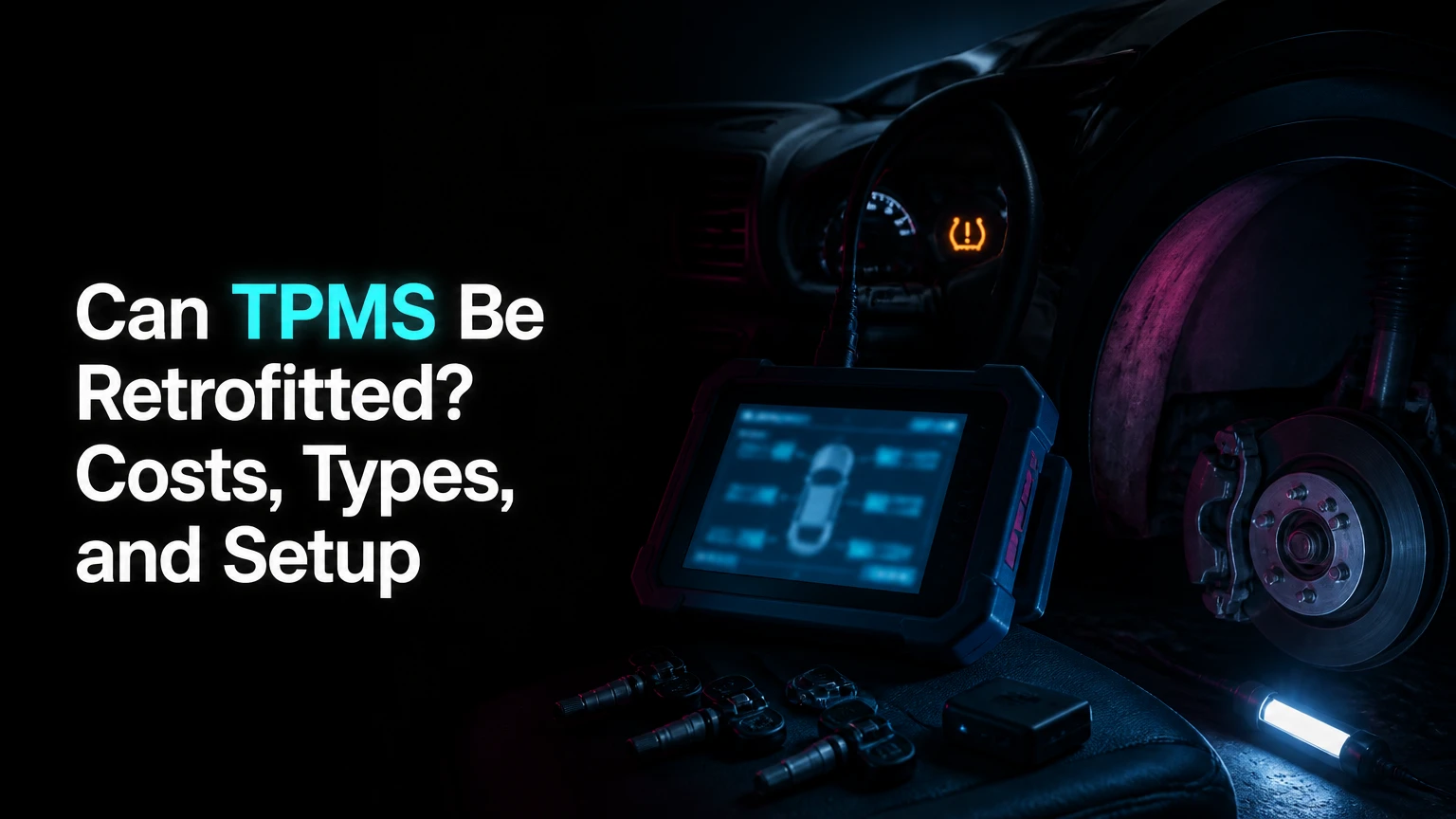
Yes, a Tire Pressure Monitoring System (TPMS) can be retrofitted to nearly any car, van, RV, trailer, or light truck that lacks factory TPMS. The practical choice is usually an external valve-cap kit for quick installation or an internal valve-stem kit for better protection. Most retrofits use their own display or phone app rather than the vehicle’s original warning light.
Key facts at a glance
An aftermarket TPMS measures tire pressure at the wheel and transmits readings to a dedicated display or smartphone.
External valve-cap sensors typically cost $30-$80 and can be fitted without removing the tire.
Internal sensors typically cost $60-$150 for hardware, plus about $60-$100 for professional mounting and balancing.
A retrofit may not communicate with the vehicle’s original body control module or dashboard TPMS lamp.
Passenger-car kits commonly support 0-80 psi; RV and commercial kits may support pressures up to 200 psi.
TPMS supplements a calibrated tire-pressure gauge and does not replace checking the manufacturer’s cold inflation specification.
Can TPMS Be Retrofitted to Any Vehicle?
A standalone aftermarket TPMS can be fitted to almost any vehicle with pneumatic tires, provided the sensor pressure range, valve-stem design, signal distance, and display are compatible. Factory-style integration is much less universal because the vehicle may lack the TPMS receiver, software configuration, antenna wiring, and dashboard programming needed to operate an original warning lamp.
The distinction matters. A universal retrofit can show live pressure and temperature independently, while an OEM retrofit may require compatible wheels, a receiver module, wiring, diagnostic coding, and manufacturer-specific sensor IDs. A specialist can sometimes add those components, but the cost can exceed the value of an older vehicle.
NHTSA describes the safety purpose plainly: “TPMS is designed to warn you when your tire pressure is low.” An aftermarket system can provide that warning even when a vehicle was never equipped with factory TPMS, but the alert appears on the supplied screen or app unless the vehicle electronics are separately integrated.
What vehicles are good retrofit candidates?
Passenger cars, classic cars, imported vehicles, older vans, caravans, motorhomes, utility trailers, and vehicles with multiple wheel sets are all common retrofit candidates. The wheel does not need a factory TPMS pocket when using external sensors, which makes that design suitable for temporary or seasonal use.
Before buying, record the following:
- Recommended cold tire pressure from the driver-door placard or owner’s manual
- Maximum tire pressure printed on the tire sidewall
- Number of tires requiring monitoring
- Valve-stem material and thread condition
- Expected pressure range, especially for loaded RVs and trailers
- Distance between the farthest wheel and the display
- Whether the kit supports a spare, twin wheels, or additional axles
A TPMS kit rated for 0-80 psi is unsuitable for a trailer tire that requires 110 psi. The sensor may display an incorrect value, fail to report, or become damaged when operated beyond its specification.
How Does Aftermarket TPMS Work?
Aftermarket TPMS sensors measure pressure, and many also measure air temperature, inside or at the valve of each tire. A radio-frequency sensor commonly transmits near 315 MHz or 433 MHz, while Bluetooth models send data to a compatible receiver or smartphone application; the display then compares readings with programmed alarm thresholds.
Direct systems measure actual pressure. That differs from indirect factory systems, which infer a pressure change from wheel-speed differences through the anti-lock braking system. An indirect system cannot normally be retrofitted with sensors because it depends on compatible ABS software and vehicle calibration.
A typical monitoring cycle includes:
- The pressure transducer samples internal air pressure.
- A microcontroller attaches a sensor ID and tire position.
- The sensor transmits a packet at intervals or after detecting movement.
- The receiver validates the signal and converts kPa, bar, or psi.
- The display shows pressure, temperature, battery status, and an alarm state.
Many kits do not transmit continuously while parked. They wake when vibration or acceleration indicates movement, which saves battery power but means a parked tire may not update immediately. A system that reports every 30 seconds gives faster warning than one that reports every five minutes, although frequent transmission usually reduces battery life.
Does a retrofit TPMS use the factory warning light?
Usually, no. Most universal retrofit systems have a separate dash display, 12-volt receiver, solar panel, or smartphone app, and they cannot control the original TPMS warning lamp without vehicle-specific hardware and coding.
An OEM-style conversion may use programmable sensors and a compatible receiver, but compatibility depends on make, model, year, market, wheel configuration, and diagnostic software. A parts catalog listing a sensor as “programmable” does not prove that the vehicle has the receiver or software required for a complete retrofit.
Which Retrofit TPMS Type Is Best?
External valve-cap sensors are best for low cost, quick installation, and vehicles that change wheels frequently. Internal valve-stem sensors are usually better for long-term use, theft resistance, weather protection, and a clean appearance, but tire removal and balancing make them a shop installation.
| Criterion | External valve-cap | Internal valve-stem | Best fit |
|---|---|---|---|
| Hardware cost for 4 wheels | $30-$80 | $60-$150 | External for budget |
| Typical fitting time | 5-10 minutes | 45-90 minutes | External for immediate use |
| Battery service | CR1632 or similar, 1-2 years typical | Sealed battery, 5-7 years typical | Internal for less frequent service |
| Exposure to theft and debris | High, sensor remains outside | Low, sensor sits inside rim | Internal for daily driving |
| Tire removal required | No | Yes | External for temporary wheels |
| Typical pressure range | 0-80 psi | 0-80 psi, model-dependent | Match the tire specification |
| Trailer and RV expansion | 4-6 sensors commonly | 4-12 or more, model-dependent | Dedicated RV kit |
| Air filling convenience | Sensor often must be removed | Valve remains conventional | Internal for frequent inflation |
Are external TPMS sensors reliable?
External sensors can be reliable when the valve stem is sound, the sensor is correctly sealed, and the locknut is tightened without damaging the stem. Their main weaknesses are physical exposure, theft, contamination, and the need to remove or use flow-through sensors during inflation.
Use a sensor with a replaceable battery when the vehicle is accessible and the owner accepts periodic checks. Inspect the valve stem before fitting because an old rubber stem may flex under the added mass of the sensor. A brass sensor cap on an aluminum valve stem can also corrode and seize through galvanic corrosion.
Are internal TPMS sensors more accurate?
Internal sensors are not automatically more accurate, because accuracy depends on the transducer, calibration, temperature compensation, and display resolution. Their main measurement advantage is that they read the tire cavity directly and avoid some external exposure, while their principal service disadvantage is tire removal when the sealed battery expires.
Internal units normally attach to a metal or reinforced valve stem. The tire shop must protect the bead, tighten the retaining hardware to the sensor manufacturer’s specification, inflate the tire, and rebalance the wheel. A sensor adding 10-40 grams to one rim location can create a vibration if balancing is skipped.
Which Display and Signal Setup Should You Choose?
A dedicated 12-volt or solar display is the simplest option for most cars, while a Bluetooth app suits drivers who accept phone dependence. RVs, trailers, and long wheelbases often need a repeater because the sensor-to-receiver path can pass through steel, bodywork, cargo, and multiple axles.
| Display option | Power source | Typical use | Main limitation |
|---|---|---|---|
| 12-volt plug display | Accessory socket, 12 V | Daily commuter | Occupies a power outlet |
| Solar dash display | Integrated solar cell and battery | Parked cars and caravans | Needs light and periodic charging |
| Bluetooth phone app | Coin cells plus smartphone | Minimal dash hardware | Phone permissions and battery matter |
| Android head-unit receiver | USB power and head unit | Aftermarket stereos | Compatibility varies by app and receiver |
| Dedicated RV monitor | Internal rechargeable battery or 12 V | 6-24 tire systems | Higher price and more setup |
A radio repeater is useful when the farthest sensor repeatedly drops out, not as a cure for an incompatible sensor. Mount the repeater according to the kit instructions, usually near the vehicle’s center or toward the trailer connection, and test every wheel before travel.
What pressure and temperature range should a kit support?
Select a sensor whose rated pressure exceeds the tire’s maximum operating requirement by a practical margin. For example, a tire inflated to 80 psi should not use a sensor rated only to 80 psi if the vehicle routinely operates near that limit; an RV owner may need a 100, 150, or 200 psi model.
| Vehicle application | Typical cold pressure | Suitable sensor specification | Recommended alarm setup |
|---|---|---|---|
| Small passenger car | 30-36 psi | 0-80 psi | Use door-placard pressure as baseline |
| SUV or light van | 35-60 psi | 0-100 psi | Set limits for axle load |
| Caravan or motorhome | 45-90 psi | 0-150 psi | Include temperature and repeater support |
| Heavy trailer | 80-110 psi | 0-150 or 0-200 psi | Use load-specific high-pressure sensors |
| Commercial light truck | 60-100 psi | 0-200 psi | Confirm fleet or tire-maker limits |
Pressure changes with temperature. A common workshop rule is approximately 1 psi for each 10°F change in air temperature, although the exact result varies with tire construction, starting temperature, sun exposure, and driving heat. Set cold-pressure thresholds from the manufacturer’s specification, not from a warm reading after highway travel.
How Much Does TPMS Retrofit Installation Cost?
A basic four-wheel external TPMS retrofit typically costs $30-$80 and takes 5-10 minutes, while an internal installation commonly totals $120-$250 when $60-$150 of hardware is combined with $60-$100 for mounting and balancing. RV, trailer, repeater, and eight-wheel systems can cost substantially more.
| Retrofit scenario | Hardware range | Labor range | Typical total | Time |
|---|---|---|---|---|
| Four external car sensors | $30-$80 | $0 DIY | $30-$80 | 5-10 minutes |
| Four internal car sensors | $60-$150 | $60-$100 | $120-$250 | 45-90 minutes |
| Six-tire RV system | $100-$250 | $0-$100 | $100-$350 | 15-90 minutes |
| Eight-tire truck or trailer system | $180-$450 | $0-$150 | $180-$600 | 20-120 minutes |
| OEM-style integration | $250-$1,000+ | $100-$500+ | $350-$1,500+ | 2-8 hours |
Prices are typical retail and workshop ranges, not fixed quotes. Additional costs can include new rubber valve stems, metal stems, replacement valve cores, tire disposal, wheel balancing, a signal repeater, sensor programming, or a second sensor set for winter wheels.
The cheapest system is not always the lowest-cost ownership choice. Four external sensors may require replacement batteries and periodic valve checks, whereas internal sensors save exterior handling but create a labor event when their sealed batteries fail.
How Do You Install a Retrofit TPMS?
External TPMS installation is a short DIY procedure, but internal TPMS installation requires a tire changer, correct valve hardware, torque control, and wheel balancing. The factor that most determines success is sensor compatibility with the tire pressure, valve stem, wheel layout, and receiver before installation begins.
Before you start
| Requirement | Typical value |
|---|---|
| External installation time | 5-10 minutes |
| Internal installation time | 45-90 minutes |
| DIY difficulty | Low for external, high for internal |
| Basic tools | Tire gauge, valve-core tool, soapy water, sensor wrench |
| Extra materials | 4 CR1632 batteries if the kit uses them |
| Prerequisite | Correct pressure range and valve-thread fit |
| Calibration reference | Door placard or owner’s manual cold pressure |
Step 1: Record the correct cold pressures
Read the driver-door placard or owner’s manual and write down the front and rear cold-pressure values. Do not use the maximum pressure molded into the tire sidewall as the normal target unless the vehicle manufacturer specifies it.
You will know this step is complete when the axle-specific pressures are recorded. A common mistake is programming identical limits when the vehicle uses different front and rear pressures.
Step 2: Pair and label the sensors
Turn on the display or open the app, then assign each sensor to front-left, front-right, rear-left, or rear-right. Follow the kit’s pairing sequence because some systems learn positions automatically while others require manual ID entry.
The display should show each sensor ID and position before the sensors are exposed to road conditions. A swapped left-right assignment can produce a correct pressure value beside the wrong tire location.
Step 3: Fit external sensors
Remove the original valve caps, inspect the threads, and install any supplied sealing washer or anti-theft nut. Screw each sensor onto the clean valve stem by hand, then tighten the locknut with the supplied wrench without overtightening.
Apply a small amount of soapy water around the valve core and sensor connection. No growing bubbles should appear after 30-60 seconds. A common mistake is using a damaged valve core and blaming the sensor for the leak.
Step 4: Install internal sensors professionally
A technician must deflate the tire, break the bead, remove or replace the valve stem, attach the sensor, reseat the bead, inflate the tire, and balance the wheel. The technician should use the sensor maker’s torque specification, because a generic value such as 4 Nm is not universal.
You will know the installation is complete when the tire holds pressure, the valve area is leak-free, and the balanced wheel produces no new vibration. Never attempt bead breaking with improvised tools, since an uncontrolled bead can damage the tire or injure the operator.
Step 5: Drive and verify every reading
Drive for 1-2 minutes on a safe route if the kit requires motion to wake the sensors. Compare the displayed pressure with a calibrated handheld gauge at the same temperature and confirm every position.
The system passes its initial test when all sensor IDs appear, pressure readings are plausible, temperature readings update, and the alarm activates during a controlled threshold test if the manufacturer permits that test. Do not deliberately deflate a road tire below a safe level.
What Problems Occur After Retrofit Installation?
Most retrofit TPMS problems come from wrong sensor specifications, incorrect position mapping, valve leaks, weak batteries, radio obstruction, or alarm thresholds copied from another vehicle. A visible warning is useful only when the sensor has been tested against a trustworthy gauge and the tire’s actual load requirement.
| Symptom | Likely cause | Verification | Corrective action |
|---|---|---|---|
| No reading from one wheel | Dead battery or wrong pairing | Swap sensor position in the app | Replace battery or relearn sensor |
| All readings disappear | Receiver power or signal fault | Check 12 V supply and antenna | Restore power or reposition receiver |
| Slow leak after fitting | Damaged valve core or seal | Soapy-water test | Replace core, washer, or stem |
| False low-pressure alarm | Cold-weather pressure drop | Compare cold gauge reading | Inflate to placard pressure |
| Wrong wheel location | Manual ID error | Inspect programmed sensor map | Relearn the correct position |
| Vibration after internal fitting | Wheel imbalance | Road-speed vibration and balance check | Rebalance the wheel |
| Sensor will not screw on | Damaged or incompatible thread | Inspect valve stem and cap | Use the supplied compatible hardware |
Why does TPMS show a low pressure warning in cold weather?
Cold air reduces tire pressure, so a tire near its lower threshold can trigger an alarm after an overnight temperature drop. Measure the tire cold, inflate it to the vehicle placard value, and avoid resetting the alarm to a dangerously low pressure merely to stop the warning.
A warm tire will often read higher after driving because the air and tire carcass heat up. Adjust pressure when the tires are cold, ideally after the vehicle has been stationary for at least three hours or has driven less than one mile at low speed.
Can external TPMS sensors cause a leak?
External sensors can contribute to a leak when the valve core, sealing washer, valve stem, or sensor thread is damaged. The sensor itself does not normally release tire air when correctly installed, but repeated removal can wear seals and dirt can prevent a proper seat.
Remove the sensor and refit the original valve cap if the leak is rapid. Confirm the valve core with soapy water, then replace the core or valve stem rather than continuing to tighten the sensor, since excessive force can damage the stem.
What Are the Important Edge Cases?
Retrofit TPMS needs special planning for winter wheels, spare tires, dual wheels, trailers, and vehicles that store wheels away from the receiver. A four-sensor passenger-car kit may work perfectly on the main vehicle yet fail to monitor a spare or a connected trailer.
Winter wheel sets: Buy a second sensor set or move the sensors during seasonal changes. Internal sensors require tire work, while external sensors can be transferred after checking battery condition and valve compatibility.
Temporary spare tires: Many kits monitor only four positions. A punctured spare may therefore have no sensor, so check the spare manually before installation and verify whether the display supports a fifth tire.
Trailers: Choose a system designed for trailer axles, with the required pressure rating and a repeater if the drawbar-to-cab distance is long. Monitor trailer tires separately because the tow vehicle’s factory system, if present, cannot usually see them.
Dual wheels: Inner and outer valves may require angled extensions or specialized sensors. Confirm that the sensor body will clear neighboring sidewalls, valve extensions, brake components, and wheel covers.
Vehicle inspections: Rules differ by jurisdiction. A standalone accessory may not satisfy a legal requirement for factory-installed TPMS, and an illuminated factory warning lamp can still cause an inspection issue even when an aftermarket display works correctly.
What Can You Use Instead of TPMS?
A calibrated handheld pressure gauge is the essential low-cost alternative and remains necessary even when TPMS is installed. Indirect ABS-based monitoring is another option only when the vehicle already supports it through factory software; it is not a universal accessory conversion.
| Option | Live pressure value | Temperature value | Typical cost | Best use |
|---|---|---|---|---|
| Handheld gauge | No, manual reading | No | $10-$40 | Weekly cold checks |
| External TPMS | Yes | Often | $30-$80 | Budget retrofit |
| Internal TPMS | Yes | Often | $120-$250 installed | Permanent wheel setup |
| Indirect ABS monitoring | No direct psi | No | Vehicle-dependent | Existing factory system |
| Professional inspection | No continuous reading | No | $15-$40 visit | Leak or tire diagnosis |
A gauge cannot warn the driver while moving, while TPMS cannot identify every slow leak before its threshold is crossed. The strongest practice combines both: use TPMS for in-motion warning and a gauge for cold-pressure verification.
Which Retrofit Should You Choose?
Choose an external valve-cap system for a low-cost commuter retrofit, an internal system for permanent passenger-car use, and a dedicated high-pressure kit for an RV, trailer, or multi-axle vehicle. Choose OEM-style integration only after confirming that the vehicle supports the receiver, programming, and dashboard communication.
Daily commuter
An external four-sensor kit with a 12-volt or solar display usually provides the best proportion of cost, speed, and useful information. Select replaceable batteries, locking nuts, a display with visible low-pressure alerts, and a pressure range above the vehicle’s maximum tire requirement.
Classic car or vehicle without electronics
A standalone display avoids dependence on the vehicle’s body control module and diagnostic coding. Internal sensors offer a discreet permanent installation, while external caps are preferable when preserving original wheels and avoiding tire removal.
RV, caravan, or trailer owner
Use a dedicated system rated for the highest cold pressure, supporting the full number of tires, spare wheels if needed, and a repeater when the signal path is long. The display should show each tire independently and provide both pressure and temperature alarms.
Driver with winter wheels
External sensors are easier to move between wheel sets, but a second internal sensor set avoids seasonal removal. Program each sensor set before driving and store unused sensors with fresh batteries in a dry location.
Frequently Asked Questions
Can a retrofit TPMS be installed without removing the tires?
Yes, external valve-cap sensors install without tire removal and usually take 5-10 minutes for four wheels. Internal valve-stem sensors require the tire bead to be broken so the sensor can attach inside the rim. External systems suit temporary wheels, while internal systems suit permanent installations where theft and weather exposure matter.
Will aftermarket TPMS work with an iPhone or Android phone?
Some aftermarket TPMS kits transmit through Bluetooth to a dedicated iPhone or Android application, but compatibility depends on the receiver, operating system, app permissions, and sensor protocol. A Bluetooth kit may not work directly with a phone unless the manufacturer supplies the required gateway, so verify the complete package rather than buying sensors alone.
How often should retrofit TPMS readings be checked against a gauge?
Check each tire with a calibrated gauge at least monthly and before long trips, even when the retrofit display appears normal. Compare readings when the tires are cold, because driving heat changes pressure. Gauge comparison also reveals a sensor that has drifted, stopped updating, or developed a low battery.
Can TPMS detect a puncture immediately?
TPMS detects pressure loss only after the pressure falls enough for the sensor to transmit a changed value or cross its alarm threshold. A large puncture may trigger quickly, but a small nail leak can take hours or days. Inspect the tire after every warning and do not continue driving solely because the pressure remains above the alarm limit.
Do retrofit TPMS sensors need programming after a tire rotation?
The requirement depends on the kit. Automatic systems may identify positions from signal strength or movement, while manual systems require the owner to assign sensor IDs after rotation. Confirm the displayed wheel position with a pressure change performed safely at a service station, rather than assuming the original mapping remains correct.
Can TPMS monitor a trailer and tow vehicle together?
Yes, a multi-tire trailer TPMS can monitor both the tow vehicle and trailer when the system supports the required sensor count, pressure range, and signal distance. Use a repeater when the trailer sensors do not maintain a stable connection, and configure separate alarm thresholds when the vehicle and trailer use different cold pressures.
The Bottom Line
Can TPMS be retrofitted? Yes, a standalone direct TPMS retrofit is practical for almost any vehicle, and external sensors provide the fastest installation at roughly $30-$80. Internal sensors cost more and require tire-shop equipment, but they protect the sensor and create a cleaner permanent setup.
Choose by vehicle use rather than appearance alone. Match pressure range and sensor count first, confirm the display or app connection second, and treat factory dashboard integration as a separate compatibility project. A retrofit TPMS improves warning coverage, but a cold-pressure gauge check remains part of responsible tire maintenance.