Valvoline Instant Oil Change locations generally cannot patch or internally repair a tire because their fast-lube bays focus on oil, fluids, batteries, inspections, tire pressure, and selected maintenance services. A separate Valvoline Tire & Auto franchise may offer tire repair, but availability depends on the specific location, equipment, and inspection result.
Key Facts at a Glance
- Valvoline Instant Oil Change is usually not a tire-repair provider.
- A Valvoline location may check or adjust tire pressure, but inflation does not repair a puncture.
- Valvoline Tire & Auto is a separate full-service automotive network in some regions.
- A conventional puncture is commonly repairable only when it is no larger than 1/4 inch, lies in the repairable tread area, and has not damaged the inner liner.
- A proper repair requires removing the tire from the wheel for an internal inspection.
- A tire that lost air while being driven may require replacement even when the original puncture is small.
Can Valvoline Patch a Tire?
Valvoline Instant Oil Change locations generally do not patch tires, install internal plug-patch repairs, or dismount tires from wheels. The company’s standard fast-lube model is designed for rapid preventive maintenance, so a location normally lacks the tire changer, inspection equipment, and wheel balancer needed for a complete puncture repair.
A technician may still inspect the visible tire condition, measure or adjust inflation pressure, or recommend another provider. Those actions can stabilize a tire temporarily, but they do not seal a nail or screw channel. If the tire loses pressure again, treat the puncture as an active safety problem.
The name “Valvoline” creates a common source of confusion. Valvoline Tire & Auto locations are separate full-service automotive repair franchises that may provide tire repair and replacement services. The service menu is not interchangeable with Valvoline Instant Oil Change, so confirm the exact location before driving there.
What Can Valvoline Instant Oil Change Do?
Valvoline Instant Oil Change may provide tire-related maintenance such as pressure checks or inflation, and some locations offer tire rotation or other services according to local equipment and staffing. A tire rotation moves the existing wheel and tire assembly between vehicle positions; it does not remove the tire from the rim or repair a puncture.
| Service | Typical Instant Oil Change capability | Does it repair a puncture? | Important limitation |
|---|---|---|---|
| Tire pressure check | Commonly available | No | Finds low pressure, not the leak cause |
| Tire inflation | Commonly available | No | Air may escape again within minutes or hours |
| Tire rotation | Location dependent | No | Moves wheel assemblies without repairing rubber |
| Wheel removal | Not a standard fast-lube service | No | Required for many tire inspections |
| Tire dismounting | Usually unavailable | No | Requires a tire-changing machine |
| Internal plug-patch repair | Usually unavailable | Yes, when performed correctly | Requires tire inspection and repair equipment |
Call the location directly if the website lists a tire-related service. Ask whether the bay can remove the tire from the wheel and perform an internal puncture inspection. That question distinguishes a genuine repair capability from a simple inflation service.
How Does a Professional Tire Repair Work?
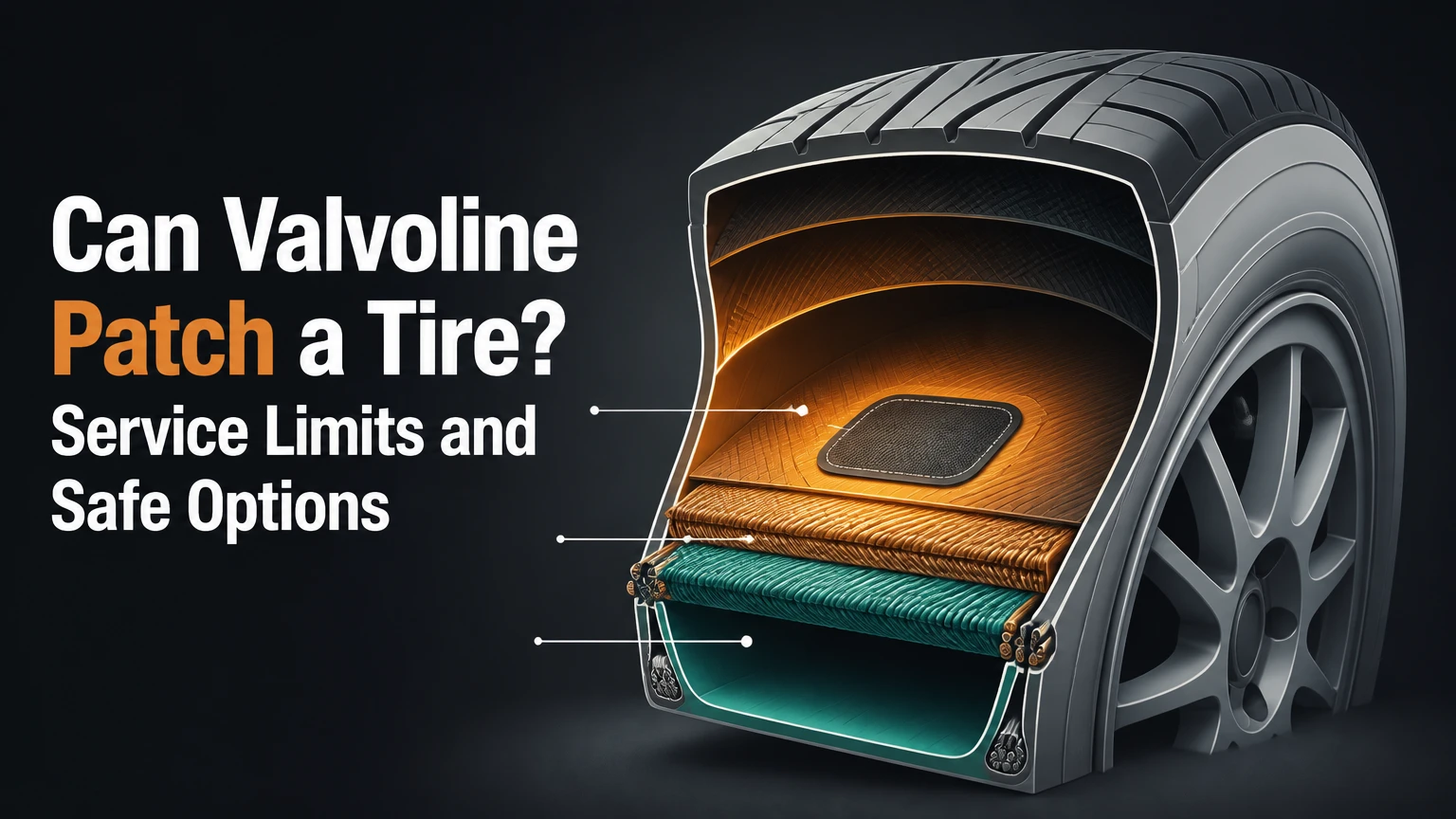
A professional puncture repair removes the tire, inspects the inside, prepares the injury, and installs a repair that seals both the puncture channel and the inner liner. The commonly preferred method for a repairable tubeless passenger-tire puncture is a one-piece plug-patch, sometimes called a combination repair unit.
The attached rubber stem fills the puncture path. The internal patch bonds to the inner liner and closes the air chamber. This design addresses two separate failure paths: air escaping through the channel and air migrating between tire layers.
The U.S. Tire Manufacturers Association states that tire repairs should be performed only after the tire is removed from the wheel for a complete internal inspection. That requirement matters because external inspection cannot reveal abrasion, wrinkling, or heat damage caused by driving underinflated.
The Standard Repair Sequence
- Locate the injury. The technician identifies the nail, screw, cut, or object and records its position and approximate size.
- Remove the tire. A tire-changing machine separates the bead from the wheel without damaging the bead area.
- Inspect the inner liner. The technician looks for abrasion, rubber dust, wrinkles, discoloration, and separation.
- Measure the puncture. A repairable passenger-tire injury is commonly limited to 1/4 inch, or 6 millimeters, in diameter.
- Prepare the channel. The technician cleans and prepares the injury using tools and materials specified by the repair-system manufacturer.
- Prepare the inner liner. The repair area is buffed and cleaned so the cement and patch can bond correctly.
- Install the plug-patch. The stem fills the channel while the patch bonds to the inner liner.
- Seal and remount. The repair receives the required finishing treatment, and the tire returns to the wheel.
- Inflate and test. The tire is inflated to the vehicle manufacturer’s cold-pressure specification, then checked for leaks.
- Rebalance when needed. Removing and reinstalling a tire can alter balance, so the wheel should be checked if vibration appears or the shop’s procedure requires it.
A proper repair is not the same as pushing a sticky cord into the tread from outside. An external string plug can provide emergency mobility, but it does not allow the technician to inspect hidden internal damage.
Which Tire Punctures Can Be Repaired?
A tire puncture is a candidate for repair when the injury is small, located in the central tread, and discovered before the tire has been driven significantly while underinflated. The final decision belongs to the inspecting technician and the tire manufacturer’s repair policy.
| Eligibility factor | Common repairable condition | Replacement warning | Why it matters |
|---|---|---|---|
| Injury diameter | 1/4 inch or less, about 6 mm | Larger than 1/4 inch | A large channel may weaken the casing |
| Injury location | Central tread | Shoulder or sidewall | Flexing prevents a durable structural repair |
| Inner liner | Smooth, intact rubber | Scuffing, wrinkles, crumbs, heat marks | Indicates possible run-flat damage |
| Tread depth | Above the replacement limit and evenly worn | At or below 2/32 inch | Limited tread leaves little safe service life |
| Repair history | No overlapping repair | Repairs too close or overlapping | The casing may have lost structural integrity |
| Tire construction | Standard tubeless passenger tire | Run-flat or specialty tire outside policy | Manufacturer rules can be stricter |
| Leak type | Single puncture channel | Bead, valve, rim, or multiple leaks | A patch cannot correct a wheel or valve fault |
The 2/32-inch figure is a widely used legal and industry replacement threshold for worn passenger tires in the United States, but it is not a universal promise that every tire above that depth should be repaired. Age, uneven wear, cracking, load rating, speed rating, and manufacturer instructions also affect the decision.
Why Are Sidewall and Shoulder Injuries Rejected?
Sidewall and shoulder punctures are normally not repairable because those areas flex repeatedly during steering, braking, cornering, and load changes. A patch that appears airtight while stationary can lose adhesion or fail structurally after repeated flexing.
A nail near the outer tread may look repairable from above but fall inside the shop’s prohibited shoulder zone. The exact boundary varies by tire design and repair policy, so a technician should measure the injury rather than rely on visual judgment.
Is a Plug or Patch Better?
A professional plug-patch is generally the safest repair option for an eligible puncture because it seals the internal liner and fills the puncture channel. A string plug, adhesive patch applied without dismounting, or liquid sealant may help in an emergency, but those methods do not provide the same inspection or repair coverage.
| Method | Installation position | Typical role | Main limitation | Typical cost |
|---|---|---|---|---|
| Plug-patch combination | Tire removed from wheel | Professional permanent repair | Requires suitable location and intact casing | $20-$45 |
| Internal patch only | Inside of tire | Limited repair-system application | May not fill the puncture channel adequately | $20-$45 |
| String plug | Inserted from outside | Temporary roadside mobility | No internal inspection; possible slow leak | $5-$15 kit |
| Aerosol sealant | Injected through valve | Emergency leak reduction | Mess, TPMS concerns, limited distance | $8-$20 |
| Tire replacement | New tire installed | Unrepairable or unsafe damage | Higher cost and possible matching issue | $100-$400+ |
The term “patch” is used loosely in everyday conversation. A shop may say it patches a tire while actually installing a combination repair unit. Ask whether the tire will be removed and whether the repair seals the puncture channel from the inside.
Is a String Plug Safe for Highway Driving?
A string plug should not be treated as the final repair for routine highway use. It can restore enough pressure to reach a repair facility when installed correctly in a suitable tread puncture, but it leaves unresolved questions about inner-liner damage, puncture angle, and contamination.
Long-distance driving increases heat and cyclic loading. If the plug leaks or shifts, pressure can fall quickly. Check the tire pressure immediately after installation and obtain an internal inspection as soon as possible.
Does Tire Sealant Damage TPMS?
Some liquid tire sealants can interfere with a tire-pressure monitoring system sensor, coat the inner liner, and create cleanup costs during later dismounting. Compatibility varies by product, so read the label and vehicle instructions before using sealant.
Sealant is a poor choice when the tire has a large cut, a sidewall injury, or a complete bead leak. It cannot restore damaged cords or make an unsafe casing structurally sound.
How Much Does a Tire Patch Cost?
A typical professional plug-patch repair costs about $20-$45 in the United States and often takes 30-45 minutes when the shop is not busy. Some tire retailers repair qualifying punctures at no charge, particularly when the tire was purchased from that retailer or covered by a road-hazard policy.
| Provider or situation | Typical repair price | Typical time | What changes the result |
|---|---|---|---|
| Tire retailer, qualifying customer | $0-$25 | 30-60 minutes | Purchase history and warranty coverage |
| Independent tire shop | $20-$45 | 30-45 minutes | Local labor rates and tire condition |
| Full-service automotive repair shop | $25-$60 | 45-90 minutes | Scheduling and equipment availability |
| Mobile tire service | $50-$120 | 30-75 minutes | Travel distance and roadside conditions |
| Replacement passenger tire | $100-$400+ | 45-120 minutes | Tire size, brand, mounting, and balancing |
| Roadside towing or service call | $75-$200+ | Variable | Membership, mileage, and after-hours fees |
These are typical planning figures, not a guaranteed Valvoline price. A repair may become a replacement when the tire was driven flat, has a shoulder injury, contains an overlapping repair, or fails a pressure test.
Should You Drive to Valvoline With a Flat Tire?
Do not drive on a visibly flat or rapidly deflating tire to reach Valvoline or another repair shop. Driving even a short distance with very low pressure can damage the inner liner and sidewall, turning a repairable nail puncture into a replacement tire.
Use the vehicle’s spare tire if it is properly inflated and follow the temporary-spare speed and distance limits printed on its sidewall. If no safe spare is available, call roadside assistance or a mobile tire technician.
Use This Immediate Safety Checklist
- Move away from traffic when possible.
- Turn on hazard warning lights.
- Check whether the tire is losing air rapidly.
- Do not remove a nail or screw before a technician examines it.
- Read the pressure listed on the driver-door placard, not the tire sidewall maximum.
- Install the spare, if available, according to the owner’s manual.
- Photograph the puncture location and tread position for the repair shop.
- Request towing when the tire is flat, shredded, or damaged on the sidewall.
A tire-pressure warning light does not identify the cause of the leak. Cold weather, a faulty valve, a damaged wheel, and a puncture can all trigger the same warning.
What Are the Best Alternatives to Valvoline?
A dedicated tire shop is usually the best alternative because it has a tire changer, internal inspection tools, repair materials, and a wheel balancer. A full-service repair franchise, dealership, mobile tire service, or roadside provider may also be appropriate depending on urgency and tire condition.
| Alternative | Best use case | Equipment or capability | Typical response | Limitation |
|---|---|---|---|---|
| Dedicated tire retailer | Routine nail or screw puncture | Tire machine, balancer, repair inventory | Same day | May refuse specialty or heavily worn tires |
| Independent tire shop | Price-sensitive local repair | Full tire service equipment | Same day to 2 days | Quality and policies vary by shop |
| Valvoline Tire & Auto | Location offers tire service | Full-service automotive bay | Appointment or walk-in dependent | Separate network from Instant Oil Change |
| Mobile tire technician | Vehicle cannot safely move | Roadside repair or replacement tools | 30-120 minutes | Some cannot perform every internal repair |
| Dealer service department | OEM-specific tires or sensors | Vehicle-specific diagnostic equipment | 1-3 days typical | Often higher labor cost |
| Roadside assistance | Flat tire away from home | Spare installation or towing | Policy and traffic dependent | Usually does not perform permanent repair |
When calling, ask four precise questions: Do you repair punctures internally? Will you remove the tire from the wheel? What is the maximum repairable injury size? Do you inspect the inner liner after a low-pressure event?
What Does a Tire Shop Check Before Repairing It?
A tire shop checks the injury location, size, angle, internal liner, tread condition, bead area, valve, wheel, and prior repairs before approving a repair. The visible nail is only one part of the diagnosis.
A slow leak may come from a bent wheel, corroded bead seat, cracked alloy, leaking valve core, or damaged TPMS service kit. Replacing the tire without inspecting the wheel can leave the original leak unresolved.
Expert Rules That Prevent Bad Repairs
A tire that held air is not automatically safe. A puncture may be small while the casing has been damaged by driving underinflated. Internal rubber dust or circumferential abrasion is a replacement signal.
Do not pull out the object at home. The object may be limiting the leak. Removing it can convert a slow leak into rapid deflation before the vehicle reaches a safe location.
A pressure reading can hide a leak. A tire may read correctly immediately after inflation yet lose several pounds overnight. Shops should test the repaired area, valve, bead, and tread with an appropriate leak-detection method.
A repair does not reset tire age. Tire age, weather cracking, and tread wear remain relevant after a successful puncture repair. The repair extends the usable life of suitable rubber; it does not make old rubber new.
An AWD vehicle may need matched tires. Replacing one tire with substantially different circumference can conflict with the vehicle manufacturer’s drivetrain requirements. Check tread-depth limits in the owner’s manual before buying a single replacement.
What If the Tire Loses Pressure After Repair?
Pressure loss after a repair requires a return inspection rather than repeated inflation. A properly repaired tire should maintain pressure, although temperature changes can alter the gauge reading by roughly 1 psi for each 10-degree Fahrenheit change.
Spray soapy water around the repair, valve stem, bead, and wheel only when the tire is safely accessible and adequately supported. Bubbles identify escaping air, but a professional should determine whether the cause is a failed repair, a second puncture, a valve leak, or wheel damage.
| Symptom after repair | Likely area to inspect | Appropriate response | Replacement likelihood |
|---|---|---|---|
| Bubbles at repair site | Patch or puncture channel | Stop driving and return to shop | Medium to high |
| Bubbles at valve base | Valve stem or TPMS seal | Replace service kit or valve | Low |
| Bubbles at bead | Wheel flange or bead seal | Remove tire and inspect wheel | Medium |
| Pressure drops only in cold weather | Temperature or marginal leak | Measure cold pressure and retest | Low to medium |
| Vibration at 55-70 mph | Balance, wheel, or tire damage | Rebalance and inspect casing | Medium |
| Pressure loss in a second location | Additional puncture or crack | Full leak diagnosis | Medium to high |
Do not continue using a tire that develops a bulge, exposed cord, severe vibration, or rapid pressure loss. Those symptoms indicate a potentially structural failure rather than a routine puncture.
What Should You Do When Valvoline Cannot Repair the Tire?
If Valvoline Instant Oil Change cannot patch the tire, keep the tire inflated only long enough to move the vehicle safely, and use a dedicated tire shop or roadside service for diagnosis. Do not assume inflation at Valvoline means the tire is repaired.
For a center-tread nail in a tire that has not been driven flat, request an internal inspection and plug-patch repair. For shoulder damage, sidewall damage, a large cut, severe wear, or inner-liner abrasion, plan for replacement instead.
The direct answer to “can Valvoline patch a tire” is therefore location-specific only when the name refers to Valvoline Tire & Auto. For the standard Valvoline Instant Oil Change model, the practical answer is no: call ahead, avoid driving on a flat, and use a properly equipped tire provider.
Frequently Asked Questions
Does Valvoline put air in tires for free?
Many Valvoline Instant Oil Change locations check and adjust tire pressure as part of customer service, but availability and pricing can vary by location. Inflation does not repair a puncture, valve leak, bead leak, or damaged tire. Ask the technician to identify the cause of pressure loss before leaving.
Can Valvoline fix a nail in a tire?
Valvoline Instant Oil Change usually cannot fix a nail puncture because standard fast-lube locations generally do not dismount tires or perform internal repairs. A Valvoline Tire & Auto location may offer the service. Confirm that the exact branch performs internal puncture repairs before traveling there.
How long can I drive with a nail in my tire?
Drive only far enough to reach a safe location or tire professional, and do not drive if pressure is falling rapidly. Leave the nail in place until inspection when possible. Highway speed, heavy loads, and low pressure increase the chance of inner-liner damage and sudden failure.
Can a patched tire last as long as the tire?
A correctly installed repair in an eligible puncture can remain serviceable for the tire’s remaining useful life, but the tire’s age, tread, casing condition, and driving conditions still control longevity. A patch does not restore tread, reverse aging, or repair damage caused by driving underinflated.
Should I replace one tire or all four on an AWD vehicle?
AWD replacement depends on the vehicle manufacturer’s allowed tread-depth difference, tire type, and drivetrain design. Some vehicles permit one tire when its circumference closely matches the others; others require a pair or a complete set. Check the owner’s manual or ask the dealer before replacing one tire.
Can a tire be repaired twice?
A tire may be repairable after a previous repair only when the new injury is independently eligible, does not overlap the earlier repair, and the manufacturer permits it. Multiple repairs, closely spaced injuries, or internal damage can make replacement safer. A technician must inspect the tire off the wheel.