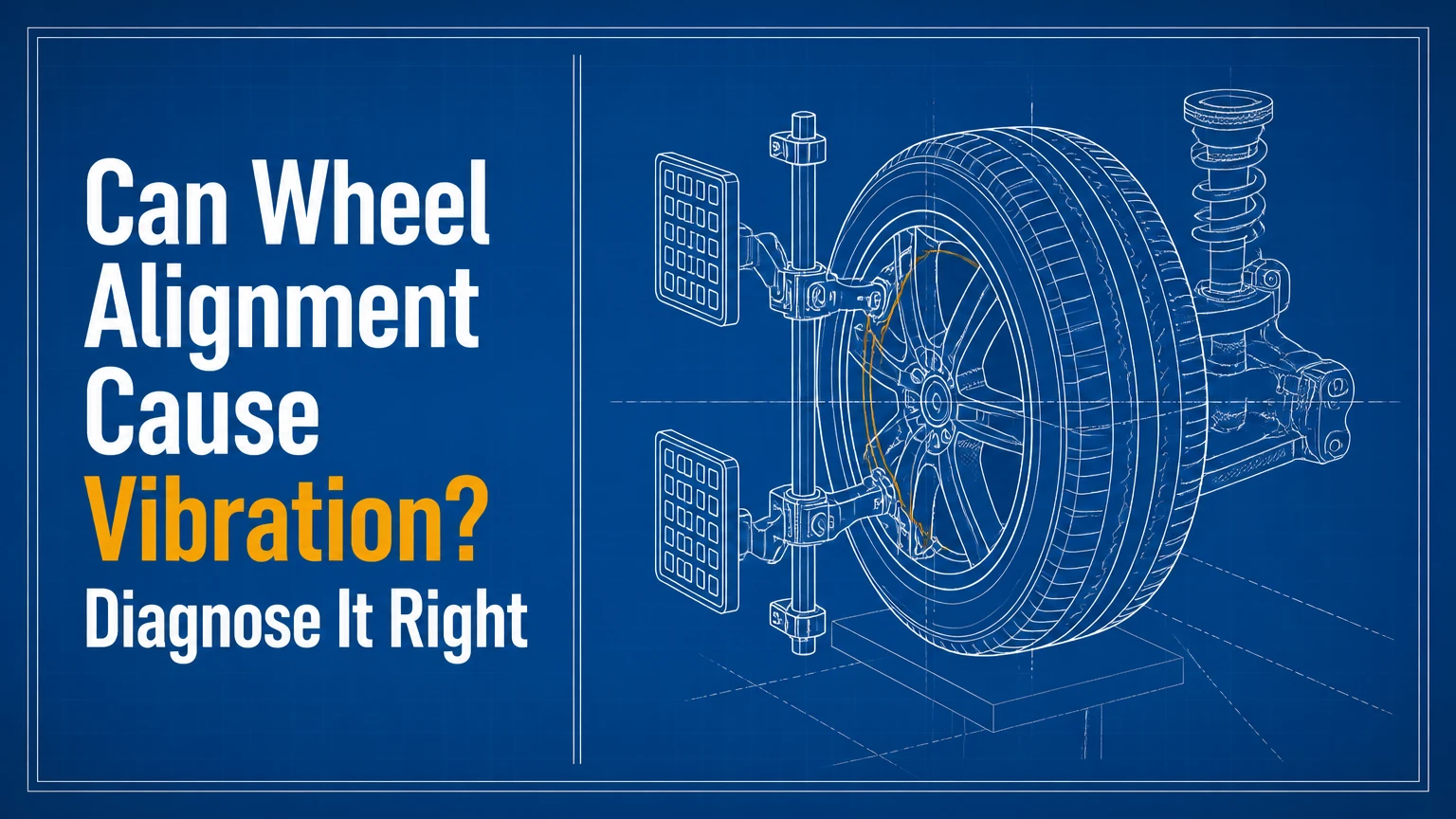
Wheel alignment can contribute to vibration, but incorrect alignment usually does not create an immediate vibration by itself. Misaligned toe or camber can produce feathered, cupped, or irregularly worn tires, and those damaged tires can then shake the vehicle. A wheel balance problem, bent wheel, tire defect, brake issue, or loose suspension part is more often the direct cause.
Key facts at a glance
Wheel alignment adjusts suspension geometry; wheel balancing corrects mass distribution in a tire-and-wheel assembly.
A steering-wheel shake concentrated around 50-70 mph more strongly suggests imbalance, wheel runout, or tire damage than alignment alone.
Misalignment commonly causes pulling, a crooked steering wheel, and uneven tire wear before it causes vibration.
Toe error produces feathering, while excessive camber usually wears one tread edge.
A vehicle with loose tie rods, ball joints, wheel bearings, or control-arm bushings should not be aligned until the fault is repaired.
A typical US alignment costs about $80-$180 and takes 45-90 minutes, before any suspension repair or ADAS calibration.
What Is the Correct Verdict?
Wheel alignment is a possible contributor, but it is not the first explanation for most vehicle vibration complaints. Alignment changes the direction and tilt of the wheels, whereas vibration requires a repeating force, such as an uneven rotating mass, tire deformation, wheel runout, or looseness in the steering and suspension.
A severe toe error can make tires scrub sideways and wear into a sawtooth pattern. Once the tread becomes irregular, the tire may generate a repeating impact or force that the driver feels through the steering wheel or seat. The vibration comes from the damaged tire and rotating assembly, not from geometric angle error acting like an unbalanced weight.
The practical rule is simple: vibration plus a crooked steering wheel or strong pull deserves an alignment measurement, but vibration alone deserves tire, wheel, and suspension testing first.
How Do Alignment and Balancing Differ?
Wheel alignment corrects vehicle geometry. Wheel balancing corrects the distribution of weight around each tire and wheel, so the assembly rotates without generating excessive centrifugal force.
| Diagnostic feature | Alignment problem | Wheel balance or runout problem | Tire or suspension problem |
|---|---|---|---|
| Main symptom | Pulling, wandering, crooked steering wheel | Shake at a repeatable speed | Thump, clunk, wobble, or persistent shake |
| Common speed pattern | Any speed, often worse on crowned roads | Usually 50-70 mph | Speed-dependent or present at low speed |
| Steering-wheel feel | Off-center or requires correction | Rhythmic shimmy | Loose, jerky, or heavy feedback |
| Tire evidence | Feathering or one-edge wear | Usually no wear at first | Cupping, bulge, flat spot, or separated belt |
| Primary service | Alignment measurement and adjustment | Spin balance or road-force balance | Component or tire replacement |
A lost wheel weight can cause a strong highway vibration without any alignment error. Mud packed inside an alloy wheel can do the same. Tire Rack and major tire manufacturers describe balancing as a correction for uneven mass, while alignment concerns toe, camber, caster, and the vehicle’s thrust direction.
A useful shop request is: “Please measure balance and radial or lateral runout before recommending alignment as the vibration cure.”
Which Alignment Angles Matter?
Toe has the strongest connection to alignment-related tire wear and the most plausible route from misalignment to later vibration. Camber mainly changes the load across the tread, while caster primarily affects steering feel, self-centering, and straight-line stability.
| Angle | Measurement direction | Typical symptom | Typical wear pattern | Direct vibration likelihood |
|---|---|---|---|---|
| Toe | Viewed from above | Scrubbing, pull, unstable tracking | Feathered or sawtooth tread | Low initially, higher after wear |
| Camber | Viewed from the front | One-edge loading | Inner- or outer-edge wear | Low initially, higher after wear |
| Caster | Viewed from the side | Poor self-centering, wander | Usually little direct tread wear | Very low by itself |
| Thrust angle | Rear axle direction relative to centerline | Dog-tracking, crooked steering wheel | Rear or diagonal wear | Low, unless tire wear develops |
Factory specifications vary by model, suspension design, ride height, and load condition. A wheel can be technically within a broad green range on a machine yet still produce a steering complaint if the left and right values differ significantly, so technicians also assess cross-camber, cross-caster, and steering-wheel center.
Caster does not normally create a vibration by itself. Claims that a caster setting alone causes “death wobble” oversimplify the issue. Violent oscillation generally requires a combination of worn or loose components, tire and wheel conditions, steering geometry, and sometimes lifted or modified suspension.
What Does Vibration Speed Tell You?
A vibration that appears at a narrow highway-speed range usually points toward a rotating assembly, not a pure alignment angle. Speed is not a complete diagnosis, but it helps separate balance, tire, brake, and drivetrain faults.
| Symptom pattern | Most likely areas | Useful first test | Alignment priority |
|---|---|---|---|
| Shake at 55-70 mph, coasting or accelerating | Wheel balance, tire uniformity, bent rim | Four-wheel balance and runout check | Secondary |
| Steering wheel shakes under braking | Brake rotor variation, pad deposits, front suspension | Measure brake and hub runout | Low initially |
| Seat or floor vibrates under acceleration | CV axle, driveshaft, engine or transmission mount | Repeat test in neutral or while coasting | Low |
| Vibration follows vehicle speed at low speed | Tire bulge, flat spot, bent wheel | Visual and radial-runout inspection | Secondary |
| Pull and crooked wheel at all speeds | Toe, camber, tire conicity, brake drag | Alignment printout and tire-pressure check | High |
| Vibration after a pothole impact | Bent wheel, damaged tire, bent suspension | Inspect wheel, tire, and steering linkage | High if geometry changed |
If the vibration changes when the driver shifts from acceleration to coasting, the drivetrain becomes more suspicious. If it remains identical during both conditions, the tire and wheel assembly deserves closer attention.
Why Can Misalignment Lead to Vibration?
Misalignment can lead to vibration through abnormal tire wear, altered contact with the road, or stress placed on already-worn components. The chain usually takes time: angle error changes tire wear, the tread becomes uneven, and the irregular tire generates a repeating force during rotation.
Toe-out on one side and toe-in on the other can make the tires fight the vehicle’s direction of travel. The tread may develop feathering, where each block feels smooth in one direction and sharp in the other. A hand moving across the tread can reveal this pattern, although a professional inspection is more reliable.
Cupping is different. It consists of repeated dips around the tread and often points to poor damping, worn suspension, incorrect inflation, imbalance, or a combination of these conditions. Misalignment can contribute, but calling every cupped tire an alignment problem leads to missed shocks, bushings, and balance faults.
A tire with internal belt separation may produce a bulge, rhythmic thump, or severe shake even when alignment readings are perfect. Alignment cannot repair a defective tire.
Why Can Vibration Remain After Alignment?
Vibration can remain after alignment because the alignment service corrected wheel angles but did not correct the rotating assembly or replace tire damage. Alignment machines measure geometry; they do not automatically diagnose tire uniformity, wheel balance, brake runout, or axle vibration.
Common explanations include:
- The tires were never balanced after installation.
- A wheel weight fell off after the previous service.
- A bent rim has excessive radial or lateral runout.
- A tire has a shifted belt, bulge, flat spot, or high radial-force variation.
- A wheel is not centered correctly on the hub because of corrosion or an incorrect spacer.
- A worn tie rod, ball joint, bearing, or bushing still allows movement.
- The vibration originates in a CV axle, driveshaft, propeller shaft, or engine mount.
Road-force balancing can identify stiff spots and tire-wheel combinations that ordinary spin balancing may not resolve. Hunter Engineering’s road-force systems measure loaded tire behavior, but the machine’s result still requires technician judgment. A road-force number is not a substitute for inspecting the tire, wheel, hub, and suspension.
What Happens During an Alignment?
A professional four-wheel alignment normally includes inspection, measurement, adjustment, and verification. Typical service time is 45-90 minutes when no damaged parts require replacement.
Step 1: Inspect the Vehicle
The technician checks tire pressure, tread wear, steering linkage, ball joints, wheel bearings, control-arm bushings, springs, ride height, and visible damage. The technician should also check whether the wheels are correctly mounted and whether the tires have abnormal runout.
An alignment cannot hold on a vehicle with looseness in a tie rod or ball joint. Adjusting geometry before replacing a worn part creates unreliable readings and may leave the vehicle unsafe.
Step 2: Measure All Relevant Wheels
Modern equipment uses camera targets or sensors mounted to the wheels. The machine compares toe, camber, caster, thrust angle, and steering position with vehicle-specific specifications.
The technician should record the initial values. “Green” does not always mean the complaint is resolved, because side-to-side differences and the vehicle’s actual symptoms matter.
Step 3: Adjust Accessible Angles
Tie rods commonly adjust front toe. Eccentric bolts, shims, adjustable links, or control-arm hardware may adjust camber and caster, depending on the vehicle.
Some rear suspensions have limited or no factory adjustment. If a rear angle is outside specification, the cause may be a bent component, damaged subframe, incorrect ride height, or aftermarket modification rather than a missing adjustment.
Step 4: Center the Steering Wheel
The technician sets the steering wheel and front toe together, rather than correcting one while ignoring the other. A centered wheel with incorrect rear thrust angle can still leave the vehicle dog-tracking.
Step 5: Verify the Result
The final printout should show before-and-after measurements, and a road test should confirm straight tracking, steering-wheel position, and the original vibration complaint. The road test cannot replace a balance or tire inspection when the symptom is a highway shake.
How Much Does Alignment Cost?
A typical US wheel alignment costs $80-$180 and takes 45-90 minutes. Luxury vehicles, damaged suspension components, modified ride height, tire replacement, and ADAS calibration can raise the total substantially.
| Service situation | Typical US price | Typical time | What the price includes |
|---|---|---|---|
| Front-end alignment | $60-$110 | 30-45 minutes | Front toe and available front-angle adjustments |
| Four-wheel alignment | $100-$180 | 45-90 minutes | Four-wheel measurement and adjustable geometry |
| Performance or modified vehicle | $150-$300 | 60-120 minutes | Custom targets, ride-height checks, specialist adjustments |
| Alignment plus suspension repair | $250-$1,000+ | 2-6 hours | Parts, labor, and final alignment |
| Alignment plus ADAS calibration | $350-$700+ | 1.5-3 hours | Geometry service plus camera or radar calibration |
These are typical market ranges, not a guaranteed quote. Labor rates, vehicle access, seized adjusters, regional prices, and replacement parts create large differences.
An alignment shop may charge an inspection fee even when the vehicle cannot be adjusted. That charge is reasonable if the technician documents worn or bent parts instead of forcing an alignment onto an unsafe vehicle.
When Is Alignment Necessary?
Alignment is necessary after a significant impact, suspension or steering repair, abnormal tire wear, a persistent pull, or a crooked steering wheel. It is not automatically necessary every time a tire is rotated or balanced.
Alignment should follow replacement of a tie rod, control arm, ball joint, strut, steering rack, subframe, rear suspension link, or spring. Changes in ride height also alter geometry and may require specialty adjustments.
The following situations justify measurement:
- A pothole or curb strike causes pulling or a changed steering-wheel position.
- The inside or outside shoulder wears faster than the rest of the tread.
- Feathering is detectable across a tread block.
- The vehicle tracks diagonally, sometimes called dog-tracking.
- The steering wheel is off-center while driving on a reasonably flat road.
- New tires develop uneven wear soon after installation.
- A collision repair or suspension modification has occurred.
There is no universal annual alignment interval. Annual inspection can be sensible for vehicles exposed to potholes, rough roads, heavy loads, or rapid tire wear, but a calendar-based service has less value when the vehicle tracks correctly and tire wear is even.
What Should You Check After a Pothole?
After a pothole, inspect the tire sidewall, wheel rim, steering position, and suspension before driving at highway speed. A pothole can bend a wheel or damage a tire without producing an immediately obvious alignment change.
Look for a sidewall bulge, cut, exposed cord, cracked alloy wheel, missing wheel weight, or a new loss of tire pressure. Check whether the steering wheel is suddenly crooked and whether the car pulls under light braking.
A bent wheel may cause radial or lateral runout that balancing cannot fully correct. A tire with an internal belt injury may look acceptable from the outside, so a persistent new vibration after impact warrants professional inspection.
Do not continue highway driving with a visible tire bulge, exposed cord, severe wobble, or loose steering. Those symptoms can indicate structural tire or suspension damage.
What Changes for EVs and ADAS Vehicles?
Electric vehicles require the same basic alignment principles, but higher vehicle weight, instant torque, low rolling-resistance tires, and expensive tire compounds can make uneven wear more costly. EV owners should follow the manufacturer’s tire-pressure, load, rotation, and alignment guidance rather than assume a universal annual schedule.
Advanced driver assistance systems may need calibration after alignment, but recalibration is vehicle-specific. A changed steering-wheel angle, altered ride height, camera replacement, windshield replacement, collision repair, or manufacturer procedure may trigger a requirement for camera or radar calibration.
| Vehicle situation | Alignment consideration | ADAS consideration | Owner action |
|---|---|---|---|
| Standard sedan | Check all adjustable angles | Usually no calibration for routine alignment | Request before-and-after printout |
| AWD crossover | Measure rear thrust angle | Follow manufacturer procedure | Confirm four-wheel service |
| Lifted truck | Check caster and altered geometry | Modified ride height can affect sensors | Use a specialist familiar with the lift |
| EV with lane-centering | Monitor rapid shoulder wear | Steering-angle and camera procedures vary | Ask the dealer or OEM service manual |
| Collision-repaired vehicle | Inspect bent subframes and links | Calibration may be mandatory | Obtain repair documentation |
A shop should not sell ADAS calibration solely because a vehicle has lane-keep assist. The required procedure depends on the model, fault codes, sensor position, and manufacturer instructions.
Is It Safe to Drive With Alignment-Related Vibration?
A mild pull with even tire pressure may allow a careful short trip to a repair shop, but severe vibration, loose steering, tire damage, or rapid worsening requires stopping and arranging inspection or towing. Vibration can signal a failing tire, loose wheel, damaged bearing, or suspension separation.
Reduce speed and avoid highways while arranging service if the vehicle has a new steering shimmy. Stop driving immediately when the tire has a bulge, the wheel visibly wobbles, the steering feels disconnected, or a clunk accompanies directional changes.
A vehicle that only shakes during braking may have a brake or hub problem. That symptom still deserves prompt attention because brake judder can worsen and suspension looseness can affect braking stability.
How Should You Confirm the Repair?
Ask the shop to identify the measured fault before approving an alignment. A credible diagnosis connects the symptom to a physical finding, such as toe outside specification, a lost balance weight, measured wheel runout, tire radial-force variation, or play in a steering component.
Request these details:
- Tire pressures used during measurement.
- Before-and-after alignment values.
- The vehicle manufacturer’s specification source.
- Balance readings and any road-force result.
- Wheel and tire runout measurements when vibration persists.
- Parts requiring replacement before alignment.
- ADAS calibration requirements for the specific vehicle.
A printout proves that measurements were recorded, not that every mechanical problem was solved. The best verification is a consistent road test on the same speed range and road condition where the vibration originally appeared.
Practitioner Rules That Prevent Wasted Repairs
- Balance before alignment when the complaint is a narrow-speed shake. A 60 mph vibration rarely disappears because toe changed.
- Treat tire wear as evidence, not proof. Feathering can support an alignment diagnosis, while cupping may implicate damping or balance.
- Never align around looseness. A worn joint can invalidate readings and create a safety hazard.
- Compare side-to-side values. A vehicle can meet a broad tolerance while cross-camber or cross-caster still explains a pull.
- Clean the wheel before balancing. Snow, mud, and packed debris can imitate a missing wheel weight.
Can Wheel Alignment Cause Vibration: The Bottom Line
Can wheel alignment cause vibration? Yes, indirectly, when incorrect geometry creates irregular tire wear or increases stress on damaged steering and suspension parts. Pure misalignment is more likely to cause pulling, wandering, a crooked steering wheel, and uneven tread wear than an immediate rhythmic shake.
For a vibration that appears at 50-70 mph, start with tire pressure, wheel balance, tire condition, wheel runout, and suspension looseness. Add an alignment measurement when the vehicle pulls, the steering wheel is off-center, tread wear is abnormal, or a pothole or suspension repair preceded the complaint.
FAQ
Can a bad tire cause vibration even after an alignment?
Yes. Alignment does not repair a shifted belt, tire bulge, flat spot, uneven radial force, or tread separation. A tire can also be installed on a bent wheel, leaving the vehicle vibrating after geometry readings return to specification. Inspect the tire and measure balance and runout before repeating alignment work.
Should wheels be balanced before or after alignment?
Balance the wheels before alignment when the main symptom is a speed-specific vibration. Alignment is still appropriate afterward if the vehicle pulls, the steering wheel is crooked, or the tires show feathering or edge wear. Balancing and alignment correct different faults, so neither service replaces the other.
Can low tire pressure feel like an alignment problem?
Yes. Unequal pressure can make a vehicle pull, alter steering effort, increase shoulder wear, and change the way a tire responds to road grooves. Set all tires to the vehicle manufacturer’s cold-pressure specification before judging alignment. Do not use the maximum pressure molded into the tire sidewall as the normal setting.
Can wheel bearings cause a steering-wheel vibration?
A failing wheel bearing can cause humming, looseness, or vibration, especially as vehicle speed increases or the vehicle turns. Bearing play can also make alignment readings unstable. A technician should check bearing movement and noise before alignment, particularly when vibration is accompanied by a growl or changes during cornering.
Does tire rotation require an alignment?
Routine tire rotation does not normally require alignment. Rotation changes tire positions, not suspension angles. An alignment check becomes sensible when the tires show uneven wear, the vehicle pulls, the steering wheel is off-center, or the tires were moved after a pothole impact and the symptom changed.
Can brake rotors cause vibration at highway speed?
Brake rotors or uneven pad deposits usually cause vibration only when the brake pedal is applied, often through the steering wheel or brake pedal. A shake that continues while coasting is less likely to be caused by the brakes. A technician can measure disc and hub runout and inspect caliper operation.


