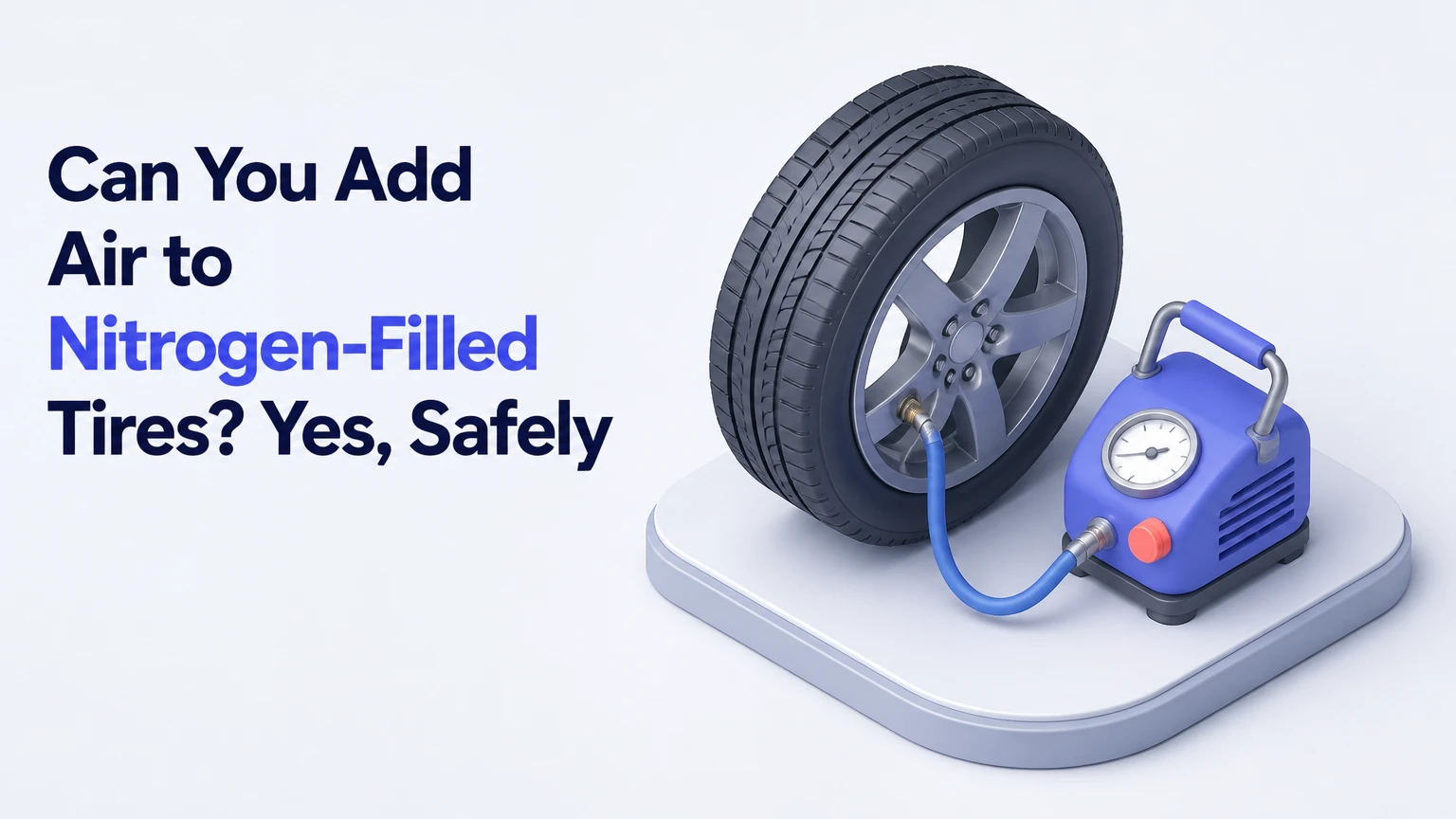
Yes, you can add regular compressed air to nitrogen-filled tires without causing a chemical reaction or damaging the tire. Inflate the tire to the vehicle manufacturer’s recommended cold pressure, even if that dilutes the nitrogen; correct pressure and prompt inspection matter more than maintaining gas purity.
Key Facts / At a Glance
Regular compressed air is compatible with nitrogen and can safely top off a tire.
A vehicle’s recommended tire pressure appears on the driver-door placard, not on the tire sidewall.
Mixing air with nitrogen changes the gas blend, but it does not create a hazardous condition.
Nitrogen does not eliminate punctures, bead leaks, valve leaks, or the need for monthly pressure checks.
A nitrogen purge is normally unnecessary after an occasional air top-off on a passenger vehicle.
If a tire is substantially underinflated, stop driving and inspect it before adding pressure.
Can You Add Air to Nitrogen-Filled Tires?
You can add air to a nitrogen-filled tire whenever the tire needs pressure. A gas station compressor, workshop air line, portable inflator, or hand pump can supply the required pressure because nitrogen and the gases in ordinary air remain chemically compatible inside a tire.
The immediate objective is proper inflation. A tire that is 8 PSI below its placard value has a handling, braking, heat, and tread-wear problem, regardless of whether its remaining gas is nitrogen, air, or a mixture.
Regular air contains approximately 78% nitrogen and 21% oxygen by volume, with argon, carbon dioxide, and variable water vapor making up the remainder. Commercial tire nitrogen commonly has a stated purity around 93-99%, although the actual value depends on the generator, storage, and filling procedure.
Adding air lowers the nitrogen percentage. That change is not dangerous. It simply means the tire no longer contains the high-purity gas blend a service provider sold or promised.
Is Mixing Air and Nitrogen Safe?
Mixing air and nitrogen is safe for ordinary automotive tires because both gases occupy the same sealed tire cavity without producing a damaging reaction. Tire manufacturers do not require motorists to deflate a tire before correcting its pressure with ordinary air.
The main safety variable is pressure. The National Highway Traffic Safety Administration recommends checking tires when cold and using the vehicle manufacturer’s placard pressure; NHTSA also identifies underinflation as a major contributor to tire failure and crash risk.
A green valve-stem cap may indicate that a shop filled the tire with nitrogen, but the cap does not measure purity. Green caps are a labeling convention used by many service providers. Replacing one with a standard cap does not change the tire’s contents or performance.
Do not delay inflation because a nitrogen station is unavailable. A properly inflated air-and-nitrogen blend is safer than a nitrogen-filled tire operating below specification.
How Do You Add Air Correctly?
Add air with the tire cold, use the door-placard pressure, and investigate any major pressure loss before driving farther. The basic procedure takes about 2-5 minutes per tire at a functioning compressor, excluding inspection or repair time.
Before inflating
Gather a tire-pressure gauge, an air compressor or inflator, and the vehicle’s owner’s manual if the placard is difficult to find. Check pressure before driving, or after the vehicle has been parked for at least three hours; driving heats the casing and temporarily raises the gauge reading.
The correct target may differ between the front and rear axles. Some vehicles also specify a separate pressure for heavy loads or high-speed operation.
Step 1: Find the manufacturer’s pressure
Read the placard on the driver-side doorjamb, door edge, glovebox, fuel-door area, or owner’s manual. Use that number, commonly 30-36 PSI for passenger cars, rather than the maximum pressure molded into the sidewall.
The sidewall value describes the tire’s allowable load and inflation limit. It is not automatically the correct operating pressure for the vehicle.
Step 2: Inspect the tire
Look for a nail, screw, cut, bulge, exposed cord, damaged valve stem, or tire bead separating from the wheel. A tire more than approximately 25% below its recommended pressure deserves special caution because internal flexing can generate heat and damage the casing.
Never inflate a tire with a sidewall bulge or major structural damage. Use a spare or roadside service.
Step 3: Measure and add air
Remove the valve cap, press the gauge squarely onto the valve stem, and record the reading. Add air in short bursts, checking the pressure after each burst until the cold target is reached.
A tire can accept air from a standard compressor even when its previous fill was nitrogen. No special adapter is required.
Step 4: Recheck and cap the valve
Measure the pressure again after disconnecting the hose. Replace the valve cap firmly because the cap helps keep dirt and moisture away from the valve core, although the valve core itself provides the primary seal.
You will know the inflation worked when the gauge matches the placard value and the tire has no visible damage or audible leak.
Step 5: Monitor the result
Check the tire again the next morning. If it loses more than about 1-2 PSI without a temperature change, arrange a leak inspection. A recurring loss is not evidence that nitrogen has “stopped working”; it usually indicates a puncture, valve problem, wheel corrosion, or bead leak.
What Happens to Nitrogen Purity After an Air Top-Off?
An air top-off lowers nitrogen concentration according to the amount of air added, but there is no universal 93% or 95% purity threshold at which nitrogen benefits suddenly disappear. Purity declines gradually, and tire pressure remains the more important practical variable.
For example, a tire initially filled with approximately 95% nitrogen may contain a substantially diluted mixture after a large correction with ordinary air. The exact result cannot be calculated from PSI alone unless the starting pressure, final pressure, tire volume, and gas composition are known.
| Inflation condition | Approximate gas composition | Practical meaning |
|---|---|---|
| Ambient dry air | 78% nitrogen, 21% oxygen | Normal, widely available tire inflation |
| Commercial nitrogen | 93-99% nitrogen | Reduced oxygen and usually reduced moisture |
| One small air top-off | Variable blend, often above 80% nitrogen | Safe for driving and routine service |
| Repeated large air additions | Progressively closer to air composition | Nitrogen-specific advantages become smaller |
| Full air refill | Approximately 78% nitrogen | Standard tire maintenance condition |
The AI Overview’s “93-95% required threshold” is too absolute. No major passenger-tire standard establishes a sharp cutoff at which a tire becomes unsafe or nitrogen benefits are neutralized. Commercial nitrogen suppliers may use a target purity for their service process, but that target is not a universal operating requirement.
Does Nitrogen Keep Tires Inflated Longer?
Nitrogen can reduce pressure loss through permeation, but the difference is usually modest for a properly maintained passenger vehicle. Oxygen and nitrogen molecules interact differently with rubber, yet real-world losses also come from punctures, valve cores, bead seals, wheel damage, and temperature changes.
Goodyear describes nitrogen as potentially reducing pressure loss and moisture inside tires, while Tire Rack’s consumer testing and explanation emphasize that regular pressure checks remain necessary. The American Automobile Association similarly warns that nitrogen does not remove the need for routine inspection.
A commonly cited practical range is about 1 PSI per month for air-filled tires and somewhat less for nitrogen-filled tires, but those figures are not guarantees. Tire age, construction, wheel material, ambient temperature, and seal condition can dominate the result.
| Pressure-loss factor | Typical effect | Best diagnostic action |
|---|---|---|
| Seasonal temperature change | About 1 PSI per 10°F change | Recheck cold pressure |
| Slow tread puncture | More than 1 PSI per month | Inspect tread and repair properly |
| Valve-core leak | Variable, sometimes rapid | Test with soapy water |
| Bead or wheel leak | Often recurring at one wheel | Remove tire and inspect rim |
| Normal permeation | Gradual, usually small | Monthly pressure checks |
| Severe underinflation | Heat and casing-flex risk | Stop and inspect before driving |
Nitrogen is therefore a maintenance option, not a leak-repair method. A nitrogen-filled tire with a puncture still loses pressure.
What Happens When Tires Heat Up?
Both nitrogen and air increase in pressure as tire temperature rises because the gas occupies a flexible but substantially fixed volume. Dry nitrogen may reduce moisture-related variability, but nitrogen does not prevent normal heat-generated pressure changes.
The ideal-gas relationship explains the basic behavior: when absolute temperature rises while tire volume remains nearly constant, absolute pressure rises as well. A tire that reads 32 PSI cold can show several PSI more after highway driving, depending on speed, load, road temperature, and starting conditions.
Water vapor complicates compressed-air behavior because moisture can condense or vaporize as temperature changes. Modern service compressors often include dryers, and the moisture content of ordinary shop air varies widely. The AI Overview’s claim that regular air necessarily causes “significantly” greater pressure fluctuation overstates the evidence for normal road use.
Never bleed a hot tire back to the cold placard value. Let the tire cool, then adjust it. Track drivers use a separate hot-pressure procedure based on tire manufacturer and vehicle data.
What Does Nitrogen Tire Service Cost?
Typical North American nitrogen service costs range from free to about $10 per tire for a top-off and approximately $30-$100 for a complete set refill, but prices vary by retailer and whether tire removal is included. Standard compressed air is often free or costs about $1-$3 at a public station.
A full purge is different from a simple top-off. A technician must remove the existing gas and refill the tire, sometimes repeating the cycle to lower oxygen and moisture levels. A vacuum cycle is not automatically required for every passenger-tire service, and customers should ask what procedure the quoted price includes.
| Service option | Typical price | Typical time | Appropriate use |
|---|---|---|---|
| Gas-station compressed air | $0-$3 | 2-10 minutes | Low tire needing immediate correction |
| Nitrogen top-off | $0-$10 per tire | 5-15 minutes | Existing nitrogen system maintenance |
| Nitrogen fill, tire mounted | $5-$15 per tire | 10-20 minutes | New installation or service visit |
| Four-tire purge and refill | $30-$100 per vehicle | 15-30 minutes | Owner specifically wants high-purity nitrogen |
| Puncture repair | $20-$40 typical | 20-45 minutes | Nail or screw in repairable tread area |
For most daily drivers, paying for a purge after one air top-off produces little measurable benefit compared with simply maintaining the correct pressure.
Which Inflation Gas Should You Choose?
Regular compressed air is the practical choice for most passenger vehicles because it is available everywhere, costs little, and supports the same required pressure. Nitrogen becomes more defensible when pressure consistency, long idle periods, moisture control, or fleet maintenance logistics justify the recurring cost.
The decision should match the operating environment, not the color of the valve cap.
| Driver or vehicle use | Recommended gas | Reason | Main limitation |
|---|---|---|---|
| Daily commuter | Compressed air | Free or low-cost, available at roadside stations | Slightly more moisture and permeation |
| Track-day vehicle | Dry nitrogen or dry air | Predictable setup for hot-pressure tuning | Requires measured track-specific data |
| Heavy truck fleet | Nitrogen or controlled dry air | Centralized maintenance and long service intervals | Equipment and labor cost |
| Trailer stored for months | Nitrogen optional | Lower permeation may reduce seasonal correction | Does not prevent aging or flat spots |
| Emergency roadside repair | Compressed air | Immediate pressure restoration | Purity is diluted |
| Passenger vehicle with TPMS | Either gas | TPMS measures pressure, not gas type | Sensor warning still requires diagnosis |
Nitrogen is not automatically a fuel-economy upgrade. Correct pressure, alignment, tread condition, driving speed, and vehicle load have larger practical effects for most motorists.
Can a Portable Compressor Be Used?
A portable 12-volt or battery-powered compressor can safely add air to a nitrogen-filled tire if the unit is rated for the tire’s pressure and connected securely. A typical passenger-car inflator may take 3-10 minutes to raise one tire several PSI, while a small emergency unit can take longer.
Use the inflator on a stable valve connection and follow its duty-cycle limit. Some compact compressors must cool for 10-15 minutes after continuous operation. Do not run a compressor beyond its instructions because overheating can damage the motor or create a burn hazard.
Portable inflators are useful for correction, not diagnosis. If the tire repeatedly needs air, test the valve and inspect for a puncture rather than continuing to refill it.
What If the Tire Keeps Losing Pressure?
A nitrogen-filled tire that keeps losing pressure has a mechanical leak or damage problem until proven otherwise. Repeated inflation cannot correct a puncture, leaking valve core, cracked wheel, corroded bead seat, or damaged tire casing.
Ask a tire professional to perform a leak test and inspect the inside of the tire. A screw in the central tread may be repairable under the tire manufacturer’s and Tire Industry Association’s procedures, but shoulder and sidewall damage generally requires replacement.
Stop driving and seek immediate service when any of these conditions applies:
- The tire is visibly flat or badly deformed.
- The TPMS warning returns soon after inflation.
- Pressure falls several PSI within hours.
- The sidewall has a bulge, cut, or exposed cord.
- The vehicle pulls, vibrates, or handles abnormally.
- The tire was driven while severely underinflated.
A TPMS warning identifies pressure outside the vehicle’s monitoring range. It does not identify whether the tire contains air or nitrogen.
Do Mixed Tires Need a Nitrogen Purge?
A tire does not need a nitrogen purge merely because ordinary air was added. Purging is optional for a passenger vehicle and makes sense only when the owner has a specific reason to restore a high-purity, low-moisture fill.
Ask the shop whether the service is a simple top-off or a complete evacuation and refill. Some providers advertise multiple cycles, but a “dual-purge” is not a universal industry requirement for restoring safe tire operation. Tire volume, equipment quality, residual gas, and the shop’s target purity determine the outcome.
A full purge may be reasonable for racing, aviation-related ground equipment, specialized industrial vehicles, or a commercial fleet with documented nitrogen procedures. It is rarely a cost-effective response to one emergency air correction on a family car.
What About Cold Weather, Storage, and Towing?
Cold weather lowers tire pressure whether the tire contains nitrogen or compressed air, while storage creates risks that gas choice cannot solve. Check cold pressure after a major temperature drop and inspect stored tires for age, cracking, and flat-spot concerns.
A useful rule of thumb is approximately 1 PSI of pressure change for every 10°F change in temperature, although tire construction and starting conditions affect the actual reading. That relationship means a 30°F overnight drop can produce a noticeable warning even without a leak.
Towing adds load and heat. Use the pressure listed for the loaded vehicle in the owner’s manual or placard, confirm the trailer tire’s load rating, and never exceed the tire sidewall limit or axle rating.
Nitrogen may reduce the frequency of pressure corrections during long storage or fleet operation. It does not stop oxygen aging, ultraviolet exposure, tread separation, wheel corrosion from external damage, or pressure loss from a leaking valve.
Expert Rules That Prevent Expensive Mistakes
Pressure takes priority over purity. A driver who postpones inflation while searching for nitrogen is choosing a lower safety margin to preserve a secondary benefit. Correct the pressure with available air, then decide later whether specialized maintenance is worthwhile.
A large pressure correction deserves an inspection. Adding 1 PSI during monthly maintenance is normal. Adding 8 PSI repeatedly is a diagnostic signal, even if the tire holds nitrogen.
Do not compare hot readings with cold targets. Measuring after a highway trip and releasing air to reach the placard number can leave the tire dangerously underinflated after cooling.
Green caps do not prove nitrogen purity. A cap identifies a service history, not a laboratory composition. Service records and a calibrated gas analyzer would be needed to verify purity.
Dry air can provide much of nitrogen’s practical advantage. A well-maintained compressor with a functioning dryer supplies low-moisture air, reducing the moisture difference without requiring a nitrogen generator.
Frequently Asked Questions
Will adding air damage the tire valve or TPMS sensor?
No. Ordinary compressed air does not damage a tire valve, valve core, or TPMS sensor when supplied at a controlled pressure. The sensor measures inflation pressure and sometimes temperature; it does not require nitrogen. Use the correct compressor fitting and replace a missing valve cap.
Can I fill all four tires with regular air after using nitrogen?
Yes. A complete air refill is safe and mechanically normal. A technician may remove the existing gas before refilling, but a purge is not necessary for safety. Inflate every tire, including the spare if applicable, to the vehicle’s specified cold pressure and reset or confirm the TPMS system according to the owner’s manual.
Does nitrogen improve fuel economy?
Nitrogen does not create a dependable fuel-economy improvement when air-filled and nitrogen-filled tires are maintained at the same pressure. Any practical benefit usually comes from better pressure retention over time, not from nitrogen directly adding power or efficiency. Checking pressure monthly delivers the more reliable savings.
Can I use a gas station compressor labeled for air?
Yes. A gas station compressor is suitable for a nitrogen-filled tire because compressed air and nitrogen are compatible inflation gases. Confirm the gauge reading with your own pressure gauge when possible, because public inflators can be inaccurate, damaged, or set to the wrong unit.
Is nitrogen better for motorcycle or bicycle tires?
Nitrogen can be used in motorcycle tires, but pressure accuracy and frequent inspection remain more important. Bicycle tires typically use ordinary air because their high-pressure systems, tubes, sealants, and portable pumps are designed around accessibility rather than nitrogen purity. Follow the tire and vehicle manufacturer’s pressure guidance.
Should I replace nitrogen after a tire repair?
A repair shop may refill a repaired tire with nitrogen if its equipment is available, but ordinary air is safe if nitrogen is unavailable. The repair quality, internal inspection, correct pressure, and leak test determine safety. Ask the technician to restore pressure before reinstalling the wheel.
The Bottom Line
You can add air to nitrogen-filled tires safely, and you should do so whenever pressure is low. Use the cold pressure on the driver-door placard, inspect for a puncture or damage, and keep monitoring the tire afterward.
For most daily drivers, an air-and-nitrogen blend needs no special correction. Nitrogen can offer modest pressure-retention and moisture-control advantages, but those benefits do not justify driving underinflated or paying for a purge after every top-off. If you searched “can you add air to nitrogen filled tires” because a tire is low now, restore the correct pressure first.