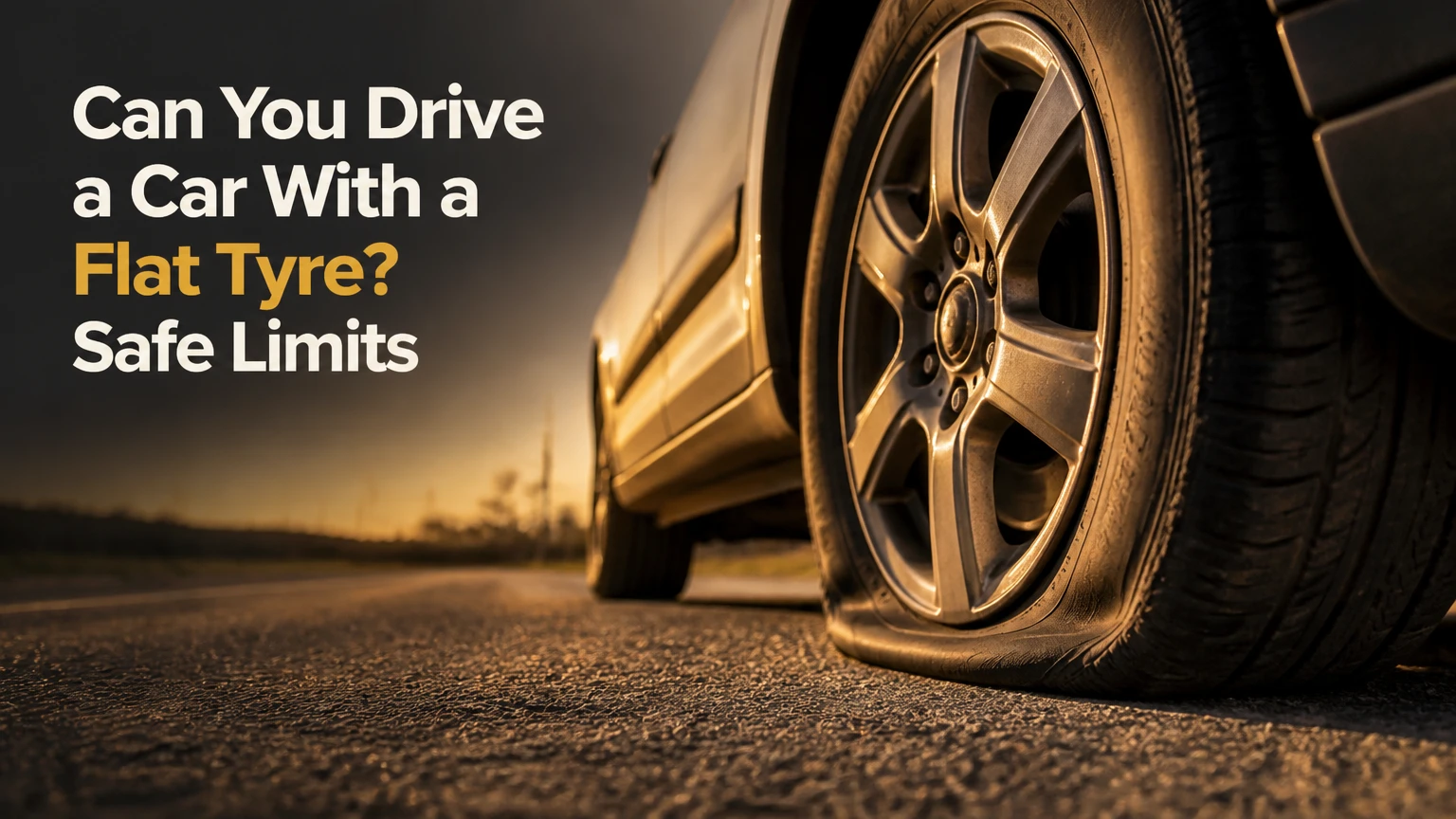
No, you should not drive a car with a flat tyre. A standard pneumatic tyre can lose steering control, overheat, destroy its internal casing, and damage the wheel within a short distance. Move only far enough, and slowly enough, to escape immediate danger, then stop on a safe surface and arrange a repair, spare-wheel change, or recovery.
Key facts at a glance
A standard flat tyre should not be driven to a garage or tyre shop.
An emergency crawl is only for reaching a safer stopping place, not for completing a journey.
Run-flat limits commonly reach 80 km at 80 km/h, but the vehicle or tyre manufacturer’s specification controls.
A self-sealing tyre can address some tread punctures, but it does not make sidewall damage safe to drive on.
A temporary spare often has a 50-80 km/h limit and should be replaced with a normal tyre promptly.
A tyre driven while flat requires internal inspection, even when the outside looks undamaged.
Can You Drive a Car With a Flat Tyre?
A driver can technically move a car with a standard flat tyre, but should do so only for an emergency crawl of a few metres to a safer position. Driving farther increases the probability of tyre destruction, wheel-rim damage, poor braking, steering instability, and loss of control. A flat tyre is a roadside safety problem, not a normal driving problem.
The answer changes when the vehicle has approved run-flat tyres or when a correctly inflated spare wheel has been installed. Those alternatives have separate limits. The sidewall markings, owner’s handbook, tyre placard, and manufacturer instructions take priority over generic figures found online.
A tyre-pressure monitoring system, or TPMS, does not make a flat tyre safe. TPMS may warn after pressure has fallen substantially, and some systems cannot identify the affected tyre without the driver checking the wheels. Treat a warning light, sudden steering change, vibration, or rhythmic thumping as a reason to reduce speed and inspect safely.
How far can you drive on a standard flat tyre?
There is no safe universal distance for driving on a standard flat tyre. A few hundred metres at walking pace might be enough to clear a live traffic lane, but even that distance can ruin the tyre and bend a rim if the road surface, vehicle load, or tyre construction is unfavorable.
The correct rule is functional rather than numerical: drive only until the immediate hazard ends. Do not use a claimed 200-400 metre allowance as permission to reach a service station. A tyre may fail after less than 100 metres, while another may appear intact after a longer crawl but contain unrecoverable internal damage.
What Happens Mechanically When a Tyre Goes Flat?
A pneumatic tyre relies on air pressure to support vehicle weight, stabilize the tread, and keep the sidewalls in their designed shape. When pressure disappears, the wheel rim and flexible sidewalls carry loads they were not designed to carry directly against the road.
Why does a flat tyre become damaged so quickly?
A flat tyre suffers repeated sidewall flexing, internal shear, bead movement, and heat generation as the wheel rotates. The road squeezes the deflated sidewall between the rim flange and the pavement, which can cut cords inside the casing even when the tread surface shows no obvious wound.
Heat is particularly destructive. The tyre’s rubber and reinforcing cords flex on every rotation, and insufficient pressure causes much greater deformation. Speed, heavy luggage, passengers, high ambient temperature, and rough roads accelerate the damage.
The loose tyre can also slip on the wheel. That movement may tear the bead, pull the valve stem, damage the TPMS sensor, or allow the tyre to separate from the rim. A driver who continues toward a workshop can convert a repairable puncture into a tyre and wheel replacement.
How does a flat tyre affect steering and braking?
A flat front tyre commonly creates steering pull, vibration, or heavy steering, while a flat rear tyre may cause sway or fishtailing. The exact sensation depends on drivetrain layout, tyre position, vehicle weight distribution, road camber, speed, and electronic stability systems.
Braking performance also changes. The affected wheel may have a different rolling radius and reduced contact stability, while abrupt braking can transfer load unpredictably. Anti-lock braking and electronic stability control can help manage some disturbances, but neither system restores the structural support of a pressurized tyre.
What Should You Do When a Tyre Goes Flat While Driving?
When a tyre fails in motion, hold the steering wheel firmly, release the accelerator gradually, signal early, and move to a safe stopping location without sudden braking or steering. Once stopped, activate hazard lights, secure passengers away from traffic, and decide between a spare, a repair kit, roadside assistance, or emergency services.
Safe stopping procedure
- Keep both hands on the steering wheel. Correct a gentle pull without making sharp steering inputs.
- Release the accelerator smoothly. Let the vehicle lose speed naturally; avoid abruptly lifting off in a bend.
- Avoid hard braking. Use light, progressive braking only when necessary to reach a safe position.
- Signal before changing position. Move toward a hard shoulder, parking area, lay-by, or wide verge when a safe gap appears.
- Stop on firm, level ground. Avoid soft soil, a blind bend, a crest, railway tracks, narrow shoulders, and locations where doors open into traffic.
- Apply the parking brake and select Park or first gear. Turn on hazard lights and switch off the engine.
- Protect occupants. On a high-speed road, leave the vehicle only if the safer route is away from traffic and local guidance permits it. Keep children and animals away from the carriageway.
- Call for help when conditions are unsafe. Give the road name, direction of travel, nearest junction or marker, vehicle registration, and tyre position.
- Do not crawl onward to save money. A short tow or mobile tyre visit is usually cheaper than a destroyed tyre, wheel, and suspension component.
A motorway shoulder is not automatically safe for a tyre change. Fast traffic, limited visibility, rain, darkness, and narrow shoulders can make remaining inside the locked vehicle safer than unloading a jack. Follow the road authority’s emergency instructions and use an emergency phone where mobile reception is poor.
What should you inspect after an emergency crawl?
Check the tyre sidewall, tread, bead area, valve, wheel lip, and nearby suspension components. Look for cuts, exposed cords, rubber dust, flattened sidewalls, fresh scoring, a bent rim, or fluid leakage.
Do not inflate and reuse a tyre that has been driven while fully deflated unless a qualified tyre technician has inspected it internally. Inflation can hide casing damage that later produces a rapid failure. A plug inserted from outside is not a substitute for proper internal examination.
Which Tyre Types Can Be Driven After Pressure Loss?
Standard tyres, run-flat tyres, self-sealing tyres, and spare wheels have different capabilities after pressure loss. The label “puncture-resistant” does not provide a general driving permission; the construction, remaining pressure, damage location, vehicle system, and manufacturer limits determine the safe response.
| Tyre or solution | Pressure-loss capability | Typical limit | Main restriction |
|---|---|---|---|
| Standard pneumatic tyre | No structural support at zero pressure | Emergency crawl only | Internal casing and rim damage |
| Run-flat tyre | Reinforced sidewall support | Up to 80 km at up to 80 km/h | Manufacturer, load, temperature, and TPMS limits |
| Self-sealing tyre | Seals some tread punctures | Continue only after pressure confirmation | Sidewall cuts and large objects remain unsafe |
| Temporary space-saver spare | Supports vehicle after replacement | Often 50-80 km/h | Short-term use, altered handling |
| Full-size spare | Normal-size support when correctly inflated | Vehicle handbook limit | Must match load, speed, and drivetrain requirements |
Can you drive on run-flat tyres?
You can usually drive on an approved run-flat tyre after a puncture, but only within the limit printed by the tyre or vehicle manufacturer. Many systems specify a maximum of 80 km at 80 km/h, while some specify lower distances, lower speeds, or different limits after a severe loss of pressure.
Run-flat tyres require a working TPMS because the reinforced sidewall can mask the normal feel of a deflation. They also require prompt professional inspection. A run-flat that has carried the vehicle while underinflated may be non-repairable, even when the puncture is in the tread.
Do not mix generic run-flat advice with a vehicle-specific instruction. BMW, Mercedes-Benz, Mini, Bridgestone, Michelin, Goodyear, and other manufacturers publish differing restrictions for load, temperature, speed, and repairability.
Are self-sealing tyres safe when punctured?
Self-sealing tyres can remain usable after a small tread puncture because a sealant layer closes some holes as the object enters or leaves. The feature is intended to reduce pressure loss, not to guarantee unlimited driving or eliminate the need for pressure checking.
A self-sealing layer may not close a sidewall cut, shoulder puncture, large tear, valve failure, bead leak, or damage caused by a pothole. If the TPMS warning remains on, check pressure with a gauge and have the tyre inspected. A sealed puncture can still lose air gradually.
Can you drive on a temporary spare tyre?
You can drive on a correctly fitted temporary spare, but only for the distance and speed stated on its sidewall and in the owner’s handbook. Many temporary spares carry a 50 or 80 km/h maximum and are intended to reach a repair facility, not to replace the original tyre permanently.
A narrow spare changes braking, cornering, ride height, and traction. Avoid heavy loads, high speed, sudden lane changes, and prolonged wet-road driving. Four-wheel-drive and all-wheel-drive vehicles may have additional circumference restrictions because a mismatched rolling radius can stress the drivetrain.
| Replacement option | Typical fitting time | Typical cost range | Suitable use |
|---|---|---|---|
| Tread puncture repair | 20-30 minutes | $20-$50 | Approved repairable tread damage |
| Standard replacement tyre | 30-45 minutes | $80-$250+ | Normal long-term use |
| Run-flat replacement | 30-45 minutes | $200-$500+ | Vehicles specified for run-flats |
| Temporary spare installation | 15-30 minutes | Existing spare plus labor | Short trip to a tyre facility |
| Roadside mobile callout | 30-90 minute wait | $50-$200+ typical | Unsafe or unequipped roadside |
Prices vary by country, tyre dimension, brand, vehicle access, labor rate, and whether wheel damage is present. The ranges above are typical consumer figures, not fixed quotations.
Can a Flat Tyre Be Repaired?
A puncture may be repairable when the damage is in the central tread area, the hole is within the repairer’s permitted size, the tyre has not been driven underinflated, and the internal inspection finds no casing damage. A qualified technician should remove the tyre and use an approved internal repair method rather than relying on an external plug alone.
Sidewall and shoulder damage generally requires replacement because those areas flex heavily and cannot safely regain their original structural strength through a normal puncture repair. A bulge, exposed cord, bead damage, split, or irregular wear also points toward replacement.
The British Tyre Manufacturers’ Association and similar industry bodies distinguish repairable tread punctures from damage outside the repairable zone. Exact limits differ by jurisdiction and repair standard, so the inspecting technician’s legal and technical requirements apply.
What damage makes replacement necessary?
Replace the tyre when any of these conditions applies:
- The casing has been driven while flat or severely underinflated.
- The puncture is in the sidewall or shoulder.
- The tyre has a bulge, exposed cord, deep cut, or bead deformation.
- The hole exceeds the repairer’s permitted diameter.
- The tyre has uneven internal abrasion or rubber dust.
- The tread is below the legal minimum or has unsafe age-related cracking.
- The tyre is incompatible with the vehicle’s required load or speed rating.
A repair is not automatically safe because the object was a small nail. The location and internal condition matter more than the object’s apparent size.
How Do You Choose Between a Spare, Inflator Kit, and Recovery?
Choose a spare wheel when the tyre is visibly damaged and the vehicle is parked safely with the required jack, wrench, key, and locking-wheel-nut adapter. Choose an inflator and sealant kit only for a small tread puncture when the vehicle maker approves that method. Choose recovery when traffic, weather, location, damage, or equipment makes roadside work unsafe.
| Situation | Best immediate option | Why | Do not do this |
|---|---|---|---|
| Nail in central tread, pressure slowly falling | Gauge, approved sealant, or technician | Damage may be small and accessible | Drive at normal speed without checking pressure |
| Sidewall split or visible bulge | Roadside recovery | Sealant cannot restore sidewall strength | Use a plug or inflate repeatedly |
| Motorway shoulder at night | Roadside assistance | Traffic exposure outweighs repair convenience | Change the wheel beside fast traffic |
| Flat tyre with usable full-size spare | Spare-wheel change if safe | Restores normal dimensions and handling | Ignore spare pressure or load rating |
| Run-flat warning with stable handling | Follow run-flat handbook limit to service | Construction supports limited mobility | Assume every run-flat permits 80/80 |
| Two damaged tyres or no spare | Tow or mobile tyre service | One spare cannot solve every failure | Install an incompatible tyre |
An inflator cannot repair a large tear, detached tread, damaged valve, or bead leak. Sealant can also interfere with some TPMS sensors and may impose a speed or distance limit printed on the product. Tell the technician that sealant was used.
What Are the Main Mistakes After a Flat Tyre?
The most expensive mistake is driving farther after reaching a place where the vehicle could have stopped safely. A repairable tread puncture can become a destroyed casing, and rim contact can add wheel, sensor, alignment, or suspension costs.
Mistake 1: Braking sharply
A sudden brake application can destabilize a vehicle whose tyre is already deforming. Reduce speed progressively, maintain a straight path where possible, and avoid abrupt lane changes.
Mistake 2: Trusting the TPMS light alone
TPMS warns about pressure, not every form of tyre damage. A sensor may report late, lose communication, or fail to identify a rapid blowout. Inspect pressure with a calibrated gauge when safely possible.
Mistake 3: Driving at 15-20 PSI
A tyre with partial pressure is not necessarily safe. Underinflation increases sidewall flex and heat, and a driver may not feel the damage until the casing has deteriorated. Use the pressure on the vehicle placard, not the maximum pressure molded into the tyre sidewall.
Mistake 4: Using a jack on unsuitable ground
A jack can sink, slide, or tip on gravel, mud, a slope, or a soft shoulder. Never place any part of the body beneath a vehicle supported only by a jack.
Mistake 5: Replacing only one tyre without checking axle pairing
Replacing one tyre may be acceptable when tread depth, size, model, and drivetrain requirements permit it. Some all-wheel-drive vehicles require closely matched rolling circumference, so the handbook or tyre specialist should determine whether one tyre, two tyres, or a full set is appropriate.
What Should You Do in Specific Situations?
The safest action depends on the tyre position, road environment, vehicle design, and available equipment. A flat tyre on a quiet driveway is a repair task; a flat tyre in a live motorway lane is an emergency scene.
What if the tyre fails on a motorway?
Keep the vehicle moving only long enough to reach a refuge or shoulder, then stop as far from traffic as the surface allows. Switch on hazard lights, leave headlights on in darkness, and contact the relevant road authority or emergency service.
Do not attempt a wheel change on a narrow shoulder unless authorities or a trained recovery provider confirms that the location is safe. Stand behind a barrier where one exists, and never place a warning triangle where doing so requires walking in a live lane.
What if the tyre goes flat at night or in heavy rain?
Prioritize visibility and distance from moving traffic. A waterproof jacket, reflective vest, charged phone, torch, and roadside membership are more useful than a jack when the ground is flooded or the shoulder is narrow.
If the vehicle is in an unsafe position, call emergency services first and state that the vehicle is obstructing traffic or that occupants face immediate danger. A tyre change can wait.
What if the flat tyre is on an electric vehicle?
Electric vehicles can weigh substantially more than comparable petrol cars, which increases the load carried by the tyre and raises the importance of using the correct jack points and load-rated replacement tyre. Some EVs have no spare wheel because of underfloor battery packaging.
Never lift an EV at an unapproved point or use equipment that cannot support the vehicle’s mass. Follow the manufacturer’s recovery instructions, especially after a wheel or underbody impact. A flat tyre does not normally expose the traction battery, but collision damage requires professional assessment.
What if the car has passengers, children, or animals?
Move occupants away from traffic when a safe protected area is available. Keep children supervised and animals secured; a loose dog or passenger on a shoulder creates a secondary collision risk.
If leaving the vehicle would require stepping into traffic, keep occupants belted inside unless emergency personnel direct otherwise. The best decision changes with traffic speed, barriers, visibility, weather, and the vehicle’s final position.
How Much Does a Flat Tyre Usually Cost?
A straightforward approved puncture repair typically costs about $20-$50 and takes 20-30 minutes. A standard replacement commonly costs $80-$250 or more, while run-flat replacements often cost $200-$500 or more before fitting, depending on size and brand.
Wheel damage can add substantially to the bill. A bent alloy wheel, TPMS sensor, alignment issue, or suspension component may turn a tyre incident into a repair costing several hundred dollars. Driving farther to avoid a callout often creates the larger expense.
What equipment should stay in the vehicle?
Check this equipment at least twice a year:
- Correctly inflated spare wheel, if supplied.
- Vehicle-specific jack and wheel wrench.
- Locking-wheel-nut key.
- Working pressure gauge and 12-volt inflator.
- Manufacturer-approved sealant with an unexpired date.
- Reflective vest, torch, gloves, and kneeling mat.
- Roadside-assistance details and vehicle recovery points.
A full-size spare needs the correct load and speed rating. A temporary spare needs its own pressure check, commonly at a higher pressure than the four road tyres, according to the sidewall or handbook.
The Bottom Line
Can you drive a car with a flat tyre? Only far enough to escape immediate danger, and only at very low speed when stopping in place would be more hazardous. A standard flat tyre should never be driven to a garage, while run-flat tyres, self-sealing tyres, and spare wheels require their own manufacturer-defined conditions.
Stop safely, protect passengers from traffic, inspect the tyre, and use the correct recovery method. Professional inspection is necessary after any meaningful distance on a deflated tyre because hidden casing damage can cause a later failure.
Frequently Asked Questions
Can I drive one mile on a flat tyre?
You should not plan to drive one mile on a standard flat tyre. One mile is approximately 1.6 kilometres, far beyond a sensible emergency crawl in many cases. The tyre may be destroyed within a few hundred metres, and the wheel rim may also be damaged. Call roadside assistance unless remaining stopped creates an immediate danger.
Can I inflate a flat tyre and keep driving?
You may inflate a tyre only after checking for a visible puncture, valve failure, bead leak, or sidewall damage, and inflation does not prove that the casing remains safe. If the tyre was driven while flat, a technician should inspect it internally. Follow the vehicle placard pressure and stop if pressure falls again.
Is a flat tyre covered by car insurance?
Tyre punctures and ordinary wear are often excluded from standard vehicle insurance, while roadside assistance may be included separately or purchased as an add-on. Collision damage to a wheel or tyre may be treated differently. Check the policy wording, excess, recovery limits, and local jurisdiction rather than assuming coverage.
Can I use tyre sealant for a sidewall puncture?
No, standard emergency sealant is not a safe repair for a sidewall puncture, cut, bulge, or torn bead. Sealant products are generally intended for limited tread punctures within their stated size range. A sidewall failure requires a spare wheel, mobile tyre service, or vehicle recovery.
Should I replace two tyres or one?
The answer depends on tread depth, axle position, drivetrain, tyre model, and the vehicle manufacturer’s instructions. Replacing two tyres on the same axle can preserve more even handling, and many all-wheel-drive vehicles require closely matched circumference across all wheels. A tyre professional should measure the existing tread before deciding.
How do I know whether my car has run-flat tyres?
Look for markings such as RFT, SSR, ZP, ROF, EMT, or a manufacturer-specific designation on the sidewall, then confirm the result in the owner’s handbook. Run-flat tyres usually require TPMS and may have reinforced sidewalls. Do not rely on appearance alone because some standard tyres also have stiff sidewalls.


