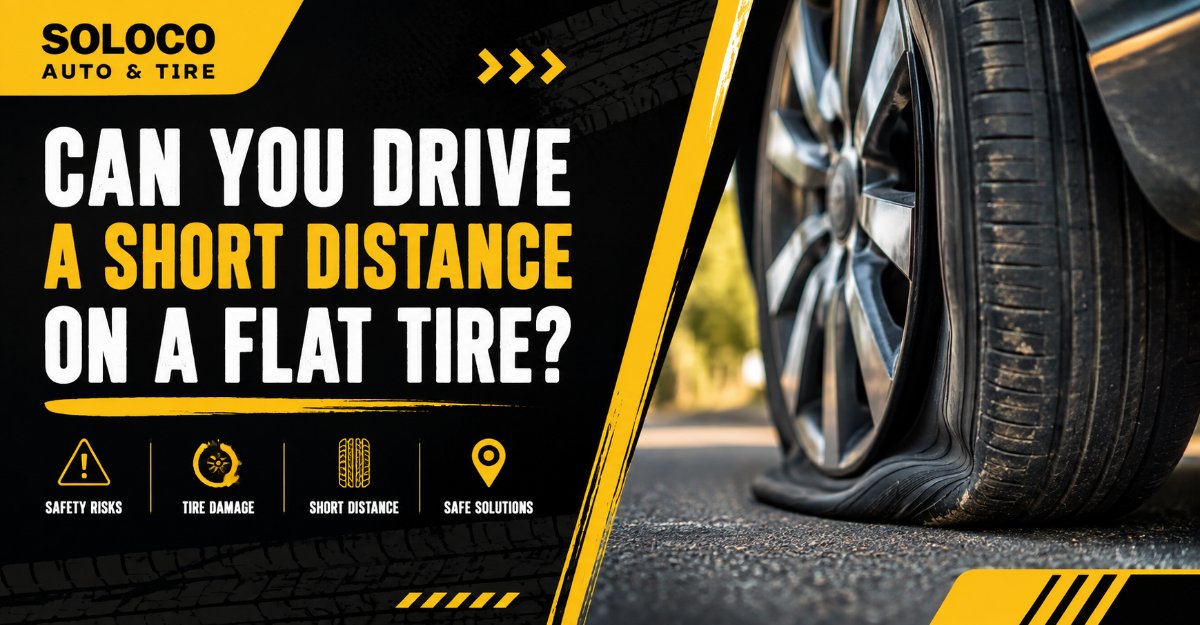
Drivers should never drive on a flat tire because even a short distance causes permanent, irreversible damage to the internal tire structure and wheel rims within blocks.
Operating a vehicle without proper air pressure transfers total weight directly onto unsupported rubber walls, creating extreme heat, friction, and immediate structural breakdown.
At a Glance
- Driving a flat tire further than a few hundred feet destroys the internal cords and shreds the rubber sidewall.
- Standard tires have a maximum safe flat-driving distance of zero miles, with a 5 to 10 mph emergency crawl reserved strictly for hazardous locations.
- Run-Flat tires support vehicle weight without air, allowing travel up to 50 miles at speeds under 50 mph.
- Repairing a punctured tire costs around $20 to $40, while driving on it forces a $100 to $300 tire replacement plus potential $800 rim repairs.
- Emergency exceptions like highway shoulders, blind curves, or active danger zones override the immediate stop rule to prevent catastrophic collisions.
What happens mechanically to a tire when driven flat?
When air pressure drops to zero, the pressurized air cushion vanishes, forcing the wheel rim to press directly into the deflated rubber sidewall. The inner liner and body plies experience intense pinching and crushing forces. As the wheel rotates, the rubber flexes repeatedly at an accelerated rate, generating extreme internal heat that breaks down the chemical bonds of the rubber compound and melts the internal polyester and steel belts.
How far can you drive on a flat tire before total destruction?
Drivers can travel between zero and two hundred feet before irreversible structural damage locks in, though any movement risks the tire. The structural failure timeline unfolds in distinct phases based on distance:
- 0 to 200 feet: The rim presses into the sidewall, leaving the tire potentially repairable if unhitched safely.
- 200 feet to 0.25 miles: Internal friction creates extreme heat, shredding internal rubber and making tire replacement mandatory.
- 0.25 to 0.5 miles: The tire sidewall tears completely apart, forcing the metal wheel rim to slam directly into the asphalt, damaging brakes and suspension components.
How does vehicle weight and temperature change flat tire limits?
Vehicle weight load and ambient temperature directly dictate how fast a flat tire disintegrates. Heavy SUVs, trucks, or vehicles loaded with cargo exert massive downward force, compressing the unsupported sidewall instantly and accelerating structural collapse. Furthermore, driving on hot summer asphalt increases internal friction temperatures, causing the rubber compound to disintegrate twice as fast compared to freezing winter conditions.
Can I drive a few blocks to a gas station for air?
Drivers can only travel to a nearby gas station if the tire is leaking slowly and still retains structural shape and air pressure. If the tire is completely flat and resting on the wheel rim, driving those few blocks will shred the internal structural cords before arrival. This transforms a simple $30 puncture repair into a mandatory tire replacement costing hundreds of dollars.
What are Run-Flat tires and how far can they go flat?
Run-Flat tires feature heavily reinforced sidewalls engineered to support the entire weight of a vehicle even after a complete loss of air pressure. Vehicles equipped with Run-Flat technology can drive up to 50 miles at a maximum speed of 50 mph. Motorists must monitor their instrument cluster dashboard for tire pressure warnings and proceed directly to the nearest tire service center without exceeding speed thresholds.
What happens if you exceed Run-Flat limits?
Exceeding the 50-mile distance limit or the 50 mph speed threshold causes the reinforced internal inserts inside Run-Flat tires to overheat catastrophically. The extreme heat buildup melts the structural sidewall support, leading to a sudden and violent blowout. This loss of structural integrity causes the driver to lose steering control at high speeds, risking a serious accident.
When should you ignore safety rules and drive on a flat tire?
Specific high-risk emergency scenarios override the standard rule to stop immediately. Motorists stuck on a narrow highway shoulder with high-speed traffic flying past should sacrifice a tire and rim by driving slowly to the next exit rather than risking a fatal rear-end collision. Similarly, drivers stranded in zero-occupancy wilderness areas during freezing temperatures can drive slowly to safety to protect personal survival.
How do you handle a flat tire on a blind curve or left lane?
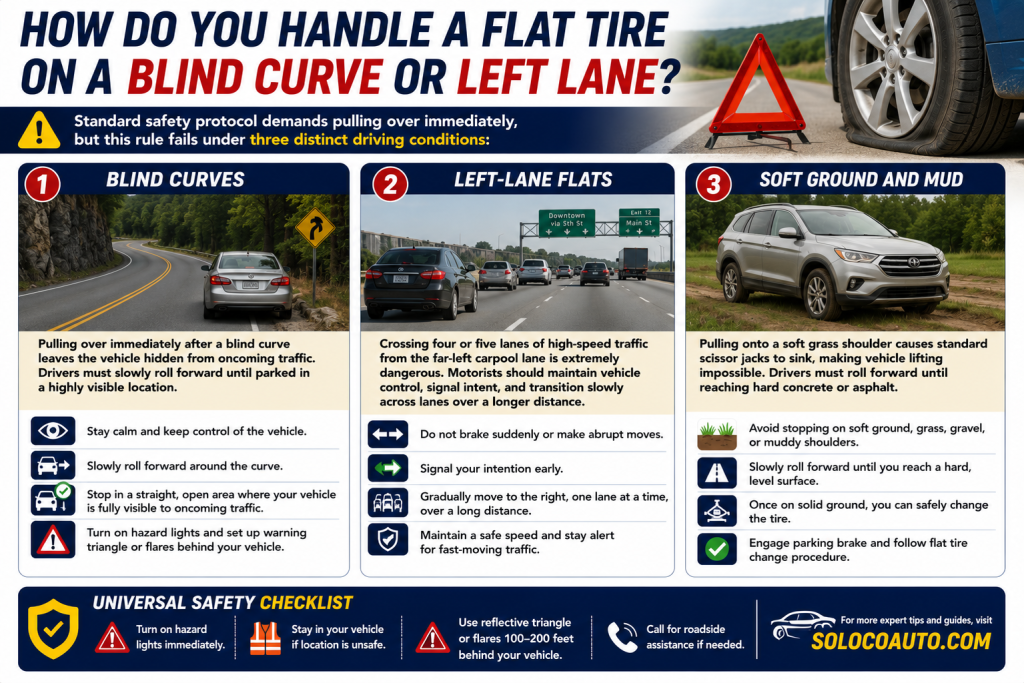
Standard safety protocol demands pulling over immediately, but this rule fails under three distinct driving conditions:
- Blind Curves: Pulling over immediately after a blind curve leaves the vehicle hidden from oncoming traffic. Drivers must slowly roll forward until parked in a highly visible location.
- Left-Lane Flats: Crossing four or five lanes of high-speed traffic from the far-left carpool lane is extremely dangerous. Motorists should maintain vehicle control, signal intent, and transition slowly across lanes over a longer distance.
- Soft Ground and Mud: Pulling onto a soft grass shoulder causes standard scissor jacks to sink, making vehicle lifting impossible. Drivers must roll forward until reaching hard concrete or asphalt.
Will driving on a flat tire ruin my wheel rim?
Driving on a flat tire ruins the wheel rim by allowing the heavy steel or alloy wheel to act like a cookie cutter, chopping through the rubber sidewall. Once the rubber splits completely, the bare metal rim grinds directly against hard pavement. This friction warps the metal wheel flange, creating permanent gashes and structural bends that prevent the rim from ever holding air again.
How do emergency tire sealants change driving distances?
Emergency tire sealant cans inject liquid latex and compressed propellant into a punctured tire to temporarily plug the leak and reinflate the chamber. While sealants can restore enough pressure to drive a short distance to a repair shop, they do not fix structural sidewall damage. Drivers using sealants must still limit speeds to 45 mph and drive fewer than 5 miles to prevent chemical breakdown and wheel corrosion.
What should you do the exact second a tire blows out at high speed?
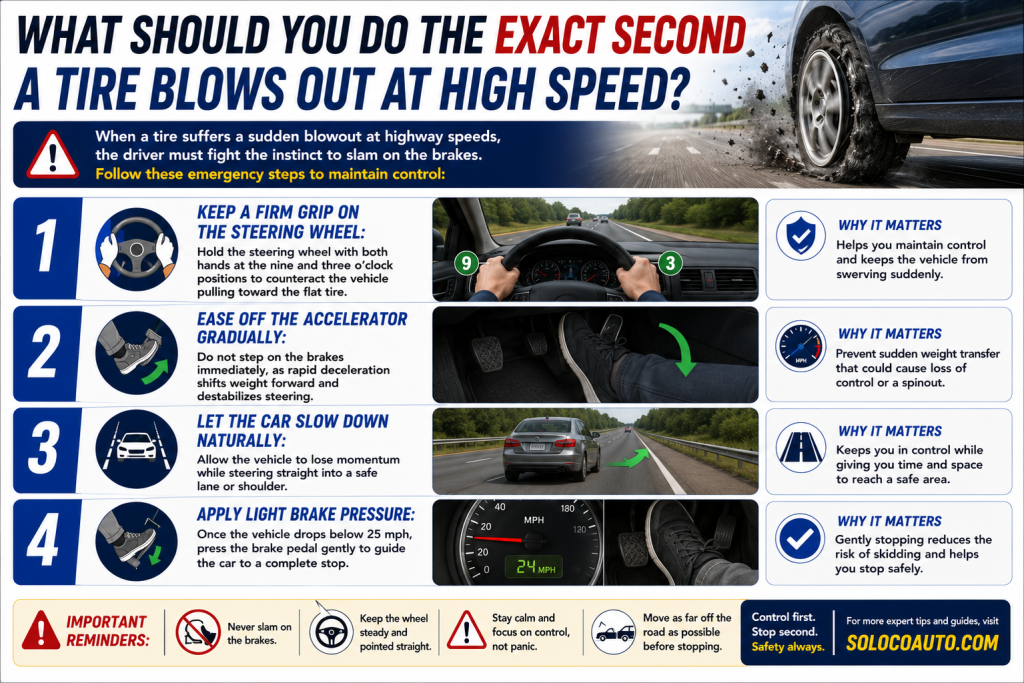
When a tire suffers a sudden blowout at highway speeds, the driver must fight the instinct to slam on the brakes. Follow these emergency steps to maintain control:
- Keep a firm grip on the steering wheel: Hold the steering wheel with both hands at the nine and three o’clock positions to counteract the vehicle pulling toward the flat tire.
- Ease off the accelerator gradually: Do not step on the brakes immediately, as rapid deceleration shifts weight forward and destabilizes steering.
- Let the car slow down naturally: Allow the vehicle to lose momentum while steering straight into a safe lane or shoulder.
- Apply light brake pressure: Once the vehicle drops below 25 mph, press the brake pedal gently to guide the car to a complete stop.
Is it safe to drive on a donut spare tire?
Space-saver donut spare tires are safe for temporary use only if drivers strictly follow the 50/50 rule. Motorists must never exceed 50 mph and must limit total driving distance to 50 miles. Because donut spares are significantly narrower, lighter, and lack the tread depth of standard tires, they reduce braking performance and traction, especially on wet or icy roads.
How much does driving on a flat tire cost in repairs?
Repair and replacement costs escalate dramatically depending on whether the driver stops immediately or continues driving on the flat. Review the cost breakdown below:
| Repair or Replacement Item | Cost Range | Condition Trigger |
| Standard Puncture Repair | $20 to $40 | Tire stopped immediately, hole is in the tread area. |
| New Replacement Tire | $100 to $300+ | Sidewall destroyed from driving short distances. |
| Wheel Rim Replacement | $200 to $800+ | Metal rim ground against pavement, warping the structure. |
Can driving on a severely damaged tire affect auto insurance claims?
Driving on a severely damaged tire can complicate or void auto insurance collision claims if the resulting crash is deemed a result of gross driver negligence. Insurance adjusters inspect vehicle maintenance records and tire conditions after major accidents. Operating a vehicle with known, severe mechanical damage that leads to a loss of control can shift liability onto the driver.
How do you safely pull over when your tire goes flat?
- Activate hazard warning lights: Turn on your emergency flashers immediately to alert surrounding drivers of your reduced speed.
- Signal and scan for a safe zone: Check your mirrors, indicate your direction, and look for a wide shoulder, well-lit parking lot, or off-ramp.
- Steer smoothly out of traffic: Guide the vehicle off the active roadway while maintaining steady steering control.
- Engage the parking brake: Shift the transmission into park and pull the parking brake lever firmly before exiting the vehicle on the side away from traffic.
The Bottom Line
Driving on a flat tire is never recommended because structural failure occurs within the first few hundred feet, turning an inexpensive patch into a costly wheel replacement.
While safety exceptions exist for active highway danger zones, blind curves, or specialized Run-Flat tires, standard tires require an immediate and safe stop.
Prioritizing vehicle control and prompt roadside assistance saves hundreds of dollars in repair bills and prevents severe accidents.


