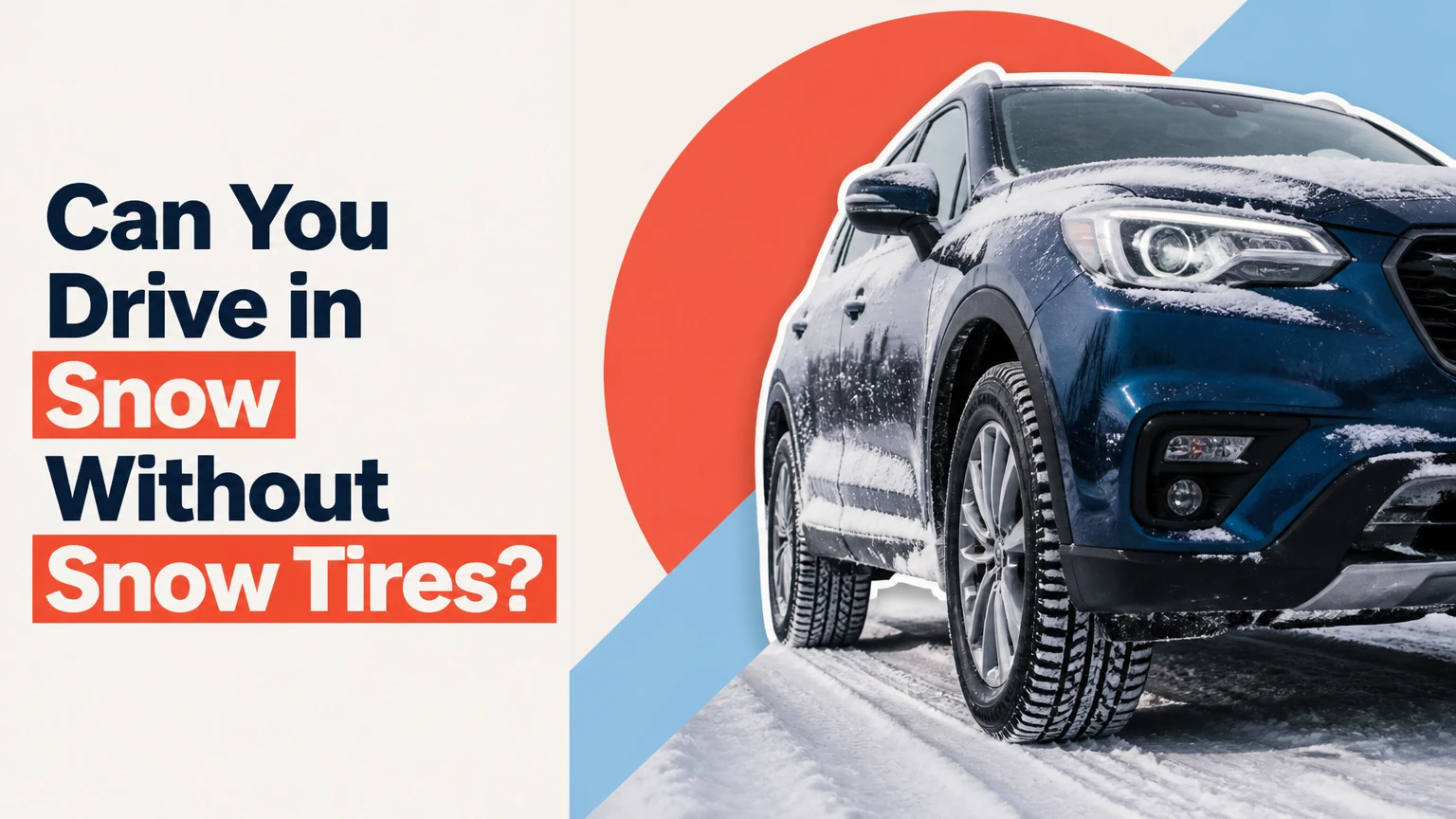
Yes, you can drive in snow without snow tires, but the trip is safe only when road conditions, tire condition, speed, and stopping distance remain manageable. All-season tires may handle a thin layer of fresh snow, while summer tires, worn tires, packed snow, ice, steep grades, and heavy snowfall can make driving unsafe even with AWD.
Key Facts at a Glance
Winter tires remain more flexible than many all-season and summer tires in freezing conditions, improving traction for braking, steering, and acceleration.
All-wheel drive helps a vehicle move away from a stop, but it does not provide extra tire grip for braking or cornering.
The 3PMSF symbol identifies a tire that meets a standardized severe-snow traction test; it does not make the tire identical to a dedicated winter tire.
Tire chains can provide strong traction in deep snow, but they require correct fitment, clearance, installation, and compliance with local speed and road rules.
Snow socks are emergency traction aids for short, low-speed use on snow-covered roads, not a substitute for winter tires.
A vehicle with low tread, incorrect pressure, exposed damage, or tires older than the manufacturer’s recommended service period should not be used for a marginal winter trip.
Can You Drive in Snow Without Snow Tires?
You can drive in light snow without snow tires if your tires are in good condition, roads are treated or mostly clear, visibility is adequate, and you can travel slowly without urgent stopping or steep climbing. Do not make that choice for ice, deep snow, mountain passes, freezing rain, or an active storm when postponing the trip is possible.
The central issue is available tire-road friction. A modern vehicle can have ABS, electronic stability control, traction control, and AWD, but those systems cannot create grip that the tire cannot transmit to the pavement. They can help a driver retain control within the tire’s limits; they cannot remove those limits.
A short trip through two centimeters of fresh snow is materially different from a commute over polished, hard-packed snow. Road temperature, tire compound, tread depth, traffic, grade, and the opportunity to stop safely all matter more than the vehicle badge.
Is it legal to drive without winter tires?
Driving without winter tires is legal in some jurisdictions and restricted in others, especially on designated mountain routes or during posted winter-tire periods. Canada’s Quebec, British Columbia, and several mountain jurisdictions have rules that differ by date, road, vehicle, tire marking, or weather condition, so check the applicable transportation department before traveling.
Legal does not mean advisable. A driver may still face a citation, insurance complications, blocked access, or liability questions after a collision if local requirements or road-control instructions were ignored. Rental-car contracts can impose stricter requirements than the law.
Why Do Winter Tires Grip Better?
Winter tires combine a cold-weather rubber compound, flexible tread blocks, deeper grooves, and dense siping to preserve traction below freezing. Their design helps the tire conform to rough ice and snow, evacuate slush, and generate mechanical edges that ordinary all-season or summer tires may lack.
The commonly cited 7°C, or 45°F, threshold is a useful changeover guideline, not a switch that makes every all-season tire suddenly unusable. Tire compounds differ, pavement temperatures lag air temperatures, and a premium all-season tire can outperform an old winter tire with poor tread. Below-freezing conditions still generally favor a true winter compound.
Snow traction also comes from snow packing inside tread grooves. Compacted snow can adhere to snow on the road more effectively than smooth rubber adheres to snow. Sipes open under load and create additional biting edges, while tread voids help clear slush.
The “hydroplaning on ice” explanation needs precision. A thin water film can reduce ice friction, but tire failure on ice is not simply ordinary highway hydroplaning. Smooth ice, temperature, pressure, surface texture, and tread compound all affect the contact patch. Sipes help, but they do not make ice safe.
What do the tire markings mean?
The 3PMSF symbol, a mountain outline containing a snowflake, indicates that a tire passed a standardized severe-snow traction test under the applicable tire regulations. The M+S marking means mud and snow suitability under a manufacturer-defined tread criterion, but it does not equal the severe-snow certification.
All-weather tires commonly carry 3PMSF certification and remain installed year-round. Dedicated winter tires also carry 3PMSF, but they use a more cold-focused compound and tread design. A 3PMSF tire is therefore a screening signal, not a complete performance ranking.
| Marking or tire type | Cold-weather design | Snow certification | Typical best use |
|---|---|---|---|
| Summer tire | Optimized for warm pavement | No | Above roughly 7°C/45°F |
| M+S all-season | Moderate cold flexibility | Usually no 3PMSF | Rain, clear roads, light occasional snow |
| 3PMSF all-weather | Year-round compound with severe-snow traction | Yes | Variable climates and moderate winters |
| Dedicated winter tire | Cold-flexible compound and dense siping | Yes | Frequent snow, ice, and freezing temperatures |
| Studded winter tire | Winter compound plus metal studs | Yes, where certified | Glare ice and severe winter routes |
Which Tires Can Handle Snow Without Dedicated Winter Tires?
A 3PMSF all-weather tire is the strongest year-round alternative to a dedicated winter tire for drivers who face occasional or moderate snow. A conventional M+S all-season tire can manage limited fresh snow at low speed, but it offers less winter margin as temperatures fall and surfaces become packed or icy.
Summer tires are the poorest choice. Their tread and compound prioritize warm, dry handling, and many manufacturers advise against using them in near-freezing conditions. Even a small amount of snow can overwhelm their available traction.
Tire condition can reverse the expected ranking. A new, properly inflated all-season tire with 8 millimeters of tread may be safer in a light snowfall than a 10-year-old winter tire with 3 millimeters of tread. Replace tires with visible cracking, bulges, cords, uneven wear, or tread at or near the legal minimum.
| Tire choice | Fresh snow | Packed snow | Ice | Year-round practicality | Typical installed cost |
|---|---|---|---|---|---|
| Summer tires | Poor below 7°C/45°F | Very poor | Very poor | Low | $500-$1,200 per set |
| M+S all-season | Fair at low speed | Poor | Poor | High | $500-$1,100 per set |
| 3PMSF all-weather | Good | Fair to good | Fair | Very high | $650-$1,400 per set |
| Dedicated winter tires | Very good | Very good | Good | Low in warm seasons | $700-$1,600 per set |
| Studded winter tires | Very good | Excellent | Excellent on permitted ice | Low | $800-$1,800 per set |
Costs are typical North American retail ranges for four tires, mounting, balancing, and basic installation. Wheel size, vehicle class, brand, taxes, storage, and regional demand can change the total substantially.
How Should You Drive in Snow Without Winter Tires?
Drive at a speed that preserves a visible escape path, increase the gap to at least eight seconds, and complete most braking before entering a turn. Smooth steering, throttle, and braking inputs matter because sudden control movements can exceed the limited friction available to ordinary tires.
Use this operating sequence:
- Check the trip first. Delay the journey if authorities advise against travel, roads are closed, freezing rain is falling, or you cannot identify a safe stopping point. A shorter route is not automatically safer if it includes a steep untreated grade.
- Inspect the tires. Set pressure to the vehicle-door placard specification, measure tread, check for damage, and confirm all four tires match the vehicle’s required size and load rating. Do not reduce pressure to gain snow traction.
- Clear the vehicle. Remove snow and ice from every window, mirror, lamp, roof, hood, radar panel, and camera. Snow falling from the roof can blind the driver behind you or slide over your own windshield during braking.
- Accelerate gently. Apply light throttle and let the transmission select a low gear. A manual vehicle may pull away in second gear when the owner’s manual permits it, but forcing a high gear can cause lugging and loss of control.
- Look far ahead. Release the accelerator early for intersections, bends, stopped traffic, and downhill sections. Coasting reduces the need for abrupt braking.
- Brake in a straight line. Press the brake firmly enough for ABS to operate during an emergency stop, keep steering input controlled, and do not pump an ABS pedal. ABS helps preserve steering while braking, but it cannot shorten every slippery-road stop.
- Turn smoothly. Slow before the bend, use a small steering angle, and apply power only after the vehicle is aligned. Combining heavy braking with sharp steering consumes the same limited traction twice.
- Manage speed, not the posted maximum. On snow or ice, a speed that feels normal on dry pavement may be excessive. Following distance must allow for much longer stopping and for other drivers losing control.
The often-repeated “quintuple the following distance” rule is a useful conservative target, not a physics constant. Eight to ten seconds may still be inadequate on glare ice, where the correct gap is the one that allows you to stop without contact.
What should you do if the vehicle starts to skid?
If the vehicle skids, ease off the accelerator, look toward the intended path, and steer smoothly in that direction without making a sudden correction. During a front-wheel skid, reduce steering input and wait for the front tires to regain grip; during a rear-wheel skid, a measured countersteer may be needed, followed by straightening the wheel as the vehicle recovers.
Do not yank the parking brake, shift abruptly into park, or stare at the obstacle. If ABS activates, maintain firm brake pressure and steer around the hazard. Electronic stability control should normally remain on because it can reduce engine torque and selectively brake wheels during a loss of control.
Does AWD Make Snow Tires Unnecessary?
AWD does not make snow tires unnecessary because all vehicles already use four-wheel braking, while stopping and cornering depend on the grip available at each tire. AWD improves propulsion when one or more drive wheels would otherwise spin, but it cannot overcome polished ice or worn tread.
Michelin summarizes the distinction in its winter-driving guidance: “AWD helps you accelerate, but it does not help you stop.” The statement applies equally to many 4WD systems. Four driven wheels can make a vehicle feel confident during acceleration, which can encourage a speed that the tires cannot support when braking begins.
| Vehicle and tire setup | Pulling away | Braking | Cornering | Practical winter verdict |
|---|---|---|---|---|
| FWD with all-season tires | Fair | Fair to poor | Fair to poor | Light snow only |
| AWD with all-season tires | Good | Fair to poor | Fair to poor | Better launch, same tire limit |
| FWD with winter tires | Very good | Very good | Very good | Strong balanced setup |
| AWD with winter tires | Excellent | Very good | Very good | Best severe-winter margin |
| RWD with all-season tires | Poor to fair | Fair to poor | Fair to poor | Extra caution on grades |
Vehicle weight also creates misleading confidence. A heavier SUV may take longer to stop than a lighter car when both use similar tires, and a high center of gravity can make abrupt maneuvers less forgiving.
Are Chains or Snow Socks Better Alternatives?
Chains provide more durable traction in deep snow and on steep grades, while snow socks install faster and suit short emergency movements on snow-covered pavement. Neither option replaces winter tires, and both must match the vehicle’s clearance, drive axle, tire size, speed limit, and local legal requirements.
Read the owner’s manual before buying chains. Some vehicles permit chains only on a specific axle, require low-profile cable chains, or prohibit them because suspension, brake, or wheel-well clearance is insufficient. Installing chains on the wrong axle can damage the vehicle or reduce control.
Remove chains when reaching bare pavement. Snow socks can shred quickly on dry asphalt, and chains can damage pavement, tires, wheel wells, or suspension components when driven too fast.
| Traction aid | Typical purchase cost | Typical installation | Suitable surface | Main limitation |
|---|---|---|---|---|
| Cable chains | $50-$180 per pair | 15-30 minutes | Snow and some ice | Less durable than link chains |
| Link chains | $80-$300 per pair | 15-30 minutes | Deep snow and steep grades | Clearance and pavement damage |
| Snow socks | $50-$150 per pair | 5-10 minutes | Snow-covered pavement | Rapid wear on dry roads |
| Automatic tire chains | $500-$2,000 installed | Permanent system | Frequent commercial use | High cost and vehicle-specific fit |
| 3PMSF all-weather tires | $650-$1,400 per set | 45-90 minutes once | Mixed winter roads | Less ice grip than winter tires |
Practice fitting chains or socks in dry weather before an emergency. Cold fingers, darkness, slush, and roadside traffic turn a five-minute advertised installation into a difficult task.
What If You Get Stuck in Snow?
If a vehicle gets stuck, stop spinning the tires, clear snow from around the drive tires, straighten the wheels, and create a low-speed path before attempting to move again. Continuous wheelspin polishes snow into ice, increases heat in the drivetrain, and can bury the vehicle more deeply.
Use the following recovery method:
- Turn off accessories and keep the exhaust pipe clear to prevent carbon monoxide entering the cabin.
- Clear packed snow from beneath the bumper, tires, and chassis with a shovel.
- Place purpose-built traction boards, approved grit, or a properly secured mat under the drive tires.
- Use the lowest suitable gear and apply gentle throttle.
- Rock the vehicle only if the owner’s manual permits it, alternating forward and reverse with a complete stop between selections.
- Disable traction control temporarily only when the manual specifically allows it and wheelspin is preventing movement. Re-enable it immediately after freeing the vehicle.
- Call roadside assistance instead of digging beneath a heavy vehicle without proper support.
Floor mats are a poor emergency substitute. They can be pulled under a tire, damaged, or thrown backward, and they may create a hazard when returned to the driver’s footwell. Traction boards and a compact shovel are safer preparations.
When Should You Avoid Driving Without Snow Tires?
Avoid driving when snow or ice prevents you from seeing pavement, when roads are untreated and steep, when freezing rain is active, or when the journey requires highway speed during a fast-moving storm. The safest winter-driving decision is often postponement, especially when the vehicle has summer or worn all-season tires.
Use this go-or-no-go screen:
| Condition | Proceeding without winter tires | Safer decision |
|---|---|---|
| 1-2 cm fresh snow, treated urban roads | Possible at low speed | Drive only if essential |
| 5-10 cm snow, clear visibility | Marginal | Wait or use winter-equipped transport |
| Hard-packed snow with polished wheel tracks | Unsafe for ordinary tires | Postpone |
| Freezing rain or glare ice | Unsafe | Do not drive |
| Steep untreated hill | High risk of stopping or sliding | Use chains if legal and approved |
| Mountain pass warning or closure | Not acceptable | Follow official closure |
| Snow-covered highway with limited visibility | High risk | Delay and monitor authorities |
A vehicle can begin the trip successfully and still become unsafe after temperature drops, snow accumulates, or traffic compresses the surface. Check the road forecast at departure and again before returning; the return leg frequently occurs after darkness and refreezing.
What vehicle preparation changes the decision?
Correct pressure, adequate tread, working lights, clean glass, a full or near-full fuel tank, and an emergency kit materially improve winter resilience. Carry a shovel, gloves, flashlight, reflective warning device, blanket, water, charger, and a method of contacting help.
Tire pressure usually falls about 1 psi for each 10°F drop in temperature, although the exact change varies with the tire and measurement conditions. Check pressure when the tires are cold and use the vehicle placard, not the maximum pressure molded into the sidewall.
Never mix a single winter tire with three non-winter tires. Install matching tires as a complete set unless the vehicle manufacturer and tire professional specify an alternative arrangement, because unequal grip can destabilize braking and cornering.
Which Winter-Tire Option Fits Your Climate?
Choose dedicated winter tires for frequent snow, ice, sustained freezing temperatures, or mountain travel; choose 3PMSF all-weather tires for moderate winter conditions without seasonal tire changes; use conventional all-seasons only for occasional light snow on mostly clear roads. Chains or socks supplement the decision for specific routes.
Occasional urban snow
A driver who sees one to three minor snow events each year may keep good all-season tires, a properly sized set of snow socks, and a shovel in the vehicle. That arrangement does not make an active storm safe; it addresses a short trip after snowfall when roads are already passable.
Variable climate
A driver who experiences repeated cold mornings, occasional moderate snow, and warm summers may prefer 3PMSF all-weather tires. The trade-off is faster warm-weather wear and generally less dry-road performance than a dedicated summer or touring all-season tire.
Frequent severe winter
A driver facing regular packed snow, ice, freezing temperatures, or mountain passes should use four dedicated winter tires and retain approved chains when route rules require them. Seasonal storage and two annual changeovers add cost, but the benefit is available during braking and steering, not merely during acceleration.
Rental cars and borrowed vehicles
Inspect the tire sidewalls and tread before leaving a rental facility. Ask whether the vehicle has winter or all-weather tires, whether chains are permitted, and whether the contract prohibits mountain roads or requires specific equipment. AWD on a rental car is not evidence of winter readiness.
How Much Do Winter Options Cost?
A seasonal winter setup typically costs $700-$1,600 for four dedicated tires plus approximately $80-$200 for two annual mount-and-balance services, while all-weather tires avoid seasonal changes but may cost $650-$1,400 initially. Storage, wheels, taxes, tire repairs, and vehicle size can materially change those totals.
| Setup | Typical initial cost | Recurring annual cost | Changeover frequency | Expected trade-off |
|---|---|---|---|---|
| Existing all-seasons | $0 | $0-$100 maintenance | None | Lowest cost, least winter margin |
| 3PMSF all-weather | $650-$1,400 | $0-$100 maintenance | None | Convenience, moderate winter performance |
| Winter tires on existing wheels | $700-$1,600 | $160-$400 | Twice yearly | Strong winter grip, extra labor |
| Winter tires on spare wheels | $900-$2,100 | $0-$250 | Twice yearly | Faster changes, higher upfront cost |
| Chains plus existing tires | $50-$300 | $0-$50 replacement | Per storm | Route-specific traction, difficult fitting |
Winter tires also wear during warm weather. Remove them when sustained temperatures remain well above freezing, following the manufacturer’s guidance, because warm pavement accelerates tread wear and reduces handling precision.
Common Mistakes That Make Snow Driving Worse
Mistake 1: Treating AWD as a stopping system. AWD can increase launch confidence, so drivers often travel too quickly. Correct the error by setting speed according to stopping distance, not acceleration ability.
Mistake 2: Using the 7°C rule as a binary test. A tire does not instantly lose all grip at 6°C. Treat 7°C as a practical changeover reference, then weigh road surface, tire condition, precipitation, and local temperatures.
Mistake 3: Installing chains without checking clearance. A chain that contacts a strut, brake line, or wheel arch can cause expensive damage within seconds. Confirm the owner’s manual and test-fit before the storm.
Mistake 4: Braking late because ABS is available. ABS helps maintain steering during hard braking, but it does not repeal low friction. Slow earlier and keep the wheels pointed where you need to go.
Mistake 5: Leaving snow on the roof. Roof snow can slide over the windshield during a stop and can strike another vehicle. Clear the entire vehicle, not only the driver’s viewing area.
Mistake 6: Disabling stability systems permanently. Traction-control intervention can sometimes impede extraction from deep snow, but stability control should normally remain active during travel. Follow the vehicle manual, then restore the system after recovery.
FAQ
Can you drive on snow with all-season tires?
You can drive on a thin layer of fresh snow with healthy all-season tires when roads are level, visibility is good, and speed remains low. Conventional all-seasons provide less cold-weather and packed-snow traction than winter or 3PMSF all-weather tires, so avoid ice, steep grades, heavy accumulation, and urgent trips.
Are all-weather tires the same as snow tires?
All-weather tires are not identical to dedicated snow tires. Both may carry the 3PMSF symbol, but dedicated winter tires generally use a softer cold-weather compound and more winter-focused tread, while all-weather tires balance snow performance with warmer-weather handling and year-round service.
Can you use summer tires in snow?
Summer tires should not be used in snow or near-freezing winter conditions unless a manufacturer specifically approves that operation. Their tread and compound are designed for warm pavement, and traction can become inadequate for acceleration, braking, and steering even before snow accumulates.
How long does it take to install tire chains?
Installing tire chains typically takes 15-30 minutes per vehicle after practice, although cold, darkness, tight wheel wells, and roadside conditions can extend that time. Practice at home, carry gloves, stop in a safe pullout, and verify the chain tension after moving a short distance.
Do winter tires improve braking on ice?
Winter tires generally improve braking and steering on cold, snow-covered, and icy surfaces compared with many all-season tires, but they cannot make glare ice safe. Speed, road temperature, tire age, tread depth, ABS operation, and the specific tire model determine the actual stopping distance.
Should you drive during a snowstorm with AWD?
You should not drive during an active snowstorm merely because the vehicle has AWD. AWD may help the vehicle start moving, but winter tires, visibility, road treatment, speed, following distance, and the ability to stop safely determine whether the trip is reasonable.
The Bottom Line
Can you drive in snow without snow tires? Sometimes, but only in light, manageable conditions with sound tires, reduced speed, clear visibility, and a route that does not require aggressive braking or steep climbing. Conventional all-seasons are a limited compromise, 3PMSF all-weather tires provide more year-round winter margin, and dedicated winter tires remain the safest choice for frequent snow, ice, or freezing temperatures. When conditions exceed the tires’ grip, postpone the trip rather than relying on AWD, ABS, chains, or driving skill to compensate.