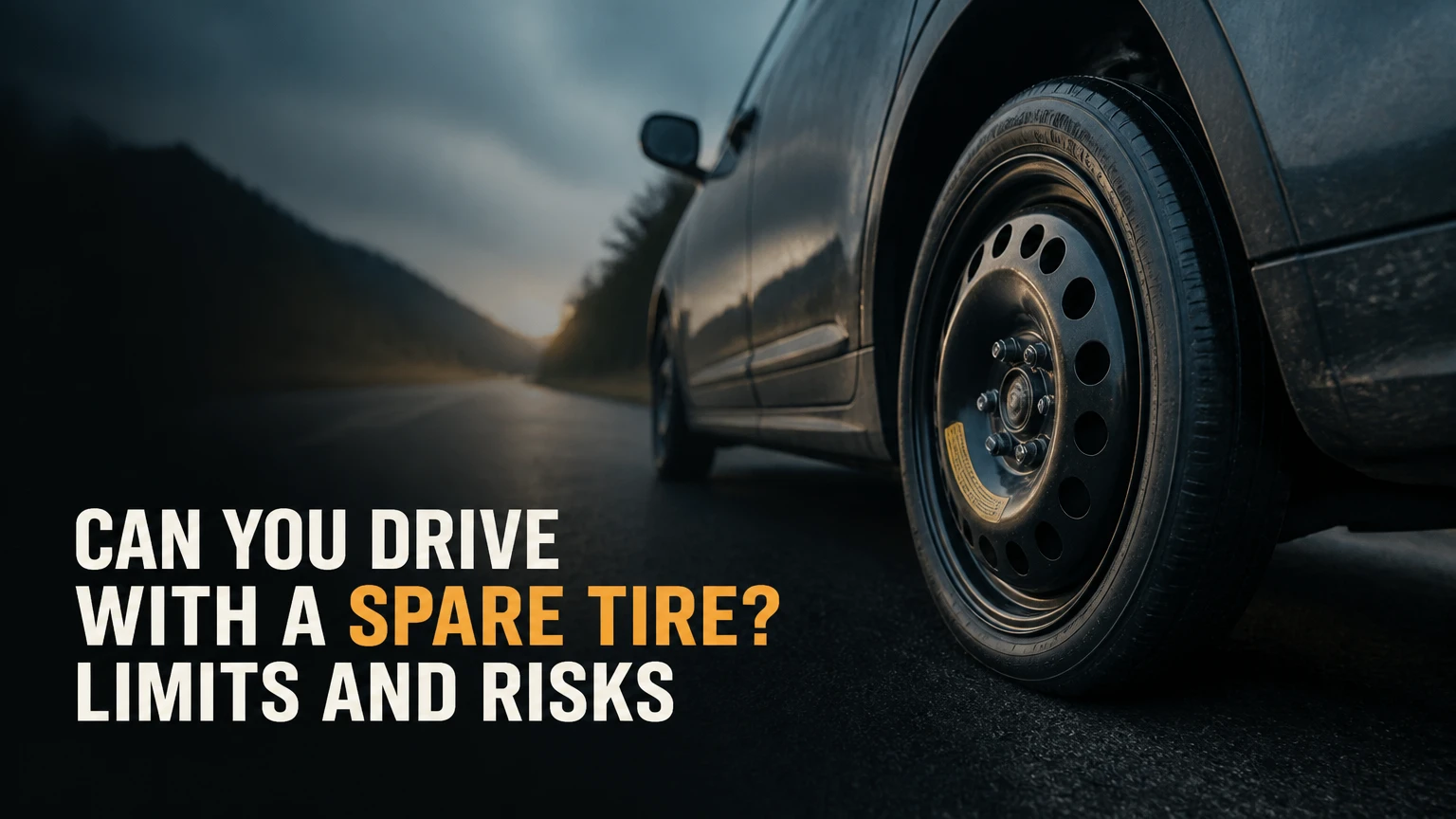
Yes, you can usually drive with a spare tire, but only as a temporary emergency measure and within the limit printed in the vehicle owner’s manual or on the spare’s sidewall. A compact temporary spare commonly permits up to 50 mph and roughly 50 miles, while a matching full-size spare may be driven like the other tires when its pressure, load rating, and condition are correct.
Key facts at a glance
A compact temporary spare commonly has a maximum speed of 50 mph (80 km/h), but the sidewall and owner’s manual control.
A donut spare is intended to reach a tire shop, not to replace a normal tire for commuting or road trips.
A spare tire must be inflated to its specified cold pressure before driving; compact spares often require 60 psi, but not every model does.
A mismatched spare can affect braking, steering, ABS, traction control, and AWD or 4WD components.
A front-wheel-drive vehicle often needs a temporary spare installed on the rear axle, but the correct procedure depends on the manufacturer.
A tire with a sidewall blowout, damaged wheel, unsafe roadside location, or unavailable jack point may require towing instead of a roadside change.
Can You Drive With a Spare Tire?
A driver can use a spare tire to travel from a disabled vehicle to a safe location or tire-repair facility, provided the spare is serviceable and the vehicle remains within its specified limits. A compact donut changes the vehicle’s handling and should be driven slowly, gently, and only far enough to obtain a permanent repair.
A spare wheel is an emergency replacement for a punctured, cut, or otherwise unusable road tire. It restores mobility, but it does not necessarily restore the vehicle’s original braking balance, cornering grip, ground clearance, or electronic-system calibration.
The familiar 50/50 rule is useful for many compact temporary spares: no more than 50 mph and no more than 50 miles. It is not a universal law. Some manufacturers specify a lower speed, shorter distance, or a different procedure, especially for performance cars, AWD vehicles, and vehicles with unusual wheel sizes.
Michelin’s guidance describes a temporary spare as a tire intended “only for emergency use.” That wording captures the practical rule: the repair destination matters more than completing the journey.
What Determines the Safe Limit?
The safe limit comes from the lowest applicable specification among the spare tire, vehicle, wheel, and route conditions. A 50-mph sidewall marking does not make 50 mph safe if the spare is underinflated, overloaded, badly aged, or fitted to a vehicle whose manual imposes a lower limit.
Check four sources before moving:
- The spare’s sidewall: Find the maximum speed, temporary-use warning, and required cold inflation pressure.
- The owner’s manual: Confirm axle placement, distance, speed, and AWD instructions.
- The driver’s door-jamb label: Use the vehicle’s recommended pressures, except where the spare has a separate pressure specification.
- The wheel and tire markings: Confirm that the spare’s load capacity and wheel fitment suit the vehicle.
How Does a Spare Tire Affect the Vehicle?
A temporary spare affects the vehicle through a smaller contact patch, different rolling circumference, altered sidewall stiffness, and a different tread compound. Those changes can lengthen braking, reduce wet or snow traction, increase steering effort or sensitivity, and cause the vehicle to pull or feel unstable.
A smaller tire rotates more times per mile than a standard tire. On a driven axle, the differential allows left and right wheels to rotate at different speeds, but a large and persistent circumference mismatch can create heat and wear. AWD and some 4WD systems are more sensitive because they connect additional axles through a center differential, clutch pack, or transfer case.
Electronic systems also detect wheel-speed differences. ABS, electronic stability control, and traction control may illuminate warning lamps or intervene unexpectedly when one wheel has a significantly different rolling diameter. A warning light does not automatically mean damage has occurred, but it requires careful driving and prompt inspection.
A donut is especially poor at high-speed lane changes, hard braking, standing water, loose gravel, and snow. A normal tire may have a contact patch about 7-9 inches wide, while a compact spare can be substantially narrower, depending on the vehicle.
Why Is AWD More Sensitive?
AWD vehicles can suffer drivetrain stress from mismatched tire circumferences, even when the compact spare is installed correctly. The risk depends on the vehicle’s allowable circumference difference, the tire wear on the remaining wheels, driving distance, road speed, and whether the AWD system is always engaged or electronically controlled.
Some manufacturers prohibit a compact spare on an AWD vehicle. Others permit it only on a specified axle and for a short distance. Subaru, BMW, Mercedes-Benz, Audi, and other manufacturers have model-specific procedures, so a generic 50-mile rule cannot override the manual.
Practitioner rule: If an AWD vehicle has one flat tire and the manual does not clearly approve the spare, choose a tow truck. Replacing or shaving a matching tire may be cheaper than repairing a damaged transfer case or center differential.
Which Spare Tire Types Can You Drive On?
The main categories are compact temporary spares, matching full-size spares, non-matching full-size spares, run-flat tires, and tire-repair kits. Each category has a different failure mode, and the word “spare” alone does not identify a safe speed or distance.
| Spare or alternative | Typical operating limit | Main restriction | Best emergency destination |
|---|---|---|---|
| Compact temporary donut | 50 mph, often about 50 miles | Narrow tread and different diameter | Nearest tire shop |
| Matching full-size spare | Vehicle speed limit when correctly matched | Must meet size, load, speed, and pressure specifications | Tire shop or normal travel |
| Full-size non-matching spare | Manual and sidewall limits | Tread, diameter, axle, and traction differences | Tire shop, not permanent use |
| Run-flat tire | Commonly 50 mph for 50 miles | Manufacturer-specific distance and pressure conditions | Tire shop |
| Sealant and compressor kit | Often 50 mph after repair | Small tread punctures only; temporary seal | Tire shop |
| Roadside tow | No tire-driving limit | Requires safe stopping and service access | Approved repair facility |
What Is a Compact Temporary Spare?
A compact temporary spare, commonly called a donut, is a narrow emergency tire mounted on a lightweight wheel. The design reduces storage space and vehicle weight, but its smaller tread and different rolling diameter make it unsuitable for normal driving.
The correct pressure is often much higher than the pressure of the regular tires. A compact spare may require 60 psi, , or another value printed on its sidewall. Never estimate this pressure from the door label or from the appearance of the tire.
A donut is a poor choice for a long motorway trip, mountain pass, heavy rain, snow, towing, or a vehicle carrying its maximum payload. If a front tire fails on many FWD vehicles, the recommended method is to move a full-size rear tire to the front and install the donut on the rear, because steering and braking remain on the full-size tires. The manual controls.
Is a Full-Size Matching Spare Safer?
A full-size matching spare is generally the closest replacement to the road tires when it matches their size, construction, load index, speed rating, wheel diameter, and tread type. It can normally tolerate ordinary driving better than a donut, but the tire still needs correct pressure, adequate tread, and acceptable age.
A matching spare in a five-tire rotation receives regular wear, so its circumference remains closer to the other four tires. A full-size spare stored for years outside the rotation may have a different tread depth or an aged rubber compound, even if it looks identical.
“Full-size” describes dimensions, not full compatibility. A tire with the same diameter but a lower load index, different wheel offset, damaged bead, or incompatible brake clearance is not a safe substitute.
Can You Drive on a Full-Size Non-Matching Spare?
A full-size non-matching spare can usually take the vehicle to a repair facility when its dimensions and ratings are approved, but it is not automatically suitable for unlimited travel. Different tread patterns, tire compounds, circumferences, and wheel constructions can alter traction and trigger ABS or stability-control warnings.
Do not use a non-matching spare indefinitely because uneven tread wear can increase the circumference difference over time. Avoid towing, aggressive cornering, high-speed travel, and severe weather until the original tire is repaired or replaced.
How Fast and How Far Can You Drive on a Spare?
A compact donut commonly allows a maximum of 50 mph and approximately 50 miles, but the sidewall and owner’s manual may specify less. A driver should treat those figures as an upper boundary, not a target, and should reduce speed further for rain, snow, curves, heavy cargo, or poor road surfaces.
| Driving condition | Sensible temporary approach | Reason |
|---|---|---|
| Dry city streets | 35-45 mph when traffic permits | Lower heat and cornering load |
| Dry highway section | Stay below the spare’s posted maximum | Use only to reach the next safe exit or shop |
| Heavy rain | Reduce speed substantially or stop for assistance | Narrow tread loses wet grip sooner |
| Snow or ice | Avoid driving on a donut | Braking and stability margins are poor |
| Heavy cargo or towing | Do not tow; reduce load if possible | Spare load capacity may be limited |
| AWD or 4WD mismatch | Follow manual, otherwise tow | Drivetrain limits vary by model |
The distance limit includes every mile driven after installation, including the route to a safe parking area and a tire shop. A spare that has already traveled 35 miles has about 15 miles remaining under a 50-mile instruction, not a new 50-mile allowance after stopping.
How Long Can a Spare Stay on the Vehicle?
A temporary spare should normally remain installed only until the damaged tire is repaired or replaced, preferably the same day. A delay of several days may be unavoidable, but continuing for weeks increases exposure to potholes, weather, tread wear, and mechanical stress.
A tire shop may repair a puncture in the central tread if the damage is within accepted repair limits and the tire was not driven severely underinflated. A sidewall puncture, shoulder damage, exposed cords, bead damage, or blowout usually requires replacement rather than a plug-only repair.
Where Should You Install a Donut Spare?
The correct axle depends on the vehicle’s drivetrain and manufacturer procedure, but a temporary spare is commonly kept off the front axle of a front-wheel-drive vehicle. If a front tire fails, many manuals direct the driver to move a full-size rear tire to the front and fit the donut on the rear.
| Vehicle situation | Common manufacturer-style procedure | Required verification |
|---|---|---|
| FWD, rear tire flat | Install donut at the rear | Manual and wheel-direction instructions |
| FWD, front tire flat | Move full-size rear tire to front, donut to rear | Manual, especially with directional tires |
| RWD, front tire flat | Donut may remain at front if approved | Manual and steering clearance |
| RWD, rear tire flat | Confirm driven-axle restriction | Manual and traction-control guidance |
| AWD or 4WD, any tire flat | Use only an approved spare procedure | AWD circumference and axle instructions |
| Directional tire or staggered wheels | Follow exact tire-position rules | Tire arrows, wheel size, and manual |
The rear axle is often preferred for a temporary spare because rear tires do not control steering, but drivetrain requirements can override that preference. Never place a directional tire backward unless the manufacturer’s emergency procedure permits it.
How Do You Change a Flat Tire Safely?
Changing a spare tire usually takes 20-40 minutes with the supplied jack and tools, although roadside traffic, rusted lug nuts, darkness, and an inaccessible wheel can make towing safer. The most important factor is not speed; it is securing the vehicle on firm, level ground away from moving traffic.
Before You Start
| Requirement | Typical specification |
|---|---|
| Time | 20-40 minutes |
| Tools | Jack, lug wrench, spare, gloves, flashlight |
| Safety equipment | Warning triangle, reflective vest, wheel chock |
| Vehicle condition | Park brake engaged, transmission in Park or first gear |
| Surface | Firm, level ground away from traffic |
| Cost | $0 with supplied tools, or about $75-$150 for roadside service in the USA |
Do not change a tire in a live traffic lane, on soft soil, near a blind curve, or where the jack cannot sit vertically. Call roadside assistance if the shoulder is narrow, the wheel is damaged, the vehicle is loaded beyond safe lifting conditions, or you cannot identify the jack point.
Step 1: Secure the Vehicle
Turn on the hazard lights, move as far from traffic as possible, apply the parking brake, and select Park or first gear. Ask passengers to leave the vehicle only when a safe area exists.
Success checkpoint: The vehicle is stationary, visible, and positioned on firm ground.
Common mistake: Working beside traffic without placing warning devices where local rules permit.
Step 2: Check the Spare and Loosen the Lug Nuts
Confirm that the spare has no cracks, bulges, exposed cords, or severe corrosion, then check its pressure against the sidewall specification. Loosen each lug nut about half a turn while the flat tire remains on the ground.
Success checkpoint: Every lug nut turns without the vehicle shifting.
Common mistake: Removing the nuts before lifting, which allows the wheel to rotate or fall unpredictably.
Step 3: Lift at the Designated Jack Point
Locate the reinforced jack point in the owner’s manual or behind the rocker-panel notch. Raise the vehicle only until the flat tire clears the ground by roughly 1-2 inches.
Success checkpoint: The jack is vertical, stable, and contacting the specified lifting point.
Common mistake: Supporting the vehicle under a suspension arm, plastic trim, fuel tank, or floor pan.
Step 4: Install the Spare
Remove the loosened nuts, pull the damaged wheel straight off, and place it under the vehicle as a backup barrier if practical. Mount the spare, install the nuts by hand, and tighten them in a star or crisscross pattern.
Success checkpoint: The wheel sits flush against the hub and every nut engages several threads by hand.
Common mistake: Forcing a nut with a power tool or installing a wheel that does not clear the brake caliper.
Step 5: Lower and Torque the Wheel
Lower the vehicle until the spare contacts the ground, then tighten the nuts in a star pattern. Fully lower the vehicle, remove the jack, and torque the nuts to the manufacturer’s specification, often about 80-110 lb-ft for passenger vehicles, but never use that range instead of the manual.
Success checkpoint: The wheel is seated, the nuts are torqued, and tools are removed from the roadway.
Common mistake: Treating “tight by hand” as a torque specification.
Step 6: Recheck After Driving
Drive slowly for a short distance, stop in a safe location, and check for looseness, pulling, vibration, or unusual noise. Recheck lug-nut torque as soon as possible, particularly after a wheel installation performed with basic roadside tools.
What Should You Avoid While Driving on a Spare?
Avoid high speed, sudden braking, sharp steering, potholes, standing water, snow, towing, and unnecessary mileage. A temporary spare provides less grip and may have a lower load capacity than the original tire, so normal driving inputs can exceed its design margin.
Common mistakes and corrections include:
- Driving at 70 mph: Exit when safe and continue below the posted spare limit.
- Ignoring low pressure: Stop and inflate the spare to its sidewall specification before driving farther.
- Using a donut for a commute: Arrange same-day repair rather than accumulating distance.
- Installing it on the wrong axle: Follow the manual; do not guess based only on FWD or RWD.
- Leaving the flat tire unrepaired: Replace the spare with a permanent tire promptly.
- Assuming a warning light means the spare failed: Stop if the vehicle handles poorly, then have tire pressure, wheel speed, and fault codes checked.
A tire-pressure monitoring system may not display the compact spare correctly, particularly if the spare lacks a TPMS sensor. That does not make the tire safe to drive underinflated. Measure it with a gauge.
When Should You Stop Driving and Tow?
Stop driving and request assistance when the spare is flat, visibly damaged, incorrectly sized, or not approved for the vehicle. Towing is also the safer choice when the vehicle pulls violently, the steering wheel vibrates, the tire rubs the body, the wheel is bent, the jack point is inaccessible, or the shoulder exposes you to traffic.
Stop immediately for a loud clicking, grinding, or whining noise that increases with speed. On an AWD vehicle, a persistent drivetrain whine can indicate heat or stress from circumference mismatch, although only an inspection can identify the cause.
A flashing stability-control lamp, ABS warning, or tire-pressure warning warrants slower driving and prompt inspection. A red brake warning, loss of steering control, smoke, burning odor, or repeated impact from the wheel requires stopping as soon as safely possible.
What If the Spare Is Too Old?
A spare tire can age while unused, so inspect its manufacture date, sidewalls, tread, valve, and wheel before relying on it. Tire-aging recommendations vary by manufacturer, climate, storage, and condition; many tire companies advise professional inspection after five years and replacement around ten years, even when tread remains.
Heat, ozone, sunlight, humidity, and storage beside chemicals accelerate deterioration. A ten-year-old spare with visible cracking is not an emergency solution. Some vehicles carry a spare under the body where corrosion and water exposure deserve particular attention.
Are Sealant Kits and Run-Flat Tires Better Alternatives?
Sealant kits are suitable for some small tread punctures, while run-flat tires allow limited travel after pressure loss, but neither alternative repairs every tire failure. A sidewall gash, blowout, separated tread, damaged wheel, or puncture outside the repairable tread area generally requires a spare or tow.
| Option | Typical cost in the USA | Usable after failure | Key limitation |
|---|---|---|---|
| Compact spare replacement | $100-$300 | Yes, if inflated and approved | Speed and distance limits |
| Full-size matching spare | $200-$500 | Yes, with correct ratings | Storage space and weight |
| Compressor and sealant | $20-$60 | Small tread puncture | Not for sidewall or blowout |
| Run-flat replacement tire | $200-$600 per tire | Often 50 miles at 50 mph | Model-specific limit and harsh ride |
| Roadside service call | $75-$150 typical | No self-driving required | Availability and waiting time |
Run-flat limits are not universally 50 miles at 50 mph. Bridgestone, Michelin, Continental, and vehicle manufacturers publish different restrictions, and those limits may apply only when the tire was not overloaded and the driver remained below the specified speed.
Sealant can contaminate a tire-pressure sensor in some designs, but it does not automatically destroy every TPMS sensor. Read the sealant manufacturer’s compatibility instructions and tell the tire technician that sealant was used.
How Much Does Spare-Tire Repair Usually Cost?
A temporary tire change costs nothing when the supplied equipment works and the driver can safely perform the task, while roadside assistance commonly costs about $75-$150 in the USA before membership, mileage, or after-hours charges. Permanent repair or replacement costs depend on tire size, vehicle class, wheel damage, and local labor rates.
| Service or part | Typical USA price | Typical time | Decision point |
|---|---|---|---|
| Tread puncture repair | $20-$40 | 30-60 minutes | Repairable central tread |
| Passenger tire replacement | $100-$300 | 45-90 minutes | Sidewall, shoulder, or severe damage |
| Compact spare | $100-$300 | Same-day purchase if stocked | Existing spare unsafe or missing |
| Full-size matching tire | $200-$500 | 1-2 hours | Matching set or rotation requirement |
| Wheel replacement | $150-$600 | 1-3 hours | Bent, cracked, or damaged rim |
| Tow to tire shop | $75-$200 plus mileage | 30-120 minutes | Unsafe shoulder or incompatible spare |
Prices are typical retail ranges, not guarantees. Luxury, performance, run-flat, commercial, and EV tires can cost more, while tire warranties, roadside plans, and insurance may reduce the driver’s out-of-pocket cost.
Which Spare Setup Fits Your Driving?
A compact donut suits drivers who stay near populated roads and can reach a tire shop quickly, while a full-size matching spare better suits road-trippers, rural drivers, off-road users, and vehicles that cannot tolerate a large circumference mismatch. AWD owners should prioritize the manufacturer-approved solution over storage convenience.
City Commuters
Choose the factory compact spare if the vehicle’s manual approves it and nearby tire service is reliable. Keep a pressure gauge and inspect the spare at every scheduled service because an unused donut commonly loses pressure unnoticed.
Long-Distance Travelers
A full-size matching spare offers more resilience when the nearest open repair facility is far away. Rotate the fifth tire if the vehicle and tire manufacturer approve a five-tire rotation, and monitor tread depth so the stored tire does not become a mismatch.
SUV, 4WD, and Off-Road Drivers
Use a full-size matching spare with the correct load index and wheel construction. Off-road punctures often involve sidewalls or wheel damage, which sealant cannot solve, and AWD systems can be damaged by mismatched circumferences on extended drives.
Winter Drivers
A compact spare is a poor substitute for a winter tire on icy or snow-covered roads. Install it only to reach a safe location when conditions permit; lower speed cannot fully restore the missing winter traction and tread design.
Frequently Asked Questions
Can I drive 100 miles on a donut spare?
No, not unless the vehicle and spare manufacturer explicitly allow that distance. Most compact temporary spares carry a limit near 50 miles, and the limit is cumulative. Driving 100 miles can overheat the tire, increase wear, and expose the drivetrain and stability systems to prolonged circumference mismatch.
Can I drive on a spare tire overnight?
Usually, a short overnight drive is acceptable when the spare is correctly installed, properly inflated, undamaged, and within its speed and distance limits. Avoid unnecessary travel, bad weather, heavy cargo, and high speed, then arrange repair or replacement at the first available opportunity.
Can I drive with a spare tire in the rain?
You can drive a short distance in rain only when the spare’s condition and vehicle instructions permit it, but reduce speed and avoid standing water. A narrow donut has less wet-road grip, and abrupt braking or cornering can cause earlier loss of control than with a normal tire.
Does a spare tire affect insurance or legal driving?
Insurance coverage and legal requirements vary by jurisdiction and policy, while the vehicle manufacturer’s operating instructions establish the mechanical limits. A driver can still be liable for unsafe operation if the spare is visibly damaged, overloaded, incorrectly installed, or driven beyond its posted restriction.
Should I replace the other tires after using a spare?
Using a spare does not automatically require replacing the other tires. Replace or repair the damaged tire when legally and technically permitted, but replace additional tires when tread depth, age, damage, or AWD circumference requirements make a single replacement incompatible with the remaining set.
Can I drive with a spare tire on an AWD car?
Only when the owner’s manual specifically permits that spare, axle position, speed, and distance. AWD systems vary significantly in their tolerance for mismatched tire circumference. If the instructions are unavailable or unclear, towing is safer than risking transfer-case or differential damage.
The Bottom Line
You can drive with a spare tire, but the correct answer is temporary and conditional, not unlimited. A compact donut commonly means no more than 50 mph and about 50 miles, while a matching full-size spare may support normal travel when its ratings and pressure match the vehicle. Check the sidewall and owner’s manual, install the spare on the prescribed axle, avoid severe weather and aggressive inputs, and repair the original tire immediately. If the spare is damaged, the vehicle is AWD with unclear instructions, or the roadside position is unsafe, arrange a tow instead of driving.