Yes, you can fill a nitrogen-filled tire with regular compressed air, and mixing the gases is chemically safe for the tire, wheel, valve, and TPMS. Inflate the tire to the vehicle manufacturer’s recommended cold pressure immediately if the tire is low. Adding air reduces nitrogen purity, but correct pressure matters far more for normal road safety.
Key Facts
Regular compressed air is approximately 78% nitrogen, 21% oxygen, and a variable amount of water vapor and trace gases.
Adding air to a nitrogen-filled tire does not create a dangerous reaction or damage the tire.
Use the cold tire pressure printed on the driver’s door-jamb placard, not the maximum PSI molded into the sidewall.
Nitrogen reduces moisture and may slow pressure loss, but it cannot stop punctures, bead leaks, valve leaks, or wheel damage.
A standard passenger vehicle does not need a nitrogen purge after an occasional air top-off.
Check tire pressure at least monthly and before long trips, regardless of the inflation gas.
Can You Fill a Nitrogen Tire With Air?
You can fill a nitrogen tire with air at any gas station, tire shop, or home compressor that has a suitable tire chuck. The resulting contents are a mixture of nitrogen, oxygen, water vapor, and trace gases, not a hazardous compound.
The immediate decision is simple: underinflation is the problem to correct. A tire that is several PSI below specification can flex excessively, build heat, reduce handling stability, and suffer accelerated shoulder wear. Waiting for a nitrogen machine creates more practical risk than temporarily lowering the gas purity.
A nitrogen-filled tire does not require a special valve, tire casing, or wheel. Green valve caps sometimes identify nitrogen service, but the cap color is not a safety standard and does not prevent air from entering. The valve core and inflation connection operate the same way.
What happens when air and nitrogen mix?
Air and nitrogen mix uniformly inside the tire. They do not separate into layers, react with each other, or produce a combustible gas. A small air top-off changes the mixture only modestly, while a complete deflation and refill with air would replace most of the original nitrogen.
For example, a tire containing 93% nitrogen receives a small amount of air to restore pressure. The final percentage depends on the starting pressure and added volume, but it remains a safe inert-gas mixture from an automotive tire perspective. Purity is a service objective, not a condition for safe driving.
What Is Inside a Nitrogen-Filled Tire?
A nitrogen-filled tire normally contains nitrogen at a higher concentration than atmospheric air, often around 93%-95% after commercial inflation equipment removes much of the oxygen and moisture. The exact percentage depends on the generator, purge method, compressor maintenance, and whether the tire was previously inflated.
| Inflation source | Approximate nitrogen content | Other contents | Typical availability |
|---|---|---|---|
| Atmospheric compressed air | 78% | About 21% oxygen, variable moisture, argon, carbon dioxide | Gas stations, garages, home compressors |
| Commercial nitrogen top-off | 90%-99% | Residual oxygen and moisture vary by equipment | Tire dealers, dealerships, fleet shops |
| Purged nitrogen tire | Often 95% or higher | Low oxygen and low moisture when equipment is maintained | Specialty tire and service shops |
| Tire after repeated air top-offs | Usually 78%-90% | Oxygen and moisture depend on added air volume | Any location with an air compressor |
The often-repeated claim that air contains exactly 1% water vapor is misleading. Atmospheric humidity changes with temperature, pressure, location, and compressor drying. Water vapor is not a fixed component of air at a constant percentage.
Does nitrogen prevent pressure loss?
Nitrogen can reduce gas permeation through tire rubber because oxygen and nitrogen interact differently with elastomer compounds. The advantage is measurable in controlled conditions, but consumer claims such as “three or four times longer” are not a reliable expectation for every tire, climate, wheel, or driving pattern.
A roadside pressure loss is more often caused by a nail, screw, valve core, bead seal, bent rim, or temperature change than by gas slowly passing through the casing. Nitrogen does not repair any of those faults.
Is Adding Air to Nitrogen Safe?
Adding compressed air is safe because nitrogen and the gases in ordinary air are compatible under normal tire operating conditions. No chemical reaction occurs inside the tire, and the mixture does not increase explosion risk compared with the same tire filled with air.
The safety issue is pressure, tire condition, and heat. The U.S. National Highway Traffic Safety Administration recommends checking tires when they are cold and following the vehicle placard’s specified inflation pressure. The pressure printed on the sidewall is generally a maximum tire rating, not the correct target for that vehicle.
Michelin’s consumer guidance summarizes the maintenance principle directly: “Nitrogen is not a substitute for regular tire maintenance.” That statement matters because nitrogen can create false confidence. A nitrogen tire can still lose pressure overnight from a puncture or bead leak.
Can compressed air damage a nitrogen tire or wheel?
Compressed air will not damage a sound tire, steel wheel, aluminum wheel, valve stem, or tire-pressure monitoring sensor. Damage can result from using contaminated compressor equipment, striking the valve with a poorly fitted chuck, or inflating a structurally damaged tire, but those risks also exist with nitrogen equipment.
Avoid driving on a visibly flat or severely damaged tire merely because a nitrogen refill is unavailable. Inflate only enough to reach a tire shop when the casing appears intact and the tire holds pressure; a sidewall bulge, cut, exposed cord, or rapidly recurring pressure loss requires professional inspection.
Why Does Tire Pressure Matter More Than Gas Purity?
Correct pressure matters more because tire pressure directly controls the tire’s load capacity, sidewall flex, steering response, braking behavior, and contact patch. Gas purity changes the rate of pressure migration and moisture content, while incorrect PSI changes how the vehicle operates immediately.
Check pressure when the vehicle has been parked for at least three hours or driven less than about one mile at low speed. Set all tires, including the spare when applicable, to the vehicle manufacturer’s cold specification. Do not subtract pressure because the tire is warm, and do not add pressure to compensate for having used air.
Temperature also changes pressure. A common service rule is that pressure changes by roughly 1 PSI for every 10 degrees Fahrenheit change in ambient temperature, although the exact result varies with tire construction and starting conditions. A cold-weather TPMS warning does not automatically indicate a puncture, but the tire still needs measurement.
| Situation | Correct action | Reason | Typical time |
|---|---|---|---|
| TPMS warning, tire looks normal | Measure all tires cold and inflate to placard PSI | Confirms actual pressure and detects imbalance | 5-10 minutes |
| One tire loses 2 PSI in a week | Inflate, inspect tread, schedule leak test | Slow punctures and valve leaks are common | 1-3 days for diagnosis |
| Tire is visibly flat | Do not drive normally; use spare or roadside service | Sidewall damage can occur before inflation | Immediate |
| Pressure is low after a cold snap | Restore placard pressure and recheck | Temperature reduces measured PSI | 5 minutes |
| Pressure is high after highway driving | Recheck when cold; do not bleed hot tires | Warm pressure is temporarily elevated | 3-4 hours cooling |
How Do You Fill a Nitrogen Tire With Air?
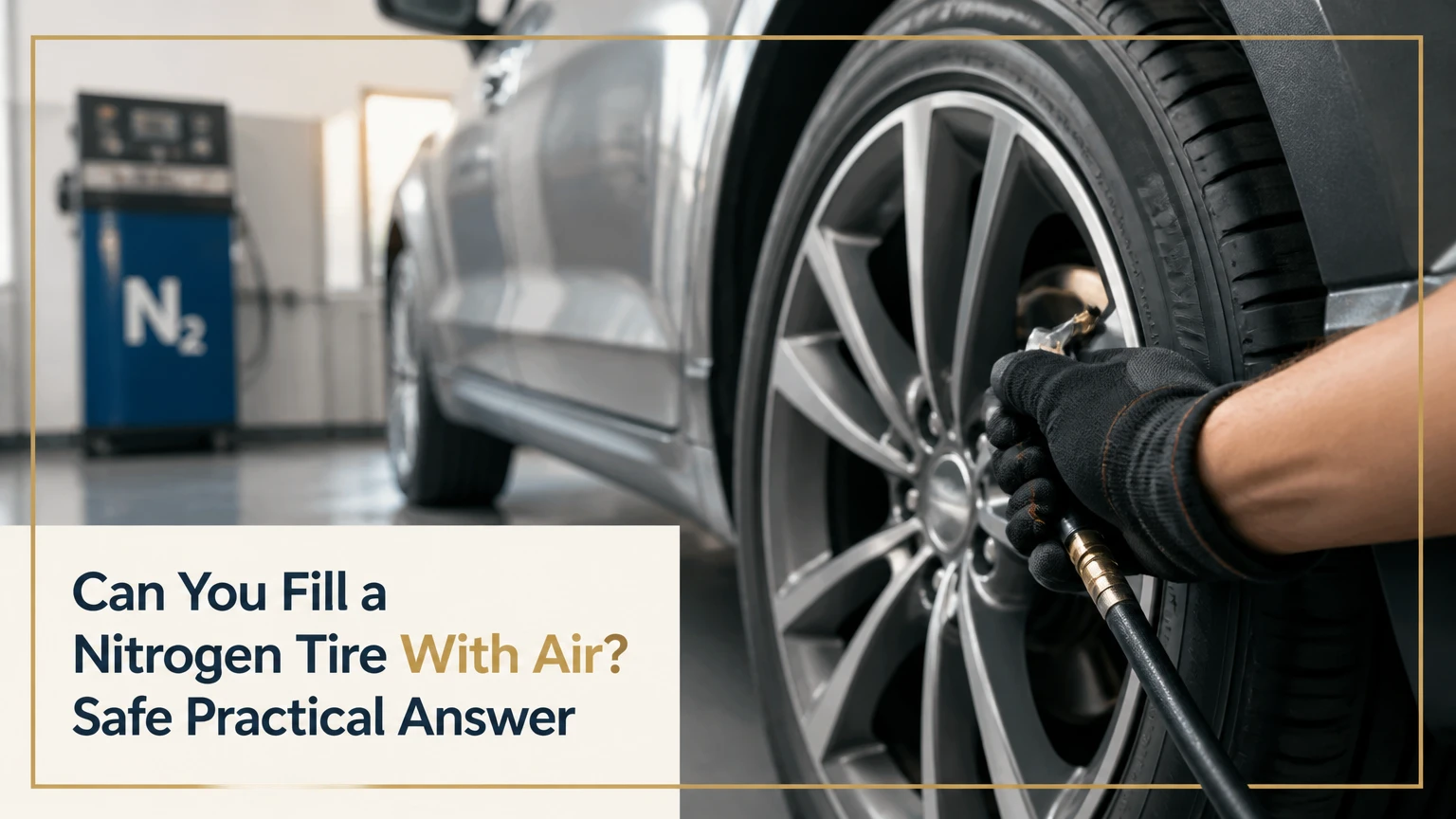
To fill a nitrogen tire with air, measure the cold pressure, connect a standard compressor, and inflate to the door-jamb specification. The process usually takes 2-5 minutes per vehicle, and the correct pressure setting is the main factor determining success.
Step 1: Find the recommended cold PSI
Read the tire-pressure placard on the driver’s door frame, door edge, fuel-door area, or owner’s manual. Record the front and rear specifications separately if the vehicle uses different pressures.
Do not use the tire sidewall’s maximum PSI as the routine target. The sidewall number describes a tire limit under a specified load and is not necessarily the vehicle’s handling or load recommendation.
Step 2: Measure before connecting the compressor
Remove the valve cap and press a reliable tire gauge onto the valve stem. Measure each tire, because one low tire can be hidden by a dashboard warning that does not identify the exact wheel.
A successful measurement has a stable reading without continuous hissing. If air escapes around the gauge, reseat it before deciding that the valve leaks.
Step 3: Add compressed air
Attach the chuck firmly and add air in short bursts. Check the gauge after each burst because compact compressors and gas-station inflators can overshoot a target by 1-2 PSI.
Set the tire to the specified cold pressure, not to the pressure of the other tires if those tires are also incorrect. Replace the valve cap after inflation to reduce contamination and protect the valve core.
Step 4: Inspect the tire and confirm the warning
Look across the tread and sidewall for nails, screws, cuts, bulges, and objects lodged near the shoulder. Drive only after confirming that the tire holds air and has no visible structural defect.
Some vehicles clear a TPMS warning automatically after several minutes of driving. Other vehicles require a reset procedure in the vehicle menu, and some direct TPMS systems need a scan-tool relearn after sensor or wheel work.
Should You Purge the Tire Back to Nitrogen?
Most passenger-car owners should not purge a tire after a normal air top-off. A purge is reasonable when a fleet, racing team, laboratory, aircraft operator, or manufacturer requires a controlled gas composition, or when a tire shop is already dismounting and servicing the tire.
A technician normally removes the existing gas, inflates with dry nitrogen, and may repeat the purge to reduce residual oxygen and moisture. A vacuum or nitrogen exchange procedure can improve consistency, but the result depends on the equipment and the tire’s internal volume.
A purge cannot fix a leak. If a tire loses pressure faster than its other tires, leak testing with soapy water or an immersion tank is more valuable than restoring nitrogen purity. The same rule applies to a slow valve-core leak or a wheel with corrosion at the bead seat.
How much does nitrogen service cost?
Typical consumer pricing ranges from free to about $10 per tire for a nitrogen top-off, while a complete four-tire purge commonly costs about $30-$120 where the service is offered. Prices vary by region, retailer, tire package, and whether lifetime nitrogen maintenance was included at purchase.
| Service | Typical price | Typical time | Best reason to choose it |
|---|---|---|---|
| Public compressed-air inflator | Free-$2 per use | 2-5 minutes | Immediate low-pressure correction |
| Nitrogen top-off | Free-$10 per tire | 5-15 minutes | Existing service plan or controlled fleet routine |
| Four-tire nitrogen purge | $30-$120 per vehicle | 15-30 minutes | Motorsport, specialized equipment, service consistency |
| Leak inspection and repair | $20-$40 inspection, repair extra | 15-60 minutes | Recurring pressure loss |
| New valve core or stem | About $5-$30 plus labor | 10-30 minutes | Valve-related leak |
Is Nitrogen Better Than Air for Everyday Driving?
For ordinary passenger vehicles, nitrogen offers a modest maintenance advantage rather than a dramatic performance improvement. Dry nitrogen can reduce moisture-related variability and may slow natural permeation, but regular air is cheaper, easier to find, and fully adequate when pressure is checked consistently.
The U.S. Department of Energy has described nitrogen tire inflation as offering little benefit for typical drivers compared with properly maintained tires. Fuel economy gains are not guaranteed, and any improvement is usually smaller than the effect of correcting a tire that is underinflated.
| Decision factor | Regular compressed air | Nitrogen service | Practical winner |
|---|---|---|---|
| Gas composition | About 78% nitrogen, variable moisture | Commonly 93%-99% nitrogen | Nitrogen for controlled composition |
| Availability | Nearly universal | Limited to participating shops | Air |
| Routine price | Free-$2 per use | Free-$10 per tire typical | Air |
| Leak protection | Does not stop punctures or valve leaks | Does not stop punctures or valve leaks | Tie |
| Moisture control | Depends on compressor filtration | Usually lower with maintained equipment | Nitrogen |
| Passenger-car benefit | Adequate with monthly checks | Incremental pressure-retention benefit | Air for value |
| Track or fleet consistency | Variable humidity and gas mixture | More predictable dry-gas behavior | Nitrogen |
What are the benefits and limits of nitrogen?
Nitrogen is useful where pressure consistency, low moisture, and repeatable operating conditions justify the access and cost. Racing teams may use dry nitrogen to make pressure behavior more predictable during repeated heat cycles, while commercial fleets may value standardized maintenance procedures across many vehicles.
Nitrogen is not useful as a substitute for checking pressure, repairing a puncture, preventing tread wear from misalignment, or correcting an overloaded vehicle. It also cannot guarantee a fixed pressure increase during heating, because tire temperature depends on speed, load, road surface, ambient conditions, and braking.
Aircraft and some heavy-duty applications use nitrogen for specialized engineering and fire-safety reasons. Those requirements should not be generalized to a family SUV or sedan.
What Should Different Drivers Do?
Everyday commuters should use whichever clean, functional inflation source is available and maintain the placard PSI. Drivers with a tire warning should add air immediately rather than searching for a nitrogen station.
Track-day drivers should follow the tire manufacturer’s pressure guidance and measure hot and cold pressures with the same gauge. Dry nitrogen can improve repeatability, but tire temperature, alignment, load, and driving technique have larger effects on grip and wear.
Fleet managers should choose one documented inflation process, calibrate gauges, inspect valves, and record pressure trends. A consistent air-maintenance program is safer than an inconsistent nitrogen program that leaves vehicles underinflated between service visits.
Classic-car owners may prefer dry nitrogen when a vehicle sits for long periods, but storage pressure, vehicle support, moisture control, and periodic movement still matter. Nitrogen does not guarantee protection from flat spots or wheel corrosion.
What Problems Can Air Top-Offs Create?
An air top-off creates problems only when the driver treats gas purity as more important than pressure or fails to investigate repeated loss. The mixture itself is safe, but continued underinflation, inaccurate gauges, and unresolved leaks can damage a tire.
Mistake: using the sidewall PSI
The sidewall maximum is not automatically the vehicle’s operating target. Correct the mistake by setting pressure from the vehicle placard and checking whether the placard lists separate front, rear, or loaded-vehicle values.
Mistake: bleeding a hot tire
A warm tire normally reads higher because driving heats the air and casing. Bleeding it to the cold specification can leave it underinflated after cooling, so measure again when cold instead.
Mistake: ignoring one repeatedly low tire
A tire that loses pressure repeatedly needs a leak inspection. Inspect the tread, valve core, stem base, bead area, and wheel for damage; adding either air or nitrogen only postpones the repair.
Mistake: assuming a green cap guarantees nitrogen
A colored cap may identify a dealer’s service choice, but it does not prove current gas purity. Replace a missing cap, check pressure, and use a standard inflator without concern about the cap color.
Mistake: resetting TPMS without measuring
A warning reset can hide a low tire without correcting it. Measure every tire first, inflate to specification, and follow the vehicle’s sensor relearn instructions only after the physical condition is acceptable.
What Should You Do in Special Situations?
A low tire on a remote road should receive ordinary compressed air if that is the available safe option. A tire with a sidewall bulge, exposed cord, large cut, or rapidly escaping air should not be driven simply because inflation equipment is nearby.
Electric vehicles use the same basic tire-pressure principle as gasoline vehicles, although their higher curb weight can make the specified PSI and load rating especially important. Follow the EV manufacturer’s placard and do not infer pressure from another vehicle using the same tire size.
Tire sealant can interfere with some TPMS sensors and may complicate later repairs. If sealant is used as an emergency measure, tell the tire technician which product entered the tire and follow the product’s speed and distance limits.
A spare tire may have a different pressure from the road tires. Check its label or the owner’s manual, because compact temporary spares often require substantially higher PSI than the main tires.
Nitrogen Tire FAQ
Can I mix nitrogen and air in all four tires?
Yes, nitrogen and compressed air can be mixed in all four automotive tires without a chemical hazard. Set each tire independently to the vehicle placard pressure, because front and rear specifications may differ. If pressure continues falling, arrange a leak inspection rather than repeatedly adding either gas.
Will adding air make my tire explode?
Adding ordinary compressed air at the correct pressure will not make a sound tire explode. Tire failures are associated with severe underinflation, overinflation, damage, improper mounting, excessive load, or heat. Never inflate a tire with visible structural damage or a separated tread without professional assessment.
Does nitrogen improve gas mileage?
Nitrogen does not guarantee a measurable fuel-economy improvement for a passenger vehicle. Maintaining the correct PSI can improve rolling resistance and fuel use, but the benefit comes from pressure accuracy rather than nitrogen purity. A properly inflated air-filled tire is generally the more economical choice for routine driving.
How often should I check a nitrogen-filled tire?
Check nitrogen-filled tires at least once a month and before long trips, using a gauge when the tires are cold. Check sooner after a TPMS warning, pothole impact, tire installation, or sudden temperature change. Nitrogen slows some natural pressure loss but does not prevent punctures or valve leaks.
Where can I refill a nitrogen tire while traveling?
Most gas stations and tire shops can add ordinary compressed air, which is safe for a nitrogen-filled tire. Nitrogen availability is more limited and depends on local tire dealers, dealerships, fleet facilities, and service plans. Correct low pressure at the first practical opportunity instead of delaying for a nitrogen station.
The Bottom Line
Can you fill a nitrogen tire with air? Yes. Add regular compressed air whenever a nitrogen-filled tire needs pressure, inflate it to the vehicle’s cold PSI, inspect for leaks, and continue normal maintenance. The added air lowers nitrogen purity, but it does not harm the tire or wheel. For most drivers, accurate pressure and prompt leak repair provide more safety and value than preserving a high-purity nitrogen mixture.