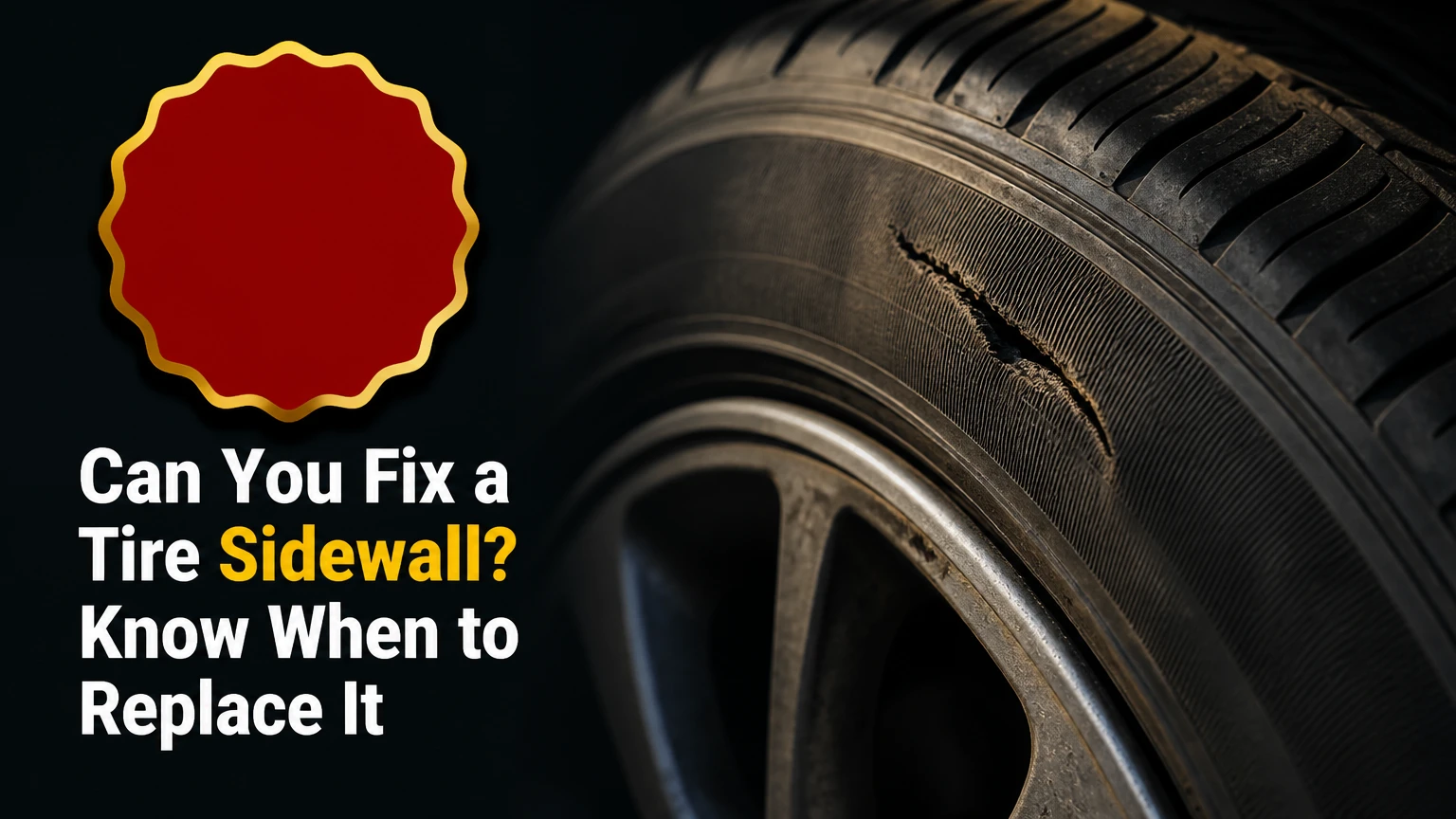
You generally cannot safely repair a structurally damaged tire sidewall. A puncture, deep cut, exposed cord, bead injury, or bulge requires tire replacement because the sidewall carries air pressure while flexing continuously; a plug, patch, or vulcanized boot cannot reliably restore its internal strength.
Key Facts at a Glance
- A tire sidewall runs from the tread shoulder to the bead that seals against the wheel rim.
- A superficial scuff that leaves the rubber surface intact may be cosmetic, but a deep gouge or exposed cord makes the tire unserviceable.
- A sidewall bulge or bubble indicates broken internal reinforcing cords and requires immediate replacement.
- Tire plugs and internal patches are designed for eligible tread punctures, not sidewall injuries.
- A vehicle with a damaged sidewall should remain parked until a tire professional assesses it, especially when air pressure is falling.
- Replacement decisions depend on tread depth, tire age, axle matching, drivetrain requirements, and possible wheel damage.
Can You Fix a Tire Sidewall?
No, a tire shop should not repair a punctured, cut, torn, bulged, or cord-damaged sidewall for road use. The accepted safety decision is replacement, although a shallow abrasion limited to the outer rubber can remain in service after careful inspection confirms that no fabric, inner liner, or air cavity is affected.
The exact legal position varies by country and state, but tire-industry repair guidance is consistent: structural sidewall damage falls outside normal puncture-repair limits. The U.S. Tire Manufacturers Association recommends restricting permanent puncture repairs to the repairable tread area, with the tire removed for internal inspection.
A sidewall “boot,” hot patch, plug, or section repair can make the outside look sealed without restoring the original carcass strength. That distinction matters because the tire may hold air while parked and still fail after repeated flexing, heat buildup, cornering, or a second impact.
What Is the Sidewall of a Tire?
The sidewall is the flexible vertical section between the tread shoulder and the bead. The sidewall carries molded information such as tire size, load index, speed rating, inflation limits, brand, construction type, and the DOT identification code.
A passenger tire contains several functional zones:
| Tire area | Main construction | Primary job | Typical damage consequence |
|---|---|---|---|
| Tread center | Rubber over steel belts and casing plies | Contact, traction, puncture resistance | Some small punctures may qualify for repair |
| Shoulder | Curved transition from tread to sidewall | Cornering support and heat transfer | Damage near the shoulder may be non-repairable |
| Sidewall | Flexible rubber over polyester or nylon cords | Flexing, pressure containment, impact absorption | Cuts and punctures commonly require replacement |
| Bead | Steel wire bundle with rubber coating | Locks tire to rim and maintains the air seal | Bead damage can cause leaks or mounting failure |
| Inner liner | Airtight halobutyl rubber layer | Retains inflation air | Liner damage can create a persistent leak |
The shoulder is the important boundary. A puncture near the outer tread may be repairable under manufacturer limits, while the same puncture a few centimeters farther outward can enter the sidewall flex zone and require replacement.
Why Does Sidewall Damage Usually Require Replacement?
Sidewall damage requires replacement because radial cords carry much of the tire’s load while the sidewall bends thousands of times during ordinary driving. A tread repair can seal a puncture through a relatively reinforced area, but a sidewall repair must survive constant bending, heat cycles, air pressure, and lateral force.
A radial tire’s sidewall typically uses textile cords coated in rubber. The cords help control the shape of the inflated casing, while the inner liner retains air. If a cut severs those cords, an external rubber repair does not reliably reconnect them or reproduce the manufactured casing structure.
The failure may be delayed. A repaired sidewall can appear sound during a low-speed inspection, then separate under motorway speed or a heavily loaded vehicle. The result can be rapid air loss, tread or casing separation, loss of control, and wheel damage.
Continental and Michelin both direct motorists toward replacement when sidewall structural damage is present. USTMA consumer guidance also distinguishes eligible tread punctures from damage in the shoulder and sidewall. These recommendations reflect tire construction and repair limits, not merely shop policy.
How Can You Inspect Sidewall Damage?
Inspect the tire when it is cool, parked on level ground, and fully visible. Do not press hard on a bulge, remove an embedded object, or deflate the tire to examine a suspected injury; photograph the area and arrange a professional inspection.
Use this sequence:
- Clean the surface. Wipe away mud with water and a cloth so a scuff is not mistaken for a cut.
- Identify the location. Record whether the damage is on the sidewall, shoulder, bead, or wheel.
- Look for depth. A surface abrasion has no open channel, separated rubber flap, or visible fabric.
- Check for cords. White, gray, yellow, or dark textile strands indicate structural exposure.
- Check the shape. A localized outward bubble is more serious than a shallow inward scratch.
- Check pressure. Compare the cold pressure with the door-jamb specification, not the maximum molded on the sidewall.
- Inspect the wheel. A bent rim, cracked alloy, or displaced bead can cause a leak even when the rubber looks intact.
- Arrange professional service. Ask the technician to inspect the tire internally after removal from the rim.
Sidewall Damage Decision Table
| Visible condition | Air-loss risk | Safe road-use decision | Recommended action |
|---|---|---|---|
| Light gray curb scuff, no groove | Low | Usually serviceable after inspection | Monitor and photograph |
| Gouge deeper than the outer rubber | High | Do not drive normally | Replace the tire |
| Visible polyester, nylon, or steel | Very high | Do not drive | Replace immediately |
| Nail or screw through sidewall | Very high | Do not plug or patch | Use a spare or tow |
| Outward bubble after impact | Critical | Do not drive | Tow vehicle and replace tire |
| Leak at bead or rim edge | Variable | Avoid driving if pressure falls | Inspect tire and wheel together |
A tire professional may use a pressure test, inside-out inspection, and wheel runout check. No consumer inspection can confirm that hidden cords remain intact after a severe pothole impact.
Should You Drive on Sidewall Damage?
You should not drive on a tire with a bulge, exposed cord, open cut, sidewall puncture, or rapidly falling pressure. If the damage is only a confirmed superficial scuff and the tire holds the specified cold pressure, drive cautiously to a tire shop only after professional or manufacturer guidance.
The safest response is to stop on a firm, level surface away from traffic. Turn on hazard lights, keep passengers away from the roadside, and call roadside assistance or a mobile tire service.
Do not drive to the shop on a bubble. Heat and centrifugal force increase as speed rises, and the damaged area may rupture without warning. Do not rely on a tire-pressure monitoring system as permission to continue: TPMS often warns only after pressure has already fallen substantially.
If a blowout occurs, hold the steering wheel firmly, avoid abrupt braking, release the accelerator gradually, and steer toward a safe stopping area. After stopping, do not reinflate a tire with a visible bulge or open sidewall injury.
What Types of Sidewall Damage Can Occur?
The main types are abrasion, cut, puncture, bulge, bead damage, and weather cracking. Their appearance helps classify the problem, but only a trained inspection can determine whether an apparently minor wound has entered the casing.
| Damage type | Common cause | Structural meaning | Normal resolution |
|---|---|---|---|
| Surface scuff | Curb contact or parking scrape | Outer rubber may remain intact | Inspect, photograph, monitor |
| Cut or slash | Glass, metal, road debris | Cords may be severed | Replace if deep or open |
| Puncture | Nail, screw, sharp object | Air cavity and cords may be penetrated | Replace, never plug |
| Bulge or bubble | Pothole or curb impact | Internal cords are broken | Stop driving and replace |
| Bead injury | Mounting error or impact | Rim seal may be compromised | Tire and wheel inspection |
| Weather cracks | Age, ozone, sunlight, chemicals | Rubber may lose flexibility | Replace if cracking is deep or widespread |
A bulge is not a cosmetic defect. Internal air pressure is pushing against a weakened section after the reinforcing structure has failed. A cut can be equally serious even when no bubble has formed.
Weather cracking deserves attention on older tires. Small surface lines in the sidewall do not always require immediate removal, but deep cracks, cracks between tread blocks, or cracking around the bead justify replacement. Tire age, storage history, heat exposure, and load all affect the decision.
What Is the Difference Between a Tread Repair and a Sidewall Repair?
An eligible tread puncture may be permanently repaired with an internal patch-plug after the tire is removed and inspected, while a sidewall puncture is normally replaced. The repair boundary is based on construction and flexing, not on whether the hole appears small.
| Repair factor | Eligible tread puncture | Sidewall puncture or cut |
|---|---|---|
| Typical repair zone | Central tread area | Flexible sidewall area |
| Common industry limit | About 6 mm, or 1/4 inch, for many passenger tires | No normal permanent repair limit |
| Internal inspection | Required for permanent repair | Required to confirm replacement |
| Repair method | Combined plug and inner patch | Replacement recommended |
| Main failure concern | Improper seal or hidden damage | Casing fatigue and sudden air loss |
| Manufacturer acceptance | Often allowed within stated limits | Usually prohibited for road use |
The often-repeated “6 mm rule” is not universal. Tire manufacturers may specify a smaller maximum, a different repair zone, or no repair for certain performance, run-flat, commercial, or specialty tires.
A rope plug inserted from outside is not the same as a permanent repair. A professional repair normally removes the tire, checks for internal abrasion from driving while flat, fills the puncture channel, and installs an approved combination repair.
Can a Tire Bulge or Bubble Be Fixed?
A tire bulge or bubble cannot be safely fixed; replacement is the remedy. A bubble usually means the sidewall cords broke after a pothole, curb strike, or severe underinflation event, allowing the inflated casing to deform outward.
Do not puncture the bubble, add a boot, or reduce pressure to make it smaller. Those actions remove material or load from a section that already lacks structural support.
The impact may also bend the wheel, disturb the bead seal, damage suspension components, or alter alignment. A replacement tire should therefore be accompanied by a wheel and steering inspection when the impact was severe, the vehicle pulls, or the steering wheel is no longer centered.
What Should You Do After Curb or Pothole Damage?
After a curb or pothole impact, check for a new bulge, pressure loss, steering vibration, pulling, rim damage, or an illuminated TPMS warning. Park the vehicle and arrange inspection if any symptom appears, because impact damage can affect the inner sidewall or wheel even when the outer side looks normal.
Record the date, road location, tire position, photographs, pressure reading, and visible wheel damage. This evidence can support a road-hazard warranty or a local authority claim where applicable.
A professional should check:
- The damaged tire’s inner liner and casing.
- Wheel rim flange and radial or lateral runout.
- Alignment angles and steering components.
- TPMS sensor, valve stem, and bead seal.
- Matching tire size, load index, and speed rating.
An impact-related bulge is different from a temporary change in shape caused by a parked tire. A mild flat spot may disappear after driving, while a persistent localized bubble remains visible and is unsafe.
How Much Does Sidewall Replacement Cost?
Typical US replacement cost is about $100-$450 per tire for common passenger vehicles, including mounting and balancing, while performance, run-flat, truck, and specialty tires can exceed $500. The final bill depends on tire size, brand, local labor, disposal fees, taxes, wheel damage, and whether additional tires must be matched.
| Replacement pathway | Typical tire cost | Typical service time | Main limitation |
|---|---|---|---|
| New standard passenger tire | $80-$220 | 30-60 minutes | May require axle matching |
| New SUV or light-truck tire | $140-$350 | 45-75 minutes | Higher load and size costs |
| New run-flat tire | $180-$500+ | 45-90 minutes | Specialized mounting equipment |
| Quality used tire | $40-$150 | 30-60 minutes | History and age may be unknown |
| Road-hazard replacement | $0-$100 deductible | 1-3 business days | Coverage must already exist |
| Wheel plus tire replacement | $250-$900+ | 1-2 hours | Needed if the rim is bent or cracked |
These are typical retail ranges, not a universal price list. Prices in Canada, the United Kingdom, Bangladesh, Australia, and other markets differ substantially, so obtain a written quote that separates tire, fitting, balancing, valve or TPMS service, disposal, and alignment charges.
Road-hazard coverage may pay for some impact damage, but exclusions often include deliberate damage, cosmetic wear, racing, off-road use, and tires below a stated tread depth. Check the policy and retain the damaged tire until the claim decision is complete.
Should You Replace One, Two, or Four Tires?
Replace one tire when the other tires have closely matched tread depth, age, model, size, load rating, and speed rating, and the vehicle manufacturer allows that configuration. Replace two tires on the same axle when the replacement tire would otherwise create a significant tread-depth difference or handling imbalance.
A shop should measure tread depth rather than guess from mileage. Typical new passenger tires have about 8-10 mm of tread, but the actual value varies by model. Many shops become more cautious when the remaining tire is around 3-4 mm, especially on wet roads.
| Vehicle situation | Typical replacement choice | Why it matters |
|---|---|---|
| FWD or RWD, matching tires with low wear difference | One tire may be acceptable | Diameter and grip remain closely matched |
| Same axle has substantial tread difference | Two tires on one axle | Braking and cornering balance improve |
| AWD or 4WD with uneven tread depths | Follow owner’s manual, often four | Drivetrain systems can tolerate only limited diameter difference |
| Staggered fitment | Replace the specified position | Front and rear sizes may differ |
| Tires older than the manufacturer’s service recommendation | Replace affected aged tires | Rubber condition matters beyond tread depth |
When two tires are replaced on many vehicles, tire retailers commonly place the pair with deeper tread on the rear axle, regardless of whether the car is front-wheel drive. The reason is hydroplaning control: rear traction loss can produce sudden oversteer. Follow the vehicle and tire manufacturer’s instructions when they differ.
What Changes on AWD and 4WD Vehicles?
AWD and 4WD vehicles can require tighter tire-diameter matching than two-wheel-drive vehicles. Replacing one tire with a substantially different circumference may force the center differential, clutch pack, or transfer case to compensate continuously, increasing heat and wear.
Read the owner’s manual before ordering a single tire. Some manufacturers specify a maximum tread-depth difference, while others require replacing a complete set. A tire shop may offer tire shaving, which removes tread from a new tire to match the remaining tires, but the service must use compatible tires and accurate measurements.
Do not assume that four tires with the same size marking have the same rolling circumference. Brand, model, inflation pressure, load, wear, and construction all affect effective diameter.
Is a Used Replacement Tire Acceptable?
A used tire can be a reasonable budget option only when its size, load index, speed rating, tread pattern, age, and condition match the vehicle’s requirements. A low purchase price does not compensate for unknown repairs, storage damage, uneven wear, or a hidden impact.
Before buying, inspect both sidewalls and the inside if possible. Reject a used tire with a bulge, deep cracking, exposed cord, bead damage, uneven wear, an unknown repair, or a missing identification marking.
Check the DOT date code. The final four digits identify the production week and year, such as 2323 for week 23 of 2023. Tire manufacturers differ in service-life guidance, but Michelin advises regular inspection after five years in service and replacement at ten years from manufacture as a precaution, regardless of remaining tread.
A used tire should also have sufficient tread for the vehicle and climate. Avoid mixing a worn touring tire with a new high-grip tire on the same axle unless a qualified technician confirms that the combination is acceptable.
Do Run-Flat Tires Change the Decision?
Run-flat construction does not make sidewall damage repairable. A run-flat tire may support limited travel after pressure loss, but a visible sidewall cut, puncture, or bulge still requires inspection and usually replacement.
Driving a run-flat while deflated can create internal heat damage that is invisible from the outside. Some run-flat manufacturers permit limited repairs for specific tread punctures, while others prohibit repair entirely after any extended low-pressure operation.
Follow the tire manufacturer’s instructions, not a generic run-flat rule. Record how far and how fast the vehicle traveled after the warning appeared, because that information helps the technician judge hidden casing damage.
What Mistakes Make Sidewall Damage Worse?
The most dangerous mistake is treating a sidewall wound like a normal tread puncture. A plug kit, sealant, or external patch can conceal air loss while leaving severed casing cords unrepaired.
Avoid these failure modes:
- Driving to save a service call. Recovery: stop and use a spare or tow service.
- Removing a nail or screw. Recovery: leave it in place if the tire is still inflated, then prevent driving and replace it.
- Applying tire sealant. Recovery: tell the shop which product was used, because sealant can affect TPMS and inspection.
- Accepting a sidewall boot for road use. Recovery: request a replacement and retain the invoice or removed tire.
- Ignoring the wheel. Recovery: inspect the rim and alignment after any hard impact.
- Installing the wrong load rating. Recovery: compare the replacement with the door placard and owner’s manual before fitting.
A sidewall repair may be described as “vulcanizing,” “section repair,” or “booting.” Terminology does not change the engineering limitation. Some agricultural, trailer, racing, or off-road applications use specialized casing repairs under controlled conditions, but those practices do not establish a safe repair for an ordinary passenger car on public roads.
How Can You Prevent Future Sidewall Damage?
Maintain the vehicle manufacturer’s cold inflation pressure, inspect tires monthly, and avoid curb contact at speed. Correct inflation reduces sidewall deflection, but correct pressure cannot prevent every pothole or sharp-object impact.
Use these preventive checks:
- Measure pressure when tires are cold, at least monthly and before long trips.
- Inspect sidewalls after contact with curbs, potholes, or road debris.
- Replace missing valve caps and repair slow leaks promptly.
- Keep tire size, load index, and speed rating compatible with the vehicle.
- Avoid overloading beyond the placard or tire load limit.
- Rotate tires according to the vehicle manufacturer’s schedule.
- Replace tires with persistent vibration, irregular wear, or age-related cracking.
- Keep tire dressing away from products that damage rubber or obscure cracking.
The door placard usually appears on the driver’s door jamb or fuel-filler area. The maximum pressure molded into the sidewall is not automatically the correct operating pressure for the vehicle.
Frequently Asked Questions
Can I drive a short distance with a small sidewall cut?
No ordinary passenger tire with an open sidewall cut should be driven, even for a short distance. A professional may approve cautious movement only when the mark is confirmed to be a superficial abrasion with no pressure loss, cord exposure, or casing deformation. Use a spare or towing service when the classification is uncertain.
Does tire insurance cover a sidewall puncture?
Road-hazard coverage often covers sidewall punctures caused by potholes or road debris, but policies differ by provider, tire age, tread depth, deductible, and excluded uses. Contact the seller before discarding the tire, photograph the damage, and request a written claim decision.
Can tire sealant repair a sidewall leak?
Tire sealant does not restore damaged sidewall cords and should not be treated as a structural repair. Sealant may also contaminate a TPMS sensor or complicate the technician’s internal inspection. A sidewall leak requires replacement after the tire and wheel are examined.
Why is my tire sidewall bulging without a puncture?
A sidewall bulge usually results from broken internal cords after a pothole or curb impact, although severe underinflation can also weaken the casing. The rubber may remain unbroken while the internal reinforcement fails, so the absence of a visible hole does not make the tire safe.
Can a tire shop repair damage near the tread shoulder?
Damage near the shoulder requires an exact location and internal inspection. Many repair standards restrict permanent repairs to the central tread area, so a puncture close to the shoulder may be rejected even when it looks like a small nail hole. Follow the tire manufacturer’s repair map.
The Bottom Line
Can you fix a tire sidewall? You should replace a tire with a sidewall puncture, deep cut, exposed cord, bead injury, or bulge rather than patching or plugging it. A shallow cosmetic scuff may remain usable after inspection, but uncertain damage, pressure loss, or impact symptoms justify stopping the vehicle and calling a tire professional.