You cannot permanently fix dry rot tires because ozone cracking and rubber oxidation permanently weaken the tire compound. A tire dressing can improve appearance and reduce further surface exposure, but it cannot restore lost elasticity, cord adhesion, or structural strength. Tires with deep cracks, exposed cords, bulges, air loss, or tread separation require replacement.
Key Facts at a Glance
- Tire dry rot is commonly called sidewall weathering or ozone cracking.
- A protectant can cover or slow superficial surface weathering, but it cannot reverse structural rubber damage.
- Cracks reaching cords, bead areas, tread grooves, or the inner sidewall make a tire unsafe for normal road use.
- The four-digit DOT date code identifies the tire’s manufacture week and year, not its expiration date.
- Tire age guidance varies by manufacturer, but Michelin recommends professional inspection annually after five years and replacement at ten years from manufacture at the latest.
- Passenger-car tires with dry rot should not be made roadworthy with an inner tube.
Can You Fix Dry Rot Tires?
Dry-rotted tires cannot be structurally repaired. Tire repair plugs and patches address qualifying punctures in the tread’s repairable area; they do not rebuild rubber that has cracked from ozone, ultraviolet exposure, heat, or age.
A tire shop can sometimes confirm that very fine surface checking is cosmetic rather than structural, especially on a relatively new tire. That inspection is a decision about continued service, not a repair. No spray, petroleum product, sealant, heat treatment, or home-applied rubber coating restores the original tensile strength of weathered tire rubber.
The correct response depends on the location and severity of the cracking. A few shallow lines on an otherwise young tire may justify monitoring and better storage, while cracks in the tread base, bead, inner sidewall, or carcass justify immediate replacement. Highway speed, heavy loads, towing, high ambient temperatures, and long-term parking reduce the acceptable risk.
What Is Tire Dry Rot?
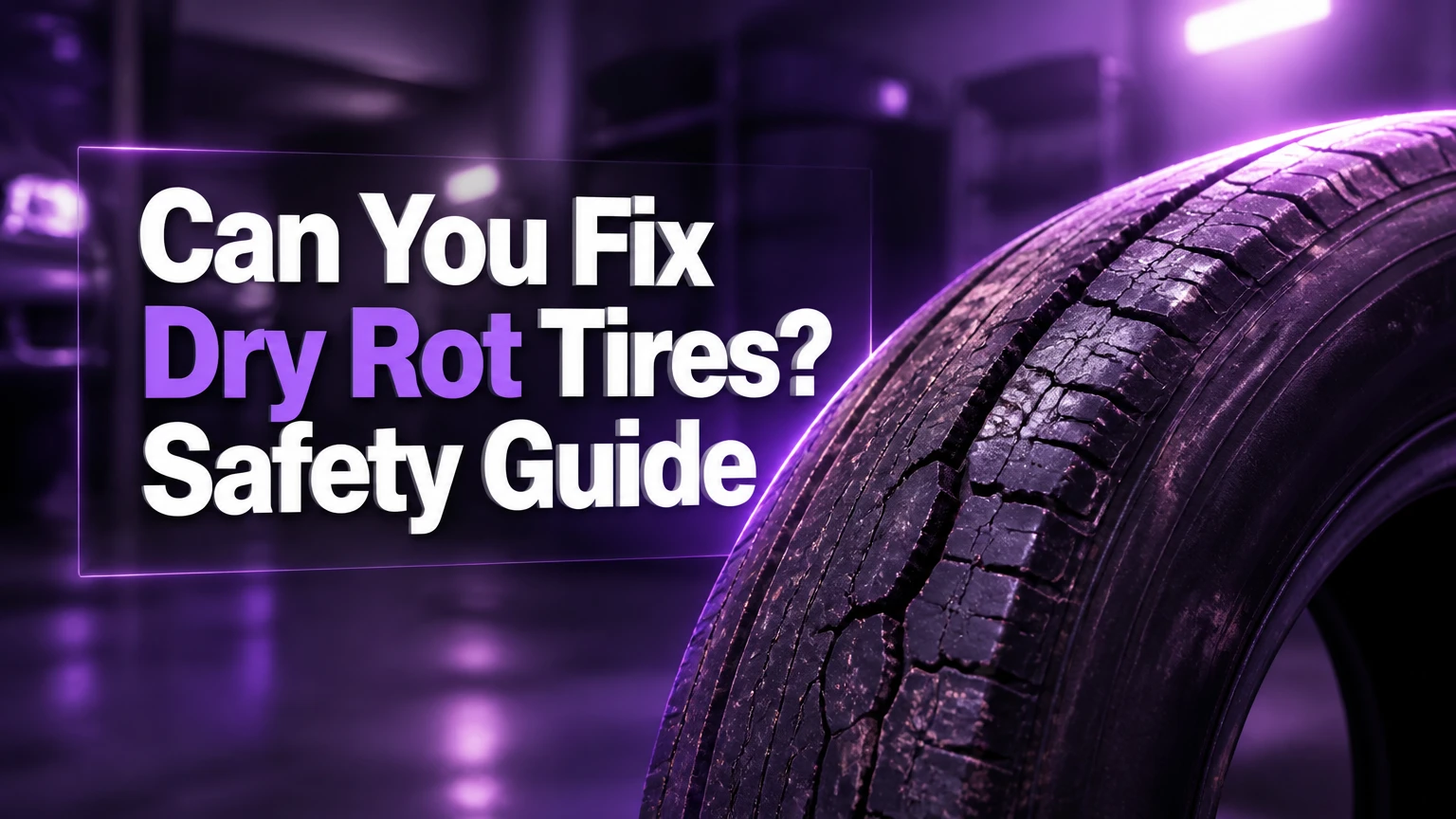
Tire dry rot is visible cracking caused by weathering of the rubber compound. The technical terms sidewall weathering and ozone cracking describe related damage, although the cracking can also appear in tread grooves, between tread blocks, and on the inner sidewall.
Rubber contains polymers, reinforcing fillers, oils, waxes, antioxidants, and anti-ozonants. Ozone and ultraviolet radiation attack exposed rubber surfaces; heat and repeated flexing accelerate aging. Protective waxes can migrate toward the surface during use, but that process does not make an already degraded tire new again.
The phrase “dry rot” is useful for consumers but imprecise chemically. Tire damage is not simply moisture evaporating from rubber. Weathering involves oxidation, ozone attack, heat history, mechanical strain, and the compound’s formulation.
Why Does Tire Rubber Develop Dry Rot?
Tire rubber develops dry rot when environmental oxidation and mechanical stress consume or weaken protective compounds faster than the tire can resist them. Sunlight, ozone, heat, low usage, incorrect inflation, and long storage all influence the rate.
A parked vehicle can age differently from a regularly driven vehicle. Regular movement does not stop aging, but flexing can help distribute protective surface waxes in some compounds. A tire stored beside electric motors, generators, welders, or ozone-producing equipment may weather faster because those devices can produce ozone.
Main causes of tire weathering
| Cause | Typical exposure | Resulting damage | Higher-risk example |
|---|---|---|---|
| Ultraviolet radiation | 4-8 hours of direct sun daily | Surface oxidation and fading | Uncovered RV in Arizona |
| Ozone | Continuous atmospheric exposure | Fine circumferential sidewall cracks | Tire stored near electric motor |
| Heat | 100°F-plus pavement or enclosed storage | Faster compound aging | Underinflated trailer tire |
| Low use | 3-12 months parked | Localized cracking and flat spotting | Spare tire under a trunk floor |
| Underinflation | 5-15 psi below specification | Excess sidewall flex and heat | Passenger car with neglected TPMS |
| Overloading | Above placard or tire load limit | Carcass strain and heat buildup | Trailer carrying more than its rating |
The U.S. National Highway Traffic Safety Administration advises drivers to inspect tires for damage and maintain inflation according to the vehicle placard or owner’s manual. Correct pressure cannot reverse weathering, but it limits heat and flexing that can turn minor cracking into a failure.
How to Identify Tire Dry Rot
You can identify tire dry rot by inspecting every visible rubber surface for networks of fine cracks, deep fissures, missing chunks, bulges, or exposed reinforcement. A flashlight, tread-depth gauge, and the vehicle’s service history provide more useful evidence than shine or remaining tread alone.
Inspect the outer sidewall first, then turn the steering wheel to expose more of the front tires. Have a tire professional inspect the inner sidewalls because suspension components can hide damage from a standing position. Examine the tread grooves and the spaces between tread blocks, where cracking can signal deeper carcass aging.
Visual severity guide
| Appearance | Location | Driving decision | Recommended action |
|---|---|---|---|
| Fine lines under strong light | Outer sidewall only | Avoid high-speed assumptions | Photograph, monitor, and request shop inspection |
| Multiple cracks opening under hand flex | Sidewall shoulder | Do not tow or drive at highway speed | Schedule replacement promptly |
| Cracks at tread base or between blocks | Tread area | Stop normal road use | Replace the tire |
| Visible fabric, cords, or steel | Any location | Do not drive | Fit the spare or arrange a tow |
| Bulge, blister, or localized deformation | Sidewall or tread | Do not drive | Replace and inspect wheel |
| Chunking, separation, or missing rubber | Tread or shoulder | Do not drive | Replace immediately |
Do not press a sharp tool into a crack to measure its depth. A crack’s width or an internet threshold such as “2 millimeters” cannot establish safety because the tire’s compound, construction, load, and internal condition vary. A professional inspection is more reliable than a ruler.
When Are Dry-Rotted Tires Unsafe?
Dry-rotted tires are unsafe when cracking affects structural areas, exposes cords, produces bulges or separation, causes air loss, or appears alongside advanced age and heavy service. A tire with visible structural damage should not be driven to a tire shop at highway speed.
Replace rather than monitor a tire when any of these conditions apply:
- Cords, fabric, or steel belts are visible.
- Cracks extend into tread grooves, the bead, or the inner sidewall.
- Rubber chunks are missing or tread blocks are separating.
- A sidewall has a bulge, blister, flat spot, or deformation.
- The tire repeatedly loses pressure without a confirmed valve or wheel issue.
- The tire has suffered a puncture, impact, or overload while visibly weathered.
- The tire’s age exceeds the manufacturer’s service recommendation.
- The vehicle will carry a heavy load, travel at highway speed, or tow.
A TPMS warning does not detect all dry rot. Tire-pressure monitoring systems generally report pressure changes, not ozone cracks, cord separation, or rubber oxidation. Normal pressure therefore cannot prove that an aged tire is safe.
Can a tire shop repair dry rot?
A tire shop cannot repair dry rot itself. The technician can identify whether the observed damage is weathering, a puncture, bead damage, wheel corrosion, or tread separation, then recommend continued service or replacement.
A plug or patch may be appropriate for a separate puncture in the central tread, provided the tire is removed for internal inspection and the puncture meets the tire manufacturer’s repair criteria. A puncture repair does not cure sidewall cracking. Sidewall and shoulder punctures are normally non-repairable for passenger tires.
Do Tire Protectants Repair Dry Rot?
Tire protectants do not repair dry rot. Water-based dressings can reduce the tire’s exposure to UV light and restore a darker appearance, but they do not rebuild oxidized polymer chains or strengthen damaged cords.
For superficial checking on a young tire that a professional considers serviceable, wash with mild soap and water, rinse completely, and dry in the shade. Apply a manufacturer-compatible, water-based protectant to the sidewall according to its label. Keep the product off the tread, brakes, valve stem, and wheel surfaces unless the label specifically permits those areas.
The blanket claim that every silicone-containing product accelerates dry rot is not well supported. Product formulas differ, and some tire manufacturers permit particular silicone-based dressings. The safer rule is to avoid petroleum solvents, gasoline, brake cleaner, bleach, and unapproved solvents, then follow the tire manufacturer’s care guidance.
Safe cosmetic-care procedure
| Step | Material or action | Typical amount or time | Stop condition |
|---|---|---|---|
| 1 | Read DOT date and inspect | 5-10 minutes | Damage or age concern appears |
| 2 | Wash with mild tire cleaner | 1-2 ounces per tire | Cracks reveal cords or separation |
| 3 | Rinse with clean water | 2-5 minutes | Soap remains in grooves |
| 4 | Dry in shade | 20-60 minutes | Rubber remains visibly wet |
| 5 | Apply labeled water-based dressing | 1-2 ounces per tire | Product reaches tread or brakes |
| 6 | Reinspect after drying | 5 minutes | Cracks open, widen, or expose material |
Protectant is maintenance for appearance and surface exposure, not a safety treatment. Do not use it to make a rejected tire look newer before selling, towing, or returning a vehicle.
How Do You Read the DOT Tire Date?
The final four digits of the DOT Tire Identification Number show the manufacture week and year. A code ending in 1224 means the tire was manufactured in the 12th week of 2024, not that it expires in 2024.
The complete DOT marking may appear on only one sidewall. If the visible side lacks the date, inspect the opposite side or ask a tire shop to locate it. Record the date for all four tires because replacement tires may have different ages.
| DOT ending | Manufacture period | Age in March 2026 | Decision context |
|---|---|---|---|
| 1018 | Week 10 of 2018 | About 8 years | Replace or obtain immediate inspection |
| 3521 | Week 35 of 2021 | About 4.5 years | Inspect visible cracking and service history |
| 1224 | Week 12 of 2024 | About 2 years | Surface checking still requires evaluation |
| 4825 | Week 48 of 2025 | About 3 months | Investigate damage, storage, or contamination |
Age is not a standalone safety certificate. A two-year-old tire can be damaged by underinflation, chemicals, impact, or poor storage, while a properly maintained older tire still requires manufacturer-directed inspection. Michelin recommends annual professional inspection after five years of service and replacement at ten years from the manufacture date at the latest; other manufacturers may publish different limits.
Check the NHTSA tire recall database when replacing tires, and retain the invoice showing brand, size, load index, speed rating, and date code.
How Many Tires Should You Replace?
Replace all four tires when all four show comparable weathering, when the vehicle uses all-wheel drive with a narrow allowable circumference difference, or when the remaining tires are near the end of their service life. Replacing one tire can be appropriate only when the other tires are demonstrably sound and the vehicle and tire manufacturer permit the tread-depth difference.
The axle should normally have matching tire size, construction, load index, and speed rating. On many two-wheel-drive vehicles, a shop may recommend placing the newer pair on the rear axle to reduce oversteer risk in wet conditions, even when the driven axle is at the front. Follow the vehicle manufacturer’s instructions for rotation and replacement.
For all-wheel-drive vehicles, consult the owner’s manual before installing fewer than four tires. Some systems tolerate only a small circumference difference, and a mismatch can stress the drivetrain or trigger control-system faults.
Why Are Inner Tubes Not a Passenger-Car Fix?
An inner tube does not repair a dry-rotted passenger-car tire because the outer tire still carries cornering, braking, heat, and impact loads. The tube only contains air, while the weathered casing remains a potentially unstable structural component.
Tubes may be specified for certain agricultural, implement, low-speed industrial, or specialty applications, but the tire, tube, rim, speed, and load must be compatible. A tube inside a tubeless passenger tire can chafe, generate heat, fit incorrectly, or fail without making the aged casing safe.
Do not install a tube to keep a cracked car, SUV, RV, or highway trailer tire in service. A professional may use a tube in a manufacturer-approved off-road application, but that is a vehicle-system decision, not a general dry-rot repair.
How Much Does Replacement Cost?
Typical replacement cost ranges from $80-$300 or more per tire, including mounting and balancing, while a complete passenger-car set commonly costs $400-$1,400 before alignment or specialty disposal charges. Exact pricing depends on size, brand, load rating, run-flat construction, region, and installation fees.
| Vehicle or tire type | Typical tire price | Typical installed set | Typical shop time |
|---|---|---|---|
| Compact passenger car | $80-$160 each | $360-$720 | 45-90 minutes |
| SUV or light truck | $130-$280 each | $600-$1,250 | 60-120 minutes |
| Run-flat passenger tire | $180-$350 each | $850-$1,600 | 60-120 minutes |
| RV or heavy trailer tire | $180-$450 each | $800-$2,000 | 90-180 minutes |
| Agricultural implement tire | $70-$300 each | $250-$900 | 45-150 minutes |
These are typical U.S. consumer ranges, not published national averages. Ask for a quote that separates the tire, valve stem or TPMS service, mounting, balancing, disposal, alignment, taxes, and roadside assistance. A low tire price can conceal substantial installation charges.
What Should Different Vehicle Owners Do?
Vehicle use changes the risk calculation. Highway commuters, RV owners, trailer operators, and agricultural users should not apply the same tolerance to weathered rubber because speed, heat, load, and consequences differ.
Daily commuter
Replace any tire with structural cracking before highway travel. Do not rely on tread depth, normal pressure, or a dark dressing. If cords, bulges, separation, or rapid pressure loss appear, park the vehicle and arrange mobile service or a tow.
RV owner
Inspect the inner and outer sidewalls before every major trip, including tires that look unworn. Michelin and other tire manufacturers emphasize age and inspection because RV tires can accumulate calendar age while stationary. Use fitted, breathable UV covers during storage, maintain placard pressure, and avoid parking on petroleum-contaminated surfaces.
Boat or utility trailer owner
Check the full load rating, not only the tire size. Trailer tires often sit for months, experience high heat on long trips, and suffer from overloading or low pressure. Replace weathered tires before towing, and inspect the spare because it may be older than the mounted set.
Farm and low-speed equipment owner
A tube can be acceptable only for a compatible, manufacturer-approved low-speed application. Do not transfer that practice to a road vehicle. Replace any casing with exposed cords, bead damage, severe chunking, or a load rating below the equipment requirement.
How Can You Slow Future Dry Rot?
You can slow future dry rot by controlling pressure, sunlight, heat, chemicals, storage position, and inspection frequency. Prevention reduces environmental stress; it does not extend a tire beyond its manufacturer’s age or damage limits.
Use the vehicle placard pressure when the tires are cold. Inspect monthly and before long trips. Keep tires away from gasoline, diesel, solvents, brake fluid, and strong cleaners. During storage, shield them from direct sunlight, avoid standing water, and prevent contact with ozone-producing equipment.
Do not coat tires with household oils, petroleum jelly, cooking oil, or solvent-based shine products. Do not park for years on severely underinflated tires. Rotate passenger tires according to the vehicle manual, because uneven wear can mask weathering and create additional heat.
An overlooked point is the spare. A full-size spare can age for a decade under a cargo floor, while a temporary spare can lose pressure and develop cracking without regular inspection.
Emergency Decision Checklist
Use the following checklist before moving a vehicle with suspected dry rot:
- Read the DOT date on every tire.
- Check cold pressure against the door-jamb placard.
- Inspect both sidewalls, the tread grooves, bead, and spare.
- Look for cords, bulges, separation, chunking, and air loss.
- Consider recent overload, impact, long storage, or extreme heat.
- Do not drive if structural damage is visible.
- Use a properly inflated spare only if its age and condition are acceptable.
- Ask a tire shop for an internal inspection when the outside view is incomplete.
A tire with visible cords or a sidewall bulge should be transported by tow truck or mobile tire service. Driving slowly does not eliminate failure risk because the casing still carries vehicle load and may fail during braking or cornering.
Common Mistakes That Make the Problem Worse
Mistaking tread depth for tire health
Tread depth measures remaining groove material, not rubber elasticity, cord adhesion, or sidewall weathering. A tire can have 7/32 inch of tread and still be unsafe because of age or structural cracking.
Measuring crack depth with a ruler
The location and pattern matter more than a universal millimeter cutoff. A narrow crack at the bead or tread base can be more concerning than a wider superficial mark on a molded sidewall line.
Cleaning with solvents
Gasoline, brake cleaner, acetone, and strong degreasers can damage rubber and remove surface protection. Mild soap and water are the safer default unless the tire manufacturer specifies another cleaner.
Hiding cracks with shine
A wet-looking sidewall can conceal small fissures during a quick inspection. Clean the tire, let it dry fully, and assess the rubber before applying any dressing.
Replacing only the visibly worst tire
Weathering may affect the other tires, the spare, and the hidden inner sidewalls. Compare all date codes and ask the shop to document each tire’s condition.
Frequently Asked Questions
Can tire dry rot happen while a car is driven every day?
Yes. Daily driving may distribute some protective surface waxes, but it does not prevent ozone, ultraviolet radiation, heat, age, contamination, or underinflation from damaging rubber. Inspect regularly, especially when the vehicle is parked outdoors in a hot, sunny climate or the tires are more than five years old.
Are small cracks on a tire sidewall always dangerous?
Small superficial sidewall lines are not automatically proof of immediate failure, but they deserve inspection because appearance alone cannot reveal internal damage. Replace the tire when cracks open under normal flexing, reach the bead or tread, accompany a bulge, or appear on an old or heavily loaded tire.
Can dry rot cause a flat tire?
Dry rot can contribute to air loss when cracks reach the inner liner, bead, valve area, or casing. A flat tire may also result from a puncture, valve leak, wheel corrosion, or bead damage. Have a shop identify the leak rather than assuming a sealant or plug will solve weathering.
Should I use tire covers in a garage?
Tire covers are useful when sunlight reaches the vehicle or when an RV or trailer is stored outdoors. A clean, dry, UV-resistant cover reduces light exposure, but it does not correct pressure, stop ozone exposure entirely, or make aged tires safe. Inspect tires before covering and after removing the covers.
Is tire dry rot covered by a tire warranty?
Coverage varies by manufacturer and warranty terms. Road hazards, aging, improper inflation, chemical exposure, and storage damage are often excluded, while premature workmanship or material defects may qualify for adjustment. Keep purchase records, photograph the DOT code and cracking, and request a formal inspection from the seller or manufacturer.
The Bottom Line
You cannot permanently fix dry rot tires. Cosmetic care may protect superficial weathering on a young, professionally approved tire, but cracks in structural areas, exposed cords, bulges, separation, air loss, advanced age, or severe service require replacement. Check the DOT date, inspect every surface, match replacement specifications, and never use an inner tube to make a dry-rotted passenger tire roadworthy.