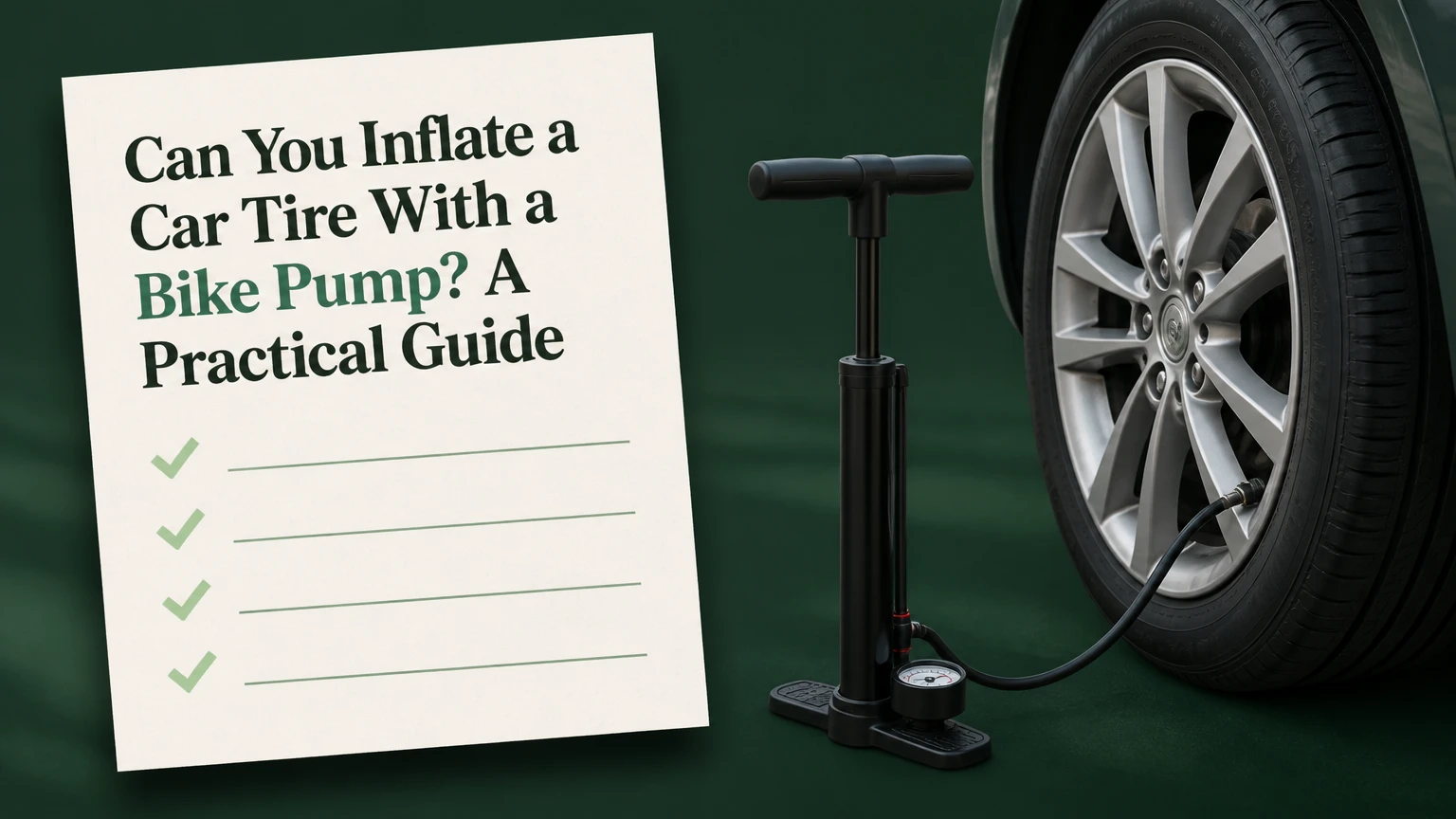
Yes, you can inflate a car tire with a bike pump if the pump has a Schrader-compatible head and the tire is still safely seated on the wheel. The main limitation is air volume, not pressure: a bicycle pump can usually reach 30-35 PSI, but a low or flat passenger-car tire may require hundreds or thousands of strokes and should not be driven until checked.
Key Facts at a Glance
Most passenger cars specify approximately 30-36 PSI cold, but the correct value is printed on the driver-door placard or owner’s manual.
Most car tires use Schrader valves, which many floor pumps support without an adapter.
A floor pump is practical for a small top-off, while a mini pump is a poor choice for filling a fully flat car tire.
Tire volume determines the work required; a higher bicycle-pump maximum PSI does not make the pump fast.
Stop if the tire has a visible sidewall bulge, exposed cord, bead separation, or a valve that leaks continuously.
Never use a universal 25 PSI rule as permission to drive. The safe pressure depends on the vehicle, tire, load, and damage condition.
Can You Inflate a Car Tire With a Bike Pump?
A bicycle pump can inflate a car tire because both devices move air into a pressurized chamber, and most bicycle pumps can generate more than the 30-36 PSI commonly required by passenger vehicles. A floor pump with a stable base and pressure gauge is the most workable manual option.
The task becomes inefficient when the tire is several PSI low or completely flat. A bicycle tire may contain only a small fraction of the air volume of a passenger-car tire, so each stroke contributes little relative to the vehicle tire’s total capacity. The pump must also overcome increasing back pressure as the tire approaches its specified pressure.
The answer changes when the tire is damaged. A bike pump cannot repair a puncture, reseat a badly unseated bead, or make a tire safe after sidewall damage. Manual inflation is an emergency method or a top-off technique, not a substitute for inspecting the tire and finding the leak.
Why Is Volume More Important Than PSI?
Air volume makes car-tire inflation slow because a car tire requires substantially more air mass than a bicycle tire, even when both operate within a pump’s pressure range. Pressure determines the force required to push air in; volume determines how many effective pump strokes are needed.
A typical compact passenger-car tire has roughly 35-60 liters of internal geometric volume, depending on tire size and construction. A bicycle tire often has approximately 1-4 liters. Those figures describe chamber volume, not the total amount of atmospheric air required, because the air inside the car tire is compressed above atmospheric pressure.
For a rough example, a 45-liter tire raised from 20 to 35 PSI requires approximately 46 liters of free air at atmospheric pressure before accounting for hose losses, temperature, and changing pump efficiency. A bicycle pump with a 0.4-liter effective displacement would therefore need roughly 115 theoretical strokes, while real use may require substantially more.
Pressure and Volume Are Different Measurements
| Measurement | Meaning | Practical effect |
|---|---|---|
| PSI | Pounds per square inch of gauge pressure | Determines resistance at the valve |
| Tire volume | Internal chamber space | Determines total air required |
| Pump displacement | Air moved per stroke | Determines approximate stroke count |
| Effective output | Air that reaches the tire after losses | Falls as seals, hose, and technique worsen |
A pump advertised at 120 PSI does not move air faster than a 60 PSI pump when both have the same cylinder volume. The maximum-pressure figure describes the highest resistance the pump may overcome, not the quantity of air delivered per stroke.
Will a Bike Pump Fit a Car Valve?
A bike pump will fit a car tire when its pump head supports a Schrader valve. Schrader valves are the wider, spring-loaded valves used on virtually all standard passenger-car tires, while Presta valves are narrow bicycle valves that require a different opening or an adapter.
Inspect the pump head before attaching it. Dual-head and convertible heads commonly support both valve types, but a Presta-only head will not seal correctly on a car tire. Do not force a narrow opening over the Schrader valve because the pump head or valve core can be damaged.
A short hiss during connection is normal. Continuous hissing after the locking lever is closed usually indicates a crooked chuck, a damaged rubber seal, a loose valve core, or a valve stem that is bent or cracked.
Valve Compatibility Checklist
| Pump-head type | Car Schrader valve | Adapter needed | Typical issue |
|---|---|---|---|
| Dual-head floor pump | Compatible | No | Head must be set to Schrader mode |
| Convertible bicycle pump | Compatible | No | Internal gasket may be installed backward |
| Presta-only road pump | Not compatible | Yes | Narrow chuck cannot seal directly |
| Schrader-only mini pump | Compatible | No | Small cylinder requires many strokes |
| CO2 bicycle inflator | Usually compatible | No | Cartridge capacity may be insufficient |
How Do You Inflate the Tire?
Inflate a car tire with a bike pump by checking the recommended cold pressure, securing the vehicle, locking a Schrader-compatible chuck onto the valve, pumping in controlled intervals, and verifying the final reading with a reliable gauge. The process is physically demanding but straightforward when the tire has no major leak.
Before You Start
| Requirement | Typical value or specification |
|---|---|
| Time for a 5 PSI top-off | 10-30 minutes with a floor pump |
| Time from very low pressure | 30-90 minutes, depending on tire and pump |
| Manual difficulty | Moderate to high |
| Pump | Floor pump preferred, mini pump as backup |
| Gauge | 0-60 PSI or 0-100 PSI digital or analog gauge |
| Vehicle position | Flat, stable surface with parking brake engaged |
| Pressure target | Door-placard cold pressure, often 30-36 PSI |
Step 1: Find the Correct Pressure
Read the pressure specification on the driver-side doorjamb, fuel-filler flap, or owner’s manual. The number molded into the tire sidewall is usually the tire’s maximum allowable pressure, not the vehicle’s recommended operating pressure.
Check pressure when the tire is cold, ideally before driving or after the vehicle has been parked for at least three hours. The U.S. National Highway Traffic Safety Administration explains that the recommended tire pressure is provided by the vehicle manufacturer and that the tire sidewall maximum is not the same specification.
You will know the target is correct when the value matches the vehicle placard rather than the tire’s maximum sidewall number. A common mistake is inflating every tire to 35 PSI even when a particular vehicle specifies different front and rear pressures.
Step 2: Position and Inspect the Vehicle
Park on firm, level ground, apply the parking brake, and switch off the engine. Position the valve where your hands and pump hose can reach it without twisting the stem or placing the pump under moving traffic.
Remove the valve cap and inspect the tread, sidewall, bead, and valve stem. A nail in the tread may permit slow inflation but still requires professional repair. A bulge or cut in the sidewall means the tire should not be inflated for normal driving.
You will know the setup is suitable when the vehicle is stable and the valve stem remains straight during chuck attachment. A common mistake is lying beside a traffic-side wheel on a narrow shoulder when a safer location or roadside service is available.
Step 3: Attach the Schrader Chuck
Press the pump head straight onto the valve stem until the chuck reaches its sealing position, then close the locking lever. A brief hiss is acceptable, but a strong continuous leak requires removal and realignment.
Keep the valve core centered and avoid bending the stem, especially on vehicles with rubber snap-in stems or tire-pressure monitoring hardware. If the pump uses a threaded connection, tighten it by hand until sealed, without using pliers.
You will know the connection works when the pump gauge rises slightly during the first compression stroke and air no longer escapes around the chuck. A common mistake is locking the lever before the head is fully seated.
Step 4: Pump in Full Controlled Strokes
Use the pump’s entire stroke length at a steady pace. Keep both feet on the base, hold the handle with two hands, and let your legs and body weight drive the downward movement rather than repeatedly bending your lower back.
After approximately 50-100 strokes, pause for a minute and check the gauge. The cylinder and hose may become warm during repeated compression, particularly with a narrow mini pump. Warm air can produce a temporarily higher gauge reading, so allow the tire and equipment to stabilize before the final check.
You will know progress is occurring when the tire visibly firms and the gauge rises between checks. A common mistake is pumping rapidly with incomplete strokes, which increases fatigue without delivering the pump’s rated displacement.
Step 5: Verify and Disconnect
Stop at the vehicle manufacturer’s cold-pressure specification, then remove the chuck quickly and replace the valve cap. Check the pressure again after disconnecting because a leaking chuck can give a misleading reading.
If the tire was hot from driving, the measured pressure may be higher than its cold value. Do not automatically release air from a hot tire; record the reading, allow it to cool, and recheck under cold conditions.
You will know the job is complete when the final gauge reading matches the placard and the valve does not hiss after the cap is installed. A common mistake is treating a firm-feeling tire as adequately inflated without measuring it.
How Long Will It Take?
A bicycle floor pump typically needs 10-30 minutes to add 5 PSI to a passenger-car tire, while a very low tire may take 30-90 minutes or more. A small mini pump can require 500-2,000 strokes for the same task because its cylinder moves less air.
These are typical field estimates, not universal specifications. Tire size, starting pressure, pump-cylinder volume, hose losses, user strength, gauge accuracy, and the tire’s leak rate change the result. A large SUV tire generally requires more air than a compact hatchback tire.
| Pump type | Typical time to add 5 PSI | Approximate strokes or cycles | Best use |
|---|---|---|---|
| Track floor pump | 10-20 minutes | 150-300 strokes | Home top-off or moderate pressure loss |
| Large foot pump | 15-30 minutes | 200-400 cycles | Occasional emergency use |
| High-volume mini pump | 25-60 minutes | 500-1,200 strokes | Portable backup |
| Small road mini pump | 45-90 minutes | 1,000-2,000 strokes | Last-resort inflation |
| 12V electric inflator | 5-15 minutes | Not applicable | Roadside and routine vehicle use |
The most useful planning rule is to count time by pressure increase, not by tire condition alone. Adding 2 PSI is materially different from raising a tire from nearly flat to 35 PSI.
Can a Bike Pump Inflate a Completely Flat Tire?
A bike pump can inflate a completely flat car tire only when the tire remains properly seated on the rim and the air loss is slow enough for the pump to overcome it. A tire with a separated bead, major puncture, damaged valve, or sidewall failure may never hold pressure.
A visibly flat tire deserves inspection before pumping. Look for a screw or nail, a torn sidewall, a missing valve core, a gap between the bead and rim, or air escaping from one specific area. A tire that immediately collapses after inflation has a fault that manual pumping does not solve.
Never crawl under a vehicle or place hands near a bead that may move suddenly. If the tire has come off the rim, professional equipment is normally needed to reseat it safely. Do not attempt to seat a bead with gasoline, ether, or an improvised explosive method.
When a Flat Tire Is Not a Pumping Job
| Observation | Likely condition | Correct action |
|---|---|---|
| Sidewall bulge | Internal structural damage | Replace or obtain roadside service |
| Bead visibly separated | Tire unseated from rim | Professional tire service |
| Air exits at valve stem | Valve or core leak | Replace core or stem |
| Nail in tread | Puncture | Inflate only for inspection, then repair |
| Tire loses pressure immediately | Large puncture or bead leak | Do not drive; call service |
| TPMS warning remains after inflation | Sensor or pressure issue | Verify with gauge and inspect system |
Which Bike Pump Works Best?
A track floor pump works best because its larger cylinder, stable base, long handle, and integrated gauge move more air per stroke than a compact bicycle pump. A mini pump remains useful when portability matters, but it is the least practical choice for filling a car tire from low pressure.
Pump design involves a trade-off between volume and pressure. High-volume bicycle pumps generally move air quickly at lower resistance, while high-pressure road pumps use smaller cylinders that become inefficient for a large car-tire chamber.
| Feature | Floor pump | Foot pump | Mini pump | 12V inflator |
|---|---|---|---|---|
| Typical purchase price | $25-$70 | $15-$40 | $15-$50 | $30-$120 |
| Built-in gauge | Usually | Sometimes | Often, less precise | Usually digital |
| Power source | Human arms and legs | Human legs | Human arms | Vehicle battery |
| Portability | Low | Medium | High | Medium |
| Car-tire suitability | Best manual option | Acceptable backup | Emergency only | Best routine option |
| Cooling concern | Moderate | Moderate | High | Motor-duty limitation |
A bicycle pump is a reasonable choice for a 1-3 PSI correction at home. It is a poor choice when the tire is flat, the weather is cold, the valve is hard to reach, or the car is stopped on an unsafe roadside.
What Are the Better Alternatives?
A 12V electric tire inflator is usually the best roadside alternative because it supplies air continuously and normally includes a pressure gauge with automatic shutoff. A service-station compressor is also effective, while a portable compressor with a battery pack avoids reliance on the car’s accessory socket.
Alternative Comparison
| Option | Typical cost | Typical fill time | Main limitation |
|---|---|---|---|
| 12V plug-in inflator | $30-$80 | 5-15 minutes for 5 PSI | Needs a working 12V socket |
| Cordless inflator | $60-$150 | 5-12 minutes for 5 PSI | Battery may be empty |
| Service-station compressor | $1-$3 or free | 3-10 minutes | Location and hose access vary |
| Full-size workshop compressor | $100-$400 | 1-5 minutes | Requires power and storage |
| Bicycle floor pump | $25-$70 | 10-30 minutes | Physical effort and heat |
Do not select an inflator only by its advertised maximum PSI. For vehicle use, compare airflow, duty cycle, hose length, power-cable length, gauge readability, and the manufacturer’s stated continuous operating time. A compressor rated at 150 PSI may still inflate slowly if its airflow is low.
How Does Temperature Affect Pressure?
Temperature changes tire-pressure readings because air pressure falls as the air cools and rises as the air warms. A common service rule is that pressure changes by roughly 1 PSI for every 10 degrees Fahrenheit change, although the exact result depends on the tire and temperature range.
The U.S. Department of Energy and tire manufacturers such as Michelin and Bridgestone recommend checking pressure when tires are cold. Driving heats the tire through flexing and road contact, so a warm reading should not be compared directly with the cold specification.
Cold weather can trigger a TPMS warning even when a tire has no puncture. Add air to the placard value when the tire is cold, then investigate repeated losses rather than repeatedly compensating for them.
When Is Driving Unsafe?
Driving is unsafe when the tire is visibly damaged, cannot hold pressure, has a sidewall bulge, or remains substantially below the vehicle’s specified pressure. A low-pressure warning does not provide a universal safe-driving threshold, and 25 PSI is not an appropriate target for every vehicle.
If the tire is only slightly low, has no visible damage, and reaches the placard pressure, driving directly to a tire shop may be reasonable. Drive slowly, avoid highways, minimize distance, and stop if steering changes, vibration, pulling, noise, or renewed pressure loss occurs.
A tire that has been driven while severely underinflated may have internal damage even after it appears inflated. The sidewall can flex excessively and generate heat, so a technician should inspect a tire that was driven flat or nearly flat.
How Do You Fix Common Problems?
Most bicycle-pump failures on car tires come from valve mismatch, a poor chuck seal, a leaking tire, or an inaccurate gauge. Identify whether air is escaping at the pump connection, valve core, tread, bead, or sidewall before continuing to pump.
The Chuck Hisses
Remove the chuck, straighten it, press it fully onto the Schrader valve, and lock it again. Replace a cracked gasket or worn pump head if the leak continues with the chuck attached to an undamaged valve.
The Pump Handle Has No Resistance
A handle with no resistance usually indicates an open hose connection, failed check valve, damaged piston seal, or a pump head that is not actually pressurizing the tire. Test the pump on a bicycle tire or use a second gauge before disassembling it.
The Gauge Rises but the Tire Does Not Firm Up
A rising gauge with no visible tire change can indicate a gauge reading trapped inside the hose, a large puncture, or a bead leak. Stop after a few checks and listen around the tread and rim rather than increasing pumping speed.
The Pump Becomes Very Hot
Pause when the barrel, hose, or handle becomes uncomfortably hot. Repeated high-speed strokes can soften seals and shorten pump life, but exact internal temperatures vary by pump construction, ambient temperature, lubrication, and duty cycle; avoid unsupported claims about a universal melting point.
The Valve Stem Moves or Leaks
Do not bend or pull a loose valve stem while attaching the pump. A damaged stem can require tire removal and replacement, particularly when it incorporates a TPMS sensor.
Can You Use a Bike Pump for a Small Top-Off?
A bicycle floor pump is suitable for adding 1-3 PSI when the tire is otherwise healthy and the vehicle is parked at home. A small correction takes far less effort than filling a flat tire and can restore the pressure lost through seasonal temperature changes or slow permeation.
Check all four tires, and inspect the spare if the vehicle has one. Front and rear specifications may differ, especially on SUVs, performance cars, and vehicles carrying heavy loads. Replace the valve caps after measuring because caps help keep dirt away from the valve core.
When Should You Stop?
Stop manual inflation when the tire reaches the placard pressure, the pump or hose becomes excessively hot, the tire leaks faster than the pump can fill it, or any structural damage appears. Stop driving plans immediately if the tire cannot retain pressure or the vehicle becomes unstable.
Call roadside assistance when the wheel is in an unsafe traffic position, the tire is fully unseated, the valve stem is damaged, or the tire has a sidewall injury. A $50-$150 service call is usually less costly than wheel damage or a high-speed tire failure.
FAQ
Can a bike pump inflate a tubeless car tire?
A bike pump can add air to a tubeless car tire that remains seated on its rim, but it usually cannot deliver the sudden high airflow needed to reseat a separated bead. A bead that has dropped into the rim well requires a proper compressor and trained technique, so roadside service is safer.
Can you inflate a car tire with a Presta pump?
A Presta-only pump cannot seal directly against a car’s Schrader valve. A threaded Schrader adapter may make the connection possible if the pump hose and adapter are compatible, but a dual-valve floor pump is more reliable and reduces the chance of damaging the valve.
How many PSI can a bicycle pump produce?
Many bicycle pumps are rated between 60 and 160 PSI, depending on whether they are high-volume, road, mountain-bike, or shock pumps. The rating describes maximum pressure capability, not inflation speed, and a suspension shock pump is unsuitable for efficiently filling a car tire.
Will pumping a car tire damage the bike pump?
Occasional car-tire inflation normally will not damage a sound bicycle floor pump when the pump is used within its instructions and allowed to cool. Continuous rapid pumping can wear piston seals, hose fittings, and check valves, especially in small mini pumps with limited cooling capacity.
Why does tire pressure keep dropping after inflation?
Repeated pressure loss usually indicates a puncture, leaking valve core, damaged valve stem, bead leak, rim corrosion, or tire damage. Temperature can explain a small reading change, but a tire that repeatedly loses several PSI needs a leak inspection rather than repeated manual top-offs.
Should you remove air if the tire is above the recommended PSI?
Check whether the reading was taken with the tire cold. If a cold tire exceeds the door-placard value, use a reliable gauge and release air in short bursts, rechecking after each adjustment; never exceed the tire or wheel manufacturer’s limits.
The Bottom Line
You can inflate a car tire with a bike pump, especially when adding a few PSI to a healthy tire with a compatible Schrader chuck. A floor pump is the only practical manual choice for most drivers, but a 12V inflator or service-station compressor is faster and less exhausting.
Use the vehicle door placard for the pressure target, measure cold, inspect for damage, and do not treat manual inflation as a repair. The answer to can you inflate a car tire with a bike pump is yes, but the safe answer also includes knowing when the tire needs professional service instead.