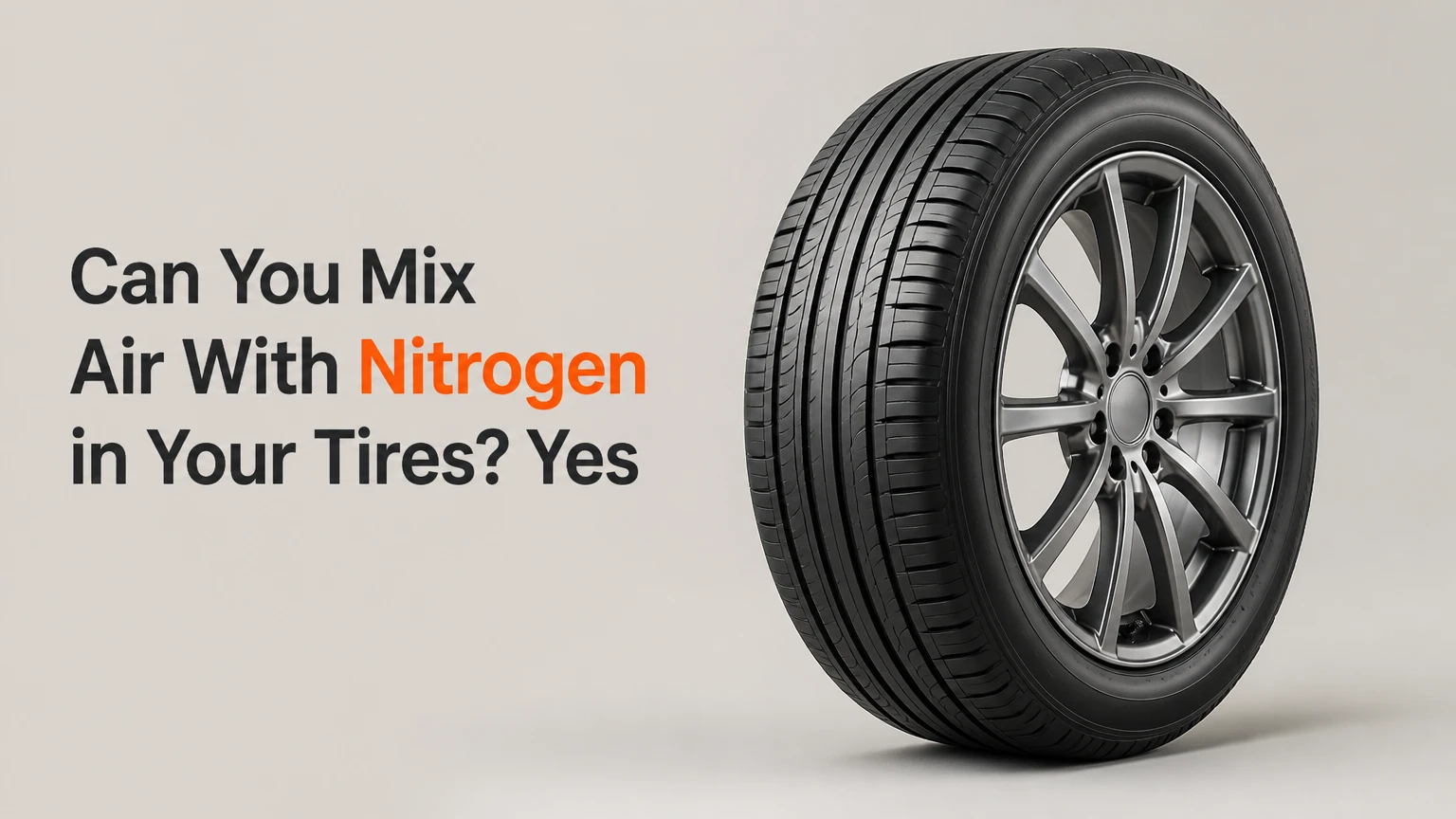
Yes, you can safely mix compressed air with nitrogen in your tires. Air and nitrogen do not create a hazardous chemical reaction, and ordinary air is already about 78% nitrogen by volume. If a nitrogen-filled tire is low, add air until it reaches the vehicle manufacturer’s recommended cold pressure rather than driving underinflated or waiting for a nitrogen station.
Key Facts at a Glance
- Mixing compressed air with nitrogen lowers nitrogen purity, but it does not make the tire unsafe.
- The correct tire pressure is more important for handling, braking, tread life, and fuel economy than the inflation gas.
- Use the cold pressure on the driver’s-door placard, not the maximum pressure molded into the tire sidewall.
- A nitrogen tire does not need to be purged after an occasional air top-off.
- Nitrogen can reduce moisture and may slow pressure loss, but the everyday advantage is usually modest.
- A tire-pressure warning, visible damage, or repeated pressure loss requires inspection, regardless of the gas inside.
Can You Mix Air With Nitrogen in Your Tires?
Mixing air with nitrogen is safe because both gases remain chemically stable inside a tire. The result is a mixture containing nitrogen, oxygen, argon, carbon dioxide, and whatever water vapor entered with the compressed air; the mixture does not ignite, explode, or damage the tire simply because the gases were combined.
The practical consequence is dilution. A tire filled with 95% nitrogen may move closer to ordinary atmospheric composition after several air top-offs, but the tire still functions normally at the correct pressure. No special valve, gauge, or TPMS reset is required solely because air was added.
The U.S. Tire Manufacturers Association summarizes the maintenance priority as: “Nitrogen is not a substitute for proper tire maintenance.” That principle matters more than preserving a particular purity percentage. A correctly inflated tire containing mixed gas is safer than a nitrogen-filled tire that has lost 6 psi.
What gases are in a tire filled with air?
| Gas or component | Approximate share of dry atmospheric air | Practical tire implication |
|---|---|---|
| Nitrogen | 78.08% | Main inert component |
| Oxygen | 20.95% | Supports oxidation and permeates rubber somewhat faster |
| Argon | 0.93% | Chemically inert, minor component |
| Carbon dioxide | About 0.04% | Trace atmospheric component |
| Water vapor | 0%-4% by volume, variable | Depends on compressor drying and ambient humidity |
Compressed-air composition is not perfectly fixed. Water vapor varies with weather and compressor equipment, while a well-maintained shop compressor with a dryer can introduce very little moisture.
What Happens When Air and Nitrogen Mix?
Air and nitrogen mix as ordinary gases, and the tire pressure depends on the total amount of gas and temperature rather than on a dangerous interaction between the components. Each gas contributes partial pressure, so the gauge reads the combined pressure of nitrogen, oxygen, argon, and water vapor.
For example, suppose a tire contains 30 psi gauge pressure after a high-purity nitrogen fill. Adding air raises total pressure. The nitrogen percentage changes, but the tire’s load-carrying ability depends primarily on the final pressure, tire condition, wheel fitment, and vehicle load.
Nitrogen molecules are not usefully described as dramatically larger than oxygen molecules. Both are diatomic gases with very similar molecular dimensions, and tire pressure loss occurs through several paths: rubber permeation, valve-core leakage, bead leakage, punctures, temperature change, and wheel damage. That is why a fixed claim that nitrogen always escapes 30%-40% slower than air overstates the certainty of the benefit.
Does nitrogen maintain tire pressure longer?
Nitrogen can reduce pressure loss under controlled conditions, especially when the fill is dry and the tire, valve, and wheel are sound. The real-world difference is often smaller than promotional comparisons suggest because tires lose pressure through leaks and temperature changes that nitrogen cannot prevent.
The U.S. Department of Energy and tire manufacturers consistently emphasize maintaining the recommended pressure for efficiency and safety. A 2023 National Highway Traffic Safety Administration analysis of tire-related safety issues also supports treating inflation maintenance as a core safety practice, not a nitrogen-versus-air decision.
A useful practitioner rule is simple: check pressure monthly and before long trips, then investigate any tire that loses more than about 1-2 psi between checks under similar temperatures. A slow leak is a mechanical fault, not evidence that the tire merely needs a nitrogen refill.
Is Nitrogen Better Than Compressed Air?
Nitrogen offers measurable advantages in specialized applications, but dry compressed air is adequate for most passenger vehicles. Nitrogen’s strongest advantages are low moisture content, predictable composition, and somewhat slower pressure change in demanding operating environments; its disadvantages are cost, availability, and the risk that owners neglect pressure checks while chasing purity.
| Decision factor | Dry nitrogen | Ordinary compressed air | Mixed nitrogen and air |
|---|---|---|---|
| Typical nitrogen concentration | 93%-99.9% | About 78% | Usually 80%-95%, depending on fills |
| Typical passenger-car fill time | 5-15 minutes | 3-8 minutes | 3-8 minutes |
| Typical shop price per tire | $0-$10 | $0-$2 | $0-$5 |
| Moisture content | Low when equipment works correctly | 0%-variable, equipment-dependent | Variable after air addition |
| Roadside availability | Limited | Nearly universal | Nearly universal |
| Best use case | Fleet, aircraft, racing, long storage | Daily driving and emergencies | Practical maintenance compromise |
Nitrogen does not create higher maximum tire pressure. It does not repair punctures, prevent curb damage, eliminate seasonal checks, or make an overloaded vehicle safe. It also does not compensate for a worn tread pattern or incorrect wheel alignment.
Does nitrogen improve fuel economy?
Proper inflation improves rolling resistance and fuel economy; nitrogen itself usually produces little additional saving for a maintained passenger car. The U.S. Department of Energy states that underinflated tires can reduce fuel economy, with the effect depending on the vehicle, tire, pressure loss, speed, and driving conditions.
The relevant comparison is not “nitrogen versus air at identical neglected maintenance.” The relevant comparison is a nitrogen tire checked monthly against an air-filled tire checked monthly at the same placard pressure. In that fair comparison, any nitrogen-related economy advantage is generally too small to justify an expensive conversion for many drivers.
How Do You Top Off a Nitrogen-Filled Tire With Air?
Top off a nitrogen-filled tire with clean compressed air whenever pressure is low and nitrogen is unavailable. The process takes about 5 minutes, requires a pressure gauge, and succeeds when all tires reach the cold pressure printed on the vehicle placard.
Before adding air
Park on a level surface and let the tires cool for at least three hours, or measure them before driving more than a short distance. Heat raises the gauge reading, so adjusting a hot tire to the cold specification can leave it underinflated later.
Find the placard on the driver’s door jamb, fuel-filler area, or owner’s manual. The placard may specify different front and rear pressures. Do not use the sidewall maximum as the vehicle’s normal target.
Steps for a safe air top-off
- Inspect the tire and valve stem. Look for nails, cuts, bulges, cracked rubber, or a missing valve cap. Do not inflate a tire with a major sidewall bulge or obvious structural damage.
- Measure cold pressure. Press a reliable gauge firmly onto the valve stem and record the reading. Check all four tires, not only the tire that triggered a warning.
- Add compressed air gradually. Inflate in short bursts, checking the gauge between bursts so the final reading does not overshoot the placard value.
- Match the vehicle specification. Set each axle to its specified cold pressure, such as 35 psi front and 33 psi rear if those are the placard values.
- Replace the valve caps. Valve caps provide a secondary seal against dirt and moisture; they are not decorative nitrogen markers.
- Recheck for a leak. Apply soapy water around the valve core, bead, and visible tread if pressure was substantially low. Bubbles indicate a leak that needs repair.
You will know the top-off worked when the gauge matches the placard specification and the tire remains stable after a short drive and a cold recheck. Adding air does not require a nitrogen-specific gauge.
Should You Purge a Tire After Adding Air?
Most passenger-car tires do not need purging after an occasional air top-off. Purging becomes reasonable when a racing team, aircraft operator, laboratory, or specialized fleet needs controlled gas composition, or when a tire shop is already dismounting the tire for another service.
A full nitrogen conversion usually involves removing the tire’s existing gas, filling with nitrogen, bleeding it down, and repeating the process before the final fill. A dual-purge cycle can reduce residual air, but it cannot guarantee a precise concentration unless the equipment measures purity and the procedure controls leakage.
| Situation | Purge after air addition? | Recommended action | Typical time |
|---|---|---|---|
| Daily commuter, one low tire | No | Add air to placard pressure | 3-8 minutes |
| Road trip, nitrogen unavailable | No | Add air immediately and inspect | 5-10 minutes |
| New tire installation with nitrogen service | Optional | Request nitrogen if included | 10-20 minutes |
| Track vehicle with pressure targets | Often yes | Use dry nitrogen and monitor hot pressure | 15-30 minutes |
| Slow leak or damaged wheel | No | Diagnose and repair the mechanical fault | 20-90 minutes |
Purging a healthy street tire to recover a theoretical purity level can waste time and money. The better maintenance decision is to identify why the tire needed air and correct that cause.
How Much Does Nitrogen Tire Inflation Cost?
Nitrogen inflation typically costs $0-$10 per tire, while a complete four-tire conversion commonly costs about $20-$40 at an independent tire shop or dealership. Prices vary by region, service package, tire retailer, and whether nitrogen is included with a new tire purchase.
| Service | Typical price range | Typical duration | What the service includes |
|---|---|---|---|
| Public compressed-air top-off | $0-$2 per visit | 3-8 minutes | Pressure adjustment |
| Nitrogen top-off | $0-$10 per tire | 5-15 minutes | Nitrogen fill, sometimes pressure check |
| Four-tire nitrogen conversion | $20-$40 per vehicle | 15-30 minutes | Purge cycles and final fill |
| Leak diagnosis | $15-$40 | 20-45 minutes | Soap test or immersion inspection |
| Tire repair | $20-$50 | 30-60 minutes | Approved tread-area repair, when possible |
A shop may advertise free nitrogen for customers who bought tires there. Ask whether the service includes periodic top-offs, pressure checks, and leak inspection before paying for a premium package.
Is Mixing Air and Nitrogen Safe for TPMS?
Mixing air and nitrogen does not harm a tire-pressure monitoring system. TPMS sensors measure pressure, and in some vehicles temperature, but they do not identify whether the tire contains nitrogen, air, or a mixture.
If the TPMS warning remains on after inflation, drive according to the vehicle’s reset procedure and recheck pressure with a gauge. Some direct TPMS systems update after several minutes of driving, while indirect systems infer pressure from wheel-speed differences and may require a calibration command.
Why can the warning light stay on?
| Symptom | Likely cause | Correct response |
|---|---|---|
| Light turns off after driving | Sensor needed motion to update | Confirm cold pressures the next morning |
| Light flashes, then stays on | TPMS system fault | Scan sensors and inspect battery status |
| One tire loses pressure again | Puncture, valve, bead, or wheel leak | Perform leak diagnosis |
| All tires read low in cold weather | Temperature-related pressure drop | Set cold pressure to placard specification |
| Gauge is correct but warning remains | Sensor, calibration, or software issue | Follow owner’s manual reset procedure |
A TPMS warning is not a nitrogen-purity warning. Treat it as a pressure or system-maintenance signal.
What Are the Main Problems With Mixing?
The main disadvantage of mixing air with nitrogen is reduced control over moisture and gas composition, not tire damage. Dry nitrogen may be preferable where pressure behavior must be highly predictable, but ordinary driving rarely requires a controlled purity level.
Compressed air from a poorly maintained compressor can contain water and oil aerosols. Moisture can contribute to internal wheel corrosion in severe conditions, although tubeless passenger tires, coated wheels, valve assemblies, and normal service intervals limit the practical effect for many drivers.
The more common problems are behavioral. Owners may delay inflation because they think nitrogen-filled tires are “maintenance free,” pay for repeated nitrogen visits when free air is available, or ignore a slow leak after an emergency top-off.
How should moisture concerns be handled?
Use a reputable compressor, keep the valve cap installed, and inspect steel wheels that operate in salt, coastal humidity, or persistent winter slush. A shop with an air dryer and separator can provide relatively dry compressed air, so “air” does not automatically mean wet air.
Do not release pressure repeatedly to chase purity. Each purge wastes gas and may introduce more contaminants unless the equipment and valve are clean.
Which Drivers Should Use Nitrogen?
Daily commuters should normally use regular compressed air and check it monthly. Fleet operators, heavy highway users, and track drivers may obtain more value from nitrogen because consistent maintenance across many tires or predictable hot-pressure behavior can justify the service.
| Driver or vehicle situation | Best inflation gas | Reason | Maintenance priority |
|---|---|---|---|
| Daily commuter sedan | Compressed air | Low cost and easy access | Monthly cold-pressure checks |
| Long-distance fleet van | Nitrogen if convenient | Consistent service across many vehicles | Fleet pressure records |
| Track or autocross car | Dry nitrogen | More controlled moisture and pressure behavior | Hot-pressure logging |
| Electric vehicle | Air or nitrogen | Correct pressure supports range and load control | Placard pressure, tire-load checks |
| Trailer or RV in storage | Air or nitrogen | Storage duration and leakage matter more | Inspect before every trip |
| Emergency roadside situation | Whatever is available | Correct pressure prevents immediate risk | Inspect for the leak afterward |
Is nitrogen worthwhile for a track car?
Nitrogen can be worthwhile for track use because teams often set cold and hot pressure targets within narrow ranges, and dry gas reduces uncertainty from moisture. It does not replace tire-temperature readings, pyrometer data, tread inspection, or a driver’s pressure log.
Track tires experience substantial heating, but the pressure rise still follows the gas law and the tire’s operating temperature. Nitrogen does not eliminate pressure growth. It may make repeated measurements more consistent when the initial fill is dry and controlled.
Is nitrogen worthwhile for an electric vehicle?
An electric vehicle does not require nitrogen. EVs are heavier than many comparable gasoline vehicles, so correct pressure, load-rated tires, and frequent inspections matter, but the inflation gas does not change the vehicle’s recommended pressure.
If an EV owner already receives nitrogen service at no cost, continuing is reasonable. Paying a premium solely to protect range is difficult to justify when the same money could fund a pressure gauge, tread-depth check, or prompt puncture repair.
What Should You Do Before a Long Road Trip?
Before a long trip, check all tires cold, including the spare, and use the vehicle placard pressure whether the tires contain air, nitrogen, or a mixture. Inspect tread, sidewalls, valve caps, wheel damage, and the repair kit before loading luggage or passengers.
Use this short departure checklist:
- Measure all tire pressures at least three hours after driving.
- Add air if any tire is below the placard specification.
- Check the temporary spare, which may require 60 psi or another high pressure printed on its sidewall.
- Inspect tread for nails, embedded objects, irregular wear, and exposed cords.
- Confirm the jack, wrench, inflator, sealant, and pressure gauge are present.
- Recheck pressure after substantial changes in outside temperature or vehicle load.
- Stop immediately if steering becomes heavy, the vehicle pulls, or a tire-pressure warning appears.
A nitrogen station is not a reason to continue driving on a low tire. Heat buildup from underinflation can damage the tire’s internal structure before the driver reaches the next service location.
Common Mistakes and How to Fix Them
Mistake 1: Using sidewall maximum pressure
The sidewall value is generally the tire’s maximum rated cold inflation pressure, not the vehicle’s normal setting. Correct the pressure using the driver’s-door placard and follow different front and rear values when listed.
Mistake 2: Checking pressure after highway driving
A hot tire reads higher because the gas temperature has increased. Measure cold, or wait several hours after driving, and never bleed a hot tire to the cold placard value.
Mistake 3: Purging after every air top-off
Repeated purging gives little practical benefit for ordinary street driving. Add air, restore the specified pressure, and investigate the underlying leak if the tire repeatedly loses pressure.
Mistake 4: Blaming mixed gas for pressure loss
Mixed gas does not explain a tire losing 5 psi in a week. Inspect the tread, valve core, rim flange, bead seal, and wheel for a puncture or corrosion-related leak.
Mistake 5: Assuming green valve caps prove nitrogen purity
A colored cap may indicate a shop’s service convention, but it does not measure the gas inside. Pressure and leak condition require a gauge and inspection.
Frequently Asked Questions
Can I mix nitrogen and air in only one tire?
Yes, one tire can contain a different gas mixture from the other tires without creating a safety problem. Set every tire to its own cold pressure specification, because front and rear axle pressures may differ. If one tire repeatedly needs topping off, inspect it for a puncture or valve leak rather than treating the gas mixture as the cause.
Does adding air make nitrogen tires lose pressure faster?
Adding air may reduce any small pressure-retention advantage associated with dry, high-purity nitrogen, but it does not suddenly make the tire unreliable. Pressure loss depends heavily on temperature, tire permeability, valve condition, bead sealing, punctures, and wheel damage. Monthly checks matter more than preserving a precise nitrogen percentage.
Can a tire shop repair a tire that contains mixed gas?
Yes, a tire shop can inspect and repair a tire containing air, nitrogen, or mixed gas. The technician may deflate the tire during dismounting, then reinflate it with the shop’s available gas. Approved repair location, internal condition, speed rating, and manufacturer guidance determine whether repair is safe.
Does nitrogen prevent tire blowouts?
Nitrogen does not prevent blowouts caused by severe underinflation, overloading, impact damage, aged rubber, or manufacturing defects. Correct cold pressure reduces flexing and heat buildup, while regular inspection identifies damage. Nitrogen can support controlled maintenance, but it cannot compensate for neglect or a tire operated beyond its load rating.
Can I inflate a nitrogen tire with a portable compressor?
Yes, a portable compressor can inflate a nitrogen-filled tire because compressed air is compatible with nitrogen. Use a compressor rated for the required pressure, verify the reading with a separate gauge, and keep the compressor connection clean. A portable inflator is more useful during an emergency than preserving nitrogen purity.
The Bottom Line
Can you mix air with nitrogen in your tires? Yes. Add regular compressed air whenever a nitrogen-filled tire is below the vehicle manufacturer’s recommended cold pressure, because correct inflation is more important than gas purity. Mixed air and nitrogen remain safe, TPMS sensors function normally, and a purge is rarely justified for ordinary passenger vehicles.
Nitrogen is reasonable for racing, specialized fleets, or drivers who receive it free and maintain pressures consistently. For most motorists, accessible compressed air, a reliable gauge, monthly checks, and prompt leak repair deliver the larger safety benefit.