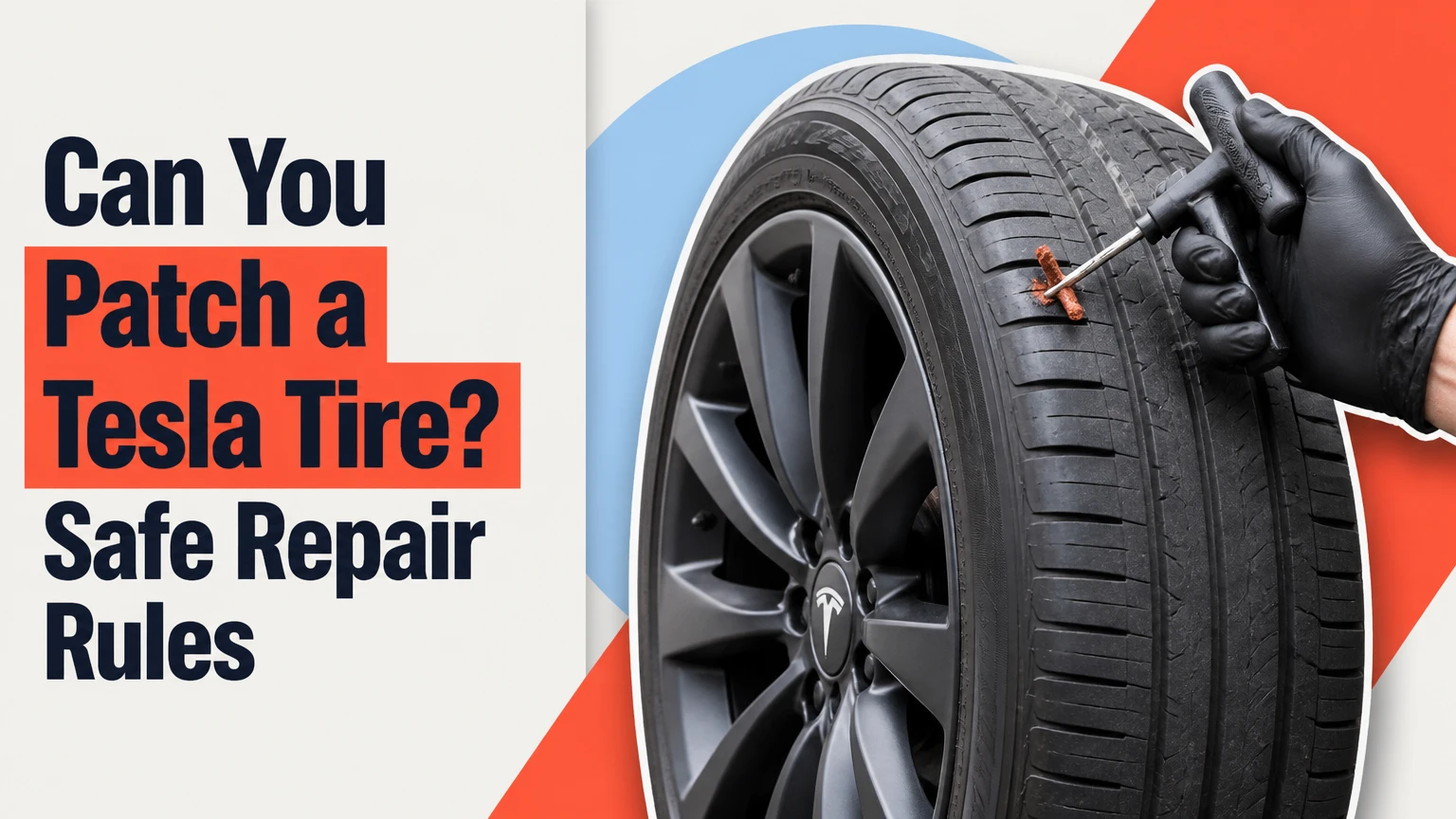
Yes, you can patch a Tesla tire when the puncture is in the repairable tread area, no larger than about 1/4 inch (6 mm), and the tire was not driven while severely underinflated. A qualified tire technician must inspect the inside, use a combination repair, and handle acoustic foam correctly when the Tesla tire includes it.
Key Facts at a Glance
- A Tesla tire is usually repairable only when the puncture is in the central tread, not the sidewall or shoulder.
- The common maximum puncture size for a permanent repair is 1/4 inch, or 6 mm, although tire and shop policies can be stricter.
- A permanent repair requires dismounting the tire and using an internal patch combined with a rubber stem.
- Some Tesla-original tires contain polyurethane acoustic foam, but not every Tesla tire has foam.
- A rope plug is a temporary roadside measure, not the preferred final repair.
- Tesla tire pressure varies by model and wheel package; use the driver-door placard or Tesla’s vehicle display rather than a generic 42 or 45 psi assumption.
Can You Patch a Tesla Tire?
A Tesla tire can be patched if the puncture is small, isolated, and located in the tread’s repairable zone. The tire must also have adequate tread, no exposed cords or internal damage, and no evidence that it was operated at low pressure long enough to damage the sidewall.
The key distinction is between a proper internal repair and a quick external plug. The U.S. Tire Manufacturers Association describes the accepted repair approach as a “combination plug and patch,” because the stem fills the puncture channel while the patch seals the inner liner. A patch placed over the inside alone does not reliably fill the puncture path.
Tesla vehicles make tire assessment more important because their battery packs create substantial vehicle weight, while electric motors deliver immediate torque. Those characteristics do not automatically prohibit repair, but they increase the consequences of an incorrectly repaired or mismatched tire.
A technician should remove the tire from the wheel before approving a permanent repair. An outside inspection cannot reveal belt separation, liner abrasion, or sidewall flex damage caused by driving on a flat.
Why Do Some Tesla Tires Have Acoustic Foam?
Some Tesla-original tires have a polyurethane foam ring bonded to the inner liner to reduce tire-generated cabin noise. The technology may appear under names such as Continental ContiSilent, Michelin Acoustic Technology, or a manufacturer-specific acoustic marking, but Tesla does not use foam in every tire, model, or replacement tire.
Acoustic foam does not make a tire unrepairable. The technician must cut or peel back the foam around the puncture, remove adhesive contamination from the repair area, and expose clean inner-liner rubber before applying the patch. A repair patch bonded to foam can detach because the foam is not the intended structural bonding surface.
A missing foam section measuring approximately 50-75 mm across usually creates no noticeable cabin-noise change, although the technician may reattach a clean, dry section if the product manufacturer permits it. The foam does not need to be restored for the tire to become airtight, and ordinary household glue is unsuitable inside a high-speed tire.
How Can You Tell Whether Foam Is Present?
Look for acoustic branding on the sidewall or ask the shop to inspect the inner liner after dismounting. Tire model names and sidewall markings provide better evidence than the Tesla model alone, because the same vehicle can leave the factory with different suppliers or receive a replacement tire without acoustic foam.
Do not cut into the tire yourself to check. Removing a tire from a Tesla wheel requires a suitable tire machine and care around the tire-pressure sensor.
Where on a Tesla Tire Can a Puncture Be Repaired?
A puncture in the central tread is the usual repair candidate; a puncture in the sidewall or shoulder normally requires tire replacement. The shoulder is the curved transition between the tread and sidewall, where flexing is too severe for a dependable permanent repair.
| Damage location or condition | Typical decision | Technical reason | Usual next action |
|---|---|---|---|
| Center tread, 1-6 mm puncture | Repair candidate | Stable tread zone with repairable belt geometry | Dismount and inspect internally |
| Outer tread near shoulder | Usually replace | High flexing and curved repair surface | Replace tire |
| Sidewall puncture or cut | Replace | Sidewall carries flexing load and lacks repair margin | Do not patch or plug |
| Puncture over 6 mm | Usually replace | Excessive casing and belt damage risk | Obtain replacement |
| Multiple repairs close together | Often replace | Reduced material between repairs | Tire-shop structural assessment |
| Tire driven flat or below safe pressure | Inspect, often replace | Internal sidewall abrasion may be invisible outside | Dismount for full inspection |
Repair-zone rules derive from tire-industry practice, but the tire manufacturer’s service guidance and the technician’s inspection control the final decision. A puncture 0.5 inch from the shoulder is not automatically safe; the actual tread design, angle, and damage shape matter.
A screw that entered squarely into a tread groove may leave a clean channel. A torn object, bolt, or angled impact can damage steel belts beyond the visible hole.
Which Tesla Tire Repair Method Is Best?
A professional combination repair is the best permanent option for an eligible puncture. An external rope plug is useful only to regain limited mobility after a roadside puncture, while liquid sealant is a last-resort recovery method that can complicate sensor and tire servicing.
| Repair method | Typical U.S. cost | Typical time | Permanent repair? | Main limitation |
|---|---|---|---|---|
| Internal combination patch/plug | $25-$80 | 30-90 minutes | Yes, if approved | Requires dismounting and internal inspection |
| External rope plug | $10-$25 DIY, $20-$40 shop | 10-20 minutes | No, unless later inspected and repaired properly | Does not inspect internal damage |
| Aerosol or injected sealant | $10-$80 | 10-20 minutes | No | Cleanup, sensor, and warranty complications |
| Tire replacement | $180-$600+ per tire | 45-120 minutes | Not applicable | Highest cost, required for unsafe damage |
Prices are typical U.S. consumer ranges, not fixed Tesla prices. Low-cost puncture repair may be free with a tire purchase, while mobile service, specialty wheels, urban labor rates, and performance tires can increase the bill.
Why Is a Combination Repair Safer?
The rubber stem occupies the puncture channel and limits air migration through the casing. The attached patch seals the inner liner, which is the surface that contains the tire’s inflation pressure.
The technician reams the channel with the correct tool, buffs only the repair area, applies vulcanizing cement, pulls the stem through from inside, and rolls the patch flat. The final repair should be coated at the stem and checked for leakage after curing or bonding according to the repair-product instructions.
A patch alone seals the liner but leaves the puncture channel open. A plug alone fills the channel but may not seal the inner liner reliably. That is why the combination repair is the accepted professional approach.
Does a Rope Plug Make Highway Driving Safe?
A rope plug should be treated as temporary transportation to a tire facility, not as permission for unrestricted highway use. A plug installed from outside cannot confirm whether the tire suffered internal damage, whether steel belts were cut, or whether the puncture is within the approved repair zone.
If a roadside plug is unavoidable, inflate the tire only to the vehicle’s placard pressure, drive slowly and directly to a tire shop, and stop immediately if pressure falls, steering changes, vibration appears, or the tire heats abnormally. Do not use a plug as a permanent repair on a puncture near the shoulder or sidewall.
How Is a Tesla Tire Professionally Repaired?
A professional Tesla tire repair normally takes 30-90 minutes and includes removal from the wheel, internal inspection, foam management, combination repair, leak testing, and balancing. The most important success factor is exposing clean inner-liner rubber before bonding the patch.
Step 1: Confirm the Leak and Tire Pressure
The technician locates the puncture with soapy water or a submerged leak check after inflating the tire to a safe inspection pressure. A Tesla touchscreen warning confirms pressure loss, but it does not identify the leak location or prove the casing is repairable.
Do not keep inflating a tire that has a large cut, exposed cords, a bulge, or a separated tread. Arrange roadside assistance instead.
Success checkpoint: bubbles emerge from one identifiable puncture rather than the bead, valve, or wheel.
Common mistake: assuming a warning means the tire itself is leaking. A bent wheel, valve seal, or bead leak can produce the same dashboard symptom.
Step 2: Remove the Wheel and Dismount the Tire
The vehicle must be lifted at the designated lift points with Tesla-compatible jack pads or a shop adapter. A jack pad protects the vehicle’s lift contact area; it does not make an unsafe tire repair acceptable.
The tire shop removes the tire using a machine that avoids the TPMS sensor mounted inside the wheel. Tesla sensor designs vary by vehicle generation, so the technician should identify the sensor position before breaking the bead.
Success checkpoint: the tire is off the wheel without sensor, bead, or rim damage.
Common mistake: lifting under the battery enclosure or using a jack point without the correct adapter.
Step 3: Inspect the Inner Casing
The technician examines the inner liner, sidewalls, bead area, and belt edges for abrasion, cuts, bulges, or separation. If the Tesla tire was driven while flat, the technician should look for a circumferential scuff or powder-like rubber debris inside the sidewall.
A tire with hidden run-flat damage should not be repaired simply because the exterior puncture is small. The inner inspection determines whether the casing retains its structural integrity.
Success checkpoint: the repair area is intact, and the puncture channel is traceable from the inside.
Common mistake: skipping the internal inspection because the tire still holds air after a temporary plug.
Step 4: Remove Acoustic Foam From the Repair Area
When foam is present, the technician removes a small section around the puncture and cleans away loose foam and adhesive residue. The exposed repair zone must contain smooth, uncontaminated inner-liner rubber.
The exact cutout size depends on the tire and repair tool. A technician should remove only enough foam to create a proper bonding surface, rather than stripping the entire acoustic ring.
Success checkpoint: the patch can lie flat on rubber without touching foam or thick adhesive.
Common mistake: bonding the patch over foam because the puncture appears small from the outside.
Step 5: Install the Combination Patch/Plug
The technician prepares the puncture channel with the repair manufacturer’s reamer, applies the specified cement, and pulls the rubber stem through from the inside. The patch is positioned flat, then rolled with a stitching tool to remove trapped air.
The stem is trimmed flush on the tread after the repair material has bonded. Repair products differ, so cement type, cure time, and trimming instructions should come from the product manufacturer rather than a generic online procedure.
Success checkpoint: the patch edges adhere continuously, the stem fills the channel, and no air pocket remains.
Common mistake: enlarging the hole unnecessarily with an oversized tool or using a plug that does not match the puncture diameter.
Step 6: Leak-Test, Rebalance, and Reinstall
The repaired tire is inflated to the vehicle’s specified cold pressure and tested for leakage at the repair, bead, valve, and sensor. The wheel is dynamically balanced after remounting because removing and reinstalling a tire can alter balance or expose an existing imbalance.
Tesla recommends the pressure shown on the driver-side door placard for the relevant wheel and tire package. The often-repeated 42 or 45 psi figures are not universal Tesla specifications.
Success checkpoint: no bubbles appear during the leak test, the TPMS reading updates, and the wheel balances within shop limits.
Common mistake: resetting the TPMS warning without verifying actual pressure and sensor communication.
How Much Does Tesla Tire Repair Cost?
A normal internal Tesla tire repair typically costs $25-$80 and takes 30-90 minutes in the United States. A mobile call, acoustic-foam handling, large wheel, premium performance tire, or after-hours emergency can raise the total, while a tire purchased from the same shop may include repair service.
| Situation | Typical price | Typical duration | Likely result |
|---|---|---|---|
| Shop repair, ordinary tread puncture | $25-$50 | 30-60 minutes | Combination repair |
| Shop repair, foam-equipped tire | $40-$80 | 45-90 minutes | Foam cut back, internal repair |
| Mobile roadside assessment | $75-$150 service call | 30-90 minutes | Inspection or temporary mobility |
| Roadside sealant kit | $10-$80 | 10-20 minutes | Temporary inflation |
| Tesla tire replacement | $180-$600+ | 45-120 minutes | New tire, mounting, balance |
Tesla Service Centers may not offer every tire-repair service at every location. Tesla Roadside Assistance can arrange towing or mobility help, but a roadside provider may not perform a permanent internal repair beside traffic.
Call ahead and ask whether the shop repairs Tesla acoustic tires, uses combination repairs, handles Tesla TPMS sensors, and will inspect a tire that has been driven underinflated.
When Should You Replace a Tesla Tire Instead?
Replace a Tesla tire when damage reaches the sidewall or shoulder, exceeds the repairable size, causes a bulge or belt separation, or follows meaningful driving while flat. Replacement is also appropriate when tread depth, age, uneven wear, or a performance-driving requirement makes a repaired casing unsuitable.
A repair shop may reject an otherwise small puncture if the tire has less than approximately 2/32 inch of remaining tread, severe inner shoulder wear, repeated repairs, or a damaged bead. Legal minimum tread depth is not the same as a sensible replacement threshold for wet-weather grip.
Performance versions deserve additional caution. A Model 3 Performance, Model S Plaid, or Model X driven on a track generates higher heat and cornering loads than a commuter vehicle, so the owner should follow the tire manufacturer’s repair and speed-rating guidance and disclose track use.
A repaired tire is not automatically unsafe for normal road use. It is also not equivalent to an undamaged tire for every racing or high-speed application.
Can You Replace Only One Tesla Tire?
Replacing one Tesla tire may be acceptable when the replacement matches the same size, construction, load index, speed rating, and tread type, and the remaining tires have closely matched tread depth. Tesla’s all-wheel-drive systems can be sensitive to diameter differences, especially when the mismatch is large.
| Replacement situation | Typical recommendation | Matching requirement | Main concern |
|---|---|---|---|
| One tire, same axle with similar tread | Often acceptable | Same size, rating, model preferred | Diameter difference |
| One tire, opposite tire badly worn | Replace two on axle | Matched pair | Handling balance |
| AWD vehicle with large tread mismatch | Manufacturer or tire-shop review | Closely matched circumference | Drivetrain and traction control |
| Mixed summer and all-season tires | Avoid | Same seasonal category | Grip imbalance |
| Performance tire replaced by touring tire | Avoid | Similar compound and speed rating | Steering and braking behavior |
The exact acceptable tread-depth difference depends on Tesla’s model guidance and tire manufacturer recommendations. A tire shop can measure all four tires and compare actual circumference rather than relying on visual appearance.
What Should You Do With a Flat Tesla Tire?
A Tesla with a flat tire should be stopped safely and inspected before driving farther. If the tire is visibly damaged, fully deflated, or has been driven underinflated, use Tesla Roadside Assistance or a qualified tow provider instead of driving to a shop.
Use the following sequence:
- Move away from traffic and stop on a stable surface.
- Check the tire visually without placing hands near a damaged tread or sidewall.
- Read the pressure in the Tesla display and inspect for a screw, nail, cut, bulge, or separated tread.
- Do not remove an embedded object before a technician evaluates it.
- Use a spare, if your equipment and model provide one; most Teslas do not include a conventional spare.
- Use a compressor only when the tire has no major structural damage and can safely hold air.
- Request a tow when pressure drops rapidly or the tire has contacted the road while flat.
Tesla’s mobile connector and charging equipment do not replace a tire inflator or repair kit. A tire sealant kit can restore temporary pressure, but the product label and Tesla instructions should be followed because cleanup and sensor inspection may be required.
Does Tire Sealant Damage Tesla TPMS?
Tire sealant can contaminate a tire-pressure sensor, but it does not guarantee immediate sensor failure in every case. Water-based emergency products may be removable, while some formulas can coat the sensor, interfere with readings, corrode components, or require sensor replacement after tire service.
Sealant also spreads through the inside of the tire, which makes a conventional permanent repair harder and increases cleanup labor. Inform the tire shop that sealant was used before the tire is removed.
Sealant is useful when a stranded driver cannot safely install a temporary plug or wait beside a road. It is a poor substitute for an internal inspection and should not be treated as a permanent repair.
Which Shop Should Repair a Tesla Tire?
Choose a shop that can dismount the tire, inspect the casing, manage acoustic foam, protect the TPMS sensor, install an internal combination repair, and rebalance the wheel. Tesla authorization is helpful but is not the only qualification; tire-repair equipment and technician competence matter more than the logo on the building.
Ask these questions before booking:
- Do you perform internal combination repairs on Tesla tires?
- Will you dismount the tire and inspect for run-flat damage?
- Does the tire contain acoustic foam, and how will you expose the liner?
- Can you service the Tesla TPMS sensor without damaging it?
- Will you match the Tesla door-placard pressure and rebalance the wheel?
- What tire manufacturer warranty or repair policy applies?
Costco, Discount Tire, independent tire dealers, and Tesla Service locations can have different policies by store, tire brand, and technician. A refusal does not prove that Tesla tires cannot be repaired; it may indicate that the location does not accept foam-equipped tires or does not want the liability.
Common Repair Mistakes
Patching the Sidewall
A sidewall patch cannot restore the casing’s designed flex behavior. Sidewall punctures and cuts require replacement, even when the hole is smaller than 6 mm.
Repairing a Tire That Was Driven Flat
A tire can look normal outside after its sidewall has been internally abraded by low-pressure driving. Dismounting is the only reliable way to assess that damage.
Applying a Patch Over Foam
Foam and adhesive residue prevent the patch from bonding to the inner liner. The technician must create a clean rubber surface before applying repair cement.
Assuming All Tesla Tires Use 42 or 45 PSI
Tesla pressure varies by model, wheel, tire, and load specification. The driver-door placard is the controlling reference for cold inflation pressure.
Using a Plug as a Final Repair
An external plug does not replace internal inspection or seal the inner liner in the same way as a combination repair. Treat it as temporary transportation only.
Replacing a Tire Without Checking AWD Matching
A new tire next to a heavily worn tire can create a diameter mismatch. Measure tread depth and follow Tesla and tire-maker guidance before replacing only one tire.
Frequently Asked Questions
Can Tesla roadside assistance patch a tire?
Tesla Roadside Assistance can help arrange towing or roadside support, but the exact service depends on location, provider, traffic conditions, and vehicle coverage. A roadside technician may inflate the tire or install a temporary plug, while a permanent combination repair generally requires a tire shop with a tire machine.
Can I drive a Tesla with a slow tire leak?
Drive only far enough to reach safety or a tire facility if the tire retains pressure, has no visible structural damage, and pressure remains within a safe range. A rapidly deflating tire, sidewall damage, vibration, or repeated pressure warning requires stopping and arranging a tow.
Are Tesla acoustic tires more expensive to repair?
Acoustic-foam tires typically cost more to repair because the technician must remove foam and adhesive from the bonding area before installing the internal repair. A typical repair may cost $40-$80 rather than $25-$50, although local labor and tire policy determine the actual price.
Can I patch a Tesla tire without removing the wheel?
A permanent repair should not be performed without removing the tire from the wheel because internal damage cannot be evaluated from outside. An external rope plug can be installed without dismounting, but it is a temporary roadside measure and should be replaced or professionally assessed promptly.
Does a tire patch affect Tesla range?
A correctly repaired tire normally has little measurable effect on range compared with the original tire. Incorrect pressure, a mismatched replacement, wheel imbalance, aggressive tread, and uneven alignment can affect rolling resistance and range more than a properly installed repair.
How long does a Tesla tire patch last?
A correctly installed combination repair can last for the remaining usable life of an eligible tire, subject to the tire manufacturer’s warranty and repair policy. A rope plug or sealant has no equivalent durability assurance, so the tire should receive professional inspection rather than indefinite use.
The Bottom Line
Can you patch a Tesla tire? Yes, when the puncture is small and located in the central tread, the casing has not been damaged by underinflation, and a qualified technician installs an internal combination patch/plug. Acoustic foam requires careful removal from the bonding area, but it does not automatically make the tire unrepairable.
Do not patch or plug a Tesla tire’s sidewall or shoulder. Do not treat sealant or an external rope plug as a permanent substitute for internal inspection. Check the vehicle’s door-placard pressure, preserve AWD tire matching, and use roadside assistance when the tire is flat or structurally damaged.