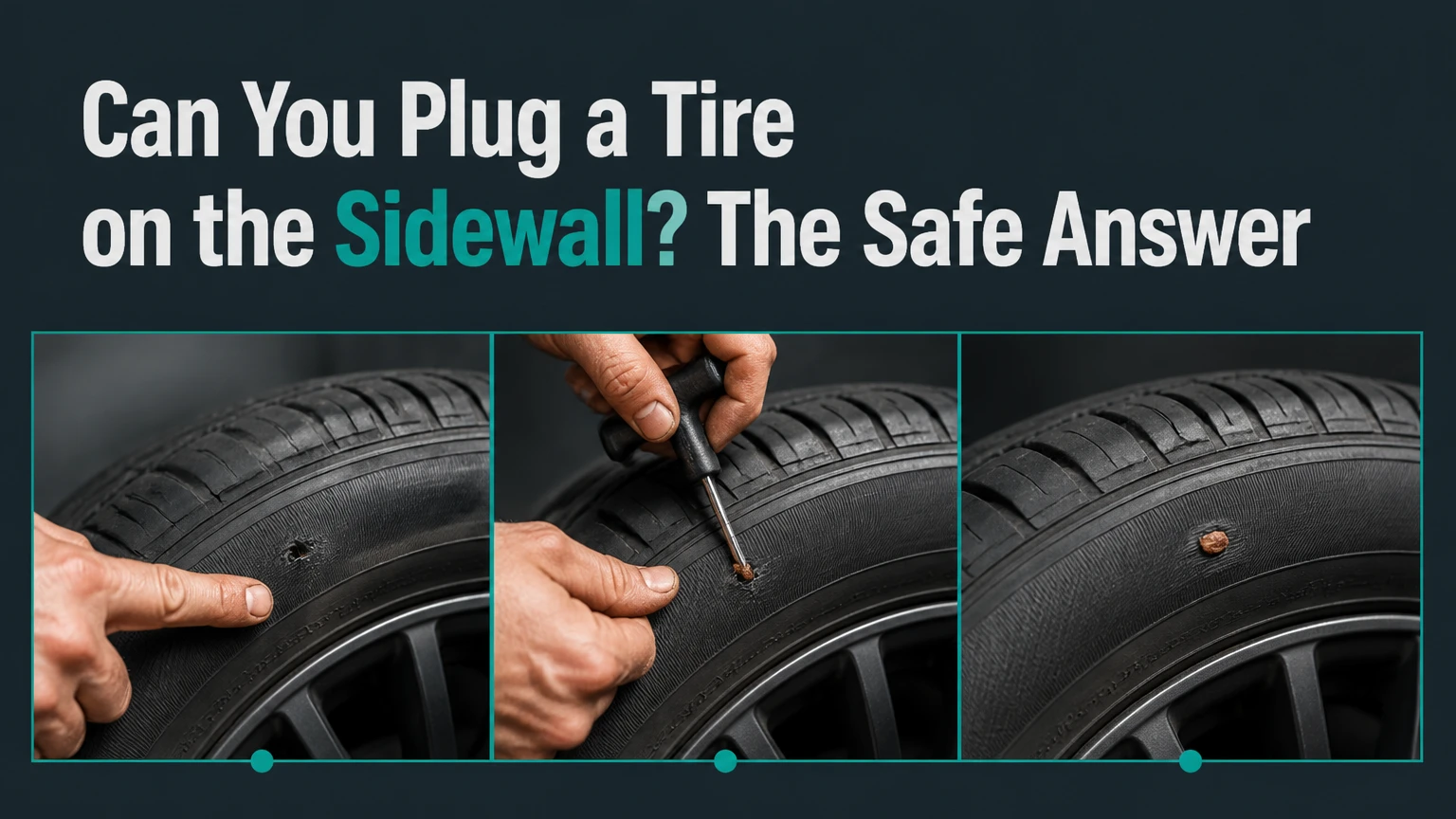
No, you should not plug or patch a puncture in a tire sidewall. A tire sidewall carries flexible body cords and contains the air pressure that supports the vehicle, so damage in that area can progress to a sudden blowout. The safe remedy for a puncture, cut, cord exposure, or bulge in the sidewall is tire replacement after professional inspection.
Key Facts at a Glance
- A permanent tire repair is generally limited to a puncture in the central tread area, not the shoulder or sidewall.
- A tire plug alone is not the industry-standard permanent repair; an approved internal patch-plug requires removal and inspection.
- A sidewall bulge indicates separated internal cords and requires immediate tire replacement.
- A visible white, gray, or yellow cord in a cut means the tire’s reinforcing structure is exposed.
- Driving on a flat or severely underinflated tire can cause internal damage even when the original puncture appears small.
- AWD vehicles may need two or four tires replaced when the new tire’s tread depth differs from the remaining tires.
Can You Plug a Tire on the Sidewall?
A sidewall puncture cannot be safely repaired with a plug, rope, mushroom plug, or internal patch. U.S. Tire Manufacturers Association guidance limits permanent puncture repair to the tread’s repairable area, while Tire Industry Association procedures require the tire to be removed for internal inspection before a permanent repair.
The reason is structural, not merely procedural. A sidewall bends whenever the tire rolls, turns, carries a load, or absorbs a road impact. A repair material designed for the comparatively stable tread cannot reliably restore the sidewall’s original strength or fatigue resistance.
The exact boundary varies by tire manufacturer and repair standard, but a common rule places the repairable area within the center three-quarters of the tread and at least 1/2 inch, or 12.7 millimeters, from the shoulder. The rounded shoulder is not automatically repairable simply because it has tread grooves.
A useful correction is necessary: a sidewall plug does not have a scientifically established “failure time” of minutes or hours, and sidewall repair is not illegal in every jurisdiction. The reliable safety conclusion is stronger than those unsupported specifics: recognized tire-repair guidance does not approve a sidewall puncture as a permanent repair.
Why Do Sidewall Repairs Fail?
Sidewall repairs fail because the sidewall repeatedly flexes while the tread has a more stable, belt-supported structure. A plug can seal a clean tread puncture when surrounding rubber compresses around the repair, but sidewall movement can enlarge the channel and damage the body cords.
A pneumatic tire contains several functional layers. The tread contacts the road, steel or textile belts stabilize the tread area, the carcass body cords support the tire, the inner liner retains air, and the bead locks the assembly to the wheel. The sidewall protects and flexes with the carcass; it is not simply a thick rubber version of the tread.
The common explanation that sidewalls contain “no steel belts” is too broad. Many passenger tires place steel belts beneath the tread rather than through the sidewall, but tire construction varies by tire type, size, run-flat design, and manufacturer. The important distinction is that the sidewall does not have the same puncture-supporting belt package as the tread repair zone.
USTMA consumer guidance states, “Never repair a tire with a puncture in the sidewall.” That instruction reflects the inability of a plug or patch to restore damaged cords and the sidewall’s repeated cyclic loading.
Where Is the Repairable Tire Zone?
The repairable tire zone is normally the central tread area, at least 1/2 inch from the shoulder, subject to the tire maker’s instructions. The shoulder is the curved transition where the tread begins wrapping toward the sidewall, so a puncture near the outermost groove may already be outside the approved zone.
| Location of damage | Typical repair status | Main reason | Correct action |
|---|---|---|---|
| Center tread, 1/2 inch or more from shoulder | Potentially repairable | Stable tread structure | Professional internal inspection |
| Outer tread groove near shoulder | Usually non-repairable | Flexing transition zone | Replace unless manufacturer permits otherwise |
| Rounded shoulder | Non-repairable | High flex and curvature | Replace the tire |
| Sidewall between shoulder and bead | Non-repairable | Damaged flexible carcass area | Replace immediately |
| Bead area at wheel rim | Non-repairable | Air seal and anchoring damage | Replace and inspect wheel |
A tire technician should measure the location from the shoulder rather than relying on the puncture’s apparent distance from the lettering. Tire dimensions, tread patterns, and shoulder shapes make visual estimates unreliable.
What Damage Requires Tire Replacement?
A sidewall puncture, cut into the carcass, exposed cord, bulge, or deep cracking requires replacement rather than plugging. A shallow cosmetic scuff may not require replacement, but only a trained technician can determine whether the damage stopped in the outer rubber.
| Damage type | What you may see | Structural meaning | Driving advice |
|---|---|---|---|
| Nail or screw in sidewall | Small round entry hole and air loss | Sidewall carcass is penetrated | Do not drive; install spare or tow |
| Cut or slice | Linear opening, possibly jagged edges | Body cords or inner liner may be severed | Do not drive if cut is open or deep |
| Cord exposure | White, gray, yellow, or black fibers | Reinforcement has lost rubber protection | Replace immediately |
| Bulge or bubble | Localized outward swelling | Internal cord separation or liner failure | Stop driving and replace |
| Dry-rot cracking | Network of cracks between lettering | Rubber compound has aged | Inspect; replace if cracks are deep |
| Surface scuff | Abrasion without open cut or cords | May be cosmetic only | Professional inspection before normal driving |
A bulge is especially urgent because air pressure pushes against a weakened section from inside. The tire may appear to hold pressure while the internal separation continues to spread.
Deep dry-rot cracks can also make an otherwise puncture-free tire unsafe. Age, ozone, sunlight, heat, and storage conditions affect degradation, so the date code and visible condition both matter.
Can You Drive on Sidewall Damage?
You should not drive normally on a tire with confirmed sidewall damage. If the tire is losing pressure, has a bulge, exposes cords, or is visibly cut, driving even a short distance can turn a repairable wheel into a damaged wheel and can cause a loss of control.
The safest response is to stop on a stable surface away from traffic, switch on hazard lights, and call roadside assistance or install the spare. Do not use a jack on soft ground, a slope, or a shoulder where passing traffic can strike the vehicle.
A technician must inspect a tire that has been driven while flat or substantially underinflated. The sidewall may show no external mark even though the inner liner and carcass were crushed during the drive.
What Should You Do Immediately?
- Reduce risk before inspecting. Move away from traffic if the vehicle remains controllable, then park on level ground and apply the parking brake.
- Avoid touching a bulge. Do not press, cut, pull out, or hammer an object from a damaged sidewall.
- Check the tire visually. Look for a hole, cut, bubbling, exposed fibers, rim damage, and the tire’s inflation condition.
- Install the correct spare. Use the vehicle’s instructions, designated jack points, wheel chocks where available, and the spare’s speed and distance limits.
- Call for assistance when needed. Use a tow or mobile tire service if the spare is missing, the wheel is damaged, or the roadside location is unsafe.
- Tell the shop about sealant use. Aerosol sealant can obstruct inspection and contaminate the inside of the tire and wheel.
You will know the emergency response is complete when the damaged tire is off the vehicle or the vehicle is secured for towing. A temporary spare is a way to reach a safe repair location, not a substitute for replacing the damaged tire.
Is a Patch Better Than a Plug?
A patch is not safer than a plug when the damage is in the sidewall. For a qualifying tread puncture, tire manufacturers and industry associations generally favor a combination repair installed from inside the tire, rather than an external rope plug used alone.
| Repair method | Approved location | Tire removal required | Permanent sidewall solution |
|---|---|---|---|
| External rope plug | Some tread punctures as temporary roadside aid | No | No |
| Internal patch | Depends on manufacturer and injury | Yes | No |
| Combination patch-plug | Qualifying tread puncture | Yes | No |
| Liquid sealant | Temporary leak control only | Usually later inspection | No |
| Sidewall plug | Not an approved permanent zone | Not sufficient | No |
An external plug can help a driver reach a repair facility when a small tread puncture occurs, but it does not establish that the tire is permanently repaired. A tire shop should remove the tire, inspect the inner liner, prepare the injury, and use a repair method approved for that tire.
The patch-plug method cannot replace missing sidewall cords. Repair material seals an opening; it does not recreate the original carcass construction.
How Much Does Sidewall Replacement Cost?
A typical replacement tire costs approximately $80-$350 before or including some installation charges, while premium truck, performance, run-flat, and large SUV tires can exceed $350. Mounting, balancing, disposal, taxes, roadside service, and wheel repair may add $20-$100 or more.
| Vehicle and tire category | Typical tire price | Typical installed total | Common timeframe |
|---|---|---|---|
| Compact passenger car | $80-$160 | $110-$210 | 45-75 minutes |
| Midsize sedan or crossover | $120-$240 | $155-$300 | 45-90 minutes |
| Light truck or large SUV | $170-$350 | $210-$430 | 60-100 minutes |
| Run-flat or performance tire | $180-$450 | $230-$550 | 60-120 minutes |
| Full AWD replacement, four tires | $480-$1,400 | $560-$1,650 | 90-150 minutes |
These are typical U.S. retail ranges, not a universal price schedule. Tire size, brand, load rating, speed rating, regional labor prices, and availability produce substantial variation.
A free or low-cost tire inspection may identify the damage, but an inspection does not make a sidewall injury repairable. Ask for an itemized estimate showing tire price, mounting, balancing, valve or TPMS service, disposal, and alignment if the wheel hit a curb.
Does AWD Require Replacing All Four Tires?
AWD does not automatically require four new tires, but the vehicle manufacturer’s permitted tread-depth difference controls the decision. A new tire with substantially more tread than the other three can create rolling-circumference differences that increase driveline strain on some AWD systems.
Check the owner’s manual before buying one replacement tire. Subaru, Audi, BMW, Mercedes-Benz, and other manufacturers publish vehicle-specific limits, and those limits can vary by model, drivetrain, tire size, and year.
| Replacement situation | Typical decision | Technical check | Possible solution |
|---|---|---|---|
| Two-wheel-drive car, similar tread | One tire may be acceptable | Match size, rating, and tread family | Replace one, then balance |
| Two-wheel-drive car, worn axle pair | Two tires often preferable | Compare both axle tread depths | Install pair on recommended axle |
| AWD with small tread difference | One tire may be allowed | Read manufacturer limit | Match tire closely |
| AWD with excessive difference | One tire may be unsuitable | Measure all four tires in 1/32-inch increments | Replace two or four |
| Rare tire size with limited stock | Matching may be difficult | Compare exact specifications | Ask about approved tread shaving |
Tread shaving can reduce a new tire to match the remaining tires, but it should be performed only by a qualified tire retailer using equipment designed for that purpose. A replacement tire must also match the original tire’s size, load index, speed rating, construction, seasonal category, and approved fitment.
What Should the Replacement Tire Match?
The replacement tire should match the vehicle’s required size, load index, speed rating, construction, seasonal type, and, where possible, the same model and tread pattern. Matching only the diameter is insufficient because load capacity, handling balance, and rolling circumference also matter.
Read the sidewall markings and the vehicle placard on the driver’s door. For example, a marking such as P225/55R17 97V identifies a passenger tire, 225-millimeter section width, 55-series aspect ratio, radial construction, 17-inch wheel diameter, load index 97, and V speed rating.
A tire shop should also inspect:
- Wheel flange and rim sealing surfaces
- Valve stem or TPMS sensor
- Alignment after curb or pothole impact
- Remaining tread depth on the axle
- Spare-tire pressure and age
- Brake, suspension, and fender clearance
A used tire can be a reasonable budget option when its size, rating, age, condition, and tread depth closely match the vehicle’s other tires. It is not a safe option if it has repairs near the shoulder, sidewall cracking, uneven wear, exposed cords, or an unknown history.
Are Run-Flat Tires or Sealants Exceptions?
Run-flat capability does not make sidewall repair acceptable. A run-flat tire may permit limited travel after pressure loss at a manufacturer-specified speed and distance, but the tire still requires inspection and may require replacement after operating deflated.
Run-flat sidewalls contain specialized reinforcement, and that reinforcement makes the tire’s construction different from a conventional tire. A shop may reject repair after a deflation event because internal damage can exist without a visible puncture.
Liquid sealants also do not create a permanent sidewall repair. Some products may temporarily reduce air loss from a small tread puncture, but they are not suitable for a cut, bulge, cord exposure, or damaged bead.
The 50-mph limit often quoted for a temporary spare applies to many compact spare tires, not every spare. Follow the exact label on the spare and owner’s manual, which may specify a lower speed, a maximum distance, or restrictions on driving in severe weather.
How Can You Tell Whether a Scuff Is Cosmetic?
A sidewall scuff may be cosmetic when it removes only a thin layer of surface rubber and leaves no open cut, raised bubble, loose flap, or exposed cord. A professional must inspect any abrasion caused by a hard curb because the visible mark does not reveal the full depth of the injury.
Use a bright light and compare the damaged area with the opposite side of the tire. Do not use a knife to widen a cut or spray solvent on the rubber. If the cut opens when the tire is inflated, if air bubbles form with soapy water, or if fibers are visible, treat the tire as non-repairable.
Soapy water can help locate a leak, but it cannot determine whether the tire is structurally sound. A slow leak at the bead, valve, wheel, or inner liner may look similar from outside, and a tire shop must identify the actual source.
What Questions Should You Ask the Tire Shop?
Ask the technician to identify the injury’s exact location, show whether cords or the inner liner are damaged, and state why replacement is required. Request the tread depths of all four tires in 1/32-inch measurements, not a vague description such as “they are close.”
Also ask:
- Does the replacement match the original size, load index, speed rating, and tire type?
- Does the AWD manufacturer permit the tread-depth difference?
- Does the wheel need leak testing, straightening, or replacement?
- Is the TPMS sensor or valve stem damaged?
- Does the quote include mounting, balancing, disposal, and taxes?
- Should the vehicle receive an alignment after the impact?
A technician who proposes an external plug in the sidewall is not following standard permanent tire-repair practice. The correct response is to obtain a second opinion from a reputable tire retailer or contact the tire manufacturer.
Common Mistakes With Sidewall Damage
Driving to “see whether it holds air”
A tire can retain pressure while its cords are damaged. Pressure retention is not proof of structural safety, particularly after a curb impact or a drive on a flat tire.
Confusing the shoulder with repairable tread
The outermost tread groove may sit on the shoulder transition. A puncture there is often outside the approved repair zone even when the hole appears to be in a tread block.
Pulling out the nail or screw immediately
Removing the object can accelerate air loss and make roadside control more difficult. Leave it in place until the vehicle is secured, unless the object creates an immediate hazard.
Using a plug because the leak is slow
Leak speed does not determine repairability. A small sidewall hole still compromises a flexible load-bearing structure.
Accepting a glued or stitched trail repair for highway use
An off-road emergency repair may help a vehicle reach a safe location with a full-size spare or tow support. It is not a validated highway repair for a passenger vehicle.
The Bottom Line
You cannot safely plug a tire on the sidewall as a permanent repair. Replace the tire when the sidewall has a puncture, deep cut, exposed cord, bulge, or structural cracking, and use a spare or roadside assistance instead of driving on the damaged tire. Check AWD tread-depth requirements before choosing one, two, or four replacement tires.
Frequently Asked Questions
Can a nail in the sidewall be repaired?
A nail in the sidewall should not be repaired with a plug or patch. The nail may have penetrated the carcass cords and inner liner, while the sidewall’s repeated flexing prevents a repair from restoring the original structure. Remove the damaged tire from service and have a technician confirm whether the wheel also suffered damage.
Is a tire shoulder puncture repairable?
A shoulder puncture is usually not repairable because the shoulder is the curved, high-flex transition between the tread and sidewall. Industry guidance commonly places the repair boundary at least 1/2 inch from the shoulder, but the tire manufacturer’s repair instructions control. A technician should measure the injury rather than judge it from appearance.
Can I drive one mile with a sidewall puncture?
Driving one mile is unsafe when the sidewall is cut, bulging, corded, or losing pressure. A very short movement may be unavoidable to escape immediate traffic, but the preferred options are a spare, roadside service, or a tow. Driving underinflated can damage the tire internally and compromise the wheel.
Will Fix-a-Flat repair a hole in the sidewall?
Fix-a-Flat and similar aerosol sealants are not permanent repairs for sidewall holes. A sealant may fail against the sidewall’s flexing motion and can complicate internal inspection, cleaning, and TPMS service. Use the product only when its label and vehicle instructions allow temporary use, then have the tire professionally inspected.
Can a tire shop repair sidewall dry rot?
A tire shop cannot restore dry-rotted rubber with a patch, plug, conditioner, or adhesive. Surface aging marks may be inspected and monitored, but deep cracking, cracking between tread blocks, exposed cords, or a brittle sidewall means replacement is appropriate. Tire age, storage history, heat exposure, and visible condition all affect the decision.
Should I replace a tire after hitting a curb?
Replace or professionally inspect a tire after a curb impact when the sidewall has a bulge, cut, cord exposure, air loss, or severe abrasion. A curb strike can also bend the wheel or alter alignment. Even when the tire looks normal, unusual vibration, pulling, or repeated pressure loss warrants inspection before highway driving.