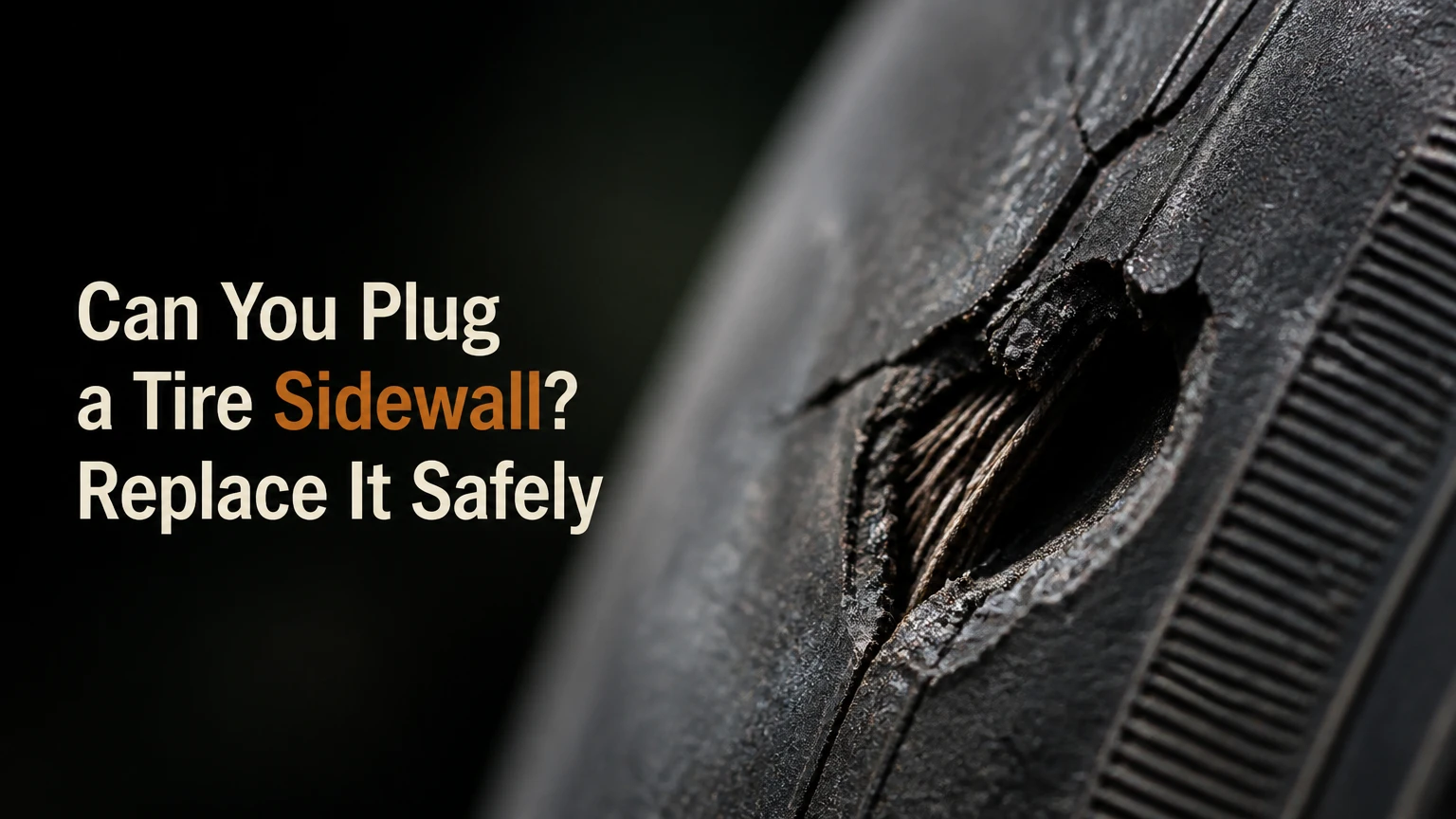
No, you cannot safely plug a passenger-vehicle tire sidewall. A sidewall puncture, cut, tear, bulge, or exposed cord damages a flexible load-bearing structure that tire plugs and patches are not designed to restore, so the correct remedy is tire replacement after safely fitting a spare or arranging roadside assistance.
Key Facts at a Glance
- A tire sidewall puncture is not a certified repair for passenger cars or light trucks.
- A rope plug repairs some tread punctures temporarily, but it does not restore damaged sidewall cords.
- A sidewall bulge indicates internal casing damage and requires immediate tire replacement.
- The commonly cited 1/4-inch, or 6-mm, limit applies only to certain punctures in the repairable tread zone.
- The shoulder and belt-edge area are generally treated as non-repairable because they flex heavily.
- Driving on a damaged or underinflated sidewall can create heat and cause sudden air loss.
Can You Plug a Tire Sidewall?
A tire sidewall cannot be safely repaired with a rope plug, rubber patch, sealant, or tire cement. The U.S. Tire Manufacturers Association (USTMA), Tire Industry Association (TIA) repair practices, and manufacturers including Michelin, Continental, and Pirelli limit conventional puncture repairs to specified tread areas.
A plug fills a channel through rubber. It does not reconstruct the tire’s internal casing, restore severed cords, or reproduce the controlled bonding process used during tire manufacture. A sidewall repair product sold online may stop air escaping while the tire is stationary, but that result does not prove structural safety during highway driving.
Michelin’s consumer guidance summarizes the manufacturer position directly: “Sidewall damage cannot be repaired.” Local laws may describe prohibited tire conditions differently, but a retailer’s willingness to install a sidewall patch is not evidence that the repair is safe or manufacturer-approved.
Is a Sidewall Nail Hole Ever Repairable?
A nail hole in the sidewall is treated as non-repairable even when the hole is small and the tire is losing air slowly. The nail can cut or separate casing cords, while the plug only seals the rubber passage around the nail path.
A tire technician should remove the tire from the wheel and inspect the inside before making a final diagnosis. Do not pull out an embedded object beside traffic, because removing it can turn a slow leak into a rapid deflation.
Why Does Sidewall Damage Make a Tire Unsafe?
Sidewall damage is unsafe because the sidewall repeatedly bends under vehicle load, and a cut through its casing can grow while heat and pressure cycle through the tire. Unlike the tread, the sidewall has no thick steel-belt package beneath the rubber to contain a conventional puncture repair.
A radial tire usually contains polyester, rayon, or nylon body cords running from bead to bead. The inner liner holds air, the sidewall protects the casing, and the tread package supplies wear resistance and road traction. Steel belts reinforce the tread beneath the grooves, not the smooth sidewall face.
During cornering, braking, acceleration, and impacts, the sidewall changes shape. The casing therefore needs continuous, uniform strength. A plug creates a local insert rather than replacing damaged cord layers, and an external patch cannot reliably control the casing’s repeated flexing.
What Happens Inside a Plugged Sidewall?
A plugged sidewall can leak, work loose, or allow the cut to lengthen as the casing flexes. Air pressure may force the damaged area outward, while friction and flexing generate heat around the weakened cords.
The most dangerous failure is not always an immediate leak. A tire can hold pressure in a driveway and still fail later after several miles of heat buildup. The risk increases with high speed, heavy loads, low inflation pressure, hot pavement, and repeated pothole impacts.
A sidewall plug also hides the extent of internal damage. A professional inspection can reveal a separated inner liner, pinched casing, abrasion, or cord rupture that is invisible from the outside.
Which Parts of a Tire Can Be Repaired?
Only a limited central tread area can usually receive a permanent puncture repair, and the puncture must meet size, angle, spacing, and condition requirements. The shoulder, belt edge, sidewall, bead, and inner liner are normally excluded from conventional repair procedures.
| Damage location | Typical position | Common repair limit | Correct action |
|---|---|---|---|
| Center tread | Middle grooves, away from shoulder | Puncture up to 6 mm, or 1/4 inch, subject to inspection | Remove tire and use an approved internal repair |
| Outer tread | Within roughly 25-40 mm of shoulder | Often excluded because of flex | Replace tire unless manufacturer permits otherwise |
| Shoulder or belt edge | Tread-to-sidewall transition | No conventional repair | Replace tire |
| Sidewall | Vertical rubber between shoulder and bead | No plug or patch repair | Replace tire |
| Bead area | Wheel-contact edge, within 0-25 mm of rim | No casing repair | Inspect tire and wheel, usually replace tire |
| Inner liner | Air-retaining interior surface | Depends on damage and tire type | Professional dismount inspection |
The 6-mm threshold is not a universal permission to repair every small hole. USTMA guidance also considers puncture location, tire condition, repair history, speed rating, run-flat construction, and whether the tire was driven while underinflated.
How Close to the Shoulder Is Too Close?
A puncture near the shoulder is generally too close to repair when it lies in the outer tread ribs or transition zone. Shops commonly use a conservative boundary of approximately 25-40 mm from the tread edge, but the tire manufacturer’s repair chart takes priority.
The visible groove is not the only reference point. A puncture can appear to sit in a tread block while actually entering the belt edge at an angle. A technician must inspect the tire internally, because the entry point and the damaged casing path may differ.
What Is the Difference Between a Plug, Patch, and Plug-Patch?
A plug is an inserted rubber or rubber-coated cord, a patch covers damage from inside, and a combination repair unit seals the puncture while filling its channel. For a permitted tread puncture, a tire removed from the wheel and repaired internally is safer than an external rope plug alone.
| Repair method | Intended location | Typical roadside time | Structural limitation |
|---|---|---|---|
| Rope plug | Tread puncture only | 5-10 minutes | Temporary method, no internal inspection |
| Internal patch | Approved tread area | 30-60 minutes | Requires tire removal and inspection |
| Combination plug-patch | Approved tread puncture | 30-60 minutes | Preferred professional repair for many tires |
| Liquid sealant | Small tread leak or tubeless emergency | 5-15 minutes | Does not repair cuts or casing damage |
| Sidewall patch | Sidewall cuts and holes | Not approved for road use | Does not restore casing strength |
A professional combination repair does not make a sidewall repair acceptable. The repair method changes, but the non-repairable location remains the deciding factor.
What Should You Do Immediately After a Sidewall Puncture?
Stop driving as soon as practical, reduce the risk of a secondary collision, and keep the damaged tire off the road. The safest solution is a correctly inflated spare tire or a tow to a qualified tire facility.
Step 1: Slow Down Without Sharp Steering
Release the accelerator gradually and avoid abrupt braking or lane changes. Keep both hands on the steering wheel if the tire is losing pressure, because a damaged sidewall can change vehicle handling quickly.
Step 2: Pull Completely Off the Road
Stop on firm, level ground away from moving traffic whenever possible. Turn on hazard lights, engage the parking brake, and place warning devices according to local traffic rules.
Step 3: Inspect Without Touching the Damage
Look for a cut, puncture, exposed cord, bulge, or separation. Do not kneel in a traffic lane, inflate a visibly torn tire, or place your body beneath a vehicle supported only by a jack.
Step 4: Install the Correct Spare or Call for Assistance
Use the vehicle’s spare, jack, wheel wrench, and locking-lug key if the surface is stable and the owner’s manual permits roadside changing. Otherwise, request roadside assistance and tell the dispatcher that the tire has sidewall damage.
Step 5: Follow the Spare’s Limits
A temporary spare commonly carries a maximum speed of 80 km/h, or 50 mph, but the sidewall marking and vehicle manual control. A compact spare is intended for limited distance, often only the trip to a tire shop, not normal commuting.
The procedure ends at a tire facility, not when the spare is installed. The shop should inspect the wheel, replacement position, inflation pressure, TPMS operation, and tread-depth relationship with the other tires.
Can You Drive on a Tire With Sidewall Damage?
You should not drive on a tire with a puncture, cut, bulge, exposed cord, or visible separation. If the tire is already losing pressure, driving even a short distance can destroy the casing and damage the wheel, so use a spare or arrange a tow.
A superficial scuff may be cosmetic when it affects only the outer rubber and reveals no cords, swelling, or air loss. However, motorists cannot reliably confirm casing integrity from a roadside glance. A tire professional should inspect uncertain damage, especially after a curb strike or pothole impact.
A sidewall bubble is an immediate replacement condition. The bubble usually indicates that internal cords have broken and inflation pressure is pushing the outer rubber outward. Lowering pressure does not repair the casing.
How Can You Tell Whether Damage Is Cosmetic?
Cosmetic rubber abrasion usually has a shallow, stable surface with no exposed fabric, no deformation, and no pressure loss. Structural damage may show white or colored textile cords, steel wire, a flap, a split that opens when flexed, a bulge, or a new vibration.
| Visible symptom | Likely significance | Can the vehicle be driven normally? | Recommended response |
|---|---|---|---|
| Light gray surface scuff | Outer rubber abrasion | No decision without inspection | Photograph and have tire checked |
| Black rubber flap | Possible cut or impact tear | No | Replace or obtain professional assessment |
| White textile cords | Exposed casing | No | Replace immediately |
| Silver metal wire | Severe casing or belt exposure | No | Replace immediately |
| Round bulge or bubble | Broken internal cords | No | Fit spare or tow |
| Slow leak at rim edge | Bead, valve, or wheel issue | Only after pressure diagnosis | Request dismount inspection |
| Cut with air bubbles in soapy water | Active leak | No | Do not drive; use spare or tow |
The absence of visible cords does not guarantee safety. Internal separation can occur beneath intact rubber, particularly after a severe impact or driving on a flat tire.
Can Tire Sealant Fix a Sidewall Leak?
Tire sealant cannot safely fix a sidewall puncture or cut. Sealant may temporarily slow a small tread leak in a tubeless tire, but it cannot replace casing cords, seal a large tear, or make a structurally damaged tire roadworthy.
Sealant can also complicate service. Some products coat the inner liner, contaminate TPMS sensors, obscure the original puncture, and require technicians to clean the wheel and tire. Certain vehicle and tire manufacturers prohibit particular sealants, so the owner’s manual and product instructions matter.
Sealant is not an alternative to a spare for a sidewall failure. Use it only when the tire, vehicle manufacturer, and product instructions permit that emergency application, and treat the result as a route to professional inspection rather than a permanent repair.
How Much Does Sidewall Replacement Cost?
A typical passenger-car replacement costs about $80-$300 per tire in the United States, excluding premium performance, run-flat, truck, or specialty sizes. Mounting, balancing, valve service, disposal, taxes, and alignment can add approximately $25-$80 per wheel, depending on location.
| Situation | Typical parts cost | Typical service time | Main cost variable |
|---|---|---|---|
| Compact-car replacement | $80-$150 | 30-60 minutes | 15-16-inch tire size |
| Sedan or crossover replacement | $120-$250 | 30-60 minutes | Brand, speed rating, and load index |
| Run-flat replacement | $180-$400 | 45-90 minutes | Reinforced bead and specialized equipment |
| Light-truck or SUV replacement | $180-$450 | 45-90 minutes | Load range, diameter, and all-terrain design |
| Mounting and balancing | $25-$60 per tire | 20-40 minutes | Local labor and wheel size |
| Roadside tow | $75-$200 typical base range | 30-120 minutes | Distance, time, and membership coverage |
Prices vary substantially by country, tire dimension, taxes, and retailer. A road-hazard warranty may cover replacement for qualifying punctures or impact damage, although prorated tread credit, installation charges, and exclusions often apply.
Do You Need One Tire or Multiple Tires?
One replacement tire may be appropriate when the other tires have closely matched tread depth and the vehicle manufacturer permits it. AWD and some 4WD systems may require two or four tires with similar rolling circumference to prevent drivetrain stress.
| Vehicle and tire condition | Likely replacement quantity | Required check |
|---|---|---|
| Front-wheel-drive sedan, matching tread within 2/32 inch | 1 tire | Match model, size, load, and speed rating |
| Same axle with one tire substantially newer | 2 tires | Confirm axle-pair policy |
| AWD vehicle with uneven tread depths | 2-4 tires | Check owner’s manual and drivetrain limits |
| Performance vehicle with staggered sizes | 1-2 tires | Match axle position and approved dimensions |
| Run-flat vehicle without a spare | 1 tire | Confirm run-flat specification and TPMS reset |
The 2/32-inch example is a practical comparison point, not a universal manufacturer rule. Some AWD manufacturers specify a much tighter circumference or tread-depth difference, and some permit tire shaving to match tread depth.
Which Replacement Tire Should You Buy?
Buy a tire with the same size, load index, speed rating, construction, and seasonal category shown on the vehicle placard and original specification. The cheapest tire is unsuitable if its load capacity, wet-grip behavior, or rolling circumference differs materially from the remaining tires.
Check the driver-door placard for a marking such as P225/65R17 102H. The size describes width, aspect ratio, construction, and wheel diameter; the load index and speed symbol describe separate performance requirements.
For one replacement, match the existing brand and model when possible. Mixing tires can alter braking response, steering feel, noise, and traction, while mixing different rolling circumferences can create problems for AWD electronics.
What Do Commercial and Off-Road Drivers Need to Know?
Fleet operators should remove a vehicle from service when sidewall cords, bulges, cuts into the casing, or ply separation appear. DOT inspection rules and commercial tire standards vary by jurisdiction, but a repaired sidewall is generally unacceptable for highway commercial operation.
Off-road drivers face more sidewall impacts from rocks, roots, and low-pressure operation. A full-size spare, tire plug kit for tread punctures, tire gauge, compressor, valve cores, and recovery equipment provide useful preparation, but the plug kit does not make a damaged sidewall repairable.
In a remote survival situation, some off-road guides describe internal boots or temporary sidewall reinforcement for crawling out at very low speed. That practice is an emergency recovery measure, not a road repair, and it offers no reliable highway safety margin. Replace the tire before normal road travel.
What Other Problems Look Like a Sidewall Puncture?
A leak at the wheel rim may come from a corroded bead seat, bent wheel, cracked alloy, loose valve core, or damaged TPMS valve rather than a punctured sidewall. A tire shop must dismount the tire to distinguish those faults from casing damage.
Slow Leak Near the Rim
Spraying soapy water around the valve and bead can help locate escaping air while the wheel is stationary, but it cannot assess internal casing damage. A technician may clean the bead, replace the valve assembly, repair an approved wheel, or replace the tire.
Tire Losing Pressure After a Pothole
A pothole can bend the wheel, pinch the tire, or break internal cords without leaving a large external cut. Stop driving if pressure falls, steering changes, or a vibration begins after the impact.
TPMS Warning With No Visible Damage
A TPMS warning may indicate low pressure, a sensor fault, temperature-related pressure change, or a slow puncture. Measure pressure with a gauge, compare it with the door-placard specification, and arrange inspection if the warning returns.
Common Mistakes With Sidewall Damage
- Installing a rope plug: Rope plugs are designed for suitable tread punctures, not flexible sidewalls. Replace the tire instead.
- Inflating a bulged tire: Pressure can enlarge the bubble and accelerate casing failure. Fit the spare without driving on the damaged tire.
- Driving to the shop on the flat: Use a tow or spare because a short trip can destroy the tire and bend the wheel.
- Judging by hole diameter alone: Location and casing condition matter more than whether the hole is 3 mm or 6 mm.
- Replacing with the wrong specification: Match load index, speed rating, size, construction, and drivetrain requirements.
- Ignoring the wheel: A bent or cracked wheel can cause a replacement tire to leak or fail.
One practitioner rule is especially useful: if a tire needs air before every trip, treat the cause as unresolved even when the leak seems minor. Repeated low-pressure operation creates heat and fatigue that a later inflation cannot undo.
Frequently Asked Questions
Can a tire shop patch the inside of a sidewall?
A tire shop may physically place a patch inside a sidewall, but that does not make the tire an approved road repair. Internal patches restore air retention more readily than casing strength, and major manufacturers generally direct replacement for sidewall cuts, punctures, and bulges.
Is a nail in the tire sidewall worse than a tread nail?
A nail in the sidewall is more serious because the sidewall flexes continuously and lacks the tread’s steel-belt reinforcement. Even a small sidewall nail hole can damage casing cords, so the usual remedy is replacement rather than a plug-patch repair.
How long can you drive on a sidewall bubble?
Do not drive on a tire with a sidewall bubble. A bubble indicates internal cord separation, and the tire can lose air or fail suddenly; use a spare or arrange a tow instead.
Can a run-flat tire with sidewall damage be repaired?
A run-flat tire with sidewall damage normally requires replacement, just like a conventional tire. Run-flat construction can support limited travel after pressure loss, but it does not make a cut, puncture, or bulge repairable.
Does tire insurance cover sidewall punctures?
Road-hazard or tire-protection coverage may cover a sidewall puncture when the damage meets the policy terms. Check the purchase date, tread-depth requirement, deductible, excluded causes, prorated credit, and installation charges before assuming the replacement is free.
Can a bicycle tire sidewall be repaired?
A bicycle tire with casing damage, exposed threads, or a sidewall cut should be replaced because the casing contains the tube or tubeless air pressure. A temporary tire boot may help a cyclist reach safety at low speed, but it is not a durable replacement for a damaged tire.
The Bottom Line
Can you plug a tire sidewall? No, not safely or as an approved passenger-vehicle repair. A sidewall puncture, cut, exposed cord, separation, or bulge requires replacement, while only qualifying tread punctures can receive a professional internal repair. Fit the correct spare or call roadside assistance, then match the replacement tire to the vehicle specification and drivetrain requirements.


