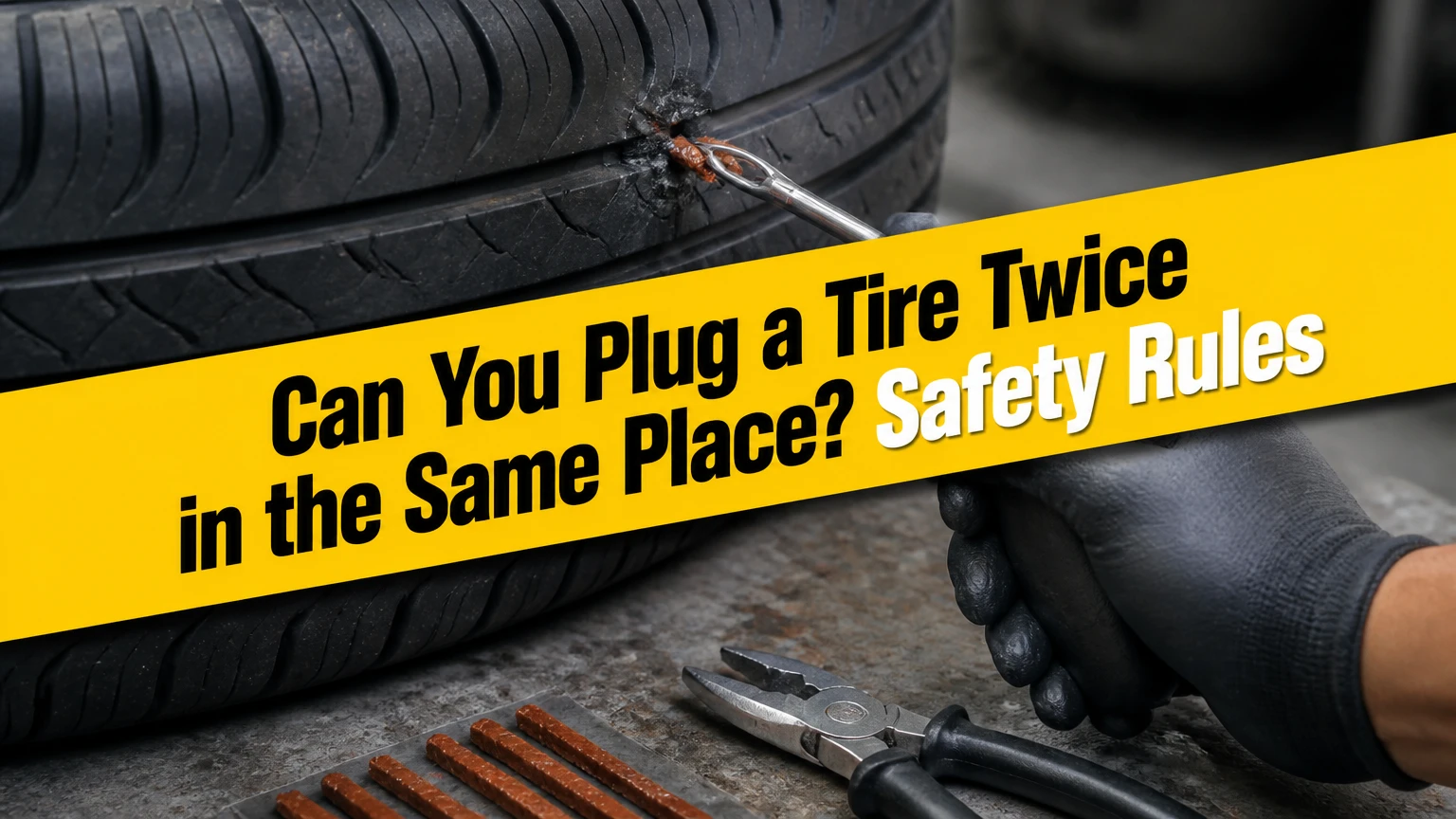
No, you should not plug a tire twice in the same place. A second plug can enlarge and distort the original puncture, damage the inner liner or steel-belt area, and leave a leak that is difficult to detect from outside. Remove the tire for internal inspection; a professional may approve an internal patch-plug only when the casing remains within the tire maker’s repair limits.
Key Facts
A second external plug is not a proper repair for an existing plug hole or a failed plug.
A permanent tire repair normally requires removing the tire and using a combination patch-plug from the inside.
Most passenger-tire repair guidelines limit punctures to the tread crown and approximately 6 mm, or 1/4 inch.
A tire that was driven while flat can have hidden sidewall and belt damage even when the puncture looks small.
The 16-inch spacing rule and two-repair lifetime limit are not universal requirements; the tire manufacturer’s instructions control.
A leaking repeat repair requires dismounting and inspection, not another insertion from the outside.
Can You Plug a Tire Twice in the Same Place?
A tire should not be plugged twice in the same place because the second insertion can make the injury larger without restoring the tire’s original structure. The first plug may also have folded, torn, or contaminated the puncture channel, leaving no reliable surface for a second cord to seal.
A string plug is an emergency external repair. It fills a channel with sticky rubberized material, but it does not recreate the tire’s inner liner or inspect the casing. Some kits use vulcanizing cement, while others rely mainly on the plug’s rubber compound and compression. Heat from driving may help some materials bond, but heat alone does not make an improperly repaired tire safe.
The correct next step is to stop treating the hole from the outside. A tire shop should remove the tire, inspect the inside, measure the injury, and determine whether an approved patch-plug can be installed. Replacement is required when the injury is too large, too close to another repair, outside the repairable zone, or associated with structural damage.
What Counts as “the Same Place”?
“The same place” means the original puncture channel, the existing plug, or the damaged rubber immediately around that channel. A plug inserted at a slightly different angle can still intersect the same weakened path and create a larger irregular injury.
An apparently separate puncture can also be too close to the first one. Repair standards assess the distance between injuries, the condition of the surrounding rubber, and whether the repaired areas overlap. The tire manufacturer may reject a casing even when two holes are several inches apart.
Why Does a Second Plug Fail?
A second plug commonly fails because reaming and insertion remove additional rubber from an already damaged channel. The process can also separate rubber around steel belts, enlarge the injury beyond the repair diameter, and leave a path that flexes as the tire rotates.
How a String Plug Seals a Puncture
A string plug seals mainly through mechanical interference and contact with the puncture walls. The repair tool pushes a coated rubber cord through the tread, where the cord expands against the hole and blocks air movement.
Chemical bonding varies by product. Cement can improve adhesion when the kit specifically requires it, but a roadside plug is not equivalent to a factory-cured repair. The outer tread also flexes, heats, and encounters water, grit, and repeated impact, so a marginal seal can deteriorate gradually.
The most dangerous failure is not always an immediate blowout. A slow leak can reduce inflation pressure, increase heat generation, and overload the tire’s sidewall. Underinflation is a major reason a small puncture becomes a structural failure.
What Damage Can Reaming Cause?
Reaming can smooth and clean a puncture path, but every pass removes or abrades rubber. Reaming an existing plug hole a second time may create an opening larger than the repair material can fill, especially when the first repair has torn the liner or distorted the belt package.
The statement that “reaming twice always makes a tire unrepairable” is too absolute. The number of tool passes alone does not decide repairability. A technician must evaluate final injury size, direction, location, liner condition, belt condition, and the tire maker’s instructions.
Can a Tire Be Repaired After a Plug?
A tire that has received one external plug may sometimes be repairable, but a technician must inspect it from inside before approving a permanent repair. A proper combination patch-plug can seal the puncture channel and the inner liner when the injury remains within the manufacturer’s limits.
A shop may reject the tire for several reasons:
- The original plug pulled out rubber or left a split.
- The puncture exceeds approximately 6 mm, or 1/4 inch.
- The injury is angled and has an extended channel.
- The tire was driven while significantly underinflated.
- The puncture reaches the shoulder or sidewall.
- Steel belts, cords, or the inner liner show damage.
- The tire has an incompatible previous repair.
- The repair would overlap another injury.
A patch alone is not the same as a patch-plug. An internal patch seals the liner surface, but it may not fill the puncture channel. A combination repair uses a stem through the injury and a patch bonded to the inside, which addresses both air passage routes.
What Does a Professional Inspection Involve?
A professional inspection begins with removing the wheel and dismounting the tire. The technician examines the inner liner for abrasion, exposed cords, run-flat creasing, bulges, and heat damage before deciding whether repair is possible.
For an approved repair, the technician generally cleans and prepares the injury, lightly buffs the liner, applies the specified vulcanizing cement, inserts the repair stem, seats the patch, rolls out trapped air, and seals the prepared area according to the product instructions. Procedures vary by repair system.
The repair should then be inflated and checked for leaks. Wheel balancing may be needed if the repair or dismounting changes the assembly balance, although balancing is not automatically part of every puncture repair.
Which Tire Punctures Are Repairable?
A puncture is usually repairable only when it lies in the central tread crown, has a limited diameter, and has not caused internal structural damage. Tire manufacturers and industry organizations commonly use approximately 6 mm, or 1/4 inch, as the maximum injury diameter for many passenger tires.
| Injury factor | Common repair boundary | Why it matters |
|---|---|---|
| Puncture diameter | 6 mm or 1/4 inch maximum | Larger holes remove too much load-bearing rubber |
| Repair location | Center tread crown only | Shoulder and sidewall flex more heavily |
| Inflation before inspection | No known extended underinflation | Low pressure can create hidden heat damage |
| Repair method | Internal combination patch-plug | Seals both the channel and inner liner |
| Repair spacing | Manufacturer-specific, often several inches | Nearby injuries can weaken one tread section |
| Tire category | Passenger and light-truck rules differ | Commercial, run-flat, and specialty tires have separate limits |
These are common boundaries, not a universal permission slip. Continental, Michelin, Bridgestone, Goodyear, and other manufacturers publish their own restrictions. The tire sidewall, vehicle load requirements, speed rating, and service history all affect the decision.
Is a Shoulder or Sidewall Puncture Repairable?
A shoulder or sidewall puncture should be treated as non-repairable for ordinary passenger-vehicle use. Those areas flex substantially and contain less tread rubber over the casing, so a plug or patch cannot reliably restore the original structural performance.
A puncture near the outer tread groove can be difficult to classify. The visible hole may appear in the tread, while the injury path extends into the shoulder. A technician must inspect the entire path, not only the point where the nail entered.
Can a Run-Flat Tire Be Repaired?
A run-flat tire may be repairable only under the manufacturer’s specific rules and after a careful inspection. If the vehicle traveled on the run-flat with low pressure, the reinforced sidewall may have suffered heat or compression damage that is invisible externally.
A tire-pressure warning light does not reveal how long the tire operated underinflated. Tell the technician the distance and speed driven after the warning appeared. That history can change a repair decision even when the puncture diameter is within limits.
How Do Repair Options Compare?
A professional internal patch-plug is the preferred permanent repair for an eligible puncture. An external string plug is a temporary mobility measure, an internal patch without a stem may not seal the channel, and liquid sealant is mainly an emergency option with equipment and cleanup drawbacks.
| Repair option | Installation location | Typical United States cost | Appropriate use |
|---|---|---|---|
| External string plug | Outside, tire remains mounted | $5-$20 DIY kit | Emergency travel to a repair facility |
| Internal patch | Inside liner only | $20-$40 typical shop range | Limited applications approved by the manufacturer |
| Combination patch-plug | Stem through injury plus inner patch | $25-$60 typical shop range | Permanent repair for an eligible tread puncture |
| Liquid sealant | Through valve stem | $8-$20 bottle | Short emergency movement when no plug is possible |
| Tire replacement | New tire mounted and balanced | $100-$350+ per tire | Structural damage or non-repairable injury |
Prices vary by tire size, region, vehicle type, balancing charges, and shop policy. A $30-$60 repair figure is a typical range, not an industry-wide price rule.
| Decision criterion | String plug | Internal patch-plug | Replacement |
|---|---|---|---|
| Wheel removal | No | Yes | Yes |
| Internal inspection | No | Yes | Tire is discarded or returned |
| Typical installation time | 10-20 minutes | 30-60 minutes | 45-90 minutes for one tire |
| Repeat same-hole suitability | No | Only after inspection | Yes, if the new tire matches requirements |
| Highway confidence | Temporary only | Intended for approved repair | Highest structural certainty |
| TPMS impact | Usually none | Usually none | Sensor transfer or replacement may be needed |
A repair facility may refuse a tire that another shop previously plugged. The refusal does not necessarily mean the first shop acted improperly; the second technician may see a damaged liner, an enlarged channel, or a repair history that prevents a compliant repair.
How Long Can You Drive on a Plug?
An external plug should be treated as temporary transportation to a tire professional, not as a guaranteed mileage repair. The safe distance depends on inflation pressure, speed, load, temperature, plug condition, and the kit instructions, so a universal mileage promise would be unsafe.
Drive only far enough to reach a qualified facility when the tire holds pressure and the plug is intended for emergency use. Check pressure with a gauge before moving, drive slowly, avoid heavy loads, and stop immediately if vibration, pressure loss, pulling, or unusual noise develops.
A properly installed internal patch-plug in an eligible injury can remain in service for the tire’s usable life, but no repair restores tread depth, age, heat history, or worn casing material. The repair method does not cancel the tire’s replacement schedule.
The U.S. Tire Manufacturers Association repair guidance uses a central safety principle: “Never repair a tire that has been punctured or damaged in the sidewall.” That rule explains why a fast seal at the visible hole cannot override the location of the injury.
What Should You Do If the Plug Is Leaking?
If a plugged tire is leaking, inflate it only to the vehicle placard pressure when safe, identify the leak, and arrange immediate inspection. Do not insert another plug into the same channel or continue driving after repeated pressure loss.
Use this troubleshooting sequence:
- Spray soapy water over the plug, tread, valve stem, valve core, and bead.
- Watch for expanding bubbles for at least 30 seconds.
- Measure pressure with a reliable gauge, then compare it after 15-30 minutes.
- Avoid removing the plug while the tire is mounted and supporting the vehicle.
- Have the tire dismounted if the plug bubbles, pulls outward, or sits at an angle.
- Replace the tire when the casing, repair zone, or injury size fails inspection.
A leak at the valve stem or bead can be mistaken for a failed plug. A TPMS warning can also reflect a temperature-related pressure change, so confirm the pressure manually before diagnosing the puncture.
What Are the Most Common Repeat-Repair Mistakes?
The most common error is treating a repeat plug as a larger version of the first repair. The surrounding casing has already experienced puncture, tool, and flexing forces, so the second repair does not begin with undamaged rubber.
Mistake 1: Plugging Without Finding the Leak
Drivers sometimes plug the visible nail hole even when the actual leak comes from the valve core or bead. Soapy water identifies the leak source, but only internal inspection reveals casing damage.
Mistake 2: Driving on a Flat Tire
Driving several miles on a flat or nearly flat tire can create sidewall scuffing, creasing, and heat damage. A plug cannot repair those conditions because the damaged components are inside the tire structure.
Mistake 3: Measuring Only the Visible Hole
The entry point may be small while the internal puncture path is long or angled. A technician measures and examines the injury path after dismounting, rather than approving a repair from the tread surface alone.
Mistake 4: Applying a Universal Spacing Rule
Sixteen inches is sometimes presented as a universal minimum distance between repairs. It is not. Tire manufacturers may specify different spacing, repair counts, or complete prohibitions on multiple repairs.
Mistake 5: Assuming Two Repairs Always Require Replacement
Two properly separated, manufacturer-approved repairs in the tread may be acceptable for some tires. The correct decision depends on the repair system, tire design, injury size, spacing, and internal condition.
Mistake 6: Using Sealant in a TPMS-Equipped Vehicle
Some liquid sealants can contaminate a tire-pressure sensor and complicate later repair. Read the sealant and TPMS instructions, tell the technician what product was used, and expect possible sensor cleaning or replacement.
How Many Repairs Can One Tire Have?
There is no universal maximum number of repairs that applies to every tire. Some manufacturers permit multiple properly separated tread repairs, while others impose stricter limits based on tire type, repair location, or casing condition.
The often-repeated “two repairs maximum” rule should therefore be treated as a shop or manufacturer policy, not a worldwide engineering standard. A tire with one unacceptable repair may be unsafe, while a tire with two compliant repairs may be serviceable under the applicable instructions.
| Situation | Likely professional decision | Reason |
|---|---|---|
| One 4 mm crown puncture, no low-pressure driving | Repair may be approved | Injury fits common size and location limits |
| One 7 mm crown puncture | Replacement likely | Injury exceeds common 6 mm boundary |
| Two separated 4 mm crown punctures | Case-by-case repair | Spacing and manufacturer policy control |
| Two plugs in one original hole | Internal inspection, often replacement | Enlarged or damaged repair channel |
| One shoulder puncture | Replacement | Location falls outside normal repair zone |
| Plug plus visible inner-liner abrasion | Replacement likely | Casing damage may compromise air retention |
The technician should record previous repairs before making a recommendation. Repair history is part of the tire’s condition.
Should You Replace One Tire or More?
Replace one tire when the damaged tire cannot be safely repaired and the remaining tires have compatible tread depth, size, construction, and service condition. Replace two or four tires when axle matching, all-wheel-drive requirements, or tread-depth differences make a single replacement unsuitable.
Check the vehicle owner’s manual before replacing one tire on an AWD vehicle. Some systems limit allowable circumference differences because mismatched tire diameters can keep the center differential or clutch pack working continuously.
A new tire may also have substantially deeper tread than the opposite tire. A tire retailer can measure tread depth and consult the vehicle and tire manufacturer’s limits. Shaving a replacement tire to match is possible in some specialist settings, but it is not a universal or economical solution.
What Should Different Drivers Choose?
Daily commuters should seek an internal professional inspection whenever a plug leaks or requires repetition. Highway speeds, daily heat cycles, and long distances make an external second plug a poor risk trade.
Off-road drivers can carry a plug kit, compressor, pressure gauge, and plug-compatible tools for trail recovery. The kit provides mobility after a puncture, but the tire still needs a permanent repair or replacement before ordinary highway service.
Fleet operators should use a written inspection policy that records injury location, pressure history, repair method, and tire identification. Repeat plugging creates inconsistent maintenance records and increases liability when a casing later fails.
Budget-conscious drivers should compare the repair price with the tire’s age, tread depth, and replacement cost. Saving $30 on a questionable repair is not economical if the tire loses pressure again or damages a wheel.
What Does a Safe Decision Look Like?
Use the following decision path before authorizing another repair:
- Is the tire losing pressure now? Do not drive normally; inflate and arrange inspection.
- Is the injury in the center tread? If not, replacement is usually required.
- Was the tire driven underinflated? Report the distance and speed to the technician.
- Has the same channel already been plugged? Do not add another external plug.
- Is the injury within the maker’s diameter limit? Common guidance uses 6 mm, but verify the tire specification.
- Are other repairs nearby? Spacing and overlap may make the tire non-repairable.
- Is the liner and belt package intact? Only a dismounted inspection can answer this.
- Does the repair system produce a stem-and-patch combination? If approved, that is more complete than a plug alone.
A tire shop may recommend replacement even when the puncture looks repairable from outside. That recommendation reflects information unavailable to a driver looking at the tread.
Frequently Asked Questions
Can I put a patch over a tire plug?
A patch should not be applied over an external plug without removing the tire and inspecting the repair path. A technician may remove the plug and install an approved combination patch-plug if the injury remains within limits, but a patch placed casually over a damaged liner does not guarantee a sealed channel.
Is a tire plug permanent?
An external string plug is generally an emergency repair, while an approved internal patch-plug can be a permanent repair for a qualifying tread injury. “Permanent” describes the repair method and approval conditions, not an unlimited promise that the tire will last indefinitely.
Can I plug a tire near another plug?
A tire can sometimes contain two separate approved tread repairs, but nearby repairs require manufacturer-specific spacing and internal inspection. Never assume that a second hole is safe because it is a few inches away. Overlapping injuries can weaken the same belt section.
How do I know whether a tire was driven flat?
Look for pressure-loss history, sidewall scuffing, circumferential abrasion, inner-liner dust, creasing, or a burning-rubber smell. The most reliable evaluation requires dismounting the tire. A tire that held a plug for several days may still have been damaged during the original low-pressure event.
Can tire sealant fix a previously plugged hole?
Liquid sealant may temporarily slow air loss, but it does not restore damaged belts or replace an approved internal repair. Sealant can also interfere with TPMS sensors and make later inspection messy. Use it only according to the product and vehicle instructions while arranging professional service.
How much pressure should a repaired tire have?
Inflate the repaired tire to the vehicle manufacturer’s placard pressure, usually found on the driver-door jamb, not to the maximum pressure molded into the tire sidewall. Check pressure when cold and recheck after repair; abnormal loss requires immediate inspection.
The Bottom Line
You cannot safely plug a tire twice in the same place as a routine repair. A second plug can enlarge the injury, compromise the liner or belt area, and continue leaking even when the tread appears sealed. The correct response is dismounting, internal inspection, and a manufacturer-approved patch-plug only if the casing qualifies. Replace the tire when the injury is outside the tread crown, exceeds the applicable size limit, overlaps another repair, or shows damage from underinflation. Never use a second plug to turn a failed first plug into a highway repair.