Yes, you can put a wider tire on the same rim when the tire manufacturer approves that rim width and the vehicle has adequate clearance. Rim width alone does not determine safety: load index, speed rating, tire diameter, wheel offset, bead-seat compatibility, and vehicle guidance also control whether the installation is suitable.
Key Facts at a Glance
- A wider tire is safe on the same wheel only when its approved rim-width range includes that wheel’s width.
- A car’s marked wheel width, such as 17x7J, is nominal width, while a bicycle tire normally depends on the rim’s internal width.
- There is no universal rule that a tire may be 20 mm wider than the original tire.
- Changing tire width can alter overall diameter, speedometer accuracy, handling, fender clearance, and load capacity.
- A tire that fits the bead seat can still rub the suspension, brake parts, fender, or frame.
- AWD vehicles usually require closely matched rolling circumferences across all four tires, according to the vehicle manufacturer.
Can You Put a Wider Tire on the Same Rim?
A wider tire can go on the same rim if the new tire’s approved rim range, load rating, speed rating, diameter, and physical clearances all meet the vehicle or bicycle manufacturer’s requirements. A 225 mm passenger-car tire may fit a 7-inch wheel in some applications, while the same nominal tire width may be unsuitable on another wheel or vehicle.
The correct question is not “How many millimeters wider can I go?” The correct question is whether a specific tire model and size are approved for a specific rim width and vehicle. Tire manufacturers publish technical data because casing shape, construction, tread design, and measuring-rim width affect the finished tire.
A wider tire does not automatically create more usable grip. A narrow wheel can distort the tire’s sidewalls, and a wider tread can introduce rubbing, steering changes, or additional rolling resistance. Fitment must be checked before mounting, not judged after the tire is inflated.
What determines compatibility?
The controlling measurements are:
- Rim width: The wheel width used for the tire manufacturer’s approved range.
- Tire section width: The nominal sidewall-to-sidewall width, measured on a specified rim.
- Overall diameter: The inflated tire height and rolling circumference.
- Load index: The maximum load assigned to that tire at its specified pressure.
- Speed rating: The tire’s certified speed category.
- Clearance: The remaining space around suspension, brakes, bodywork, frame, and drivetrain parts.
- Wheel position: Offset, backspacing, and axle placement determine where the wider tire moves.
How Does a Rim Support a Wider Tire?
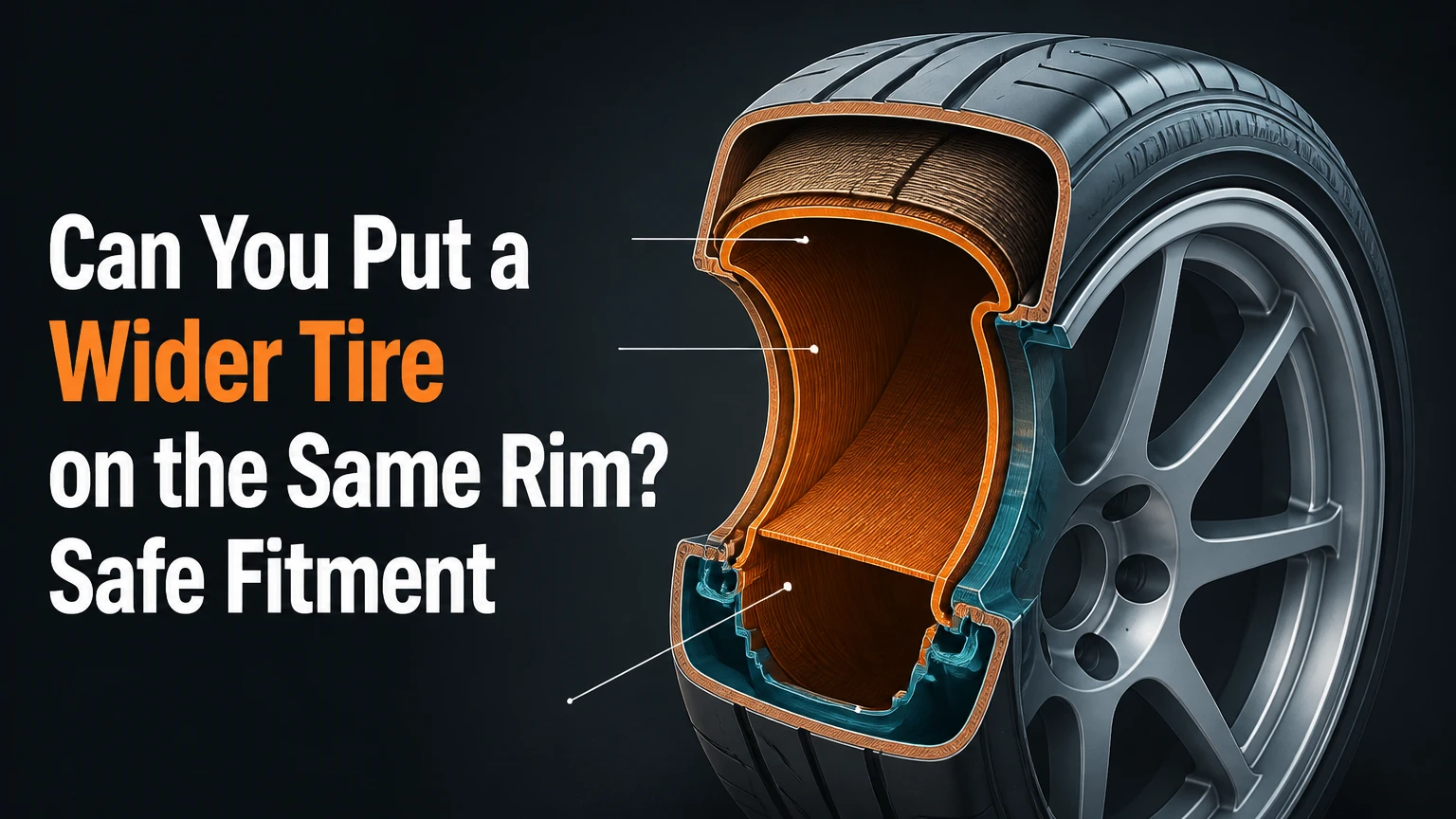
A tire’s bead must sit correctly against the wheel’s bead seat and remain securely retained under cornering, braking, impacts, and pressure changes. If the rim is too narrow for the tire, the sidewalls angle inward and the tread can form a rounded or “lightbulb” profile rather than the intended shape.
That profile changes the tire’s operating behavior. On a car, excessive sidewall flex can create delayed steering response, tread squirm, unusual shoulder wear, and poor stability during abrupt maneuvers. On a bicycle, an overly wide tire can produce vague cornering or allow the tire casing to roll against the rim under hard turns.
A tire that is too wide for its rim may also be difficult to seat evenly. A visible bead line that sits at different distances from the rim edge, a bulge concentrated above the bead, or a tire that repeatedly loses air requires immediate inspection. Do not compensate by exceeding the maximum inflation pressure printed on the tire or wheel.
Nominal rim width and internal rim width are different
Automotive wheel markings such as 17x7J identify a 17-inch nominal diameter and a 7-inch nominal rim width. The measurement is taken at the bead seats, not necessarily across the wheel’s outer lips. Bicycle wheel descriptions such as 622×19 commonly identify a 622 mm bead-seat diameter and approximately 19 mm internal width.
The ETRTO and ISO systems provide bicycle tire and rim terminology, but a bicycle rim’s published internal width does not replace the tire maker’s compatibility guidance. Hookless bicycle rims require particular attention because the tire and rim must be approved as a matched system, especially for tubeless use.
How Wide Can a Tire Go on the Same Rim?
The maximum width depends on the exact tire model, rim width, vehicle, and clearance. Generic ranges can screen possible options, but they cannot approve a fitment; the tire manufacturer’s technical chart, the wheel manufacturer’s limits, and the vehicle owner’s manual have priority.
| Rim or wheel example | Common candidate tire widths | Controlling check | Safe interpretation |
|---|---|---|---|
| Automotive 15x6J wheel | 195-215 mm | Tire maker’s approved rim range | 215 mm may be acceptable on some models, not all |
| Automotive 17x7J wheel | 205-225 mm | Vehicle placard and tire data | 225 mm is a common candidate, not a universal approval |
| Automotive 18x8J wheel | 225-245 mm | Load, offset, and body clearance | 245 mm may require a specific approved package |
| Bicycle rim, 19 mm internal | 25-40 mm | ETRTO or tire maker’s chart | Frame and brake clearance can limit width first |
| Bicycle rim, 21 mm internal | 32-45 mm | Hooked or hookless system approval | Tubeless compatibility remains a separate requirement |
| Bicycle rim, 25 mm internal | 40-55 mm | Tire casing and rim pressure limit | Fork, chainstay, and mud clearance still govern |
The table gives screening ranges, not permission. A 225/45R17 tire from one brand can have a different measured section width from another 225/45R17 tire because tread shape and casing construction vary.
Is a 20 mm increase always safe?
No. The often-repeated “maximum 20 mm wider” rule is not an engineering standard that applies to every vehicle. A 20 mm increase can exceed a tire’s approved rim range, reduce clearance below a safe margin, change the load capability, or create an incorrect overall diameter.
The U.S. Tire and Rim Association, tire manufacturers, vehicle manufacturers, and regional approval systems publish different data for different applications. Use those sources for the exact tire and wheel rather than treating a general chart as a universal limit.
How Do You Check a Wider Tire Before Buying?
Check the tire specification, wheel width, vehicle clearance, rolling diameter, ratings, and legal requirements before ordering. A practical inspection usually takes 20-45 minutes, but a tire shop should confirm uncertain measurements with the vehicle lifted and the suspension loaded appropriately.
Step 1: Record the current tire and wheel data
Read the complete sidewall marking. For example, 215/55R17 94V means:
- 215: nominal section width in millimeters
- 55: aspect ratio as a percentage of width
- R: radial construction
- 17: wheel diameter in inches
- 94: load index
- V: speed rating
Record the wheel diameter, nominal width, offset, bolt pattern, and center bore. A wheel stamped 17x7J ET45 is not equivalent to every other 17×7 wheel because offset changes the tire’s position inside the wheel well.
Step 2: Check the approved rim-width range
Use the tire manufacturer’s technical data for the exact size and model. Confirm that the proposed wheel width falls within the listed range and that the wheel type is approved for the tire, including hookless or tubeless requirements on bicycles.
Do not rely on the tire’s nominal width alone. The approved range for a 225 mm tire may differ between touring, performance, run-flat, commercial, and all-terrain constructions.
Step 3: Verify load index and speed rating
The replacement tire should meet or exceed the vehicle manufacturer’s required load index and speed rating unless local regulations and the vehicle manufacturer explicitly permit another specification. A wider tire with a lower load index is not an upgrade.
Check the door-jamb placard, owner’s manual, motorcycle data plate, or bicycle tire and rim documentation. Electric vehicles and heavy SUVs often impose higher axle-load requirements than a casual size comparison reveals.
Step 4: Calculate overall diameter
Use this formula for automotive tires:
Sidewall height = section width × aspect ratio ÷ 100
Overall diameter = 2 × sidewall height + wheel diameter in millimeters
For a 215/55R17 tire:
- Sidewall: 215 × 0.55 = 118.25 mm
- Wheel diameter: 17 × 25.4 = 431.8 mm
- Overall diameter: 2 × 118.25 + 431.8 = 668.3 mm
For a 225/50R17 tire:
- Sidewall: 225 × 0.50 = 112.5 mm
- Overall diameter: 656.8 mm
The second tire is approximately 1.7% smaller in diameter. A 225/55R17 tire would be approximately 2.5% larger than the original 215/55R17, which may affect speedometer readings and clearance.
| Tire size | Calculated diameter | Difference from 215/55R17 | Approximate speedometer effect |
|---|---|---|---|
| 205/55R17 | 657.3 mm | -1.6% | Indicated 60 mph, actual about 59 mph |
| 215/55R17 | 668.3 mm | 0% | Baseline |
| 225/50R17 | 656.8 mm | -1.7% | Indicated 60 mph, actual about 59 mph |
| 225/55R17 | 679.3 mm | +1.6% | Indicated 60 mph, actual about 61 mph |
| 235/55R17 | 690.3 mm | +3.3% | Indicated 60 mph, actual about 62 mph |
Manufacturers may allow only a narrow diameter difference, and some electronic systems require a specific circumference. Confirm the permitted range for the vehicle rather than assuming a 1-3% change is acceptable.
Step 5: Inspect clearance in every operating position
Check the tire against the strut, spring, control arm, brake hose, inner liner, fender lip, bumper edge, and mud flap. Turn the steering from lock to lock, inspect both sides, and check clearance at normal ride height and during suspension compression.
There is no universal 15 mm minimum clearance rule for every vehicle. Clearance requirements depend on suspension geometry, tire flex, steering angle, chains, snow accumulation, and local inspection rules. A qualified technician should assess borderline clearances.
Step 6: Check TPMS, chains, brakes, and legal requirements
Confirm that the tire’s pressure range works with the vehicle’s required cold inflation pressure. After installation, reset or relearn the tire-pressure monitoring system if the vehicle requires it.
Snow chains and cables often need more clearance than the tire alone. A wider tire that clears the wheel well without chains may not be chain-compatible. Vehicle approval, insurance, inspection, and fender-coverage laws also vary by location.
Which Tire-Size Changes Are Usually Practical?
The most practical change preserves the wheel diameter, keeps the overall diameter close to the original, and remains within the approved rim-width range. A modest increase often requires a lower aspect ratio, but the replacement must still provide adequate sidewall height for the road surface and vehicle load.
| Original size | Wider alternative | Diameter change | Typical purpose |
|---|---|---|---|
| 195/65R15 | 205/60R15 | -1.3% | Slightly wider tread with similar gearing |
| 205/55R16 | 215/50R16 | -1.9% | Sportier response on an approved wheel |
| 215/55R17 | 225/50R17 | -1.7% | Common plus-width comparison |
| 235/45R18 | 245/40R18 | -1.8% | Wider tread with reduced sidewall |
| Bicycle 25-622 | 28-622 | Approximately +2-3% | More comfort if frame clearance permits |
The bicycle example needs special care. Bicycle tire width is strongly affected by rim internal width, inflation pressure, casing design, and frame space. A 28 mm tire on a 19 mm internal rim may measure close to its labeled width, while the same tire on a wider rim can measure wider.
Should you change from 215/55R17 to 225/50R17?
A 225/50R17 tire is a plausible comparison for a 215/55R17 tire because both use a 17-inch wheel and their calculated diameters are relatively close. The change is safe only if the selected 225 tire approves a 7-inch rim, meets the required load and speed ratings, and clears the vehicle at full steering and suspension movement.
The change reduces sidewall height from 118.25 mm to 112.5 mm. That can sharpen steering response but also reduces impact cushioning and wheel protection. The vehicle may also require a different recommended pressure, which should come from the vehicle or tire manufacturer.
Are Wider Tires Better Than the Original Size?
Wider tires can increase dry-road traction in some conditions, but wider tread does not guarantee shorter braking distances or better wet performance. The result depends on tire compound, tread pattern, inflation pressure, road temperature, water depth, vehicle suspension, and the quality of the original tire.
| Characteristic | Wider tire effect | Narrower or original tire advantage | Main deciding condition |
|---|---|---|---|
| Dry cornering | Potentially higher grip | Lower steering effort | Tire compound and pavement temperature |
| Wet standing water | May increase aquaplaning sensitivity in some designs | Can cut through shallow water more readily | Tread grooves, speed, water depth |
| Fuel economy | Often increases rolling or aerodynamic resistance | Often lower energy demand | Tire construction and vehicle weight |
| Steering feel | More effort and possible tramlining | Lighter, more consistent response | Front-axle width and alignment |
| Ride comfort | Lower profile can feel firmer | Taller sidewall absorbs impacts better | Aspect ratio and inflation pressure |
| Snow and mud | May float on soft surfaces | Narrower tire can cut through loose material | Surface, pressure, and tread design |
| Wheel protection | Lower sidewall offers less impact cushion | Taller sidewall provides more deflection | Potholes and road condition |
The contact patch does not simply become wider in direct proportion to tire width. At similar load and pressure, contact-patch area is influenced heavily by load divided by inflation pressure, while shape changes with casing and tread design. A wider tire can still be faster or slower depending on the application.
For bicycles, independent rolling-resistance testing has often found that wider tires can reduce vibration losses on rough roads when run at suitable pressures. That does not mean every wide tire is faster on every surface, and lower pressure can increase rim strikes or tire instability when the rim and casing are mismatched.
What Happens When the Rim Is Too Narrow?
A rim that is too narrow for a tire can produce unstable sidewall behavior, an incorrect tread profile, difficult bead seating, and possible loss of control. The tire may look inflated and hold air while still operating outside the manufacturer’s approved geometry.
Common symptoms include:
- Delayed steering response during quick lane changes
- A rounded tread profile with heavily curved shoulders
- Visible sidewall bulging above the bead
- Tread or sidewall movement during hard cornering
- Uneven shoulder wear
- Repeated bead-seating problems
- A bicycle tire that feels vague when leaning
- A tire that unseats after an impact or sudden pressure loss
Lowering pressure usually makes sidewall flex worse. Raising pressure may reduce squirm but cannot make an incompatible rim-width combination safe. The proper correction is a wheel with suitable width or a narrower tire.
Can a wider tire fit but still rub?
Yes. Tire-to-rim compatibility and vehicle clearance are separate tests. A 245 mm tire may seat correctly on an 8-inch wheel yet rub the strut because the wheel’s offset places the inner sidewall too close to the suspension.
Rubbing can occur only during a bump, steering lock, heavy loading, or body flex. Inspect polished or abraded areas on the sidewall, plastic liner, spring seat, and fender lip after a controlled test drive. Any contact under normal operation requires correction, not acceptance.
What About AWD, Trucks, Motorcycles, and Bicycles?
AWD vehicles, lifted trucks, motorcycles, and bicycles have different fitment constraints, so a generic car-sizing rule cannot be transferred between them. The vehicle type changes which measurement matters most and how a mismatch can fail.
AWD vehicles
AWD systems can be sensitive to differences in tire rolling circumference. Replacing only two tires with a different diameter may force the center differential, clutch pack, or electronically controlled coupling to compensate continuously.
Follow the vehicle manufacturer’s permitted circumference difference. Many AWD manufacturers recommend replacing all four tires together, while others specify a maximum tread-depth or diameter mismatch. A 1-2% tolerance is not universal.
Trucks and SUVs
Truck tire upsizing often creates problems at full steering lock, during axle articulation, or under maximum payload. A 285 mm tire may need more wheel-well space than a 265 mm tire, and a leveling kit can alter suspension geometry without solving every contact point.
Check the spare tire, brake clearance, fender coverage, steering stops, bump-stop compression, and speedometer calibration. Do not assume that a lift kit automatically makes a tire safe.
Motorcycles
Motorcycle tire profiles are designed around particular rim widths and chassis geometry. A wider rear tire can alter the contact patch shape, turn-in behavior, chain alignment, fender clearance, and speedometer accuracy.
Use the motorcycle manufacturer’s approved tire and rim combinations. Motorcycle tire fitment is not an appropriate place for a generic “one size wider” rule.
Bicycles
Bicycle tire width must fit the rim, frame, fork, brakes, mudguards, and drivetrain area. Measure actual clearance at the narrowest point, then account for mud, wheel flex, tire growth, and manufacturing variation.
Tubeless bicycle systems need additional confirmation. The rim’s internal width, tire bead standard, maximum pressure, rim type, and seal compatibility must agree. A tire that mounts on a hookless rim is not automatically approved for that rim.
How Much Do Wider Tires Cost to Install?
Typical passenger-car installation costs range from $20-$45 per tire for mounting and balancing, with a set of four commonly taking 45-90 minutes. Wider tire prices often vary by brand and construction rather than width alone, so a typical premium may be $15-$40 per tire, while bicycle tires may differ by approximately $5-$30.
| Service or item | Typical quantity | Typical price range | Typical time |
|---|---|---|---|
| Passenger-car mounting and balancing | 4 tires | $80-$180 | 45-90 minutes |
| Tire disposal fee | 4 tires | $12-$40 | Included during service |
| Four TPMS relearns or resets | 1 vehicle | $0-$60 | 5-20 minutes |
| Alignment inspection | 1 vehicle | $0-$150 | 20-60 minutes |
| Bicycle tire installation | 1 wheel | $15-$40 labor | 15-30 minutes |
| Speedometer recalibration, when available | 1 vehicle | $100-$150 typical | 30-90 minutes |
Prices vary by region, wheel diameter, run-flat construction, tire-pressure sensors, and whether an alignment is needed. A shop may refuse a combination that falls outside published manufacturer data, which is a safety check rather than evidence that the shop cannot mount it.
Common Mistakes and How to Fix Them
Most wider-tire problems come from treating nominal width as the only specification. The following failure modes are common during real-world fitment checks.
| Mistake | Symptom | Corrective action |
|---|---|---|
| Ignoring approved rim width | Bulged profile or bead-seat concern | Use the manufacturer’s approved rim range |
| Changing only tire width | Speedometer or stability-control differences | Select a size with a compatible diameter |
| Forgetting wheel offset | Inner suspension or outer fender rubbing | Change offset, wheel width, or tire size |
| Using a lower load index | Overloaded tire under passengers or cargo | Match or exceed the required load index |
| Mixing diameters on AWD | Driveline warning or persistent coupling load | Follow the AWD circumference limit |
| Assuming higher pressure fixes squirm | Harsh ride with continued instability | Fit a suitable rim or narrower tire |
| Omitting chain clearance | Chain contact during winter use | Verify chains with the proposed size installed |
Two practitioner rules are especially useful. First, measure the actual tire and wheel combination whenever clearance is close, because catalog width is a nominal value. Second, inspect the tire after a short drive for rubbing, but never use a test drive to justify an already unapproved bead or load combination.
Stop driving if the tire loses pressure, the bead line is uneven, steering becomes unstable, or rubbing exposes cords. Remove the tire and have the fitment assessed by a qualified tire technician.
Which Setup Should You Choose?
Choose a modestly wider tire on the same rim when the manufacturer approves the combination, the diameter remains suitable, and the vehicle has measurable clearance. Keep the original size for commuting, winter conditions, heavy loads, uncertain clearance, or any application where the wider size provides no documented advantage.
Daily commuter
A stock or manufacturer-approved alternate size is usually the stronger choice for a commuter. It preserves calibrated speedometer behavior, chain compatibility, ride quality, fuel economy, and predictable wet-road handling.
Performance driver
A wider tire can help dry cornering when the wheel width, compound, alignment, and suspension are matched. A lower aspect ratio may sharpen response, but it also reduces pothole protection and can increase tramlining.
Truck or off-road owner
A wider tire may improve flotation on sand or soft terrain at suitable pressures, but rubbing and load capacity become more serious. Verify articulation, steering lock, spare fitment, fender coverage, and the tire’s maximum load before changing size.
Road or gravel cyclist
A 28 mm or 30 mm tire may improve comfort and reduce vibration on a road bicycle when the frame, rim, and brake clearance permit it. Gravel riders need to check mud clearance, tubeless approval, and the rim’s internal width rather than selecting a size from tread width alone.
FAQ
Can I put a 225 tire on a 7-inch rim?
A 225 mm tire can fit a 7-inch automotive rim in some tire models, but the exact tire manufacturer must approve that rim width. Confirm load index, speed rating, diameter, offset, and vehicle clearance. A 225 tire that fits one wheel and vehicle may rub or fall outside the approved range on another.
Will a wider tire change the speedometer?
A wider tire changes the speedometer only when its overall diameter or rolling circumference differs from the original tire. Width alone does not determine diameter because aspect ratio also changes. Compare the calculated dimensions and follow the vehicle manufacturer’s permitted tolerance before installation.
Can I install wider tires only on the rear?
Installing wider tires only on the rear can be acceptable on vehicles designed with staggered fitment, provided the manufacturer specifies the sizes. On many AWD vehicles, mismatched rolling circumference can damage the drivetrain. Never create a staggered setup without checking the vehicle’s approved tire-size combinations.
Does a wider bicycle tire need a wider rim?
A wider bicycle tire does not always require a wider rim, but the tire must fall within the rim manufacturer’s approved width range. Internal rim width affects tire shape, pressure limits, and tubeless compatibility. Frame, fork, brake, and mud clearance can impose a narrower practical limit.
Is a wider tire safer in rain?
A wider tire is not automatically safer in rain. Wet grip depends on rubber compound, tread design, inflation pressure, water depth, temperature, and speed. A wider tire may improve grip on wet pavement in some conditions, while a different tread and unsuitable pressure may increase hydroplaning risk.
Should I change all four tires when upsizing?
Replacing all four tires is usually the safest approach when changing size, especially on AWD vehicles. Install the same approved size and comparable construction across each axle unless the vehicle manufacturer specifies a staggered arrangement. Replacing only one or two tires can create handling and circumference differences.
The Bottom Line
Can you put a wider tire on the same rim? Yes, but only when the exact tire is approved for that rim width and the complete vehicle or bicycle fitment remains safe. Check the approved rim range, load and speed ratings, overall diameter, wheel offset, clearance, pressure requirements, and AWD or tubeless restrictions before buying.
A modest size change can work well. A generic width rule cannot replace manufacturer fitment data. If any specification is uncertain, have a tire professional verify the wheel and tire combination before mounting or driving.