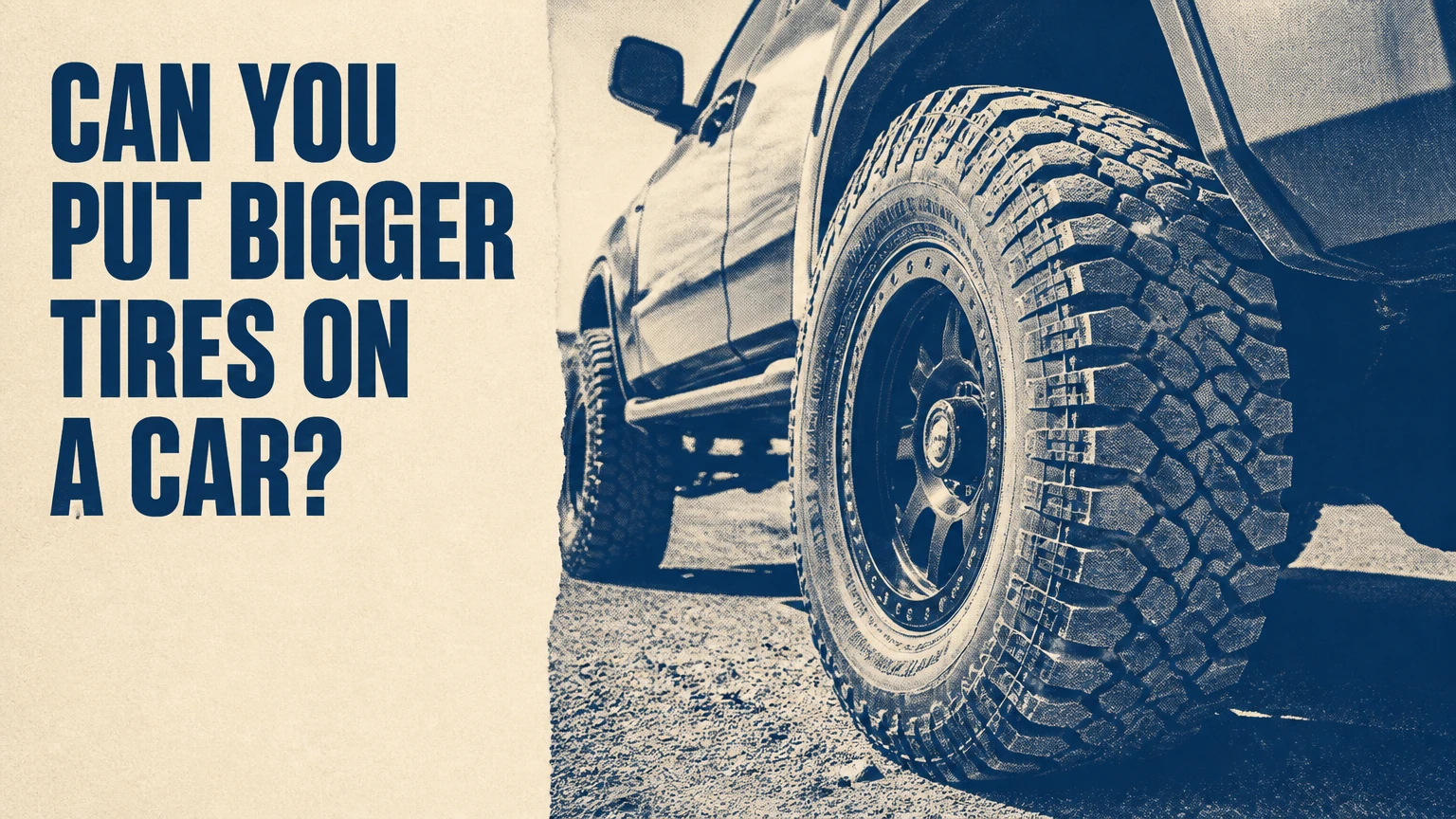
Yes, you can put bigger tires on a car if the tire diameter, width, wheel, offset, load rating, speed rating, and vehicle clearance remain compatible. A modest change, often within about 3% of the original diameter, usually preserves drivability, but the vehicle manufacturer’s tire placard and owner’s manual take priority over any general rule.
Key Facts at a Glance
- A larger tire diameter makes the tire rotate fewer times per mile and can make the speedometer read slower than the vehicle’s actual speed.
- Plus sizing increases wheel diameter while reducing sidewall height so the overall tire diameter stays near the original specification.
- A wider tire can rub the strut, inner fender, liner, sway bar, or outer fender even when its diameter matches the original tire.
- Tire load index and speed rating must meet or exceed the vehicle’s original requirements; appearance does not replace those safety specifications.
- The commonly used 3% diameter limit is a practical screening guideline, not a universal engineering standard for every car.
- Changing tire diameter alone does not automatically require a wheel alignment, but changing suspension height or correcting uneven wear does.
Can You Put Bigger Tires on a Car Safely?
You can put bigger tires on a car safely when the complete wheel-and-tire assembly clears every surrounding component through the full steering and suspension range. The replacement tire must also fit the wheel, carry the vehicle’s axle loads, maintain suitable speed capability, and work with ABS, ESC, TPMS, and the drivetrain.
The safest upgrade is usually a small diameter change that stays close to the factory rolling circumference. A tire shop should verify clearance at full steering lock, inspect the compressed suspension position, and confirm the wheel’s width and offset before mounting anything.
The original equipment tire size is a starting point, not the only fitment fact. For example, a 225/50R17 and a 235/45R18 may have similar outside diameters, but the second combination changes wheel width, sidewall stiffness, brake clearance, and rim damage risk.
What Does “Bigger” Mean?
“Bigger tire” can mean greater diameter, greater width, a larger wheel, or a combination of all three. Those changes produce different mechanical effects:
| Change | Typical numerical effect | Main benefit | Main risk |
|---|---|---|---|
| Same diameter, 10 mm wider | Section width increases 10 mm | More dry-road footprint potential | Inner or outer rubbing |
| Plus-one wheel | Rim diameter increases 1 inch | Sharper steering response | 5-15 mm less sidewall height |
| 3% larger diameter | Circumference rises about 3% | Slightly more ground clearance | Speedometer and gearing error |
| 5% larger diameter | Circumference rises about 5% | More sidewall or clearance under axle | Greater calibration and clearance risk |
A larger wheel is not automatically a larger tire. A 19-inch wheel with a low-profile tire can have the same total diameter as a 17-inch wheel with a taller sidewall.
What Is the Difference Between Plus Sizing and Over-Sizing?
Plus sizing keeps the total tire diameter close to the original while increasing wheel diameter and reducing sidewall height. Over-sizing increases the overall rolling diameter, often for a truck, SUV, crossover, or off-road vehicle that has enough fender and suspension clearance.
| Setup | Diameter change | Sidewall result | Typical application |
|---|---|---|---|
| Factory replacement | 0% | Factory height | Daily road use and warranty compliance |
| Plus one | About 0% | Usually 10-15 mm shorter | Sedan or coupe appearance and steering response |
| Plus two | About 0% | Usually 20-25 mm shorter | Sport-oriented street build |
| Moderate over-size | 1-3% larger | Similar or taller | Crossover, SUV, light truck |
| Extreme over-size | More than 3% larger | Taller and often heavier | Lifted off-road vehicle |
Plus sizing generally changes ride quality more than vehicle electronics because the rolling diameter remains similar. Over-sizing changes effective gearing, speedometer accuracy, suspension clearance, and sometimes the operating range of the transmission.
The original wheel must also accept the new tire’s approved rim-width range. A tire that technically clears the body can still be unsafe if the wheel is too narrow or too wide.
How Do You Read and Calculate Tire Size?
A tire marked 245/45R18 is 245 millimeters wide, has a sidewall height equal to 45% of its width, uses radial construction, and fits an 18-inch wheel. The sidewall height is 110.25 mm, calculated as 245 × 0.45.
Use this formula for approximate overall diameter:
Diameter = wheel diameter + 2 × sidewall height
Convert the sidewall from millimeters to inches by dividing by 25.4.
| Tire size | Sidewall height | Approximate diameter | Approximate circumference |
|---|---|---|---|
| 225/55R17 | 123.8 mm | 26.7 inches | 83.8 inches |
| 235/45R18 | 105.8 mm | 26.3 inches | 82.6 inches |
| 245/45R18 | 110.3 mm | 26.7 inches | 83.8 inches |
| 255/55R18 | 140.3 mm | 29.0 inches | 91.1 inches |
| 265/70R17 | 185.5 mm | 31.6 inches | 99.3 inches |
The actual published tire diameter can differ slightly among brands and tread designs. Use the manufacturer’s specification sheet for final calculations, especially when a vehicle has limited clearance.
How Much Bigger Can Tires Be?
For many unmodified passenger cars, staying within approximately 1-3% of the factory diameter is a sensible starting limit, but the maximum safe size is vehicle-specific. Suspension design, wheel offset, brake clearance, steering travel, body shape, and tire construction determine the real limit.
A 3% change alters speedometer indication by roughly 3%. If a factory tire is 26.0 inches and the replacement is 28.0 inches, the diameter increase is 7.7%, so a displayed 60 mph could correspond to approximately 64.6 mph, assuming the speedometer was accurate beforehand.
The 3% rule should not override the manufacturer’s approved sizes. Some vehicles tolerate a larger change with calibration and clearance work, while others rub with a much smaller increase.
What Clearance Must Be Checked?
Check four clearance zones with the vehicle loaded as it is normally driven:
- Inner sidewall to strut, spring, control arm, and brake hose.
- Outer shoulder to fender lip and quarter panel.
- Front tire to the liner and bumper at full steering lock.
- Top of the tire to the wheel arch during suspension compression.
Measure both sides because accident repairs, worn bushings, and manufacturing tolerances can create asymmetric clearance. A static gap in a parked vehicle does not prove safe clearance during braking, cornering, or a pothole impact.
A practical inspection uses chalk on the tread shoulder, a jack or alignment rack for controlled suspension movement, and a slow road test after installation. Do not rely on trimming plastic until the shop confirms that metal, brake lines, and suspension parts remain clear.
How Do Wheel Offset and Backspacing Affect Fitment?
Wheel offset moves the wheel assembly inward or outward relative to its mounting face. Positive offset places the wheel farther inward, while lower or negative offset moves the wheel outward; backspacing measures the distance from the wheel’s mounting surface to its inner rim edge.
| Fitment change | Inner-clearance effect | Outer-clearance effect | Common consequence |
|---|---|---|---|
| 10 mm lower offset | 10 mm more space inside | 10 mm less fender space | Strut clearance improves, fender rubbing increases |
| 10 mm higher offset | 10 mm less space inside | 10 mm more fender space | Inner suspension rubbing becomes more likely |
| 12 mm wider wheel, same offset | About 6 mm less space inside | About 6 mm less space outside | Both sides move closer to nearby parts |
| 25 mm wider tire, same wheel | About 12.5 mm each side | About 12.5 mm each side | Rubbing depends on tire shape and sidewall bulge |
Offset changes also alter scrub radius, steering effort, kickback, bearing loading, and the relationship between the tire contact patch and steering axis. Wheel spacers can create clearance, but they do not correct every fitment problem and may be restricted by local inspection rules or manufacturer guidance.
Practitioner rule: solve the tire’s actual inner and outer clearance problem before choosing an offset. Selecting offset from appearance alone often trades strut rubbing for fender rubbing.
What Are the Benefits and Drawbacks?
Larger tires can increase ground clearance and provide more sidewall protection, but they also add rotating and unsprung mass. Wider tires may improve dry grip on a suitable road surface, yet tread compound, temperature, inflation pressure, and alignment often matter more than width alone.
Benefits
A tire with a larger outside diameter raises the differential and other low components by roughly half the diameter increase. A 1-inch increase in tire diameter therefore provides about 0.5 inch of additional clearance beneath the axle, not 1 inch.
A taller sidewall can reduce the chance of rim damage on gravel and broken pavement. An all-terrain tire may also provide better traction on loose surfaces than a street tire of the same diameter.
Drawbacks
Heavier tires increase rotational inertia, so the engine or motor needs more torque during acceleration. Fuel economy can decline, although a fixed 5-15% loss is not universal; the result depends on tire mass, tread, pressure, aerodynamic drag, gearing, and driving conditions.
A wider tire can resist hydroplaning less effectively if its tread design and pressure are unsuitable. A lower-profile tire usually sharpens steering response but transmits more impact to the wheel and cabin.
The National Highway Traffic Safety Administration states, “Tires are the only part of your vehicle that make contact with the road.” That contact makes load capacity, inflation pressure, tread condition, and wet braking more important than visual size.
How Do Bigger Tires Affect Speedometer, ABS, and Gearing?
A larger rolling circumference makes the vehicle travel farther per wheel revolution. The speedometer may under-report speed, the odometer may record fewer miles than actually traveled, and the engine operates at lower rpm at a given road speed.
ABS and ESC compare wheel-speed signals to detect slip. A small, evenly applied diameter change may remain within the vehicle’s operating tolerance, but a large change or mismatched tire set can produce warning lights or alter intervention behavior.
| Change from factory diameter | Speedometer at displayed 60 mph | Engine rpm at same road speed | Practical interpretation |
|---|---|---|---|
| 0% | About 60 mph actual | 100% of baseline | Factory reference |
| 2% larger | About 61.2 mph actual | About 98% of baseline | Usually modest |
| 3% larger | About 61.8 mph actual | About 97% of baseline | Check vehicle documentation |
| 5% larger | About 63.0 mph actual | About 95% of baseline | Calibration and clearance review |
| 8% larger | About 64.8 mph actual | About 93% of baseline | Often unsuitable without modifications |
Electronic calibration is vehicle-dependent. Some cars can be programmed with manufacturer software or approved aftermarket tools, while others require a dealer procedure or cannot be recalibrated economically. Calibration does not solve rubbing, inadequate load capacity, or incorrect ABS behavior.
What Do Larger Tires Cost?
A typical US street-tire replacement costs about $600-$1,800 for four tires, while wheels, mounting, balancing, alignment, sensors, and suspension work can raise the total substantially. Prices vary by tire size, brand, speed rating, run-flat construction, wheel material, and local labor rates.
| Work or component | Typical US price | Typical time | When it is needed |
|---|---|---|---|
| Four passenger tires | $600-$1,200 | 1-2 hours | Normal replacement |
| Four truck or all-terrain tires | $900-$1,800 | 1-2 hours | Larger or reinforced tires |
| Four aftermarket wheels | $600-$2,500 | 1-3 hours | Larger rim or offset change |
| TPMS sensors and programming | $160-$400 | 30-60 minutes | New wheels or failed sensors |
| Alignment | $100-$250 | 45-90 minutes | Changed suspension or uneven wear |
| Leveling or lift installation | $300-$3,000+ | 4-12 hours | Required for larger clearance |
| Re-gearing differential | $1,500-$3,500 per axle | 1-2 days | Large truck tire changes |
These are typical planning ranges, not guaranteed quotes. Re-gearing is rarely justified for a modest passenger-car upgrade, and a lift kit can create new alignment, brake-line, caster, and warranty issues.
How Should You Install Larger Tires?
Use a seven-stage fitment process, beginning with factory specifications and ending with a controlled inspection. The most important success factor is confirming full-range clearance before buying tires.
- Record the factory specification. Read the driver-door tire placard, owner’s manual, and current tire sidewall. Record size, load index, speed rating, inflation pressure, wheel width, and drivetrain configuration.
- Choose a target diameter. Calculate the proposed tire’s diameter and percentage change from the original. Compare the manufacturer’s published diameter, not only a calculator’s estimate.
- Confirm wheel compatibility. Check approved rim width, bead profile, load capacity, bolt pattern, center bore, brake clearance, and offset. Confirm that the wheel supports the vehicle’s axle load.
- Check suspension and body clearance. Test full left and right steering lock, then inspect compression clearance. Check the front and rear axles separately because body openings often differ.
- Verify safety systems. Confirm TPMS compatibility and ask whether the vehicle manufacturer approves the proposed size for ABS and ESC operation. Keep the same tire size on all driven wheels unless the vehicle is designed for staggered fitment.
- Mount, balance, and inspect. Use a dynamic balance, then request road-force balancing if vibration remains. Confirm bead seating, valve condition, and correct cold inflation pressure.
- Road-test and recheck. Drive slowly first, then inspect for witness marks, liner contact, vibration, pulling, warning lights, and steering changes. Recheck lug torque according to the wheel maker’s specification after the initial drive.
A wheel alignment is mandatory after ride height changes, replacement of worn steering parts, or correction of an existing alignment problem. Diameter-only changes do not inherently alter camber, caster, or toe.
What Happens to the Spare and Drivetrain?
AWD and 4WD vehicles can be damaged by mismatched tire circumferences, especially when the tires are on the same axle or connected through a center differential, clutch pack, or transfer case. The factory spare may be unsuitable even if it fits the wheel hub.
A temporary spare should be used only as directed in the owner’s manual. On some AWD vehicles, a substantially different rolling circumference can cause driveline wind-up, heat, clutch wear, or differential damage.
Replace tires in axle pairs or as a complete set according to the vehicle manufacturer’s instructions. For an AWD vehicle, ask the manufacturer or dealer for the permitted tread-depth and circumference difference before mixing old and new tires.
Which Setup Fits Your Driving Situation?
A commuter car usually benefits from a factory-diameter plus-size combination, while a truck used on trails may accept a 1-3% increase with an all-terrain tire. A dedicated off-road build can use a larger increase, but it requires coordinated suspension, steering, gearing, brake, and body modifications.
| Driver and vehicle use | Recommended change | Tire type | Supporting work |
|---|---|---|---|
| Compact-car commuter | 0-2% diameter | Touring or grand-touring | Verify wheel and TPMS fitment |
| Sport sedan | Near 0% diameter | Max-performance summer or all-season | Preserve brake clearance |
| Crossover camper | 1-3% diameter | Light-truck all-terrain | Check liner and suspension compression |
| Pickup trail vehicle | 1-3% diameter | LT all-terrain | Confirm axle load and offset |
| Dedicated off-road truck | More than 3% diameter | LT mud-terrain | Lift, bump-stop, steering, and gearing review |
Daily Commuter
Choose a tire that preserves the factory diameter and load rating. A lower-profile plus-size setup may improve steering response, but it can increase road noise, impact harshness, wheel damage, and replacement cost.
Weekend Camper
A modestly taller all-terrain tire can add sidewall protection and under-axle clearance. Check the loaded vehicle’s axle weights because camping equipment, passengers, and cargo can consume the original payload margin.
Hardcore Off-Roader
A large tire increase is a vehicle-system project, not a tire purchase. The build may need a suspension lift, corrected caster, bump stops, fender clearance, brake-line checks, stronger steering parts, and differential re-gearing.
What Should You Do If the Tires Rub?
Tire rubbing requires identifying the contact point before modifying anything. A rubbing noise at full lock may come from the plastic liner, but contact with a strut, brake hose, control arm, or fender metal is a safety issue.
- Liner contact while parking: inspect witness marks and secure or replace the liner; trim only confirmed non-structural plastic.
- Strut contact: use a wheel with verified inner clearance; do not solve metal contact with heat or arbitrary spacers.
- Fender-lip contact during compression: reduce tire width, change approved offset, or use engineered suspension and body-clearance work.
- Vibration above 50 mph: inspect wheel runout, tire uniformity, bead seating, balance, and hub mounting; request road-force balancing.
- ABS or ESC warning light: stop treating the problem as cosmetic and scan the vehicle for wheel-speed or tire-circumference faults.
- Transmission shift changes: confirm tire diameter and calibration before considering expensive differential re-gearing.
A tire that rubs only during a parking maneuver can still damage the liner or expose wiring. A tire that rubs during compression can compromise steering control.
Common Mistakes to Avoid
The most expensive fitment mistakes begin with a correct-looking size that ignores another specification. Common examples include these:
- Buying the widest tire that fits the wheel arch without checking strut clearance.
- Matching tire diameter while ignoring load index, speed rating, or wheel load capacity.
- Assuming a 3% guideline guarantees ABS, ESC, or transmission compatibility.
- Installing different rolling diameters on an AWD vehicle because the spare or replacement tire was cheaper.
- Using wheel spacers to hide an offset problem without checking stud engagement and bearing loads.
- Treating a larger tire as a brake upgrade. A larger tire can increase stopping demand without increasing brake capacity.
- Failing to account for actual cargo weight, especially with LT tires, heavy wheels, or recreational equipment.
The original equipment tire placard remains the controlling reference for cold pressure and minimum tire capability. Tire manufacturers’ fitment charts then determine whether a proposed tire is suitable for the chosen wheel.
Frequently Asked Questions
Can I install bigger tires without changing the wheels?
Yes, if the larger tire fits the current wheel’s approved rim-width range and clears the vehicle. Increasing section width on the same wheel can create sidewall bulge, altered steering response, and inner or outer rubbing, so the tire manufacturer’s approved wheel range must be checked before purchase.
Will bigger tires make my car faster?
Bigger tires usually do not make a car faster. A larger diameter produces a taller effective gear ratio, which can reduce acceleration, while extra mass increases rotational inertia. A lightweight plus-size package may improve steering response, but straight-line performance depends on power, gearing, traction, and total wheel-and-tire weight.
Do wider tires improve braking?
Wider tires can increase dry-road grip when the compound, temperature, pressure, and pavement support it, but width alone does not guarantee shorter braking distances. Wet performance, tread design, ABS calibration, tire age, and load condition can outweigh a small section-width increase.
Are larger wheels bad for ride comfort?
Larger wheels often reduce ride comfort because the accompanying tire has a shorter sidewall with less air volume and flex. A heavier wheel can also increase unsprung mass. On rough roads, a factory-diameter tire with a taller sidewall may protect the rim and absorb impacts better than a low-profile plus-size package.
Does changing tire size void a vehicle warranty?
Changing tire size does not automatically void every vehicle warranty, but a manufacturer or warranty provider may deny a claim when it can link the failure to incorrect fitment, overload, rubbing, altered suspension geometry, or drivetrain stress. Keep the original wheels and tires, and verify approved sizes before modifying a new vehicle.
Should I use the same tire size on all four corners?
Use the same size on all four corners unless the vehicle was designed and documented for staggered fitment. Matching circumference is especially important for AWD, 4WD, ABS, and ESC systems. Follow the owner’s manual when replacing only two tires, because some vehicles require the new pair on a specific axle.
The Bottom Line
Can you put bigger tires on a car? Yes, but the safe answer depends on more than tire diameter. Compare the proposed size with the factory diameter, wheel width, offset, load rating, speed rating, TPMS, brake clearance, steering travel, suspension compression, and drivetrain requirements.
For most street cars, a near-original-diameter plus-size package is the lowest-risk choice. Larger over-size tires make more sense on properly checked SUVs, crossovers, and trucks, where added sidewall or ground clearance supports a defined use. Confirm the complete fitment before purchase, then mount, balance, inspect, and road-test the vehicle professionally.