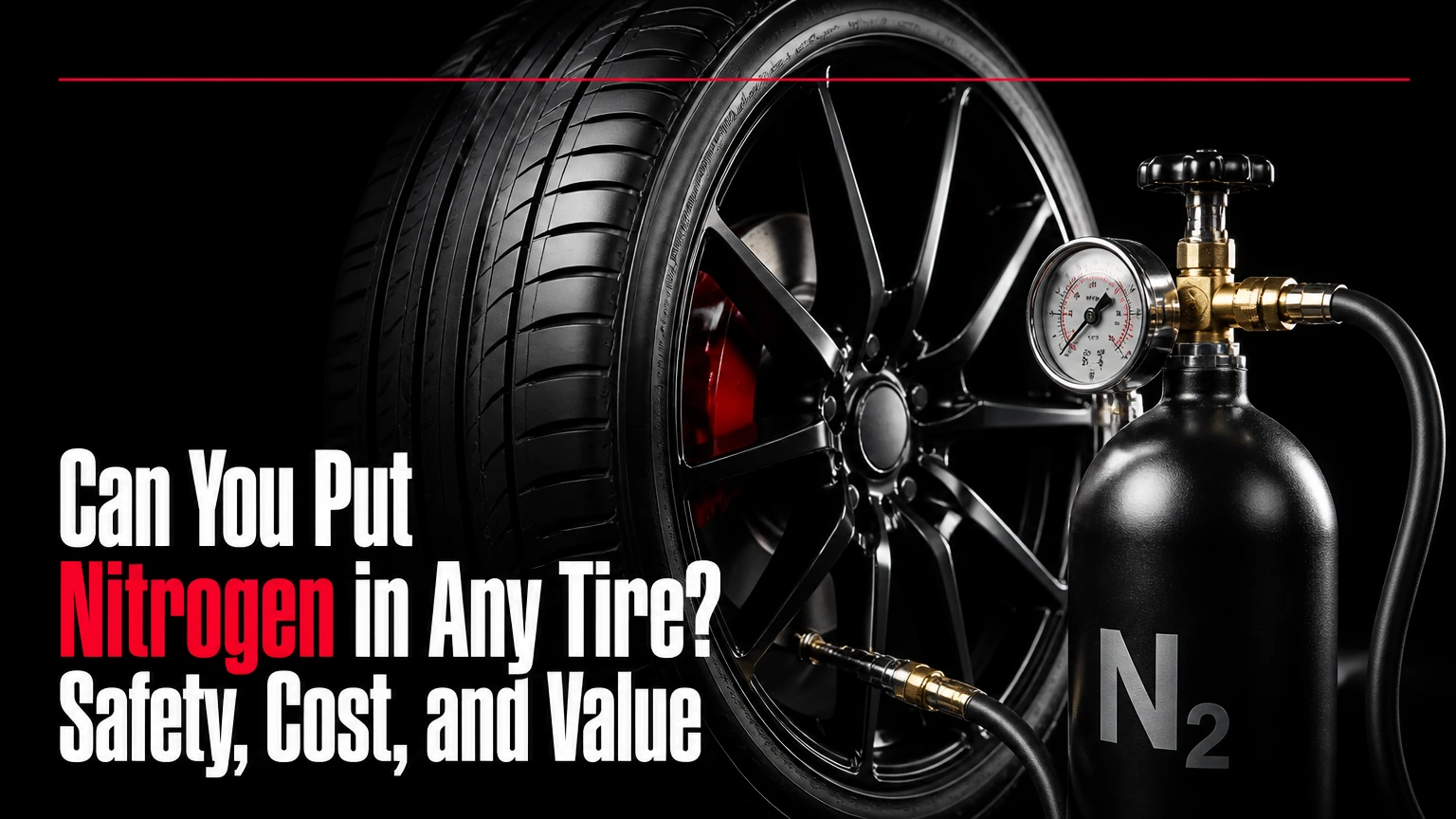
Yes, you can put nitrogen in virtually any intact pneumatic tire, including passenger-car, SUV, motorcycle, bicycle, truck, racing, and aircraft tires when the application permits it. Nitrogen is chemically compatible with normal tire rubber, steel, aluminum wheels, valve components, and tire-pressure monitoring systems. The practical question is whether dry nitrogen’s modest pressure-retention benefit justifies its cost and limited availability.
Key Facts at a Glance
- Standard compressed air already contains approximately 78% nitrogen, 21% oxygen, about 1% argon and other gases, plus variable moisture.
- Commercial tire nitrogen is typically about 93-99% nitrogen, with much less water vapor than poorly dried shop air.
- Nitrogen does not prevent punctures, bead leaks, valve leaks, tread damage, or ordinary pressure loss.
- Adding compressed air to a nitrogen-filled tire is safe; the mixture gradually becomes more like ordinary air.
- The vehicle manufacturer’s recommended cold inflation pressure matters more than whether the tire contains air or nitrogen.
- Nitrogen usually makes more financial sense for aircraft, racing, heavy equipment, and large fleets than for ordinary commuter cars.
Can You Put Nitrogen in Any Tire?
Nitrogen can inflate nearly any pneumatic tire that can safely hold compressed air. Passenger vehicles, commercial trucks, motorcycles, bicycles, trailers, agricultural machines, aircraft, and racing vehicles do not require a different rubber compound merely because nitrogen is used.
Compatibility is not the limiting factor. The limiting factors are the tire manufacturer’s instructions, the vehicle’s required pressure, the service equipment, and the consequences of pressure loss in that application. A nitrogen fill cannot make a damaged tire safe, and it cannot substitute for inspection.
A normal tire contains a flexible inner liner, steel or textile reinforcement, a bead that seals against the wheel, a valve assembly, and air or another approved inflation gas. Nitrogen does not attack those materials under ordinary service conditions. Tire-pressure monitoring sensors also measure pressure, not the identity of the gas, so TPMS operation is unaffected.
The exception involves specialized equipment. Aircraft tires, some military systems, and certain racing programs may specify nitrogen because their operating temperatures, load cycles, or fire-safety requirements differ from those of road vehicles. That specification is an application rule, not evidence that ordinary tires cannot use air.
Why Does Nitrogen Behave Differently From Air?
Nitrogen behaves differently from ordinary compressed air mainly because commercial nitrogen is dry and has a higher nitrogen concentration, not because nitrogen creates a dramatic pressure advantage. Air is approximately 78% nitrogen already, so replacing it produces a relatively small change in gas composition.
Gas pressure follows the ideal-gas relationship between pressure, temperature, and volume. If tire volume remains nearly constant, a temperature increase raises pressure whether the tire contains air or nitrogen. Dry nitrogen can reduce the extra variability associated with water vapor, but it cannot cancel the basic effect of temperature.
The familiar claim that nitrogen molecules are much larger than oxygen molecules is an oversimplification. Nitrogen gas is N₂, with a molecular mass of 28, while oxygen gas is O₂, with a molecular mass of 32. Oxygen can permeate some rubber materials faster because of differences in solubility and diffusion, but tire pressure loss also comes from valves, beads, punctures, wheels, and temperature.
Consumer Reports’ long-term testing has been widely summarized as finding only about a 1.3-psi annual difference in pressure loss between nitrogen and air under its test conditions. The result supports a limited benefit, not a maintenance-free tire. Correct inflation and regular inspections remain the dominant safety factors.
What Is in a Nitrogen-Filled Tire?
A nitrogen-filled tire normally contains a blend rather than laboratory-grade pure nitrogen. A generator or cylinder system may deliver approximately 93-99% nitrogen, while residual air remains in the casing unless the tire is repeatedly purged.
| Inflation gas or condition | Approximate composition | Moisture expectation | Practical consequence |
|---|---|---|---|
| Ambient air | 78% nitrogen, 21% oxygen | Variable, often humid | Free and widely available |
| Dried shop air | About 78% nitrogen | Low when equipment works correctly | Usually adequate for road tires |
| Commercial tire nitrogen | Typically 93-99% nitrogen | Low to very low | Slower diffusion and more stable dry-gas behavior |
| Residual gas after one fill | Mixed air and nitrogen | Depends on equipment | Purity lower than the generator rating |
| Laboratory-grade nitrogen | More than 99.9% nitrogen | Extremely low | Usually unnecessary for consumer tires |
The nitrogen percentage alone does not reveal service quality. A shop with a high-purity generator can still leave ordinary air inside the tire if technicians only add nitrogen to the existing pressure. For everyday road use, that distinction rarely changes the safety outcome, but it matters when a customer is paying for a purity-based service.
Does Nitrogen Keep Tires at the Correct Pressure Longer?
Nitrogen can slow pressure loss through the tire liner, but nitrogen does not keep a tire at the correct pressure indefinitely. A nitrogen-filled tire still loses pressure from natural permeation, valve-core leakage, bead-seal imperfections, wheel corrosion, punctures, and seasonal temperature changes.
The practical benefit is usually measured in months, not in a permanent pressure guarantee. A small pressure-retention advantage may help a commercial fleet reduce maintenance variation, especially when many tires operate under high loads. A driver who checks pressure monthly may gain little because regular air is easy to replace.
Cold weather creates a separate issue. A rough field rule is that tire pressure changes by about 1 psi for each 10°F change in temperature, although actual results depend on tire volume, construction, starting temperature, and measurement conditions. Dry nitrogen does not stop this thermodynamic pressure change.
The U.S. National Highway Traffic Safety Administration advises drivers to check tire pressure at least monthly. That instruction applies to both air-filled and nitrogen-filled tires. A nitrogen label, green cap, or dealer invoice does not change the inspection schedule.
Does Nitrogen Improve Fuel Economy or Tire Life?
Nitrogen may support tire life and fuel economy indirectly when a fleet uses a controlled inflation program, but nitrogen itself is not a substitute for correct pressure. A tire inflated 5 psi below the vehicle recommendation can create more rolling resistance and shoulder wear regardless of whether the gas is air or nitrogen.
The strongest economic argument for nitrogen is operational consistency. A fleet that services hundreds of tires, records cold pressures, uses calibrated gauges, and responds quickly to slow leaks may benefit from reduced pressure variation and less internal moisture. A private driver who rarely checks pressure will not obtain the same result simply by paying for a nitrogen fill.
Low moisture can also reduce the long-term potential for internal oxidation of steel components, particularly in tires exposed to severe heat, high load, or extended storage. The benefit is difficult to isolate on a normal passenger car because tread wear, alignment, underinflation, ultraviolet exposure, road hazards, and age usually dominate tire replacement decisions.
Nitrogen is not a performance upgrade by itself. Track drivers use it mainly when a dry, repeatable baseline helps them predict hot pressure, not because nitrogen automatically creates more grip.
How Do You Convert an Air-Filled Tire to Nitrogen?
A professional nitrogen conversion usually takes about 20-30 minutes for four tires when the tires are already mounted and accessible. The technician removes most existing gas, purges the casing with nitrogen, and inflates each tire to the vehicle manufacturer’s specified cold pressure.
A typical conversion follows these steps:
- Inspect the tire and wheel. The technician checks tread, sidewalls, valve stems, bead areas, wheel damage, and visible leaks before changing the inflation gas.
- Record the required pressure. The correct target comes from the driver’s door placard, fuel-door label, or owner’s manual, not the maximum pressure molded into the tire sidewall.
- Release the existing inflation gas. Deflation to near zero removes most of the air, but it does not remove every gas pocket.
- Perform one or more nitrogen purges. The machine fills and vents the tire, carrying some residual oxygen and moisture out of the casing.
- Inflate to cold specification. The final pressure must be measured with the tire at ambient temperature, before driving or after sufficient cooling.
- Check for leaks and reset documentation. The technician verifies the valve and bead areas and records the final pressure.
A vacuum cycle can remove more residual gas, but it is not necessary for a safe conversion on most passenger vehicles. Repeated vacuum cycling also requires suitable equipment and technician judgment. A shop that simply adds nitrogen to a tire already filled with air has performed a nitrogen top-off, not a high-purity conversion.
Is Nitrogen Worth the Cost?
Nitrogen is usually not worth paying extra for a private passenger car when free compressed air and a reliable pressure gauge are available. Nitrogen becomes more defensible when pressure stability, dry gas, reduced service frequency, or application rules have measurable operational value.
| Service or purchase | Typical price range | Typical time | Best economic use |
|---|---|---|---|
| Regular air top-off | Free-$2 per visit | 5-10 minutes | Passenger cars and motorcycles |
| Nitrogen top-off | $5-$10 per tire | 5-15 minutes | Existing nitrogen programs |
| Four-tire nitrogen conversion | $20-$120 per vehicle | 20-30 minutes | New specialty or fleet setup |
| Dealer nitrogen package | $70-$179 | Included with delivery | Only when no premium is charged |
| Digital tire-pressure gauge | $10-$30 | 1-2 minutes per check | Any vehicle owner |
| Fleet nitrogen service | Contract-specific | Scheduled route service | Large tire populations |
Prices vary by region, tire dealer, membership policy, and whether the service includes leak inspection. Some warehouse clubs offer nitrogen pressure service to members, while other locations provide only air or limit service to tires purchased there. Confirm the local policy before choosing a tire package.
The most cost-effective improvement for most drivers is a $15-$30 gauge and a monthly check. If nitrogen costs nothing as part of a tire purchase, accepting it is harmless, but it should not lead to less frequent checks.
Which Vehicles Benefit Most From Nitrogen?
The value of nitrogen depends on operating conditions, tire count, pressure consequences, and maintenance control. The table below separates physical compatibility from a sensible recommendation.
| Vehicle or use | Typical pressure or condition | Nitrogen value | Practical recommendation |
|---|---|---|---|
| Passenger car | About 30-36 psi, moderate loads | Small pressure-retention benefit | Use regular air unless nitrogen is free |
| SUV or pickup | About 35-80 psi, variable loads | Moderate when towing or heavily loaded | Prioritize placard pressure and load rating |
| Motorcycle | About 28-42 psi, small tire volume | Small, pressure checks matter more | Nitrogen is safe but rarely necessary |
| Bicycle | About 40-120 psi, very small volume | Limited convenience benefit | Use a bicycle pump or compressor |
| Race or track tire | Commonly 20-40 psi hot target | Dry, repeatable pressure behavior | Follow the tire maker or race engineer |
| Heavy truck fleet | Often 80-110 psi, many tires | Potentially valuable at fleet scale | Use nitrogen with calibrated monitoring |
| Aircraft tire | High load and severe heat cycle | Often specified by procedure | Follow aircraft maintenance documentation |
Are Motorcycle and Bicycle Tires Safe With Nitrogen?
Nitrogen is safe in motorcycle and bicycle tires, but the practical advantage is usually minor. Small tire volumes lose measurable pressure from tiny leaks, and riders gain more from checking pressure with an accurate gauge before each ride than from maintaining a high nitrogen concentration.
Bicycle tires also have specialized valve types, including Presta and Schrader valves, so availability is a bigger issue than chemical compatibility. A portable pump is easier to access than a nitrogen generator, and topping off with air does not create a safety problem.
Do Aircraft Tires Require Nitrogen?
Aircraft operators commonly use nitrogen or another approved dry gas because aviation procedures address high-energy takeoffs, landings, storage, and fire-risk control. However, the statement that the FAA universally requires nitrogen in every aircraft tire is too broad. The applicable aircraft maintenance manual, tire manufacturer, operator procedure, and airworthiness documentation control the requirement.
Aircraft owners should never substitute automotive shop air without authorization. Aviation tires operate under rules that are more specific than ordinary road-tire practice, and the correct gas, pressure, servicing method, and equipment must be documented.
Can You Mix Air With Nitrogen?
You can safely add regular compressed air to a nitrogen-filled tire. Mixing air with nitrogen causes no chemical reaction, damages no tire component, and is preferable to driving underinflated or flat while searching for a nitrogen source.
The mixture becomes less nitrogen-rich after each air top-off, reducing the pressure-retention and dry-gas rationale for the original fill. The tire remains usable. A later technician can restore a higher nitrogen concentration by deflating and purging the tire again.
Roadside priority is simple:
- Stop when the TPMS warning appears or handling changes.
- Inspect for a nail, screw, sidewall cut, separated tread, or visibly damaged wheel.
- Inflate to the placard pressure with air if the tire is structurally sound.
- Drive only far enough to reach a tire professional when a leak is suspected.
- Do not inflate a tire with sidewall damage or one that has been driven flat.
A green valve cap identifies a nitrogen program, but it does not prove purity or indicate that air is forbidden.
What Problems Does Nitrogen Not Fix?
Nitrogen cannot repair a puncture, leaking valve core, cracked wheel, damaged bead, missing valve cap, or defective TPMS sensor. A tire that loses 3 psi in a week needs diagnosis, regardless of the gas inside it.
| Pressure-loss cause | Common symptom | Correct response | Nitrogen effect |
|---|---|---|---|
| Tread puncture | One tire falls below target repeatedly | Remove, repair, or replace according to tire policy | Does not seal the puncture |
| Valve-core leak | Bubbles at valve when tested | Replace valve core and retest | Does not stop the leak |
| Bead leak | Bubbles around wheel rim | Clean, reseal, or repair wheel | Does not restore the seal |
| Corroded wheel | Recurrent slow leak at rim | Refinish or replace wheel | May reduce moisture exposure, not corrosion damage |
| Temperature drop | All tires lose similar pressure | Measure cold and inflate correctly | Does not prevent the pressure change |
| TPMS fault | Warning persists after inflation | Scan sensor and system | Gas identity is not the fault |
A common practitioner rule is to compare all four cold pressures on the same morning. One tire that differs materially from the other three deserves a leak inspection, while four tires that change together often reflect ambient temperature.
How Should Nitrogen Tires Be Maintained?
Maintain nitrogen-filled tires exactly as you would air-filled tires, with a monthly pressure check and an additional check before long trips, heavy towing, track use, or extended storage. Measure pressure when tires are cold and use the vehicle placard as the target.
Do not lower pressure because a tire contains nitrogen. Do not inflate to the tire sidewall maximum unless the vehicle or load procedure specifically calls for it. The sidewall maximum is a tire limit, while the door-placard pressure is the vehicle manufacturer’s normal operating recommendation.
Use a calibrated digital gauge and inspect:
- Tread depth and uneven wear
- Cuts, bulges, cracking, and exposed cords
- Valve caps and valve-stem condition
- Wheel corrosion or impact damage
- TPMS readings and warning-light behavior
- Pressure differences between tires on the same axle
Tire pressure should be checked before driving, because road heat raises the reading. If a tire is hot, record the result only as a diagnostic reference and recheck it cold rather than releasing pressure to reach the placard number.
Which Inflation Gas Should You Choose?
The correct choice is regular air for most road vehicles, nitrogen for applications that obtain measurable value from dry, controlled inflation, and the manufacturer-specified gas for aviation or specialized equipment. The decision should follow operating conditions rather than sales claims.
Daily Commuter
Choose regular air for a commuter car used on ordinary roads. A monthly inspection, prompt repair of slow leaks, correct wheel alignment, and proper cold pressure provide more value than paying $20-$120 for a nitrogen conversion.
Frequent Highway Driver
Regular air remains the practical default for a highway driver, although free nitrogen from a tire retailer can be convenient. Long trips make pressure inspection more important, because a small leak can become a heat-related failure after hours at speed.
Towing and Heavy Loads
Nitrogen can be worthwhile for a pickup, trailer, or recreational vehicle that carries high loads and follows a documented pressure-check routine. Correct load range, axle loading, tire age, and cold pressure still matter more than gas selection.
Track-Day Driver
Nitrogen may be useful for track driving when the team needs repeatable dry-gas behavior and predictable hot-pressure changes. Track use requires tire-specific cold and hot targets, temperature readings, inspection between sessions, and advice from the tire manufacturer. Nitrogen does not automatically increase grip.
Fleet Manager
A fleet manager can justify nitrogen when the service program measures pressure, mileage, fuel use, casing condition, and downtime across enough vehicles to show a return. The benefit comes from controlled maintenance at scale, not from the gas alone.
Expert Rules That Prevent Expensive Mistakes
Rule 1: Correct pressure beats premium gas. A properly maintained air-filled tire is safer and more efficient than a neglected nitrogen-filled tire. Gas purity cannot compensate for underinflation.
Rule 2: Diagnose the leak before changing the gas. If pressure falls quickly, use soapy water or professional leak testing at the tread, valve, bead, and wheel. A nitrogen conversion can hide the symptom temporarily while leaving the failure untouched.
Rule 3: Treat a nitrogen conversion as optional on road cars. A proper purge may improve purity, but the real-world pressure difference is usually too small to justify a recurring premium for an owner who can access free air.
Rule 4: Never chase purity during an emergency. A safe air top-off is better than driving underinflated to find nitrogen. The mixture remains chemically safe and can be serviced later.
Frequently Asked Questions
Does nitrogen make a tire go flat more slowly?
Nitrogen can reduce pressure loss through the tire liner under some conditions, but it does not prevent leaks. A puncture, leaking valve, damaged bead, or cracked wheel can deflate a nitrogen-filled tire just as it can an air-filled tire. Check pressure monthly and investigate any tire that loses pressure faster than its companions.
Can a tire shop put nitrogen in a tire with a TPMS sensor?
A tire shop can put nitrogen in a tire equipped with a TPMS sensor. Nitrogen does not interfere with direct pressure sensors mounted inside the wheel, and it does not affect indirect systems that infer pressure from wheel-speed data. Technicians still need to avoid damaging the sensor during tire removal.
Is nitrogen better for winter driving?
Nitrogen is not a substitute for seasonal pressure checks. Cold weather lowers tire pressure regardless of the inflation gas, and dry nitrogen may reduce moisture-related variation without preventing the basic temperature effect. Inflate tires to the placard pressure when cold, inspect tread, and use tires appropriate for the road conditions.
Can you buy nitrogen for a home tire compressor?
Home nitrogen systems and compressed-gas cylinders exist, but they require compatible regulators, storage practices, ventilation, and safe handling. A standard home air compressor cannot produce nitrogen without a membrane or pressure-swing generator. For four passenger tires, professional service is usually simpler and less expensive than purchasing equipment.
Should nitrogen-filled tires have green valve caps?
Green valve caps commonly identify a nitrogen service, but they are not a universal purity standard. A green cap does not prove that a tire contains 99% nitrogen, and a black cap does not prove that it contains air. Use the valve cap to identify a service history, then verify pressure with a gauge.
Should you pay a dealership for nitrogen?
Most private-car owners should decline a separate nitrogen fee unless the service is free, bundled without a meaningful premium, or supported by a specific operating need. Ask whether the dealership will provide free future top-offs and leak checks. Otherwise, a tire gauge and regular air deliver the more useful maintenance benefit.
The Bottom Line
Can you put nitrogen in any tire? Yes, provided the tire is approved for the vehicle and the service follows the relevant manufacturer or aviation procedure. Nitrogen is safe in standard road tires, but regular air is also safe for top-offs and usually offers better value for passenger vehicles. Choose nitrogen for controlled, high-demand applications, and choose disciplined pressure maintenance for everything else.