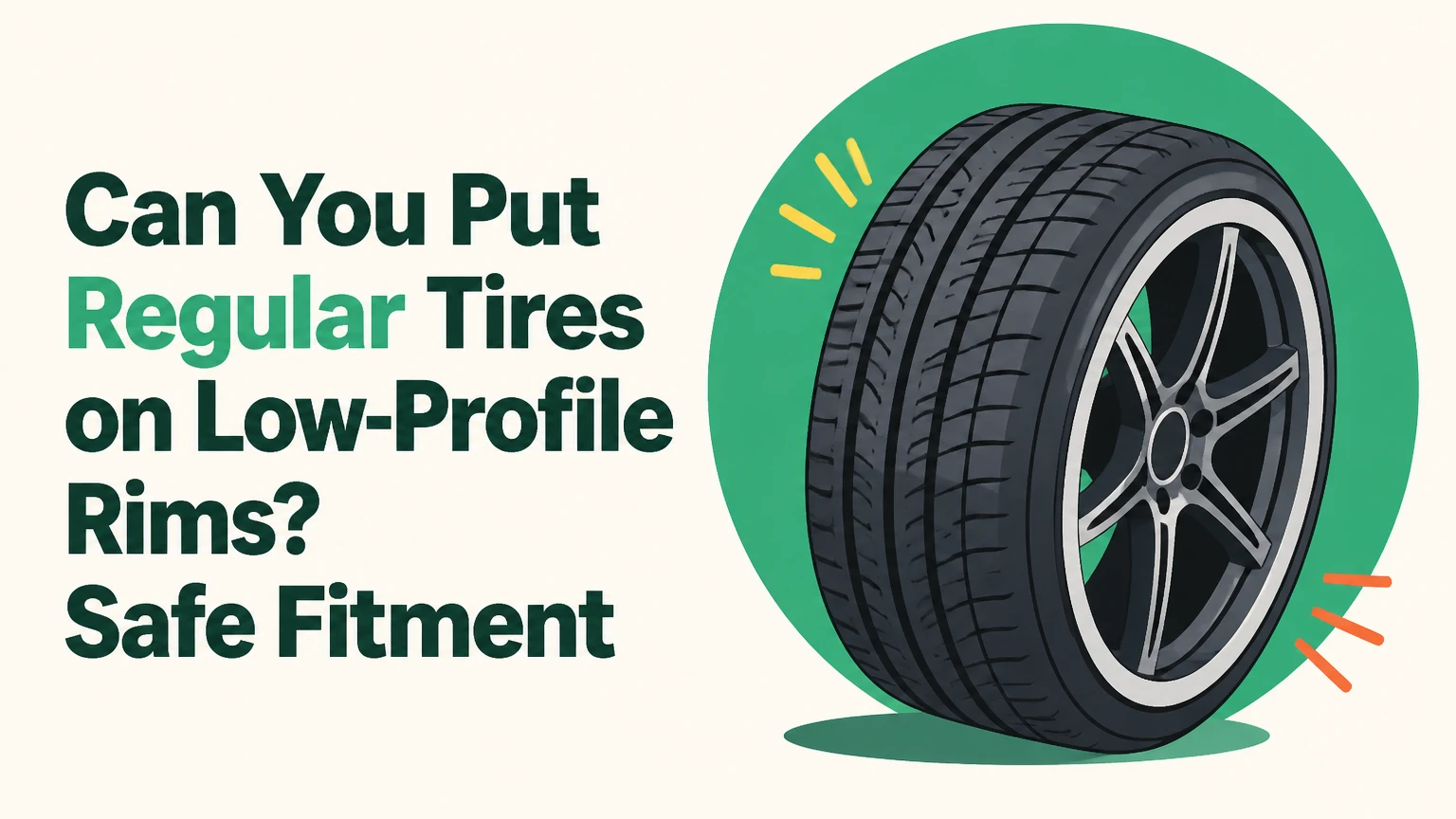
You cannot safely mount a regular-profile tire onto a low-profile rim unless the tire’s bead diameter exactly matches the wheel diameter and the complete size is approved for the vehicle. A taller sidewall does not change the rim’s diameter requirement. To gain comfort, use an approved tire size on the current wheel or replace the wheels with smaller, compatible rims.
Key Facts at a Glance
- A tire marked R18 must mount on an 18-inch wheel; an R16 tire cannot fit an 18-inch rim.
- Low-profile describes sidewall height relative to section width, not a special type of wheel.
- A safe replacement must also match vehicle load capacity, speed rating, wheel width, clearance, and rolling diameter.
- A 3% overall-diameter limit is a screening guideline, not a substitute for the vehicle manufacturer’s approved fitment chart.
- A smaller wheel with a taller tire usually improves impact comfort, but the wheel must clear the brake calipers.
- A narrower tire is not automatically a safe taller-tire replacement on the same rim.
Can You Put Regular Tires on Low-Profile Rims?
You can put a taller-sidewall tire on a wheel only when the tire’s bead diameter, approved rim width, load rating, clearance, and rolling diameter all suit the vehicle. The phrase “regular tire” is informal. Tire manufacturers classify fitments by size, construction, load index, speed rating, and application rather than by regular versus low-profile labels.
For example, a 225/45R18 tire has an 18-inch bead diameter and a sidewall about 101 mm tall. A 215/65R16 tire has a 16-inch bead diameter and a sidewall about 140 mm tall. The 215/65R16 tire cannot mount on an 18-inch wheel because its bead cannot seat on the 18-inch rim.
A taller 18-inch tire may exist, such as a 225/55R18, but its 124 mm sidewall increases the vehicle’s total diameter and may not be an approved replacement. Physical mounting is only the first test. Safe fitment requires the complete tire-and-wheel assembly to work with the suspension, brakes, steering, electronic systems, and axle loads.
What Does “Regular Tire” Actually Mean?
“Regular tire” usually means a tire with an aspect ratio around 60-75, while low-profile tires commonly use aspect ratios of 50 or less. The terms describe appearance and sidewall proportion, not a universal engineering category.
| Tire size | Aspect ratio | Approximate sidewall | Approximate overall diameter |
|---|---|---|---|
| 225/45R18 | 45 | 101 mm | 660 mm |
| 225/50R18 | 50 | 113 mm | 682 mm |
| 215/60R17 | 60 | 129 mm | 690 mm |
| 215/65R16 | 65 | 140 mm | 686 mm |
Sidewall height is calculated as section width multiplied by aspect ratio. The 225 mm width in a 225/45R18 tire multiplied by 0.45 produces a nominal 101.25 mm sidewall. Actual dimensions vary slightly by tire model and approved measuring rim.
Why Must the Tire Diameter Match the Rim?
The tire bead must seat against the wheel’s bead seat, so the tire and rim must have the same nominal diameter. An R18 tire belongs on an 18-inch wheel, and an R17 tire belongs on a 17-inch wheel. Tire mounting equipment cannot safely overcome a one- or two-inch diameter mismatch.
A tire bead is a reinforced ring designed to lock against a specific rim contour. Forcing a smaller tire onto a larger wheel can damage the bead, prevent an airtight seal, or create sudden air loss. Stretching a tire beyond its approved wheel-width range can also alter the bead angle and sidewall shape.
The same rule applies in reverse. An 18-inch tire cannot safely seat on a 16-inch wheel. A shop should reject any combination that does not appear in the tire manufacturer’s approved rim-width range and the vehicle manufacturer’s approved fitment information.
What Do Tire Size Numbers Mean?
The tire code 225/45R18 95W XL contains several separate specifications:
- 225: nominal section width in millimeters.
- 45: sidewall height as 45% of section width.
- R: radial construction.
- 18: bead diameter in inches.
- 95: load index, representing a specified maximum load.
- W: speed symbol.
- XL: Extra Load construction, when present.
Bridgestone and Continental both explain tire markings through this same width, aspect-ratio, construction, diameter, load, and speed structure. A replacement tire must meet or exceed the vehicle’s required load index and speed rating unless a manufacturer or tire professional gives a specific permitted exception.
Can a Taller Tire Fit the Same Wheel?
A taller tire can fit the same wheel only if the tire manufacturer approves that wheel width and the vehicle has enough clearance for the larger assembly. Changing from a 225/45R18 to a 225/50R18 adds about 12 mm of sidewall and about 22 mm of overall diameter, which raises the vehicle approximately 11 mm and reduces clearance by roughly 11 mm at the top of the tire.
Narrowing the tire can sometimes preserve overall diameter while increasing the aspect ratio. However, the replacement must be an approved size for that vehicle and wheel. A 215/50R18 tire is not automatically interchangeable with a 225/45R18 tire because its diameter, load capacity, rim-width range, steering geometry, and tread clearance may differ.
The vehicle owner’s manual, door-jamb placard, manufacturer fitment chart, and tire-maker specifications take priority over a generic calculator. Calculators estimate geometry. They do not approve a tire for a vehicle.
How Much Rolling-Diameter Difference Is Acceptable?
A replacement tire should normally stay within about 3% of the original overall diameter, with less than 1% preferred when an approved option is available. The 3% value is a common screening rule used by tire retailers and fitment professionals, not a universal legal threshold or guarantee of safety.
| Original size | Candidate size | Diameter change | Approximate result |
|---|---|---|---|
| 225/45R18 | 225/50R18 | +3.3% | Usually too large for a simple substitution |
| 225/45R18 | 235/40R18 | -0.6% | Similar diameter, but wider clearance required |
| 225/45R18 | 215/45R18 | -1.4% | Similar diameter, lower load capacity may be an issue |
| 225/45R18 | 215/55R17 | +0.2% | Requires a compatible 17-inch wheel and brake clearance |
Overall diameter affects speedometer indication, gearing, ground clearance, and wheel-speed calculations. If the replacement circumference is 3% larger, the vehicle travels about 3% farther per wheel revolution, so a speedometer showing 60 mph could correspond to approximately 61.8 mph before factory calibration effects.
Will a Taller Tire Rub or Affect the Speedometer?
A taller or wider tire can rub the strut, spring perch, suspension arm, fender liner, bumper edge, or bodywork, especially during steering lock and suspension compression. A larger rolling circumference can also make the speedometer read lower than actual speed and can cause wheel-speed plausibility faults in vehicles with sensitive ABS, traction-control, or all-wheel-drive systems.
The risk depends on more than diameter. Offset changes the tire’s position relative to the strut and fender, while wheel width changes the sidewall position and section width. A tire that clears while parked can contact the liner during a bump, a full-lock turn, or a loaded-corner maneuver.
NHTSA treats tire selection, inflation, load, and condition as safety factors because tires carry the vehicle and transmit braking and steering forces. The U.S. Tire and Rim Association publishes dimensional and load-related standards, but vehicle-specific approval remains the final authority.
Can the Wrong Tire Size Affect ABS and TPMS?
The wrong tire size can affect ABS and traction control because those systems compare wheel-speed signals to detect slip and braking behavior. TPMS usually measures pressure rather than tire diameter, but an indirect TPMS system may infer pressure loss from changes in wheel rotation, making incompatible sizes more likely to create warnings.
Effects vary by vehicle. A front-to-rear diameter mismatch can be especially serious on full-time all-wheel-drive systems, where different rolling circumferences may force the center differential or clutch pack to compensate continuously.
TPMS sensors also require practical attention. A replacement wheel may need the original sensor transferred, a new sensor programmed, or a vehicle relearn procedure performed. A warning lamp after installation does not prove the tire size is wrong, but it does require diagnosis before normal driving.
Which Alternative Gives the Most Comfortable Ride?
The most reliable comfort improvement is usually a one- or two-inch wheel downsize paired with a manufacturer-approved tire that preserves near-original rolling diameter. Keeping the current wheel and choosing a different approved tire construction can help, but it rarely creates as much sidewall cushion as a smaller rim.
| Conversion strategy | Typical sidewall change | Wheel purchase | Main benefit | Main limitation |
|---|---|---|---|---|
| 19-inch to 18-inch wheel | +10-20 mm | $500-$1,500 per set | More impact absorption | Brake clearance remains mandatory |
| 18-inch to 17-inch wheel | +15-30 mm | $400-$1,300 per set | Strong comfort and pothole improvement | Steering response may soften |
| Same wheel, approved narrower size | 0-15 mm | $0 | Avoids new rims | Often limited by load and clearance |
| Same wheel, touring tire model | 0-8 mm | $0 | Lower noise and softer casing | Does not create a tall sidewall |
| Original low-profile performance tire | 0 mm | $0 | Sharp handling response | Higher impact and wheel damage risk |
Smaller wheels generally leave more tire sidewall between the road and the rim. They can reduce harsh impacts and help protect against bent wheels, although tire pressure, casing design, road surface, and vehicle suspension also matter.
Are Taller Sidewalls Better for Potholes and Winter?
Taller sidewalls usually provide more deflection before an impact reaches the wheel, so they are generally better for pothole protection and rough winter roads. The benefit is not unlimited: an underinflated tire, overloaded vehicle, or severe pothole can damage any wheel and tire.
For winter use, a smaller approved wheel can also make room for a narrower winter tire with stronger traction in snow. The tire must still meet the vehicle’s axle load, brake-clearance, speed-rating, and TPMS requirements. Some vehicles require a minimum wheel diameter because large brake calipers occupy the space.
A taller sidewall is not automatically safer in every condition. Low-profile tires may provide more precise steering response on smooth pavement, while a compliant touring tire may reduce impact harshness without changing wheel diameter.
What Must Match When Downsizing Wheels?
A replacement wheel must match the vehicle’s brake clearance, bolt pattern, center bore, offset, load rating, and acceptable width. Wheel diameter alone is insufficient because two wheels with the same diameter can place the tire in different positions or fail to clear the caliper.
| Wheel specification | Example value | Why it matters | Verification method |
|---|---|---|---|
| Diameter | 17 inches | Determines tire bead diameter | Match approved tire code, such as R17 |
| Width | 7.5 inches | Controls approved tire-width range | Compare wheel and tire manufacturer charts |
| Bolt pattern | 5×114.3 mm | Secures wheel to hub | Match vehicle PCD exactly |
| Offset | ET45 | Controls inner and outer clearance | Compare OEM and replacement specifications |
| Center bore | 66.1 mm | Centers wheel on hub | Use exact fit or hub-centric ring |
| Load rating | 750 kg per wheel | Supports axle load | Meet or exceed vehicle requirement |
Brake-caliper clearance deserves a physical check, especially when moving from 18-inch to 16-inch wheels. Spoke shape, barrel profile, and caliper design can make one 16-inch wheel fit while another 16-inch wheel does not.
Offset also changes handling and clearance. Excessively low offset pushes the wheel outward, increasing fender exposure and scrub-radius effects. Excessively high offset can place the wheel or tire against suspension components.
How Much Does a Regular-Tire Conversion Cost?
A complete conversion from large low-profile wheels to smaller wheels typically costs about $800-$1,800 for four wheels, four tires, mounting, balancing, and basic installation in the United States. Tire-only replacement on existing wheels commonly costs about $600-$1,100, depending on size, brand, run-flat construction, and load rating.
| Work item | Typical quantity | Typical U.S. cost | Typical time |
|---|---|---|---|
| Four touring tires | 4 | $500-$1,100 | 45-90 minutes |
| Four aftermarket wheels | 4 | $400-$1,300 | 1-2 hours |
| Mounting and balancing | 4 assemblies | $80-$180 | 45-90 minutes |
| TPMS sensor service | 4 sensors | $40-$160 | 15-30 minutes |
| Alignment inspection | 1 vehicle | $80-$150 | 30-60 minutes |
These are typical retail ranges, not guaranteed prices. Run-flat tires, premium forged wheels, unusual bolt patterns, tire disposal, shipping, seasonal demand, and regional labor rates can increase the total.
A wheel conversion may cost more initially but reduce future replacement costs if the smaller tire size is widely available. Confirm the price of replacement tires before buying wheels, especially for uncommon luxury or performance fitments.
What Is the Safe Approval Process?
Use the following process before ordering tires or wheels:
- Record the original specifications. Read the door placard, owner’s manual, and tire sidewall. Note tire size, load index, speed rating, cold inflation pressure, wheel diameter, and whether the vehicle uses run-flat tires.
- Identify approved alternatives. Check the vehicle manufacturer’s fitment chart or a reputable tire retailer’s vehicle-specific database. Do not rely on aspect ratio alone.
- Calculate the geometry. Compare section width, sidewall height, overall diameter, circumference, revolutions per mile, and diameter percentage.
- Check wheel compatibility. Confirm diameter, width, bolt pattern, center bore, offset, load rating, and brake clearance.
- Confirm tire specifications. The replacement must meet the required load index and speed rating. Preserve XL or run-flat requirements where the vehicle specifies them.
- Inspect physical clearance. Have a technician check the inner strut area, outer fender, steering lock, suspension compression, and brake calipers.
- Install and balance professionally. Use the correct bead lubricant, torque wheel fasteners to the vehicle specification, and balance all assemblies.
- Set pressure and initialize TPMS. Use the door-placard pressure, not the maximum pressure molded into the tire sidewall, then complete the vehicle’s sensor relearn procedure.
- Road-test carefully. Listen for rubbing, vibration, warning lamps, steering changes, or pulling. Recheck fastener torque according to shop instructions.
You will know the installation is acceptable when the tire clears the vehicle through steering and suspension movement, the wheel seats flush, no warning systems activate, and the tire pressure remains stable.
What Should You Do If the Tire Rubs?
Stop using a rubbing tire at normal road speeds until the cause is identified. A technician should determine whether contact occurs at the strut, liner, fender lip, suspension arm, or bumper during turning, compression, or both.
Common causes include excessive overall diameter, excessive section width, incorrect offset, a bent suspension component, worn bushings, or a wheel that is too wide. Removing a small liner fastener may occasionally solve minor plastic contact, but cutting structural bodywork or accepting metal contact is unsafe.
Wheel spacers are not a universal solution. A spacer can create outer-fender rubbing, alter scrub radius, reduce hub engagement, and require longer wheel studs or bolts. Spacer use should follow the vehicle and wheel manufacturer’s requirements and be checked by a qualified installer.
Common Fitment Mistakes
- Assuming a higher aspect ratio is automatically approved: Confirm load, wheel width, diameter, and clearance together.
- Ignoring brake calipers: Test the exact wheel design, not only its advertised diameter.
- Using the wrong load index: Passenger tires may not replace XL or light-truck-rated tires.
- Matching bolt pattern but ignoring center bore: A loose center bore can cause vibration if the wheel is not properly centered.
- Using maximum sidewall pressure: Set pressure from the vehicle placard unless a qualified tire professional provides a documented adjustment.
- Treating the 3% rule as permission: A size within 3% can still rub, overload the wheel, or violate a vehicle-specific approval.
Which Setup Fits Each Driver?
Daily Commuter Seeking Comfort
Choose a one-inch or two-inch wheel downsize with an approved grand-touring or touring tire. This combination usually provides more sidewall movement, lower impact harshness, and better protection from pothole damage than an ultra-high-performance tire on the original wheel.
Driver Keeping the Current Wheels
Ask whether the manufacturer lists a taller or narrower tire for the existing wheel. If no approved alternative exists, retain the original size. A custom size that looks close in a calculator can still have insufficient load capacity or clearance.
Winter and Rough-Road Driver
Select the smallest approved wheel that clears the brakes, then use a winter tire with the correct load index and speed rating. A separate wheel set can reduce seasonal mounting costs and preserve the original low-profile tires for summer use.
Handling-Focused Driver
Keep the OEM low-profile size or choose a replacement with the same dimensions and rating. Grand-touring construction may soften noise and impact response slightly, but it cannot provide the same cushion as a materially taller sidewall.
Expert Fitment Rule
Do not compare tires by sidewall height alone. The safest replacement is the complete combination with approved wheel width, load capacity, speed rating, rolling diameter, brake clearance, and suspension clearance.
FAQ
Can I put a 60-series tire on an 18-inch rim?
A 60-series tire can fit an 18-inch rim only when its size ends in R18 and the specific tire is approved for the wheel width and vehicle. “60-series” describes the aspect ratio, not the bead diameter. A 225/60R18 tire still requires an 18-inch wheel, and its overall diameter may be too large for the vehicle.
Can I use a different tire width on the same rim?
A different tire width can be used only within the wheel manufacturer’s approved rim-width range and the vehicle’s approved fitment options. Width changes affect sidewall shape, load capacity, steering behavior, fender clearance, and rolling diameter. A tire shop should verify the complete specification rather than approve the change from width alone.
Will a taller tire improve fuel economy?
A taller tire can reduce engine speed slightly if its rolling circumference increases, but fuel economy may worsen if the tire is heavier, wider, has higher rolling resistance, or causes rubbing. Vehicle gearing, tire compound, inflation pressure, temperature, and driving conditions usually matter more than a small diameter change.
Can I mix regular and low-profile tires on one vehicle?
Do not mix substantially different tire sizes or sidewall constructions across an axle, and avoid mixing sizes front to rear unless the vehicle manufacturer specifies a staggered fitment. Different rolling circumferences can affect handling and wheel-speed systems. Replace tires in axle pairs or use the vehicle’s approved staggered combination.
Do I need an alignment after changing wheels?
An alignment is not automatically required when replacing wheels with the same diameter, width, and offset, but an inspection is sensible after any fitment change. An alignment becomes more important if the new offset alters steering geometry, the vehicle pulls, the steering wheel is off-center, or the original wheels suffered impact damage.
The Bottom Line
You cannot safely put a conventional R16 or R17 tire on an 18-inch low-profile rim because the bead diameters do not match. You can gain a more comfortable, regular-tire feel by selecting an approved taller sidewall size for the current wheel or downsizing to a smaller wheel, but the replacement must also satisfy rolling diameter, load index, speed rating, width, offset, brake clearance, TPMS, and suspension-clearance requirements. For the query can you put regular tires on low-profile rims, the practical answer is no for a different rim diameter, and only conditionally yes for a vehicle-approved size on the same diameter wheel.