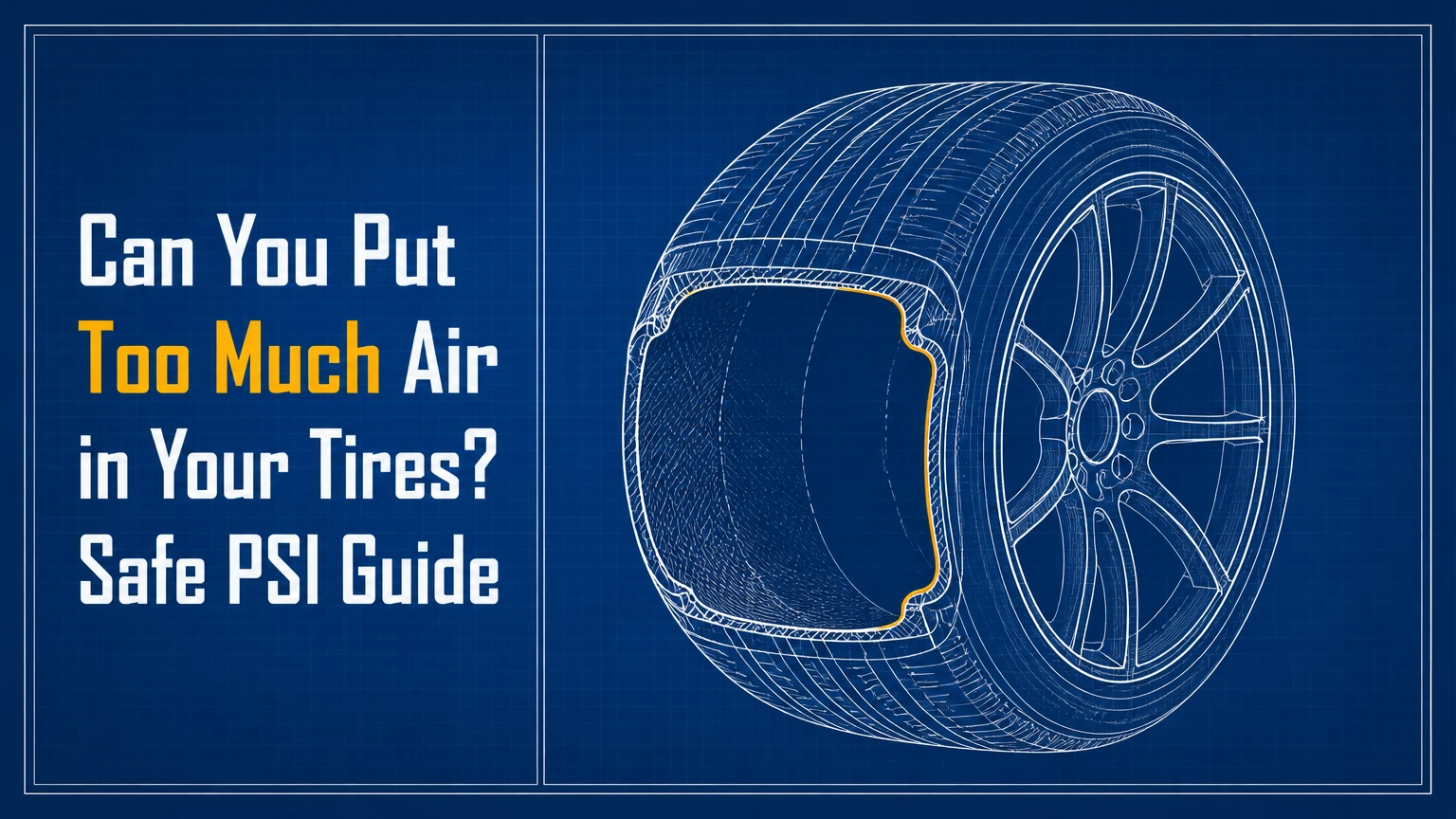
Yes, you can put too much air in your tires. Tire overinflation means the cold pressure exceeds the vehicle manufacturer’s recommended PSI on the driver’s door placard or owner’s manual, even when the number remains below the tire sidewall maximum. Excess pressure can reduce the contact patch, worsen grip, increase impact harshness, and accelerate center tread wear.
Key facts at a glance
The vehicle door placard, not the tire sidewall, gives the normal cold-pressure target.
A tire checked after driving can read several PSI higher because heat raises internal pressure.
Overinflation reduces tread contact and can make steering feel sharp but less forgiving.
Center tread wear, a hard ride, bouncing, and reduced wet grip are common warning signs.
A manual gauge is more reliable for diagnosis than relying on the TPMS warning light alone.
Never bleed a hot tire down to the cold placard number, because it may become underinflated after cooling.
Can You Put Too Much Air in Your Tires?
Can you put too much air in your tires? Yes. The safe target is the vehicle’s specified cold inflation pressure, while the sidewall figure is generally a maximum pressure associated with the tire’s load capacity, not a recommended everyday setting.
For example, a vehicle placard might specify 35 PSI for the front and rear tires, while the tire sidewall might show a maximum of 51 PSI. Inflating to 51 PSI because it is printed on the rubber can make the tire less compliant and change how the tread meets the road.
A few PSI above the placard does not create an automatic blowout emergency, but the correct response is still to measure the pressure cold and adjust it. Risk depends on the amount of overpressure, tire condition, load, speed, ambient temperature, and whether the tire has suffered impact damage.
NHTSA’s tire-maintenance guidance states, “Tire pressure should be checked when tires are cold.” That instruction matters because pressure readings taken after highway driving are not directly comparable with the placard’s cold specification.
What Happens When Tire Pressure Is Too High?
High tire pressure makes the center of the tread carry a greater share of the load, reduces the usable contact patch, and limits sidewall flex. Those changes can reduce wet-road traction and make the vehicle react more abruptly to potholes, grooves, and steering inputs.
A properly inflated tire has a designed shape and footprint. When pressure rises well above the vehicle setting, the tread crown can become more rounded. The contact patch may become shorter and narrower, so less rubber contributes to braking and cornering.
The result is not always obvious from the steering wheel. Overinflated tires can feel responsive during a slow turn while providing less reserve grip during an emergency maneuver. A stiff tire also transmits more force into the wheel, suspension bushings, and strut mounts when it hits a sharp edge.
How does overinflation affect braking and wet grip?
Overinflated tires can reduce braking consistency because the tread has less even contact with the pavement. The effect is most concerning on wet roads, where tread contact, tread grooves, and tire compound must work together to evacuate water.
The exact braking change varies by tire model and pressure difference. A modern tire at 3 PSI above the placard is not equivalent to one at 15 PSI above it, and a tire with worn tread has fewer safety margins than a new tire. Treat the placard pressure as the baseline rather than searching for a universal “safe extra PSI.”
Which PSI Should You Use?
Use the cold PSI printed on the driver’s door-jamb placard or specified in the owner’s manual. The correct value may differ between front and rear axles, normal and maximum loading, or towing and ordinary driving.
| Location or source | Typical value | Correct use | Common mistake |
|---|---|---|---|
| Door placard, compact car | 32-36 PSI cold | Normal daily inflation | Replacing it with the sidewall maximum |
| Door placard, SUV or crossover | 33-39 PSI cold | Vehicle-specific operating target | Assuming all four tires need the same PSI |
| Tire sidewall maximum | 44-51 PSI | Upper structural/load limit | Using it as the daily target |
| Temporary spare sidewall | 60 PSI, often | Temporary spare specification | Setting it to the main-tire pressure |
The placard may list different values for a lightly loaded vehicle and a fully occupied or heavily loaded vehicle. Some vehicles also specify a higher rear pressure when carrying maximum cargo. Follow the manual when the placard and a generic online chart appear to conflict.
Why is the sidewall number different?
The sidewall number describes the tire’s maximum allowable inflation pressure under a stated load-rating system. It does not account for the suspension geometry, weight distribution, steering calibration, or ride design of the vehicle carrying that tire.
A replacement tire can have a higher sidewall maximum than the original tire while still using the same vehicle placard pressure. Tire size changes, load index, and wheel width can alter the correct setup, so a replacement tire should match the vehicle manufacturer’s approved specifications.
How Does Temperature Change PSI?
Temperature changes tire pressure by roughly 1 PSI for each 10 degrees Fahrenheit change in air temperature, or approximately 1 PSI for each 5-6 degrees Celsius, although the actual change depends on starting temperature and tire construction. Pressure rises as the air and tire warm during driving.
| Situation | Typical pressure change | Correct action |
|---|---|---|
| Overnight temperature drop of 20°F | About -2 PSI | Check cold and restore placard pressure |
| Highway driving for 30-60 minutes | About +3 to +6 PSI | Do not bleed down a hot tire |
| Vehicle parked in direct sun | Variable, often +1 to +4 PSI | Compare all tires after cooling |
| Cold-weather seasonal change of 40°F | About -4 PSI | Recheck every tire at the new temperature |
A cold tire generally means the vehicle has been parked for at least three hours or has traveled less than about one mile at low speed. If a tire is hot and reads 4 PSI above the placard, record the value and recheck it later when cold instead of removing 4 PSI immediately.
The commonly quoted “4 PSI rise” is a useful diagnostic rule, not a universal limit. A larger rise can indicate low starting pressure, heavy loading, high speed, hot pavement, or a tire problem.
How Do You Correct Overinflation?
Correct overinflation by checking all tires cold, comparing each reading with the placard, releasing air in short bursts, and rechecking until the pressure matches the specified value. The job usually takes 5-10 minutes and requires a reliable gauge.
Before you start
| Requirement | Typical specification |
|---|---|
| Time | 5-10 minutes for four tires |
| Tools | Digital, dial, or pencil gauge; valve caps |
| Air-release method | Gauge bleed button or valve-core pin |
| Target | Door-placard cold PSI, often 32-39 PSI |
| Safety condition | Vehicle parked on a stable surface |
Step 1: Find the cold-pressure target
Open the driver’s door and read the placard on the door jamb, door edge, fuel-filler area, or inside the glove box. Write down the front and rear values separately if they differ.
Success checkpoint: You have a specific PSI value for each axle.
Common mistake: Reading the tire sidewall and treating its maximum as the operating target.
Step 2: Measure every tire
Remove the valve cap and press the gauge squarely onto the valve stem. Take one reading, then repeat it if the result seems unusual or differs sharply from the other tires.
Success checkpoint: Each tire has a cold reading recorded to the nearest 0.5 or 1 PSI.
Common mistake: Checking only the tire that looks inflated or feels unusual.
Step 3: Release air in short bursts
Press the small pin in the center of the Schrader valve with the bleed button on a gauge or a suitable blunt tool. Use one- to two-second bursts, because a valve releases more air than many drivers expect.
Success checkpoint: The reading falls toward the placard value without dropping below it.
Common mistake: Holding the valve open continuously and overshooting the target.
Step 4: Recheck the pressure
Measure the tire again after each short release. If the gauge has a hose or chuck, ensure the connection is straight and sealed before trusting the reading.
Success checkpoint: The cold pressure matches the placard within the gauge’s practical resolution.
Common mistake: Relying on the first reading after air escaped around a poorly fitted chuck.
Step 5: Replace the valve cap
Tighten the valve cap by hand after correcting the pressure. The cap helps protect the valve core from water, dirt, and corrosion, but it is not a substitute for a functioning valve core.
Success checkpoint: No hissing occurs after the cap is installed.
Common mistake: Driving with a missing cap or assuming a cap can stop a leaking valve.
Can You Drive on an Overinflated Tire?
You can usually drive a short distance at moderate speed to reach a safe place or service station when a tire is only a few PSI above the cold placard and has no visible damage. Avoid highway speed, heavy loads, aggressive cornering, and potholes until the pressure is corrected.
Do not continue driving normally when the pressure is dramatically above specification, the tire is visibly distorted, the vehicle bounces or vibrates, or the tire has a bulge, cut, exposed cord, or bead damage. A tire shop should inspect any tire that experienced a severe impact or an unexplained pressure increase.
| Cold pressure versus placard | Practical risk | Recommended response |
|---|---|---|
| 1-3 PSI high | Usually limited short-term effect | Correct at the next safe opportunity |
| 4-7 PSI high | Reduced comfort and altered footprint | Correct before extended or high-speed driving |
| 8-15 PSI high | Significant handling and impact concern | Avoid normal driving; deflate before travel |
| Above sidewall maximum | Potential structural and load-rating hazard | Do not drive until corrected and inspected |
These ranges are practical guidance, not a replacement for the vehicle manual or tire manufacturer’s instructions. There is no universal PSI at which every passenger-tire blowout becomes inevitable.
Can Excess Pressure Damage a Tire?
Excess pressure can contribute to irregular center wear and make impact damage more likely, but pressure alone does not predict an immediate blowout. Tire age, underinflation, overloading, heat, punctures, previous repairs, and road impacts also affect structural safety.
A sidewall maximum of 51 PSI does not mean a tire instantly fails at 52 PSI. Conversely, remaining below that number does not guarantee safety if the tire has internal damage, a damaged valve, or a past run-flat event.
Tire manufacturers design inflation pressure around load. When pressure and load no longer match the vehicle’s intended setup, the tread and casing operate outside their preferred behavior. High pressure reduces deflection, while low pressure increases flex and heat. Both extremes are undesirable.
What does center tread wear mean?
Center tread wear is a lagging sign that the tread center has carried excessive load relative to the shoulders, often because of sustained overinflation. It cannot identify the exact PSI used or prove that pressure was the only cause.
Alignment, tire construction, suspension wear, wheel balance, and frequent high-speed travel can produce related wear patterns. Measure the cold pressure, photograph the tread, inspect for cupping or feathering, and ask a tire professional to assess the pattern before replacing only one tire.
Does More Air Save Fuel?
More air can reduce rolling resistance slightly, but inflating beyond the vehicle placard is not a sound fuel-saving strategy. Any small efficiency gain must be weighed against reduced grip, harsher impacts, accelerated wear, and the cost of replacing tires early.
The practical fuel-economy priority is correcting underinflation, not creating overinflation. NHTSA has repeatedly warned that underinflated tires can reduce fuel economy and increase heat buildup, while vehicle manufacturers select placard pressures to balance handling, load support, comfort, and efficiency.
For a commuter, the measurable gain from adding several PSI above specification is typically small and vehicle-dependent. A better approach is to check monthly, correct all four tires cold, remove unnecessary cargo, and maintain wheel alignment.
Which Gauge or Inflator Should You Use?
A digital gauge is usually the easiest consumer choice, while a dial gauge offers durable operation and often includes a bleed button. A portable compressor is useful for adding air, but its built-in display should be checked against a separate gauge.
| Tool type | Typical price | Reading or feature | Best use |
|---|---|---|---|
| Pencil gauge | $5-$10 | 1 PSI markings, no battery | Basic glove-box backup |
| Digital gauge | $10-$25 | Often 0.1 PSI display | Clear, repeatable home checks |
| Dial gauge | $15-$40 | Analog scale, bleed button | Frequent maintenance and service |
| 12-volt inflator | $30-$80 | Automatic shutoff, 2-5 minutes per tire | Restoring pressure away from a station |
Gauge accuracy matters more than display style. Compare a questionable gauge with a known-good gauge at the same valve, and replace any unit that gives inconsistent readings or has a damaged chuck.
A compressor’s “150 PSI” marketing figure describes its maximum capability, not the pressure it should put into a passenger tire. Set its automatic cutoff to the placard value and verify the final reading manually.
Why Might TPMS Miss Overinflation?
TPMS may miss modest overinflation because many systems are designed primarily to warn when pressure falls below a regulatory threshold, not to maintain the exact placard pressure. A manual gauge remains necessary for accurate pressure adjustment.
Direct TPMS sensors measure pressure inside each wheel, but the warning threshold and display behavior vary by vehicle. Indirect TPMS estimates pressure through wheel-speed differences and may not report a specific PSI at all.
A warning light can appear after underinflation, a sensor fault, a temperature change, or a relearn problem. Check pressure manually in all tires, including the spare if the vehicle monitors it, then follow the owner’s TPMS reset procedure after correction.
What Changes for Towing, Winter, or a Spare?
Towing and maximum payload can require higher pressure, but the correct increase comes from the vehicle owner’s manual or a manufacturer load table. Winter temperatures reduce pressure, while temporary spares often require much higher inflation than full-size road tires.
| Driving situation | Pressure rule | Typical example |
|---|---|---|
| Normal commuting | Use door placard cold PSI | 35 PSI front and rear |
| Maximum passenger or cargo load | Follow manual’s loaded setting | 35 PSI front, 38 PSI rear |
| Trailer towing | Use vehicle and trailer placards | Rear pressure may rise 3-5 PSI |
| Temporary spare | Use spare sidewall specification | Often 60 PSI, speed-limited |
Never lower a temporary spare to match the main tires. Never raise the main tires to the spare’s pressure. The two tires have different construction, load requirements, and intended service duration.
Track driving is a separate engineering problem. Drivers may tune hot pressure for a particular tire, surface, and lap condition, but those adjustments are not suitable for ordinary street driving unless the tire and vehicle manufacturer provides specific guidance.
What Mistakes Cause Incorrect Tire Pressure?
The most common pressure errors involve using the wrong reference, measuring at the wrong temperature, or correcting only the visible problem. Each mistake can leave a tire outside its intended operating range.
- Using the sidewall maximum: Treating 51 PSI as the daily target can produce excessive stiffness and center wear.
- Bleeding a hot tire: Removing air until a hot reading equals the cold placard can create underinflation after cooling.
- Checking by appearance: Radial tires can look normal while several PSI low or high.
- Ignoring axle differences: Some vehicles specify different front and rear pressures.
- Forgetting the spare: A temporary spare may require 60 PSI and may lose pressure while unused.
- Trusting one gauge forever: Gauges can drift, stick, or lose accuracy after years of use.
- Resetting TPMS without measuring: A reset can hide a warning temporarily while the underlying pressure remains wrong.
An expert rule of thumb is to check pressure before diagnosing alignment or suspension problems. Pressure changes can alter steering feel and tread wear enough to imitate mechanical faults.
FAQ
Is 40 PSI too high for car tires?
Forty PSI is too high when the vehicle placard specifies substantially less, such as 32-36 PSI, but it may be appropriate for a vehicle or load configuration that specifically calls for it. Compare the cold reading with the placard, not with a generic internet range or the tire sidewall maximum.
How long can tires stay overinflated?
A tire can remain overinflated for days or weeks without visibly failing, but sustained excess pressure can accelerate center wear and reduce handling margin. Correct the pressure as soon as practical, especially before highway travel, towing, heavy loading, or driving on hot pavement.
Should all four tires have the same PSI?
Not always. Vehicle manufacturers may specify different front and rear pressures because axle loads, steering forces, engine weight, and suspension tuning differ. Read each placard value carefully, and use the loaded setting when the vehicle carries its maximum listed occupants or cargo.
Can a tire lose air after you let too much out?
A tire can continue losing air if the valve core leaks, the valve stem is damaged, the bead seal is compromised, or a puncture is present. After adjustment, apply soapy water to the valve and tread area if pressure falls again, then arrange a professional inspection.
Does tire pressure affect the speedometer?
Normal pressure changes do not usually create a meaningful speedometer error, but major underinflation can reduce the tire’s loaded rolling radius. Tire size, tread wear, and replacement dimensions generally have a larger effect than a few PSI of inflation difference.
The Bottom Line
Can you put too much air in your tires? Yes, and the correct remedy is simple: measure every tire when cold, use the door-placard PSI, release excess air gradually, and recheck the result. Do not use the sidewall maximum as the daily target, bleed down hot tires, or ignore vibration, visible damage, or unusual pressure loss. Proper cold inflation gives the tire the contact patch, flexibility, and load support the vehicle was designed to use.