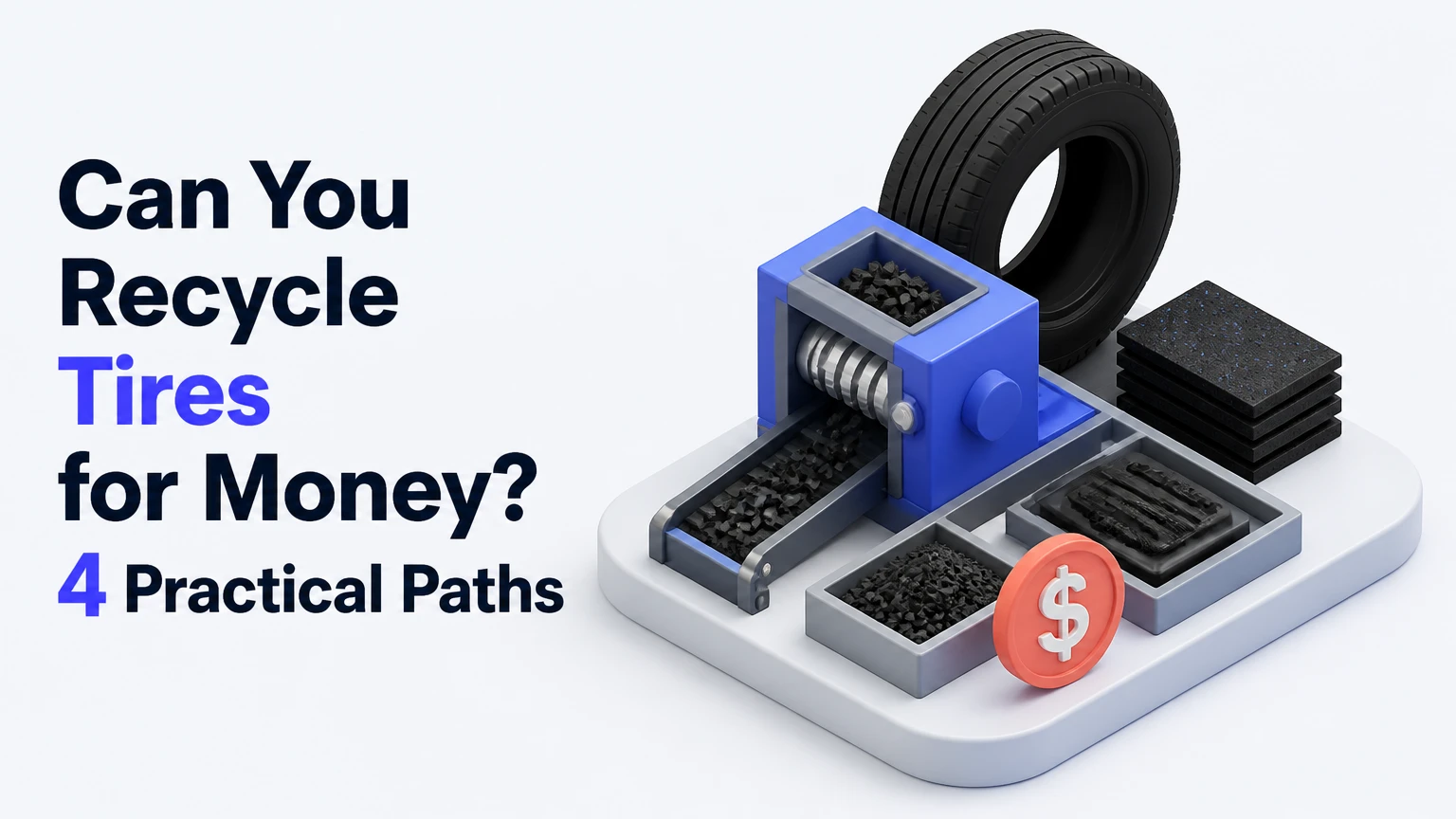
Yes, you can recycle tires for money, but most individuals earn more by reselling safe used tires or charging businesses for collection than by processing rubber themselves. Tire recycling becomes an industrial opportunity only when you have steady feedstock, permitted storage, specialized equipment, reliable buyers, and enough volume to absorb transport and disposal costs.
Key Facts at a Glance
- A usable used tire can typically sell for $25-$75, but age, tread, brand, damage, and local demand determine the actual price.
- Tire hauling earns money from collection fees, not usually from the scrap tires themselves; disposal, fuel, labor, insurance, and permits reduce the spread.
- Upcycling can produce $20-$150 products, but labor and local demand often limit volume more than material cost.
- Mechanical tire recycling requires contracted feedstock and buyers for rubber, steel, fiber, or tire-derived fuel before equipment makes financial sense.
- Pyrolysis can produce oil, recovered carbon black, and steel, but permits, emissions controls, financing, and offtake contracts make it an industrial project.
- A tire that is unsafe for road use should never be resold as a driving tire, even if it appears suitable for a craft or garden project.
Can You Recycle Tires for Money?
The most accessible money-making route is used-tire resale, followed by small-scale upcycling and local tire hauling. The best choice depends on whether you have labor, a vehicle, storage space, fabrication skills, or access to auto shops generating consistent volumes.
“Tire recycling” describes several different activities. Selling a roadworthy tire extends the product’s first life; hauling moves scrap to a permitted processor; shredding converts tires into material; pyrolysis thermally decomposes rubber in a controlled reactor. Those activities have different customers, risks, and legal obligations.
The U.S. Environmental Protection Agency has stated that “more than 250 million scrap tires are generated in the United States each year.” That large supply does not mean every tire has positive value. Scrap tires often carry a disposal cost because processors must transport, sort, shred, store, and market the resulting materials.
Which Method Requires the Least Money?
Used-tire flipping requires the least capital because a seller can source small quantities, inspect them, and list them locally without processing machinery. A basic depth gauge, cleaning supplies, a digital scale, and safe storage may cost $30-$100.
| Method | Typical startup cost | First customer | Main revenue source |
|---|---|---|---|
| Used-tire resale | $30-$500 | Driver or installer | Tire sale margin |
| Tire upcycling | $50-$1,500 | Homeowner or gym | Finished-product sale |
| Tire hauling | $5,000-$40,000 | Tire shop or farm | Collection fee |
| Mechanical recycling | $100,000-$1,000,000+ | Rubber or fuel buyer | Processed material sales |
| Pyrolysis | $300,000-$2,000,000+ | Industrial offtaker | Oil, carbon black, steel |
The figures are typical planning ranges, not universal quotes. A used box truck, a leased shredder, local grants, and regional waste-tire fees can change the economics substantially.
How Do You Resell Usable Tires Safely?
Resell only tires that pass a documented inspection, have a clear identity, and are legal to sell in your jurisdiction. The inspection must cover tread, age, sidewalls, bead condition, repairs, uneven wear, and contamination before cleaning or advertising.
Start with tire shops, fleet operators, salvage yards, estate cleanouts, and local listings. Ask for tires removed because of a vehicle upgrade or mismatch rather than tires rejected for structural damage. Record the tire size, brand, model, DOT code, remaining tread, repair history, and source.
The DOT date code contains four digits. Code 2521 means the 25th production week of 2021. Tire age is not a universal automatic rejection threshold, but many manufacturers advise replacement around six to ten years depending on condition, storage, and service history. Follow the tire maker’s guidance and local resale rules.
Use a tread-depth gauge rather than relying on a penny test. A tire near 4/32 inch has limited wet-weather margin, and legal minimums vary by jurisdiction. A tire can have acceptable tread and still be unsafe because of sidewall cracking, a bulge, exposed cords, bead damage, or an improper repair.
Used-Tire Inspection Checklist
- Confirm the size and load rating on both sidewalls.
- Photograph the full DOT code and tire identification markings.
- Measure tread depth at several points across the tread.
- Inspect both sidewalls for bubbles, cuts, cracking, repairs, and exposed cords.
- Check for uneven wear that may indicate alignment or internal damage.
- Reject tires with bead damage, belt separation, puncture repairs outside accepted zones, or unknown structural history.
- Store tires dry, shaded, ventilated, and away from ignition sources.
- Advertise the exact condition instead of calling an old tire “like new.”
A clean listing should show tread-depth readings, the DOT code, tire size, brand, model, repair disclosure, and photos from multiple angles. Local buyers often pay more for a matching pair or a complete set, but mixing models or load ratings can create a safety problem.
How Much Can Used Tires Earn?
A typical resale spread is $20-$70 per tire before labor, cleaning, storage, marketplace fees, delivery, and unsold inventory. Free sourcing does not make the margin free because inspection time, rejected tires, customer messages, and lawful disposal consume money.
| Resale scenario | Acquisition cost | Sale price | Gross margin before overhead |
|---|---|---|---|
| Budget single, 5/32-inch tread | $5 | $25 | $20 |
| Midrange single, 7/32-inch tread | $5 | $45 | $40 |
| Premium matching pair | $20 | $120 | $100 |
| Four-tire economy set | $40 | $180 | $140 |
| Rejected tire sent to processor | $0 | $0 | Negative after disposal |
A practical beginner scenario is ten tires sourced for $5 each and sold at $40 each. The $350 gross margin can become $220-$300 after cleaning, delivery, rejected stock, platform fees, and disposal. That is a side-hustle result, not a guaranteed weekly income.
What Products Can You Make From Tires?
Upcycling can earn money when the finished product solves a local need and looks professionally made. A tire planter, ottoman, dog bed, garden border, or workout sled has more value than the raw tire because the customer pays for design, labor, hardware, finishing, and convenience.
Common products include rope-wrapped ottomans, coffee tables with wooden tops, planters with drainage holes, tire swings, landscaping borders, livestock bumpers, and towable gym sleds. Products intended for children, animals, or heavy loads require stronger safety controls than decorative items.
| Product | Typical material cost | Labor time | Typical selling range |
|---|---|---|---|
| Painted planter | $5-$20 | 30-90 minutes | $20-$50 |
| Rope ottoman | $25-$70 | 3-6 hours | $75-$150 |
| Tire table | $35-$100 | 4-8 hours | $100-$250 |
| Workout sled | $20-$60 | 1-3 hours | $50-$150 |
| Garden border set | $10-$40 | 1-2 hours | $30-$100 |
Wash rubber with detergent or a suitable degreaser, dry it completely, and use an exterior-rated coating compatible with rubber. Drill drainage holes in planters so stagnant water does not create mosquito habitat. Avoid claiming that paint permanently seals tire chemicals, and do not use unknown reclaimed tires for food-contact surfaces.
Upcycling has a hard limit: bulky products are expensive to ship. Local pickup, farmers markets, garden centers, gyms, and landscaping businesses usually work better than national ecommerce for heavy rubber products.
How Does Tire Hauling Make Money?
Tire hauling makes money by charging a generator for pickup and controlling the cost of transport and permitted disposal. The hauler is paid for route density, labor, scheduling, documentation, and compliance, while the scrap tire itself often has little or negative resale value.
A typical contract might charge a tire shop $3-$6 per passenger tire, although local fees vary by tire type, market, and regulation. A processor might charge $1-$3 per tire, per ton, or per load. The correct comparison is total delivered cost, not a single posted tipping fee.
Suppose a route collects 500 passenger tires. At $4 per tire, revenue is $2,000. A $1.75 disposal cost produces $875 in processing expense; $250 fuel, $300 labor, $150 insurance allocation, and $100 maintenance reduce operating profit to approximately $325 before taxes and overhead.
| Hauling variable | Typical planning value | Why it matters |
|---|---|---|
| Collection fee | $3-$6 per tire | Sets route revenue |
| Disposal fee | $1-$3 per tire | Reduces the spread |
| Passenger-tire load | 400-800 tires | Depends on truck volume |
| Fuel and route cost | $150-$500 per week | Rises with empty miles |
| Pickup accounts | 10-20 shops | Creates route density |
| Invoice cycle | 15-45 days | Determines working capital |
The most important operating rule is to secure the disposal outlet before collecting tires. A full truck without a confirmed receiving appointment can create storage, scheduling, and cash-flow problems.
Which Permits and Rules Apply?
Waste-tire hauling commonly requires business registration, waste-hauler authorization, vehicle documentation, manifests, insurance, and a permitted receiving facility. Requirements differ by state, province, municipality, tire category, and storage quantity, so the local environmental agency is the final authority.
Contact the environmental regulator, county solid-waste office, fire marshal, and destination processor before accepting a commercial load. Ask whether the jurisdiction requires a waste-tire transporter permit, registration number displayed on the vehicle, tracking documents, storage approval, fire-prevention plan, or proof of final disposition.
Do not assume a normal business license covers waste transport. A tire pile can attract enforcement even when the hauler intended to recycle it. The U.S. EPA notes that scrap tires can collect water, provide mosquito habitat, and create difficult-to-control fires, which explains why storage regulations are stricter than ordinary inventory rules.
When Does Mechanical Recycling Work?
Mechanical recycling works when a facility has predictable tire volumes and contracted buyers for defined products. A shredder without feedstock or an offtake agreement is an expensive pile of equipment, not a recycling business.
A processing line may separate whole tires into tire-derived aggregate, coarse chips, crumb rubber, steel, and fiber. Coarse shreds can serve civil-engineering projects such as drainage layers or lightweight fill, while finer rubber may go to molded products, sports surfaces, or asphalt applications.
Machinery costs vary from small secondary shredders to complete automated lines costing hundreds of thousands of dollars or more. The financial model must include electrical service, knives and screens, conveyors, dust control, fire systems, loader equipment, buildings, labor, maintenance, permitting, and rejected material.
Tire-derived fuel can provide a high-volume outlet for properly prepared chips, especially where cement kilns or industrial boilers accept them. TDF is not automatically a high-margin product because quality specifications, transport distance, emissions controls, and competing fuels determine the net price.
When Does Pyrolysis Make Business Sense?
Pyrolysis makes business sense only when a permitted plant has reliable tire supply, tested reactor performance, environmental controls, and buyers for oil, recovered carbon black, and steel. Pyrolysis is not a low-cost home recycling method and should never be attempted with improvised equipment.
A tire pyrolysis reactor heats rubber without oxygen and produces several output streams. Typical reported mass proportions are approximately 35%-45% oil, 30%-35% recovered carbonaceous material, and 10%-15% steel, with the balance including gas and process losses; actual yields depend on tire composition and reactor design.
Recovered oil may require treatment before industrial use. Recovered carbon black often sells below virgin carbon black because consistency, ash, surface properties, and customer qualification determine its usability. Steel has an established scrap market, but wire contamination and cleaning affect its value.
The International Energy Agency, national environmental regulators, and engineering literature treat pyrolysis as a process requiring emissions management and lifecycle assessment, not as an automatic clean-fuel solution. A serious feasibility study must model product testing, flare systems, fire protection, air permits, wastewater, insurance, feedstock contracts, and shutdown procedures.
What Does Equipment and Compliance Cost?
A small resale operation can begin below $500, while a compliant hauling business commonly requires several thousand dollars before its first commercial route. Industrial recycling and pyrolysis require site development and regulatory capital that can exceed the machinery invoice.
| Cost category | Resale operation | Hauling operation | Processing plant |
|---|---|---|---|
| Vehicle | $0-$8,000 | $5,000-$40,000 | $30,000-$150,000 |
| Equipment | $30-$500 | $1,000-$15,000 | $100,000-$2,000,000+ |
| Permits and studies | $0-$1,000 | $500-$10,000 | $25,000-$250,000+ |
| Insurance | $300-$1,500 yearly | $2,000-$15,000 yearly | $10,000-$100,000+ yearly |
| Working capital | $300-$2,000 | $5,000-$30,000 | $100,000-$500,000+ |
These are planning ranges rather than quotes. A regulated facility may also need zoning approval, engineering drawings, stormwater controls, fire-water capacity, environmental testing, and financial assurance.
What Is the Break-Even Point for a Hauler?
A hauler breaks even when collection revenue covers disposal, variable vehicle costs, labor, fixed overhead, and taxes. For example, with a $4 collection fee, $1.75 disposal cost, and $0.50 variable route cost per tire, the contribution margin is $1.75 per tire before fixed expenses.
If weekly fixed overhead is $700, the route needs 400 tires simply to cover that overhead. A longer route, heavier agricultural tires, or a $300 labor day increases the required volume. Calculate by tire category because truck capacity and disposal pricing differ sharply between passenger, truck, agricultural, and off-road tires.
What Should You Never Resell or Store?
Never resell a tire for road use when it has a sidewall bulge, exposed cord, deep cracking, belt separation, bead damage, severe uneven wear, an unapproved repair, or an unknown structural history. Do not cut, drill, or paint a defective tire and advertise it as a driving tire.
Do not dump tires, bury them, burn them in the open, or store large quantities beside buildings. Tire fires can burn for long periods, generate contaminated runoff, and require specialist suppression. Keep legitimate inventory under a documented quantity limit, maintain access for emergency vehicles, remove standing water, and follow the local fire code.
A processor’s acceptance does not automatically make a load lawful. Keep receipts, manifests, photographs, customer invoices, and final-destination records for the period required by your jurisdiction.
How Can You Test Demand Before Spending Money?
Test demand for 30 days before buying a truck, shredder, or pyrolysis reactor. The validation target is five paying customers or written buyer commitments, not a large pile of free tires.
Use this sequence:
- Call 15 tire shops and ask how many tires they discard weekly, what they currently pay, and whether they need scheduled pickup.
- Call three permitted processors and obtain prices by tire category, minimum load, hours, appointment rules, and rejected-material policy.
- List five safe used tires and two upcycled products with accurate photographs.
- Ask three potential buyers for specifications, monthly volume, packaging, and payment terms.
- Build a route or product margin using actual fuel, labor, disposal, and tax estimates.
- Reject the model if the customer will not sign, the processor has no capacity, or the margin depends on free disposal.
A common mistake is buying machinery after watching equipment demonstrations. Equipment sellers show throughput, but throughput is not profit unless the machine receives suitable feedstock and produces material a buyer will accept.
Which Tire-Money Model Fits Your Situation?
An individual with little capital should start with safe resale, because the operation can be stopped without a building or specialized permit. A craft maker should choose upcycling only after confirming local pickup demand and calculating labor at an hourly rate.
A person who already owns a suitable truck and can sign shop accounts may test hauling. An investor should pursue mechanical processing or pyrolysis only after completing permitting, feedstock, offtake, fire, and sensitivity studies.
| Situation | Best starting model | Minimum validation | Main reason to avoid alternatives |
|---|---|---|---|
| Under $500 available | Used-tire resale | Sell 5-10 tires | Processing equipment is inaccessible |
| Strong DIY skills | Upcycling | Pre-sell 5 products | Shipping erodes bulky-item margin |
| Pickup truck and trailer | Tire hauling | Sign 3-5 shops | Empty miles destroy profit |
| Industrial site and capital | Mechanical recycling | Secure feedstock and buyers | Commodity prices fluctuate |
| Engineering and regulatory team | Pyrolysis | Complete permit feasibility | Product quality and emissions risk |
FAQ
Can tire shops give away old tires?
Some tire shops give away selected tires when disposal space is the problem, but many charge or require proof of lawful disposal. Ask whether the tires are available for resale, parts, or crafts, and agree in writing who is responsible for rejected tires and final disposal.
Is selling used tires legal?
Used-tire sales are legal in many places when the tire meets safety and labeling requirements, but some jurisdictions restrict tire age, tread depth, repairs, or roadside sales. Check your state or provincial environmental agency, consumer-protection office, and tire regulations before advertising inventory.
Do recycling centers pay cash for tires?
Most recycling centers charge a tipping or processing fee because scrap tires cost money to transport and process. Payment may occur for sorted steel, rubber products, or contracted feedstock, but a household should not assume a center will buy ordinary mixed tires.
How long can tires be stored?
Storage limits vary by location and may depend on tire count, site design, fire controls, and whether the tires are whole or shredded. Confirm the limit with the local fire marshal and environmental regulator before accumulating commercial inventory, especially outdoors or near structures.
Are tire-derived products environmentally safe?
Tire-derived products can have legitimate uses, but safety depends on the product, exposure, installation, and applicable standards. Use certified materials for playgrounds, flooring, drainage, or food-adjacent applications, and do not make health or environmental claims based solely on the word recycled.
Can I make money collecting tires from farms?
Farm tire collection can generate revenue because agricultural tires are difficult to handle and often require specialized processors. Quote by tire size or weight, confirm loading requirements, charge enough for travel and labor, and obtain the destination’s acceptance before removing the tires.
The Bottom Line
You can recycle tires for money, but the most reliable entry point is usually safe used-tire resale or a contracted hauling route, not ownership of a shredder or pyrolysis plant. Start with real customers, verify local permits, price lawful disposal, and separate roadworthy tires from scrap before accepting inventory.
Resale rewards inspection and sales skill. Hauling rewards dense routes and compliance. Upcycling rewards design and local demand, while industrial recycling rewards capital, engineering, feedstock security, and long-term buyers. The profitable model is the one whose full chain, from collection through final customer, remains positive after every cost.