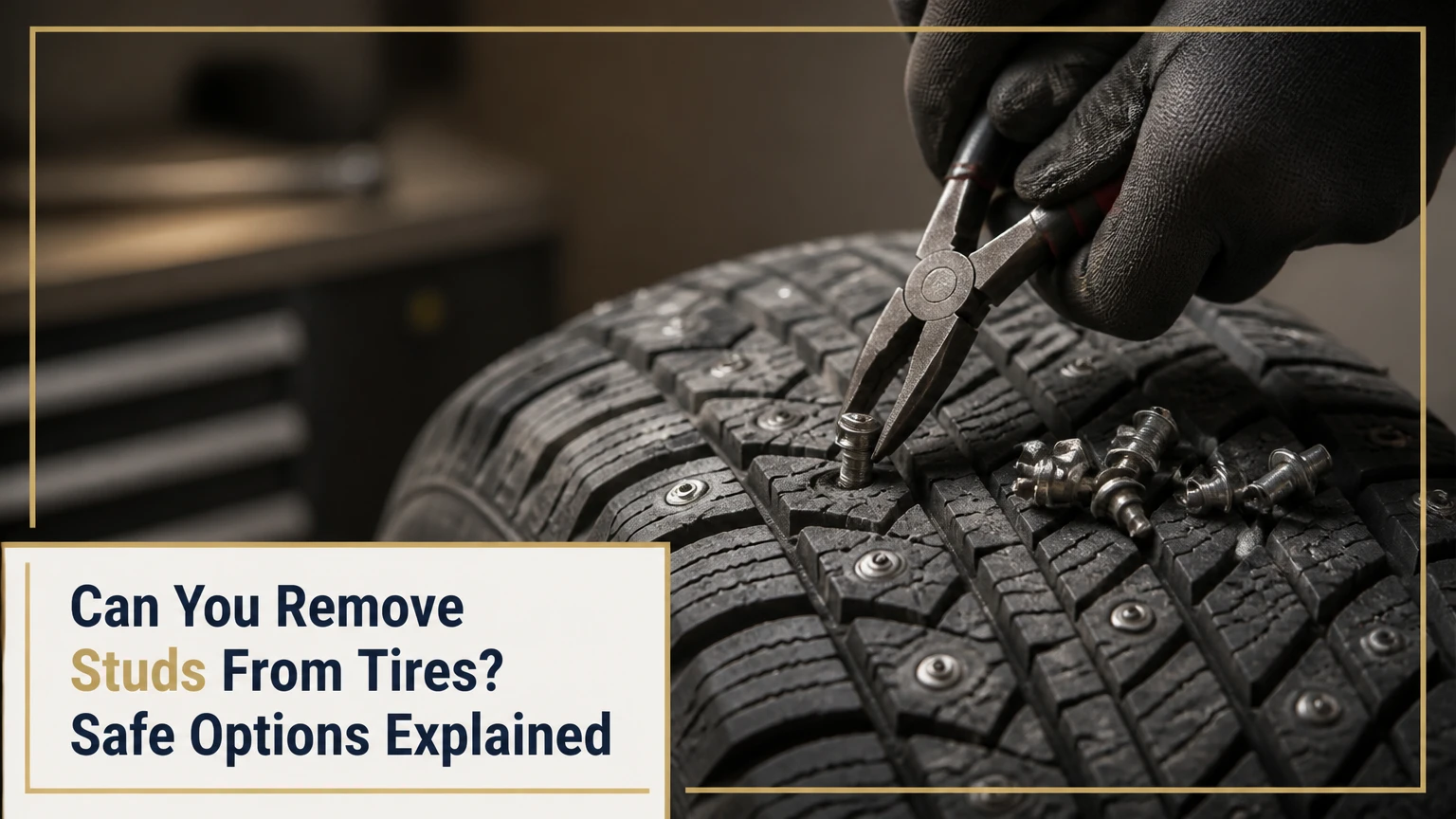
Yes, you can remove studs from a studded winter tire, but extraction is labor-intensive and can damage the tread pockets. Stud removal is safest when the tire has adequate tread, no cracking or exposed cords, and the work is performed with lubrication and controlled pulling. Removing studs does not turn the tire into a purpose-built studless winter tire.
Key Facts at a Glance
Studded winter tire studs are held in molded rubber pockets by mechanical compression.
A typical passenger tire contains approximately 80-150 studs, so hand removal can take 1-2 hours per tire.
A de-studded tire usually has less ice traction than it had with studs and may perform differently from a studless winter tire.
Petroleum-based solvents can damage tire rubber; use clean water with mild soap or a tire-safe rubber lubricant.
A torn pocket, exposed belt material, air loss, or a punctured tread means the tire should not return to service.
Restudding should not be attempted unless the tire manufacturer and a qualified tire professional specifically approve it.
Can You Remove Studs From Tires Safely?
You can remove studs from tires safely only when the tire remains structurally sound and the extraction does not tear the molded pocket. The practical question is not whether a stud can be pulled out, but whether the casing, tread rubber, and remaining pocket geometry will pass inspection afterward.
Stud removal is commonly considered when local rules restrict studded tires after winter, when metallic road noise becomes unacceptable, or when a driver wants to use an existing tire on bare pavement. The work is different from removing screws, chains, or aftermarket traction devices because each stud has a broad base below the tread surface.
A typical passenger tire may carry roughly 80-150 studs, depending on tire size and design. That count makes the project repetitive. A first-time DIY attempt may require 4-8 hours for a complete set, while a tire shop using pneumatic equipment may finish substantially faster.
The tire must be removed from the vehicle before serious inspection. Pulling studs from a tire mounted on a wheel creates poor access, encourages side loading, and makes it harder to identify damage. Never use an air-powered tool near an inflated tire unless the operator is trained in tire-service procedures.
How Are Studs Held in Winter Tires?
A tire stud is retained by a wide lower flange compressed inside a molded cylindrical pocket. The pocket has a narrower opening near the tread surface, so the rubber must stretch around the flange as the stud exits.
The metal is normally not glued or threaded into the tread. Tire manufacturers mold the pocket to match a specific stud shape, diameter, and installation depth. Stud dimensions and pocket geometry vary by tire model, which explains why some studs release easily while others resist hand tools.
The extraction force should travel as close as possible to the stud’s vertical axis. Pulling sharply sideways can tear the upper neck of the pocket, especially when the tread rubber is cold, aged, or already cut by stones.
Temperature also matters. Cold rubber is less flexible, while moderately warm rubber generally releases a stud more readily. Do not heat a tire with a torch, heat gun, open flame, or concentrated high-temperature source. Excessive heat can damage rubber compounds and internal components.
What Should You Check Before Removing Studs?
Check tread depth, tire age, cracking, puncture history, and pocket condition before removing any stud. Stud extraction is a poor use of labor when the tire is already near replacement or has structural damage.
Use the following pre-work inspection:
| Inspection item | Practical threshold or check | Decision |
|---|---|---|
| Remaining tread depth | At least 5/32 inch for meaningful winter use | Replace if near the vehicle or local minimum |
| Tread cracking | No cracks reaching cords or belt material | Reject tire with structural cracking |
| Sidewall condition | No bulges, cuts, or exposed cords | Do not remove studs from damaged casing |
| Tire age | Check DOT date code; 6 years requires careful evaluation | Follow manufacturer and professional guidance |
| Air retention | No unexplained pressure loss over 24 hours | Repair or replace before extraction |
| Stud pocket | Rubber remains continuous around the opening | Stop if the neck is torn or split |
The 5/32-inch figure is a practical winter-service threshold, not a universal legal replacement limit. Many tire professionals recommend replacing winter tires before the 2/32-inch legal wear indicator because snow evacuation and packed-snow traction decline earlier.
Clean the tread before deciding. Gravel can hide cuts, and a stud pocket surrounded by missing rubber may look intact until the debris is removed. Mark any questionable area with chalk and have a tire professional inspect it.
What Tools and Materials Do You Need?
The basic removal setup requires locking pliers or dedicated stud-removal pliers, mild soapy water, a stiff nylon brush, a plastic pick, gloves, eye protection, and a stable work surface. Professional pneumatic stud pullers improve speed and reduce the tendency to wrench the stud sideways.
| Item | Typical quantity | Purpose | Avoid |
|---|---|---|---|
| Locking pliers | 1 pair | Grip exposed stud crown | Loose jaws that slip across rubber |
| Mild dish soap and water | 500 milliliters | Lubricate pocket and flange | Petroleum solvent or brake cleaner |
| Nylon brush | 1 | Remove packed grit | Wire brush that cuts tread rubber |
| Plastic or blunt pick | 1 | Lift stones from pocket edge | Screwdriver or sharp chisel |
| Work gloves | 1 pair | Protect hands from sharp metal | Thin disposable gloves |
| Eye protection | 1 set | Block flying debris | Unprotected eyes |
| Tire-safe rubber lubricant | Optional | Reduce extraction friction | Unapproved oil or silicone product |
Dedicated pliers often have narrow jaws designed to grip the stud crown without cutting the surrounding tread. Side cutters can damage the stud, rubber, or the operator’s hands, and they are usually less effective than a tool that pulls along the stud axis.
A tire shop may use an air-powered extractor with a controlled clamp. That equipment is valuable because the tool applies repeatable force, but pneumatic equipment does not make a damaged or worn tire safe. Inspection remains the deciding step.
How Do You Remove Tire Studs by Hand?
Remove tire studs by cleaning the pocket, applying rubber-safe lubricant, gripping the exposed crown, twisting to release the flange, and pulling vertically. Work slowly enough to inspect every hole because the main failure is not a stubborn metal stud, but torn rubber around the pocket.
Step 1: Clean the Tread and Pockets
Wash the tire with water and mild detergent, then scrub the tread with a nylon brush. Use a blunt plastic pick to remove stones, compacted dirt, and ice from the area surrounding each stud.
Allow the tread to dry enough for inspection. Look for cuts that extend away from the pocket, missing tread blocks, exposed steel, and rubber that moves independently of the surrounding tread.
You will know the step worked when the stud crown and the complete pocket opening are visible. A common mistake is pulling a stud while gravel remains wedged under its flange, which increases force and tears the pocket.
Step 2: Apply a Tire-Safe Lubricant
Spray or brush a small amount of soapy water around the stud crown and pocket opening. A dedicated lubricant labeled safe for tire rubber can also work, but the product instructions must permit use on natural or synthetic rubber.
Do not soak the tire or use gasoline, kerosene, mineral spirits, penetrating oil, or brake cleaner. These chemicals can soften, dry, or degrade rubber and may leave the tread dangerously slippery.
You will know the step worked when the lubricant reaches the opening rather than pooling only on the tread surface. Reapply during removal if the rubber begins gripping the stud dry.
Step 3: Grip the Stud Crown
Close locking pliers firmly on the exposed top of the stud. Grip metal, not tread rubber, and position the jaws as close to the tread surface as possible without crushing the surrounding rubber.
Specialized stud-removal pliers may provide better alignment and reduce hand fatigue. If the crown is too short for secure engagement, do not dig into the tread with a knife to expose more metal.
You will know the grip is adequate when the pliers do not slip during moderate rocking. A common mistake is clamping at an angle, which converts upward pulling into sideways tearing.
Step 4: Twist, Rock, and Pull
Rotate the stud gently back and forth through a small arc, then pull upward while continuing a controlled rocking motion. The goal is to help the flange pass through the stretched pocket, not to rip the rubber open.
Use increasing effort gradually. If the stud does not move after several controlled attempts, add lubricant, clear debris, and change the plier angle. Do not jerk the tool or use a long bar for extra leverage.
You will know the extraction worked when the stud exits with its flange intact and the pocket edges spring back without a split. Stop immediately if rubber lifts with the stud, the pocket elongates visibly, or a tear begins.
Step 5: Inspect the Empty Pocket
Examine the empty hole with bright light. Confirm that no metal fragment remains and that the rubber surface is continuous around the entire opening.
Check for a deep cut, loose rubber flap, exposed belt material, or a hole that extends into the tire’s internal structure. A shallow, clean pocket is different from a damaged tread section that can admit water or weaken the belt area.
You will know the tire passes this individual check when the pocket is clean, stable, and free of exposed reinforcement. A common mistake is assuming that a missing stud automatically means a serviceable tire.
Can You Remove Studs From a Mounted Tire?
You can physically remove some studs while the wheel remains mounted, but mounted-tire extraction is not the preferred method. Access is restricted, the tire cannot be rotated comfortably, and damage on the inner tread may go unnoticed.
A mounted tire also encourages awkward body positioning. The operator may pull toward the wheel, slip, or strike the vehicle with pliers. If the tire must remain on the vehicle for an emergency reason, remove only easily accessible studs and arrange a proper inspection before driving normally.
Never deflate, demount, or inflate a tire without appropriate equipment and training. Tire beads can release stored energy, and tire service becomes particularly hazardous when a wheel is damaged, corroded, or fitted with a run-flat design.
For a complete set, remove the wheels and place each tire on a stable stand. A tire shop should handle extraction when the tires are still mounted on wheels, the equipment is unfamiliar, or the tire has any history of puncture or repair.
How Much Does Stud Removal Cost?
DIY stud removal typically costs $10-$60 for lubricant, pliers, gloves, and cleaning supplies, while professional service commonly costs about $20-$50 per tire. Actual prices vary with tire size, stud count, regional labor rates, whether the tire is mounted, and whether balancing is included.
| Service option | Typical cost per tire | Typical time | Best fit |
|---|---|---|---|
| DIY with existing pliers | $0-$15 | 60-120 minutes | One careful owner with a sound tire |
| DIY with dedicated pliers | $20-$60 initial tool cost | 45-100 minutes | Several tires or repeated seasonal work |
| Shop extraction, tire off wheel | $20-$50 | 15-30 minutes | Safer, faster removal with inspection |
| Shop extraction, mounted wheel | $30-$75 | 20-40 minutes | Customer lacks demounting equipment |
| Replacement with studless winter tire | $400-$1,200 per set | 1-3 hours | Better long-term winter performance |
The replacement range is a typical passenger-vehicle estimate for four tires, not a fixed market price. Premium SUV sizes, commercial tires, installation, disposal, mounting, balancing, and taxes can raise the total.
Ask a shop four questions before booking: Does the shop remove studs from this tire model? Is the quoted price per tire or per set? Does the price include mounting and balancing? Will the technician inspect and document rejected pockets?
A low extraction price may not be economical when the tire is old. Compare the labor with the remaining tread life and the price of a dedicated studless winter tire.
Is a De-Studded Tire as Good as a Studless Winter Tire?
A de-studded tire is usually not equivalent to a purpose-built studless winter tire. A studded tire is engineered with stud pockets, a tread pattern, and a compound that work together, whereas a studless winter tire uses specialized rubber and siping to create grip without metal inserts.
Removing the metal leaves empty pockets and changes the tread’s local stiffness. The effect on dry-road noise may be positive, but ice braking and steering response can decline. The result depends on tire model, temperature, tread depth, stud design, and the condition of the remaining rubber.
| Tire configuration | Ice traction | Bare-road noise | Snow performance | Main limitation |
|---|---|---|---|---|
| Studded winter tire | Highest on polished ice | High metallic noise | Strong in packed snow | Seasonal restrictions and road wear |
| De-studded winter tire | Lower than original studded state | Lower than studded state | Model-dependent | Empty pockets and altered tread stiffness |
| Purpose-built studless winter tire | Strong cold-weather grip | Low | Strong in snow and slush | Usually higher replacement cost |
| All-season tire | Moderate to poor on ice | Low | Limited in deep snow | Compound hardens in severe cold |
| Summer tire | Very poor below freezing | Low | Unsafe in snow | Not designed for winter temperatures |
The comparison is not a laboratory ranking for every tire. Manufacturers use different compounds and pocket designs, so the exact performance loss cannot be assigned one universal percentage.
A de-studded tire may be reasonable for short-term use on mostly dry roads when the tire remains in excellent condition. It is a poor choice for frequent freezing rain, polished intersections, steep untreated roads, or a vehicle that carries inexperienced drivers.
Can You Restud a Tire After Removing the Studs?
Do not restud a tire after removing its studs unless the tire manufacturer and a qualified tire professional approve that exact tire and stud system. Extraction stretches the pocket, and a replacement stud may not achieve the original retention force.
Some tire designs and commercial applications have specific retreading or restudding procedures, but that does not mean an ordinary passenger studded winter tire can be safely restudded after hand removal. A new stud may sit too high, fit loosely, or eject while driving.
The common practitioner rule is simple: treat removal as permanent. If ice traction matters enough to require studs again, purchase or retain a properly studded tire rather than improvising replacement studs.
Do not fill empty pockets with adhesive, rubber cement, screws, or aftermarket metal inserts. Those repairs do not restore the engineered retention geometry and can create new puncture or imbalance hazards.
Are Studded Tires Legal Without Their Studs?
Removing studs does not automatically determine whether the tire is legal in every jurisdiction. Studded-tire rules commonly regulate the presence and use period of metal studs, but definitions, dates, exemptions, and enforcement differ by state, province, road authority, and vehicle type.
For example, jurisdictions may specify calendar windows, road-condition exceptions, permitted stud materials, or special rules for emergency vehicles. Washington, Oregon, Idaho, Alaska, Maine, and Canadian provinces each have rules that can differ in timing and scope.
Check the current transportation department or provincial authority for the location where the vehicle is operated. A tire shop can provide practical guidance, but its advice does not replace the governing regulation.
A de-studded tire may still be identified by its original model and markings as a winter tire. Keep the tire’s sidewall markings visible and ask the authority or insurer if classification matters for a particular requirement.
What Are the Main Alternatives to Stud Removal?
The main alternatives are keeping the studded tires for legal winter use, buying studless winter tires, using all-season tires where conditions permit, or swapping complete wheel assemblies seasonally. The best option depends on ice exposure, annual mileage, storage, and total ownership cost.
| Alternative | Upfront cost | Winter capability | Seasonal labor | Suitable situation |
|---|---|---|---|---|
| Keep current studs | $0 beyond storage | Highest ice grip | 2 tire changes yearly | Frequent glare ice and legal stud period |
| Buy studless winters | $400-$1,200 per set | Strong cold and snow grip | 2 wheel changes yearly | Mixed snow, ice, and bare pavement |
| Buy all-season tires | $350-$1,000 per set | Moderate in light snow | 1 change cycle | Mild winters and infrequent storms |
| Buy separate steel wheels | $250-$700 per set | Depends on tire | 30-60 minutes for wheel swap | Owner wants low seasonal labor |
| Remove studs temporarily | $10-$200 per set | Lower than original studs | One-time extraction | Sound tires with short remaining life |
A complete wheel swap is often gentler on tire beads than repeated demounting and remounting. It also reduces the chance of seasonal mounting damage and allows winter tires to remain balanced on their original wheels.
An all-season tire is not a substitute for a winter tire in sustained freezing temperatures. The Three-Peak Mountain Snowflake symbol identifies tires meeting a severe-snow service test, but the symbol does not mean the tire has stud-level ice traction.
What Can Go Wrong During Stud Removal?
The most common failures are torn rubber pockets, damaged tread blocks, retained metal fragments, unnoticed casing defects, and a tire that no longer provides adequate winter grip. A difficult stud is a warning to reduce force, improve access, and reassess the tire.
Torn Pocket
Stop when the opening splits or a rubber flap lifts with the stud. Mark the location and have a tire professional determine whether the damage reaches the belt package.
Do not seal the pocket with glue. Adhesive cannot restore the original mechanical structure or certify the tire for highway use.
Broken or Buried Stud
If the crown breaks, do not excavate deeply with a knife or drill. A shop may remove the remaining metal with a controlled extractor, but the tire may be rejected if the pocket is compromised.
Exposed Belt Material
Any visible steel or textile reinforcement is a replacement condition. Internal belt exposure allows moisture intrusion and indicates that the tread rubber has been cut beyond a cosmetic defect.
Air Loss After Removal
Inflate the tire to the vehicle manufacturer’s cold-pressure specification and monitor it for 24 hours. Pressure loss means the tire needs professional inspection before driving.
Excessive Hand Fatigue
Hand removal across 100 or more studs creates repetitive strain. Work in 20-30 minute sessions, rotate the tire, and stop when grip deteriorates. Fatigue causes pliers to slip and increases pocket damage.
Poor Performance After Removal
If the vehicle feels unstable, wanders, vibrates, or loses ice grip, stop treating the tire as an equivalent winter replacement. Check balance, pressure, tread condition, and alignment, then compare the tire with a purpose-built studless option.
Which Option Fits Your Situation?
A daily commuter who drives mostly cleared roads should usually choose studless winter tires or all-season tires matched to local conditions rather than spend substantial labor de-studding old tires. The choice improves when the replacement tire has adequate cold-weather specifications and the vehicle receives a full seasonal inspection.
A driver in a region with frequent glare ice may be better served by retaining studded tires during the permitted period. Removing the studs for convenience sacrifices the feature that originally justified the tire, particularly on untreated rural roads and steep grades.
A budget-constrained owner can remove studs from a healthy tire when the work cost is low, the tire has sufficient tread, and winter ice performance is not the primary requirement. The result should be regarded as a temporary compromise, not a performance upgrade.
A commercial, agricultural, or off-road operator should ask a commercial tire shop about the tire’s casing and intended surface. Pneumatic extraction is faster, but a specialist still needs to confirm that the remaining tread and pocket damage are acceptable.
Use this decision rule:
- Need maximum ice traction: Keep or replace with properly studded winter tires.
- Need low noise and strong cold-weather handling: Buy studless winter tires.
- Need a short-term budget solution: Remove studs only from a structurally sound tire.
- Tire has cracks, low tread, or damaged pockets: Replace it instead of extracting studs.
- Unsure about rules or tire condition: Ask the local transportation authority and a tire professional.
FAQ
Will Removing Studs Ruin a Tire?
Removing studs does not automatically ruin a tire, but each extraction permanently changes the tread pocket and may cause damage. A tire remains a candidate for service only if the pockets are clean and intact, the casing has no structural defect, pressure remains stable, and the remaining tread suits the intended season.
Can I Remove Only the Noisy or Missing Studs?
You can remove individual damaged or noisy studs, but mixed stud retention may create uneven tread behavior and does not restore the tire’s original design. If several studs are loose, missing, or damaged, have the entire tire inspected rather than pulling random studs as a cosmetic repair.
How Long Does Hand Removal Take?
Hand removal typically takes 45-120 minutes per passenger tire, depending on stud count, rubber temperature, debris, tool quality, and operator experience. A complete set commonly requires 4-8 hours for a first-time owner. A tire shop may quote 15-30 minutes per tire with pneumatic equipment.
Should I Remove Studs Before Selling the Tires?
Do not remove studs solely to make a used tire easier to sell. Disclose that the tire was de-studded, provide its tread depth and DOT date code, and explain any damaged or missing pockets. A buyer should know that the tire is not equivalent to a factory-made studless winter tire.
Can a Tire Shop Refuse Stud Removal?
Yes, a tire shop can refuse the service if the tire is worn, damaged, too old, mounted on an unsafe wheel, or incompatible with the shop’s equipment and liability policy. Call before arriving and provide the tire brand, model, size, stud count if known, and whether the tire is mounted.
The Bottom Line
You can remove studs from tires, but the procedure is permanent and does not create a new studless winter tire. Remove them only from sound tires with adequate tread, use lubrication and controlled vertical force, inspect every pocket, and stop at the first sign of structural damage.
For frequent winter driving on ice, keeping properly studded tires or buying a purpose-built studless winter tire is usually safer than de-studding. For a temporary, lower-cost solution on mostly cleared roads, careful removal may be reasonable when a tire professional confirms that the casing and tread remain serviceable.


