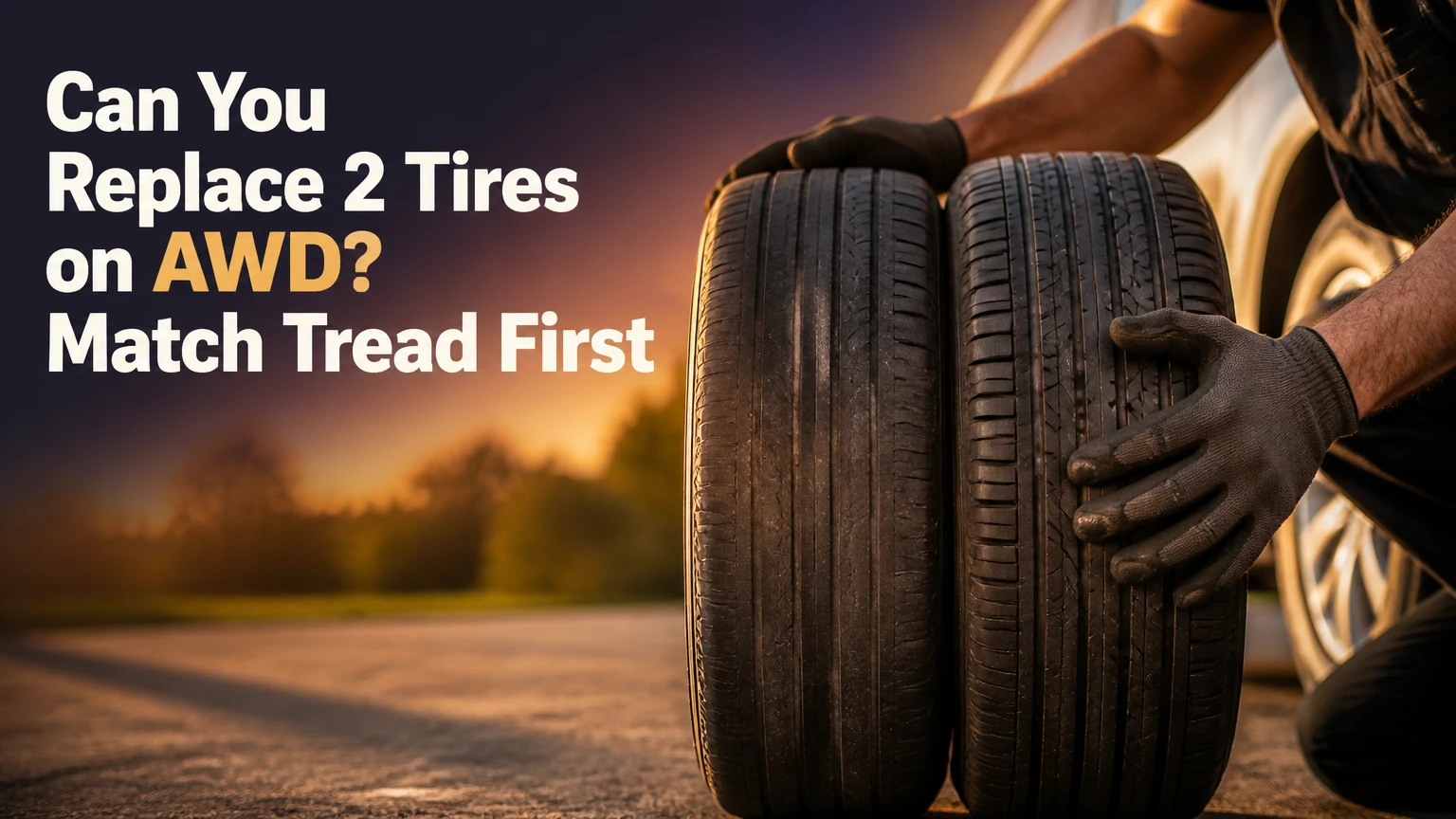
Yes, you can replace two tires on an AWD vehicle when the new tires match the existing pair closely enough in rolling circumference, tread pattern, size, load index, and speed rating. Replace all four when the remaining tires are substantially worn or the vehicle manufacturer sets a tighter limit. The owner’s manual and an accurate tread measurement decide the safe option.
Key Facts at a Glance
- AWD vehicles can tolerate two replacement tires only when all four tires remain within the vehicle manufacturer’s approved rolling-circumference difference.
- A 2/32-inch tread-depth difference is a common industry screening rule, not a universal specification for every AWD system.
- New tires normally belong on the rear axle when only two tires are replaced, because deeper rear tread helps resist wet-road oversteer.
- Tire shaving can make two new tires match an older pair, but the tire must be shaved by a qualified shop using the correct target depth.
- Identical sidewall size does not guarantee identical rolling circumference between brands, models, or wear levels.
- A flashing AWD warning light, driveline binding, or acceleration shudder requires inspection before continued driving.
Can You Replace 2 Tires on AWD?
You can replace two tires on AWD if the remaining tires are compatible and the measured difference falls within the manufacturer’s limit. Replacing two tires without checking tread depth and rolling circumference can create continuous speed differences between axles, which may overheat a center differential, viscous coupling, clutch pack, or transfer case.
The risk is not limited to high-performance vehicles. A compact crossover with front-biased, on-demand AWD can also experience unwanted clutch engagement when tire speeds do not agree. However, the severity and allowable tolerance vary considerably between systems.
The safest default is simple: replace all four tires if the existing pair has meaningful wear, irregular wear, a different tire model, or an unknown history. Replacing two can be reasonable when the other pair is nearly new, when a matching pair has been professionally shaved, or when the vehicle manual explicitly permits the measured difference.
A tire retailer may recommend four tires because it is the lowest-risk configuration. That recommendation is not automatically proof that two tires are mechanically impossible. The deciding evidence is the vehicle specification, the tire manufacturer’s dimensions, and measured wear.
Why Does Tire Mismatch Stress an AWD Drivetrain?
Tire mismatch stresses AWD components because tires with different rolling circumferences rotate at different speeds while traveling the same distance. The AWD system must absorb that speed difference even when every tire has traction and no wheel is actually slipping.
For example, assume one axle carries tires with a 1.5% smaller effective circumference than the other axle. The smaller tires must rotate about 1.5% faster at the same road speed. A center differential or electronically controlled coupling can accommodate some difference during turns, but continuous straight-line compensation creates heat and clutch or gear wear.
Different AWD designs respond differently:
- Open center differential: Allows speed differences but can transmit unwanted compensating motion through the drivetrain.
- Viscous coupling: Uses fluid shear to manage speed differences, which can generate heat during prolonged mismatch.
- Clutch-pack coupling: Electronically commands engagement and may interpret speed differences as slip.
- Transfer case with fixed or selectable AWD: Can bind when front and rear axle speeds differ on high-traction surfaces.
The phrase “catastrophic drivetrain failure” is too absolute for every mismatch. A small difference may cause no immediate damage, while a large or prolonged mismatch can contribute to overheating and premature failure. AWD component damage also depends on driving speed, road surface, tire pressure, cornering, temperature, and system design.
What Tread Difference Is Safe on an AWD Vehicle?
The safe tread difference is the maximum stated by the vehicle manufacturer, measured across all four tires. Many tire professionals use 2/32 inch as a conservative screening threshold, but Subaru, Audi, BMW, Toyota, and other manufacturers may publish different limits for particular models.
Tread depth is a useful proxy for tire wear, but effective rolling circumference is the more direct mechanical measurement. Two tires with the same tread depth can still have different dimensions because of casing construction, molding, inflation pressure, load, and tread design.
| Measurement or specification | Typical value or rule | Decision meaning |
|---|---|---|
| New passenger-tire tread | 10/32-12/32 inch | Common starting range, not a guaranteed value |
| Common replacement screen | 2/32 inch difference | Conservative industry rule of thumb |
| Legal tread limit in the United States | 2/32 inch | Replace tire, but not an AWD compatibility limit |
| Example worn tire | 6/32 inch | A new 10/32-inch tire differs by 4/32 inch |
| Typical tire circumference variance target | Under 1% | Use only when the manufacturer provides no tighter rule |
| Subaru example often cited by retailers | 2/32 inch or 1/4 inch circumference | Confirm the exact model-year manual |
The 2/32-inch value must not be confused with the legal replacement limit. A tire at 4/32 inch may be legal in many jurisdictions but unsuitable next to a new 11/32-inch tire on a sensitive AWD system.
A qualified shop can measure all four tires at the inner, center, and outer grooves. The lowest relevant reading matters when wear is uneven. The shop should also inspect tire circumference, manufacturer dimensions, and the vehicle’s service information when the measurement is close to the limit.
How Should You Measure the Existing Tires?
Measure each tire with a tread-depth gauge, record three groove locations, and compare the results with the AWD specification. A visual inspection cannot reliably identify a 2/32 or 3/32-inch difference, and a penny test cannot provide the precision needed for an AWD decision.
Use this process:
- Set all four tires to the vehicle’s cold inflation pressures.
- Measure the inner, center, and outer circumferential grooves on each tire.
- Record the lowest reading for each tire and note cupping, shoulder wear, or bald spots.
- Check the DOT tire identification number and confirm that all tires are the same size.
- Compare the readings with the owner’s manual or manufacturer service bulletin.
- Ask the tire shop to measure rolling circumference if the tread difference approaches the limit.
A tire marked 225/65R17 has a nominal size, not a guaranteed physical diameter. A 225/65R17 touring tire from one manufacturer can have a different loaded radius from another brand’s 225/65R17 tire. Even two tires with the same model name may differ if one is a run-flat, extra-load, or approved original-equipment version.
Practitioner insight: Measure wear on the same axle and across all four corners. Front tires often wear faster because steering, braking, alignment, and engine weight load them differently, so comparing only one old tire with one new tire can conceal the actual AWD mismatch.
Which Two-Tire Replacement Options Are Available?
The practical choices are replacing all four, installing two matching tires, shaving two new tires, or using a temporary repair. The correct choice depends on tread depth, damage type, tire availability, and the vehicle’s written tolerance.
| Replacement option | Typical U.S. cost | Typical time | Best use |
|---|---|---|---|
| Replace all four tires | $600-$1,400 | 1.5-3 hours | Remaining tires below about 6/32 inch or mismatched |
| Install two matching tires | $280-$650 | 45-90 minutes | Existing pair nearly new and within specification |
| Shave two new tires | $350-$750 | 1-3 days | Existing pair has usable 6/32-8/32 inch tread |
| Repair one puncture | $25-$60 | 30-60 minutes | Repairable tread-area puncture, tire otherwise sound |
| Install a used matching pair | $150-$400 | 1-2 hours | Short-term budget option with verified age and condition |
Prices are typical U.S. consumer ranges and vary by tire size, vehicle, region, mounting, balancing, disposal fees, taxes, and alignment. Tire shaving may cost about $25-$50 per tire, but availability is limited and shaving removes part of the new tire’s usable tread.
Replace All Four Tires
Four new tires are the cleanest solution when the existing pair has significant wear. All four tires then share the same model, casing, tread depth, and service history, reducing both drivetrain and traction differences.
Four-tire replacement is usually appropriate when the remaining tires measure around 5/32 inch or less, have uneven wear, are more than six years old, or cannot be matched by brand and model. It also makes sense when the AWD manufacturer publishes a very tight circumference tolerance.
Install Two Matching Tires
A two-tire replacement can work when the existing tires have low mileage and similar tread depth. The replacement pair should match the existing tires in brand, model, size, load index, speed rating, construction, and seasonal category whenever possible.
The new pair should normally go on the rear axle. Goodyear’s consumer guidance states, “If you are replacing only two tires, the new tires should be installed on the rear axle.” The rear placement improves wet-road stability because worn rear tires can lose grip first and produce oversteer.
Professionally Shave Two Tires
Tire shaving removes tread from new tires until their measured tread depth or circumference matches the tires remaining on the vehicle. Consumer Reports has described tire shaving as a way to avoid replacing all four tires on some AWD vehicles, but the vehicle manufacturer’s tolerance still controls the final decision.
Shaving is useful after one tire is damaged when the other three tires have substantial usable tread. The shop must use the correct tire model and target measurement, then balance the tire after shaving. Some manufacturers may restrict or exclude treadwear warranty coverage after shaving.
Repair the Damaged Tire
Repairing one puncture is often better than replacing two tires when the injury is repairable. The puncture must generally be in the central tread area, smaller than the repair limit specified by the tire industry, and discovered before driving extensively while flat.
A tire with sidewall damage, a shoulder puncture, exposed cords, severe underinflation damage, or an unrepairable plug-only repair requires replacement. Ask the shop to check the tire internally after a low-pressure event.
Should New AWD Tires Go on the Front or Rear?
New tires should normally go on the rear axle when only two tires are replaced, including on many AWD vehicles. Deeper rear tread helps maintain rear lateral grip on wet roads, reducing the possibility of sudden oversteer when the front tires still have more wear.
The rear-axle rule is a tire-safety recommendation, not permission to ignore the AWD system’s matching requirements. Installing new tires on the rear does not correct an excessive circumference difference. The pair still must meet the vehicle specification.
Some vehicles require a specific tire arrangement, staggered fitment, directional pattern, or front-to-rear rotation restriction. A vehicle with different front and rear sizes cannot use a generic front-or-rear rule without checking the manual.
| Vehicle condition | Recommended action | Reason |
|---|---|---|
| Same size front and rear, two new tires | Place new pair on rear | Preserves wet-road rear stability |
| Staggered front and rear sizes | Follow owner’s manual | Axles may require different specifications |
| Directional tires | Keep rotation direction correct | Tire cannot be casually crossed to another corner |
| Existing rear tires more worn | Replace all four or match circumference | New rear tires alone may leave AWD mismatch |
| Manufacturer specifies front installation | Follow manufacturer instruction | Vehicle-specific guidance overrides general advice |
After installation, confirm cold pressures, reset the TPMS, check the tire rotation direction, and inspect for alignment-related wear. A four-wheel alignment is appropriate when the old tires show shoulder wear, feathering, cupping, or unequal tread depth.
How Do Subaru, Audi, BMW, and Other AWD Systems Differ?
Subaru, Audi, BMW, Toyota, Honda, Ford, and other manufacturers use different AWD hardware and publish different tire-matching requirements. No universal 2/32-inch rule can safely replace the model-year owner’s manual.
Subaru manuals and dealer guidance commonly emphasize matching tire size, circumference, construction, and wear across all four positions. Some Subaru guidance is often summarized as no more than 2/32 inch of tread difference or approximately 1/4 inch of circumference difference, but the exact wording varies by vehicle.
Audi quattro systems can have model-specific limits, and retailer guidance sometimes cites a maximum tread variation around 3/32 inch. BMW xDrive guidance is also model-dependent, with some sources citing a percentage difference in rolling circumference rather than a tread-depth number. Those figures are not interchangeable.
| AWD vehicle example | Commonly discussed tolerance | Required verification |
|---|---|---|
| Subaru symmetrical AWD | 2/32 inch or 1/4 inch circumference in some guidance | Exact owner’s manual and model year |
| Audi quattro | Around 3/32 inch in some retailer guidance | Audi service information for the drivetrain |
| BMW xDrive | Around 1%-2% in some guidance | BMW model-specific specification |
| Toyota AWD crossover | Vehicle and coupling dependent | Toyota manual and dealer measurement |
| Honda or Acura AWD | Model-specific circumference requirement | Owner’s manual and tire placard |
The tire placard supplies size and pressure information, but it may not contain the complete AWD wear tolerance. The service department can access technical bulletins and drivetrain-specific procedures that a general tire database may not show.
Expert insight: The most defensible answer is not “AWD always requires four tires.” It is “AWD requires four compatible rolling circumferences.” That distinction explains why two nearly new tires may be acceptable while two new tires beside 6/32-inch tires may not be.
What Tire Specifications Must Match?
The replacement tires should match the existing tires in more than sidewall size. Matching the tread design and construction reduces differences in rolling behavior, grip, noise, and electronic control response.
Check these specifications:
- Tire size, such as 225/65R17.
- Load index, such as 102 or 106 XL.
- Speed rating, such as H, V, or W.
- Brand and exact model.
- Run-flat or standard construction.
- Extra-load or standard-load casing.
- Summer, all-season, or winter category.
- Original-equipment marking when the manual requires it.
- Directional or asymmetric tread orientation.
- Actual tread depth and rolling circumference.
Do not assume four tires are equivalent because the sidewall numbers match. Different tread compounds and casing profiles can create different effective diameters, especially under the vehicle’s loaded weight.
Mixing winter and all-season tires on the same AWD vehicle can also change handling substantially. A drivetrain may tolerate the rotation difference while the driver loses predictable braking and cornering balance.
What Happens If You Install Two Mismatched Tires?
Two mismatched tires can cause drivetrain stress, traction-control intervention, poor wet handling, or accelerated tire wear. The immediate result may be minor, but continuous mismatch can raise temperatures inside a viscous coupling, center differential, or electronically controlled clutch.
Possible symptoms include:
- Binding or hopping during tight, low-speed turns.
- Shuddering during acceleration.
- A humming or whining sound beneath the center console.
- A flashing AWD, 4WD, or traction-control warning.
- Unexpected fuel-economy reduction.
- Repeated tire-pressure warnings after correct inflation.
- Uneven wear on one axle.
These signs do not prove that tire mismatch damaged the drivetrain. Wheel bearings, CV joints, transfer-case fluid, alignment faults, and traction-control sensors can create similar symptoms.
Stop unnecessary driving if the AWD light flashes, the vehicle binds on dry pavement, or a new vibration appears immediately after tire installation. Have the shop verify tire circumference, pressure, wheel-speed data, fluid condition, and diagnostic trouble codes before replacing drivetrain parts.
What Are the Common Mistakes?
The most damaging mistakes involve assuming that nominal tire size equals actual circumference, treating legal tread depth as an AWD tolerance, and installing a different tire model without measurement.
- Replacing two tires based only on visual appearance: Use a tread-depth gauge and compare all four tires.
- Treating 2/32 inch as a universal law: Check the manufacturer’s written requirement first.
- Mixing tire models: Match the exact brand and model when possible.
- Installing deeper tires on the front automatically: The rear axle is usually preferred for wet stability.
- Ignoring tire pressure: Pressure changes alter loaded radius and handling.
- Using a temporary spare for too long: Follow the speed and distance limits printed on the spare.
- Skipping an alignment after irregular wear: Correct the cause before the new pair develops the same pattern.
- Buying used tires without checking age: Inspect the DOT date, repairs, sidewalls, and remaining tread.
Practitioner rule: A four-tire tread-depth average is not enough. One tire with severe shoulder wear can have a different effective rolling radius even when its center groove matches the other tires.
What Should You Do After Replacing Two Tires?
After replacing two tires, confirm the installation, reset the vehicle systems, and monitor handling during the first drive. The complete check normally takes 10-20 minutes after mounting and balancing.
Ask the installer to verify:
- New tires are on the axle specified by the manual.
- Tire direction and sidewall markings are correct.
- Cold inflation pressures match the door-jamb placard.
- TPMS sensors report correctly.
- Wheel nuts are tightened to the vehicle’s torque specification.
- Tread and circumference measurements meet the AWD limit.
- Alignment is checked when wear was uneven.
- The old tires are suitable for continued use.
Drive slowly in a parking area first, then listen for binding or vibration on dry pavement. Recheck pressure when the tires are cold after several days, because mounting work can disturb valve cores and pressure changes affect rolling radius.
How Much Does AWD Tire Replacement Cost?
AWD tire replacement typically costs $280-$650 for two tires and $600-$1,400 for four tires in the United States, including common mounting and balancing charges. Premium SUV tires, run-flats, large wheels, alignment work, and tire shaving can raise the total.
| Service item | Typical price | Typical duration |
|---|---|---|
| Mount and balance, per tire | $20-$45 | 15-25 minutes |
| Tire disposal, per tire | $3-$8 | Included with service |
| Four-wheel alignment | $100-$220 | 45-90 minutes |
| Tire shaving, per tire | $25-$50 | 1-3 days commonly |
| Tread-depth and circumference check | $0-$50 | 15-30 minutes |
| AWD diagnostic scan | $80-$180 | 30-90 minutes |
A four-tire replacement can cost less than repairing an AWD system, but the financial decision should include remaining tread value. If the existing tires have 8/32 inch of tread and a professional shop can match two new tires accurately, shaving may preserve useful tire life.
Shaving is not suitable when the existing tires are aged, damaged, unevenly worn, or close to replacement depth. Removing tread from an unsuitable tire pairing only creates a more expensive mismatch.
When Is Tire Shaving Not a Good Idea?
Tire shaving is not a good solution when the existing tires have less than about 4/32 inch tread, significant age, irregular wear, or a different construction. It also may be impractical when no local shop can document the finished circumference.
A shaved tire has less remaining tread than a new tire and may have different warranty treatment. The shop should confirm the target depth, inspect the casing, balance the tire, and document the measurement.
Tire shaving is most defensible after a single premature failure on a relatively new set. It is less attractive when two tires are worn out naturally, because replacing all four restores consistent wet traction and avoids carrying two older tires forward.
What If One Tire Is Punctured or Destroyed?
A repairable puncture should usually be repaired rather than converting a minor incident into a two-tire or four-tire replacement. If one tire cannot be repaired, measure the other three before buying anything.
| Damage situation | First choice | AWD consideration |
|---|---|---|
| Nail in central tread, no run-flat damage | Professional internal repair | Preserve the existing circumference |
| Sidewall cut | Replace damaged tire | Match the remaining three carefully |
| Tire driven flat | Replace after internal inspection | Hidden casing damage may exist |
| One tire with 2/32 inch extra wear | Shave or replace four | Two new tires may still mismatch |
| Temporary spare installed | Drive only within spare limits | Avoid extended AWD operation |
Some tire manufacturers and vehicle manufacturers discourage mixing a temporary spare with full-time AWD for extended distances. The owner’s manual gives the maximum speed, distance, and drivetrain restrictions.
Do not disable AWD or remove a propeller shaft as a casual workaround. Those modifications can affect braking systems, stability control, lubrication, warranty coverage, and legal compliance.
Can You Use Two Used Tires on an AWD Vehicle?
You can use two used tires only when their condition and rolling circumference are verified, and they match the other tires closely. Used tires require inspection for age, repairs, uneven wear, sidewall damage, and correct load and speed ratings.
A used tire with 7/32 inch tread may be a poor match if the other axle carries a different 7/32-inch tire model with a larger loaded radius. The tread number alone does not establish compatibility.
Avoid used tires with an unknown DOT date, exposed cords, bead damage, internal repairs, severe cracking, or a mismatched seasonal category. For a sensitive AWD system, a professionally measured matching pair from the same model is preferable to two visually similar bargain tires.
FAQ
Can AWD tires be different brands?
Different brands can sometimes meet the required rolling-circumference tolerance, but using the same brand and model on all four positions is safer. Brand differences also change wet grip, braking, noise, and handling, so a mechanically acceptable combination may still produce poor vehicle balance.
Do I need an alignment after installing two tires?
You do not automatically need an alignment after every tire replacement, but alignment inspection is advisable when the old tires show shoulder wear, feathering, cupping, or unequal tread. Correcting the underlying suspension or alignment problem prevents rapid wear on the replacement pair.
Can I replace only one tire on AWD?
Replacing one tire is possible only when the replacement matches the other three closely enough in circumference and specification. Many AWD vehicles have tighter limits than two-wheel-drive vehicles, so a shop may recommend shaving one tire or replacing multiple tires after measurement.
Is 4/32 tread depth safe for AWD?
A tire at 4/32 inch may be legal but can be too worn to pair with a new 10/32-12/32-inch tire on an AWD vehicle. The difference is often 6/32-8/32 inch, which exceeds common screening guidance and may exceed the manufacturer’s limit.
Should all four AWD tires be the same brand?
The same brand and model across all four positions is the preferred configuration because it minimizes differences in circumference and handling. The vehicle manual may permit alternatives, but identical tires simplify rotation, traction control, warranty claims, and future replacement.
How long can I drive with mismatched AWD tires?
Do not plan regular driving with mismatched AWD tires. If a mismatch is discovered, drive only as necessary to reach a tire professional, use the manufacturer’s temporary-spare limits, and stop immediately if binding, shuddering, or an AWD warning occurs.
The Bottom Line
Can you replace 2 tires on AWD? Yes, but only after measuring the existing tires and checking the vehicle-specific tolerance. Replace all four when the remaining pair is substantially worn, use two matching tires when the difference is within specification, and consider professional shaving after a single tire failure on a nearly new set. Always confirm the axle placement, pressure, TPMS operation, and rolling circumference before driving normally.