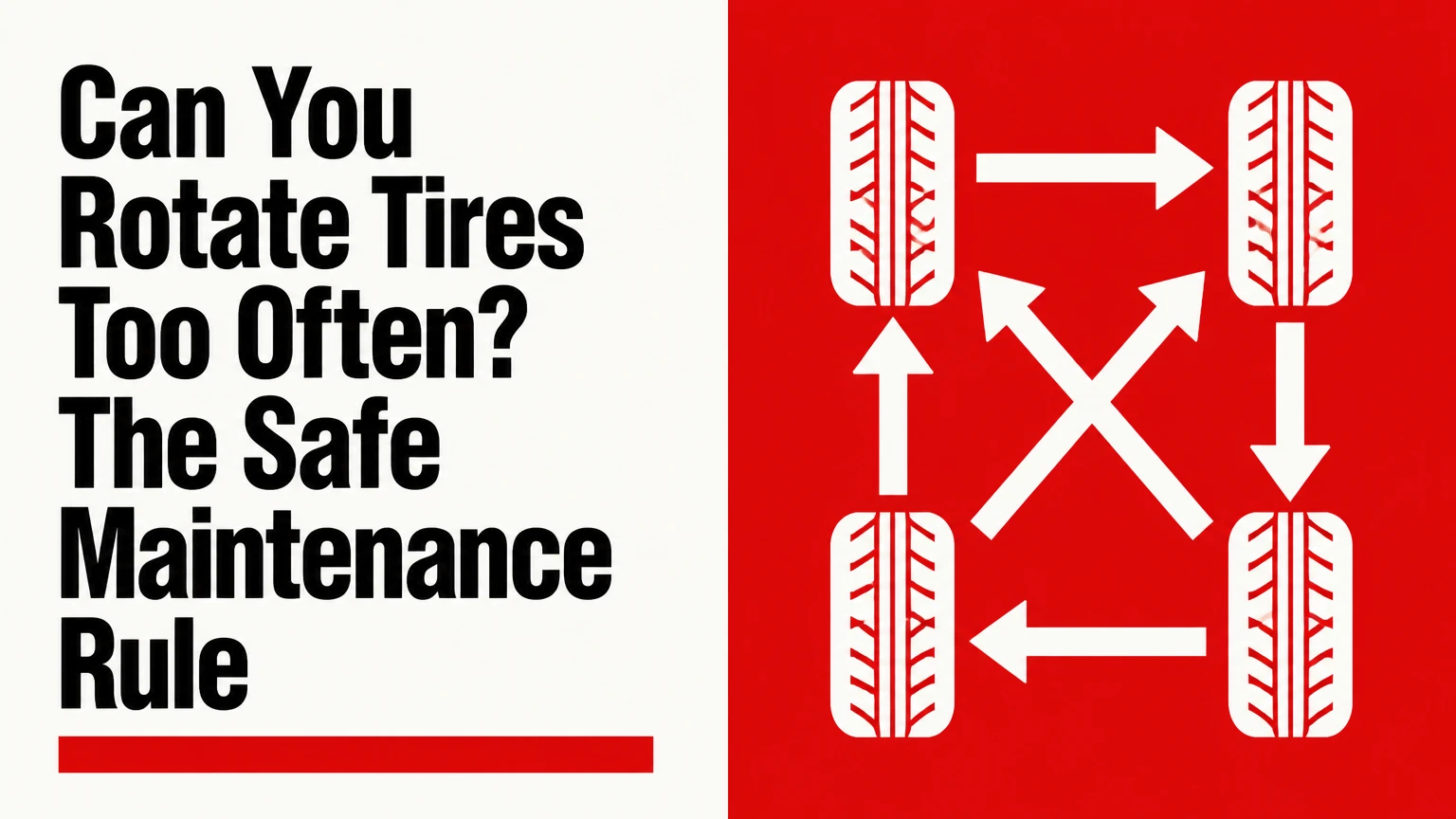
No, you generally cannot rotate tires often enough to damage the vehicle through rotation alone, but excessively frequent service has no mechanical benefit. Rotating tires every week or every 1,000 miles usually wastes time, increases handling and torque-tool wear, and can create installation errors. Most vehicles need rotation at the manufacturer’s stated interval, commonly 5,000-7,500 miles.
Key Facts at a Glance
- Tire rotation redistributes tread wear caused by different loads, steering forces, braking forces, and drive-axle torque.
- Rotating tires every 1,000 miles is usually unnecessary unless a manufacturer or tire professional identifies unusual wear.
- The vehicle owner’s manual and tire manufacturer’s instructions take priority over a generic 5,000-7,500-mile schedule.
- AWD vehicles can require shorter intervals, often 3,000-5,000 miles, especially under towing, off-road, or severe driving conditions.
- Directional tires usually move front-to-back on the same side, while staggered tires normally stay on their original axle.
- A tire rotation cannot correct poor alignment, damaged suspension parts, incorrect inflation, or a defective tire.
Can You Rotate Tires Too Often?
Rotating tires too often does not normally damage the tires, wheel bearings, drivetrain, or suspension, provided the wheels are installed correctly. The useful limit is economic and practical rather than mechanical: after the tires have changed positions, another rotation has little value until enough miles have created a measurable difference in wear.
Tire rotation is a position change, not a repair. The service moves each tire to another approved wheel position so front and rear tires share the vehicle’s workload over time. A front-wheel-drive vehicle often wears its front tires faster because those tires steer, transmit engine torque, and handle much of the braking load.
Weekly rotation can still create avoidable risks. Every removal and installation introduces another opportunity for incorrect lug-nut torque, a missed directional arrow, a damaged wheel stud, a pinched valve stem, or a forgotten TPMS relearn. The risk remains low when a trained technician follows the procedure, but the benefit is effectively zero at extremely short intervals.
What does excessive rotation actually cost?
Typical tire shops charge $20-$50 for a standalone rotation, although many include rotations with tire purchases or maintenance packages. At a $30 average, rotating every 1,000 miles over 60,000 miles could mean about $1,800 in service charges, compared with roughly eight to twelve rotations at a normal 5,000-7,500-mile interval.
| Rotation frequency | Rotations over 60,000 miles | Typical standalone cost at $20-$50 | Practical value |
|---|---|---|---|
| Every 1,000 miles | 60 | $1,200-$3,000 | Very low after initial wear equalization |
| Every 3,000 miles | 20 | $400-$1,000 | Sometimes appropriate for severe use or AWD |
| Every 5,000 miles | 12 | $240-$600 | Common maintenance interval |
| Every 7,500 miles | 8 | $160-$400 | Suitable only when the manual permits it |
The U.S. Tire Manufacturers Association advises following the vehicle manufacturer’s rotation recommendation. That guidance matters because tire size, suspension geometry, drivetrain control systems, and the owner’s driving conditions can change the correct interval.
Why Does Tire Rotation Matter?
Tire rotation matters because each wheel position creates a different wear pattern. Front tires typically experience steering scrub, greater braking load, and, on many vehicles, the engine’s static weight. Drive tires also receive propulsion torque, which can accelerate tread wear during hard starts or winter traction events.
Even wear improves the chance that all four tires reach replacement condition at approximately the same time. That outcome helps preserve balanced cornering and braking traction, especially on vehicles with similar tire sizes at all four corners. Michelin describes the purpose directly: “Regular tire rotation helps promote more uniform wear and maximize tread life.” The exact interval still belongs to the vehicle manufacturer.
Rotation does not make worn tires safe again. It only distributes future wear. If one tire already has a severe shoulder, cupped, or diagonal wear pattern, moving that tire may spread the symptom to another position without solving the cause.
How does drivetrain layout affect wear?
| Drivetrain | Tires with the highest typical workload | Common wear causes | Typical rotation starting point |
|---|---|---|---|
| FWD | Front axle | Steering, braking, engine weight, drive torque | 5,000-7,500 miles |
| RWD | Rear axle during acceleration, front axle during steering | Drive torque, towing, steering and braking | 5,000-7,500 miles |
| AWD | All four tires, with system-dependent torque distribution | Continuous torque changes, circumference sensitivity | 3,000-5,000 miles when specified |
| 4WD truck | Drive axle selected by use, often rear on pavement | Towing, payload, off-road surfaces, tire scrub | 3,000-5,000 miles for severe use |
These ranges are typical service intervals, not universal rules. A 2024 Subaru owner’s manual, a Ford truck maintenance schedule, and a Toyota crossover schedule may specify materially different intervals. The manual’s mileage or time recommendation overrides a generic chart.
What Interval Should You Follow?
Follow the owner’s manual first, then use the tire maker’s recommendation if the vehicle documentation allows a range. For many conventional sedans and crossovers, 5,000-7,500 miles is a practical interval, while severe use can justify 3,000-5,000 miles.
Time matters when mileage is low. A car driven only 3,000 miles annually may still need an annual inspection and rotation if the manufacturer specifies time-based maintenance or if tread wear is visibly uneven. Tire pressure should be checked monthly and before long trips because inflation affects wear much faster than small differences in rotation timing.
Use the shorter end of the allowed interval when driving includes repeated short trips, mountain roads, spirited cornering, towing, gravel, mud, heavy payloads, or frequent stop-and-go traffic. Do not shorten the interval merely because the vehicle is AWD. AWD can increase the importance of matching tire circumference, but the correct schedule remains model-specific.
What signs justify an early rotation?
An early rotation is reasonable when tread-depth measurements show a meaningful axle difference, a tire professional documents developing heel-and-toe wear, or the vehicle has completed an unusually severe trip. A practical inspection compares all four tires at several tread locations rather than judging wear by appearance alone.
A difference of 2/32 inch between tires is significant for many AWD systems, but the acceptable limit varies by manufacturer. Some automakers specify a maximum circumference or tread-depth difference and may require replacing more than one tire. Measure first, then consult the manual or dealer.
Which Rotation Pattern Fits the Tire?
The correct rotation pattern depends on tire direction, tire size, wheel offset, and the vehicle manufacturer’s instructions. A pattern that is correct for four identical, non-directional tires can be unsafe or impossible for directional tires, staggered wheel sizes, or vehicles with asymmetric fitment restrictions.
| Pattern | Typical application | Movement | Main restriction | Example |
|---|---|---|---|---|
| Forward cross | FWD with four same-size, non-directional tires | Front tires move straight back; rear tires cross forward | Not for directional tires | LF to LR; RF to RR; LR to RF; RR to LF |
| Rearward cross | RWD or AWD with four same-size, non-directional tires | Rear tires move straight forward; front tires cross rearward | Not for staggered fitment | LR to LF; RR to RF; LF to RR; RF to LR |
| X-pattern | Same-size tires where the manual permits crossing | Each tire moves diagonally | Directional and specialty restrictions | LF to RR; RF to LR |
| Side-to-side | Staggered front and rear sizes | Left and right tires exchange positions on the same axle | Does not move tires between axles | LF to RF; LR to RR |
| Front-to-back | Directional tires with same-size wheels | Tires remain on the same side | Cannot correct side-specific wear | LF to LR; RF to RR |
The arrows molded into a directional sidewall must point forward when the vehicle moves ahead. An asymmetric tire is different: its sidewall may say “OUTSIDE,” and the tire must remain mounted with that side outward, but it can often change sides if the wheel is dismounted and remounted correctly.
How do directional and staggered tires change the rule?
Directional tires usually permit only front-to-back movement on the same side unless a tire shop dismounts and remounts them. Staggered setups, such as a wider 275-section rear tire paired with a 245-section front tire, normally prevent front-to-rear rotation because the tire and wheel dimensions do not match.
Performance vehicles can have directional tires, staggered wheels, or both. Side-to-side swapping may be allowed for equal-size tires, but wheel width, brake clearance, and tire markings must be checked. Never force a rotation pattern based only on drivetrain.
How Do You Rotate Tires Safely?
A home tire rotation typically takes 30-45 minutes with the correct equipment, while a professional shop often needs 15-30 minutes. The success factor is not speed; it is supporting the vehicle securely and tightening every lug nut to the manufacturer’s torque specification.
Before you start
| Requirement | Typical specification |
|---|---|
| Work surface | Flat, hard pavement or concrete |
| Equipment | Floor jack rated for vehicle weight, 4 jack stands, 2 wheel chocks |
| Tools | Lug wrench, calibrated torque wrench, vehicle-specific socket |
| Time | 30-45 minutes at home |
| Cost | $0 if equipped, or $20-$50 professionally |
| Reference | Owner’s manual for pattern, torque, and TPMS procedure |
Step 1: Confirm the pattern and tire condition
Read the owner’s manual, inspect directional arrows and “OUTSIDE” markings, and measure tread depth across each tire. Mark the original positions with chalk so you can verify the movement.
You will know this step worked when every proposed destination accepts the tire’s size, direction, and wheel fitment. The common mistake is assuming that four tires with the same diameter are interchangeable when the front and rear widths differ.
Step 2: Prepare and loosen the wheels
Park on level ground, select Park or first gear, apply the parking brake, and chock the wheels that remain on the ground. Loosen each lug nut about one turn before lifting the vehicle, but do not remove the nuts.
You will know the vehicle is ready when the lug nuts break free without wheel movement. The common mistake is using the jack to hold the vehicle while applying high force to stuck nuts.
Step 3: Lift and support the vehicle
Use the manufacturer’s jack points and raise the vehicle with a properly rated floor jack. Support the vehicle on jack stands at approved structural points, and never work beneath a vehicle supported only by a jack.
You will know the setup is stable when the vehicle remains stationary under gentle hand pressure. The common mistake is placing a stand under thin floor metal, plastic trim, or an unapproved suspension arm.
Step 4: Move each wheel to its approved position
Remove the wheels, follow the selected pattern, and inspect the hub face, wheel mounting surface, valve stem, and brake area while each wheel is off. Clean rust flakes from the mating surfaces with a suitable wire brush.
You will know the placement is correct when directional arrows point forward and each tire sits fully against the hub. The common mistake is crossing a directional tire to the opposite side without remounting it.
Step 5: Hand-tighten and lower the vehicle
Install each wheel and thread every lug nut by hand for several turns before using a wrench. Lower the vehicle until the tires contact the ground enough to prevent rotation, but do not fully load the suspension until the final torque step.
You will know the threads are sound when each nut turns smoothly by hand. Resistance at the first few threads indicates cross-threading, which requires removal and inspection rather than force.
Step 6: Torque the lug nuts and verify pressure
Use a calibrated torque wrench set to the vehicle manufacturer’s specification, commonly about 80-110 lb-ft for many passenger cars but not universally. Tighten in a star pattern, restore cold tire pressure from the door-jamb label, and complete the TPMS relearn procedure if required.
You will know the service is complete when the torque wrench clicks at the specified value, pressures match the label, and the TPMS warning clears after driving or resetting. Recheck torque after 25-50 miles if the wheel manufacturer or installer recommends it.
What Does Tire Rotation Cost?
A professional tire rotation typically costs $20-$50 in the United States, takes 15-30 minutes, and may be free for customers who purchased tires from that shop. DIY rotation costs nothing after equipment ownership, but safe equipment can cost $150-$400 or more.
| Service option | Typical price | Typical time | Best use |
|---|---|---|---|
| Tire retailer package | $0-$30 | 15-30 minutes | Tires purchased from the retailer |
| Independent repair shop | $20-$50 | 20-30 minutes | Rotation plus inspection |
| Dealership | $30-$75 | 20-45 minutes | Factory schedule and TPMS support |
| DIY with existing tools | $0 | 30-45 minutes | Experienced owner with safe equipment |
Balancing is usually a separate service and often costs $15-$30 per wheel. Alignment commonly costs $90-$200 for a four-wheel alignment, depending on vehicle and location. A shop that recommends all three services should explain the measured symptom that justifies each one.
What Problems Does Rotation Not Fix?
Tire rotation does not correct wheel alignment, bent suspension components, worn bushings, failed wheel bearings, incorrect tire pressure, or a tire with internal damage. Moving a defective tire can change where the noise or vibration is felt, but it does not remove the underlying defect.
| Symptom | More likely cause | Correct service | Rotation alone helps? |
|---|---|---|---|
| Inner-edge wear | Excessive toe or negative camber | Alignment inspection | No |
| One-sided shoulder wear | Alignment or suspension issue | Alignment and component check | No |
| Cupping or scalloping | Damper, balance, or inflation problem | Suspension and balance inspection | No |
| Steering-wheel vibration at speed | Wheel imbalance or bent wheel | Balance and wheel inspection | No |
| Pulling left or right | Alignment, pressure, or tire conicity | Pressure check and diagnosis | No |
| Even but faster front wear | Normal FWD workload | Rotation at schedule | Yes, preventively |
Alignment should be checked when a vehicle pulls, a steering wheel is off-center, or tread develops one-sided wear. Balancing addresses radial or lateral imbalance that can cause vibration, while rotation changes tire position. These services are related but not interchangeable.
Why can rotation sometimes reveal a problem?
A tire that was quiet on the rear axle may produce steering-wheel vibration after moving to the front because the driver now feels its radial force variation more directly. Rotation did not create the defect; it changed the location where the defect became noticeable.
A professional technician should measure tread depth, inspect for belt separation, check wheel runout, and verify balance when a new vibration appears. Driving on a tire with a bulge, exposed cord, severe crack, or suspected separation requires immediate removal from service.
When Should Rotation Stop?
Stop rotating a tire when tread reaches the replacement limit, when structural damage appears, or when the tire’s age and condition make continued use questionable. The U.S. legal tread-depth benchmark is commonly 2/32 inch, but wet-weather performance can decline well before that point.
Tread-wear indicators are molded bars set at 2/32 inch in the main grooves. When the tread is level with those bars, replace the tire rather than rotating it again. Many safety professionals recommend replacing tires earlier when wet traction, winter performance, cracking, or irregular wear has become unacceptable.
AWD vehicles require extra care when replacing one tire. A new tire paired with three substantially worn tires can create circumference differences that stress some AWD and traction-control systems. The vehicle manufacturer may require replacing a pair, a complete set, or shaving a replacement tire to match tread depth.
Which Situations Need a Different Plan?
Normal commuting supports the standard manual-based interval, but towing, off-road driving, winter conditions, and performance use can accelerate irregular wear. The right response is more frequent inspection, not automatic weekly rotation.
- Daily FWD commuting: Inspect monthly and rotate around 5,000-7,500 miles if permitted.
- AWD crossover use: Check the manual, measure tread differences, and consider 3,000-5,000-mile service when specified.
- Towing or heavy payloads: Inspect after long trips because axle loads and heat can change wear quickly.
- Off-road trucks: Check for stone damage, shoulder wear, cupping, and mud-packed tread after each demanding trip.
- Performance driving: Confirm whether the vehicle uses staggered or directional tires before choosing a pattern.
- Seasonal wheel changes: A tire change can include rotation, but the destination still must match size and direction.
A counterintuitive practitioner rule is that tire rotation cannot compensate for underinflation. A tire operated 6-8 psi below the placard value can develop shoulder wear rapidly, and rotating it merely transfers that wear pattern to another axle.
Common Mistakes and How to Fix Them
Rotating by drivetrain alone
FWD does not automatically mean forward cross, and AWD does not automatically mean rearward cross. Tire direction, wheel width, and the manual control the pattern.
Fix: Photograph each sidewall, record tire sizes, and compare the proposed pattern with the owner’s manual.
Treating TPMS as a tire-location tracker
Some direct TPMS systems identify individual wheel positions, while others only report pressure without exact location. A rotation can therefore make the displayed position inaccurate until the system relearns.
Fix: Follow the vehicle-specific relearn sequence and verify pressure with a gauge.
Using an impact gun for final tightening
An impact wrench can exceed the specified torque, damage studs, or make later removal difficult. Uneven torque can also contribute to wheel or rotor mounting problems.
Fix: Use the impact tool only for initial removal or snugging, then finish with a calibrated torque wrench.
Ignoring lug-nut retightening
A wheel that was not fully seated against the hub can settle after driving. The resulting looseness is a safety issue, not a minor maintenance defect.
Fix: Confirm full seating, torque in a star pattern, and follow the installer’s 25-50-mile retorque instruction.
Rotating a tire with abnormal wear without diagnosing it
A noisy, cupped, or heavily feathered tire may become more noticeable after moving axles. The rotation did not cure the problem.
Fix: Record tread measurements and request alignment, balance, suspension, and tire inspection before approving another rotation.
Frequently Asked Questions
Can I rotate my tires every 2,000 miles?
You can, but 2,000 miles is usually earlier than necessary for ordinary driving. Follow the vehicle manual unless a tire professional has identified rapid uneven wear, severe service, or an AWD tread-depth requirement. Frequent inspection is more useful than frequent repositioning when wear is already even.
Should I rotate tires before or after an alignment?
Rotate tires before a final alignment when the tire positions are changing, because alignment measurements should represent the vehicle’s actual operating setup. If uneven wear is severe, a technician may inspect alignment first to avoid moving a damaged tire before diagnosing the cause.
Does tire rotation improve gas mileage?
Tire rotation does not normally produce a measurable fuel-economy improvement by itself. Correct inflation can reduce rolling resistance, and replacing a severely damaged or underinflated tire can affect efficiency, but rotation primarily manages wear distribution and traction balance.
Can I rotate only two tires?
A two-tire rotation is appropriate only when the vehicle’s tire sizes or design restrict movement to one axle, or when a manufacturer specifies a limited pattern. Moving only two tires on a four-tire setup can preserve fitment, but it does not provide the same wear equalization as a complete approved rotation.
Is tire rotation needed with new tires?
New tires should be rotated according to the vehicle manufacturer’s schedule, often beginning around 5,000 miles unless the tire maker or vehicle manual specifies another interval. The first inspection is valuable because early wear reveals inflation, alignment, or suspension problems before they become expensive.
Can rotating tires cause a vibration?
A rotation can expose an existing imbalance, bent wheel, tire radial-force variation, or uneven wear by moving that assembly to the steering axle. Correct lug torque and wheel seating are also necessary. If vibration begins immediately after service, stop and have wheel installation, balance, and tire condition checked.
The Bottom Line
You cannot normally rotate tires too often in a way that mechanically damages a properly maintained vehicle, but rotating every week or every 1,000 miles adds cost and installation opportunities without extending tread life. Follow the owner’s manual, use the correct pattern, inspect tread and pressure, and investigate abnormal wear instead of repeatedly moving it. For most vehicles, the answer to “can you rotate tires too often” is yes in the practical sense, but no in the usual damage sense.