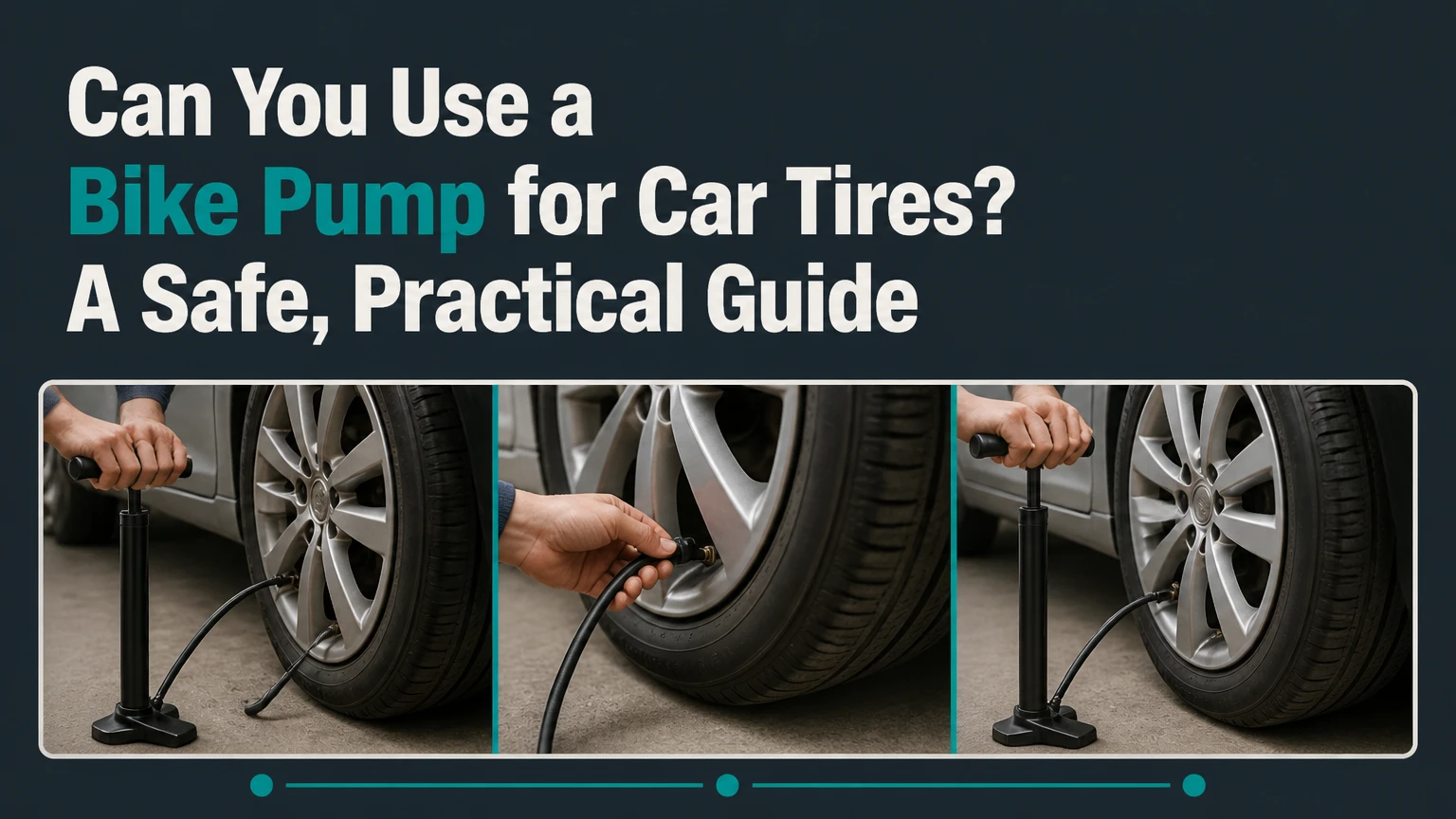
Yes, you can use a bicycle pump to inflate most car tires when the pump head supports a Schrader valve. A bike pump can reach the pressure required by a typical passenger-car tire, but its small air volume makes the job slow and physically demanding. A floor pump is practical for a minor top-up, while a mini pump is an emergency-only option.
Key facts at a glance
Most passenger vehicles use automotive Schrader valves, the wide valve with a central pin.
The correct tire pressure comes from the vehicle placard, usually inside the driver’s door, not the tire sidewall.
A floor bicycle pump is usually suitable for adding 2-5 PSI, but a fully flat car tire may require hundreds of strokes.
A mini bicycle pump can inflate a car tire in an emergency, but the process may take 30-60 minutes.
A 12-volt or battery-powered tire inflator is faster and more suitable for routine car maintenance.
A damaged sidewall, exposed cord, detached bead, or rapidly recurring pressure loss requires professional tire service.
Can You Use a Bike Pump for Car Tires?
A bike pump can inflate a car tire if its nozzle seals against the tire’s Schrader valve and the pump can reach the required PSI. The pump does not need to be designed specifically for automobiles because a manual pump compresses air into any sealed chamber when its valve connection and pressure rating are compatible.
The important distinction is between pressure and volume. A bicycle pump may create 100 PSI or more, which exceeds the 30-36 PSI commonly specified for many passenger cars. However, a car tire has a much larger internal air volume than a road-bike tire, so each bicycle-pump stroke adds only a small fraction of the required air.
A bike pump is therefore a valid backup, not usually the best primary inflator. A floor pump can restore a tire that is slightly low at home. A small frame pump can help a stranded driver reach a safer pressure, but it is a poor substitute for a compressor when the tire is completely deflated.
Does a Bike Pump Fit a Car Tire Valve?
A Schrader-compatible bike pump fits a typical car tire valve directly, without an adapter. Schrader valves have a relatively wide threaded stem and a spring-loaded pin in the center; most mountain-bike pumps and many general-purpose floor pumps support this format.
Bicycle pumps may use one of three head arrangements:
| Pump-head type | Valve supported | Car-tire compatibility | Required action |
|---|---|---|---|
| Schrader-only head | Schrader | Direct connection | Push onto the valve and lock |
| Presta-only head | Presta | No direct connection | Use a rated Presta-to-Schrader adapter |
| Dual-head head | Schrader and Presta | Direct connection | Select the Schrader opening |
| Reversible insert head | Schrader and Presta | Direct connection | Reconfigure the internal rubber seal |
Presta valves are narrow, threaded bicycle valves found mainly on road bikes. A Presta-only pump can work with a car tire only through a correctly sized adapter, and the adapter must still allow the pump’s internal mechanism to depress the Schrader valve core.
Do not force a narrow Presta opening over a car valve. A poor fit causes leakage, damages the rubber seal, or prevents the valve pin from opening. The pump head should lock firmly without excessive sideways pressure on the valve stem.
Can a Bicycle Pump Create Enough Pressure?
A bicycle pump can create enough pressure for a passenger-car tire because typical car inflation pressure is lower than the maximum pressure of many bicycle pumps. A normal vehicle placard may specify 30, 32, 35, or 36 PSI, while many floor pumps are rated around 120-160 PSI.
Pressure capability alone does not determine speed. A pump rated for 160 PSI may still take a long time to inflate a car tire if its barrel moves only 250 cubic centimeters of air per stroke. The pump rating describes the maximum pressure it can develop, not the amount of air it delivers efficiently at every stroke.
| Tire or pump example | Typical target or rating | Approximate air-volume context | Practical meaning |
|---|---|---|---|
| Passenger-car tire | 30-36 PSI | About 25-45 liters internal volume | Reachable with a floor pump |
| Compact-car tire | 30-35 PSI | About 20-35 liters internal volume | Moderate manual effort |
| Road-bike tire | 80-120 PSI | About 1-2 liters internal volume | High pressure, low volume |
| Mountain-bike tire | 25-40 PSI | About 2-5 liters internal volume | Similar pressure, much less air |
| Floor bicycle pump | 120-160 PSI maximum | About 200-500 cc per stroke | Best manual option |
| Mini bicycle pump | 80-120 PSI maximum | About 20-60 cc per stroke | Portable, very slow on cars |
The commonly repeated claim that car tires need less PSI than bicycle tires is directionally useful but incomplete. Mountain-bike tires can operate near car-tire pressures, while road-bike tires require much higher pressure; the car tire still needs substantially more total air.
How Long Will a Bike Pump Take?
A floor bicycle pump typically takes 5-15 minutes to add about 10 PSI to one passenger-car tire, while a mini pump may take 30-60 minutes under the same conditions. The exact time depends on tire size, starting pressure, pump stroke volume, pumping speed, seal quality, and whether the tire is mounted correctly on the wheel.
These are practical ranges, not universal specifications. A compact tire starting at 28 PSI may need far fewer strokes than a large SUV tire starting at 10 PSI. A tire that has lost its bead seal may accept no useful air at all, regardless of pump type.
| Inflation method | Typical time to add 10 PSI | Typical physical demand | Portability | Best use |
|---|---|---|---|---|
| Floor bike pump, 200-500 cc | 5-15 minutes | High | Medium | Home top-up or roadside backup |
| Foot or frame pump, 100-250 cc | 10-25 minutes | High | Medium | Backup when a floor pump is unavailable |
| Mini hand pump, 20-60 cc | 30-60 minutes | Extreme | High | Last-resort emergency inflation |
| 12-volt compressor | 2-8 minutes | Low | High | Regular vehicle use |
| Battery tire inflator | 3-10 minutes | Low | High | Drivers without a powered socket |
| Service-station compressor | Usually under 5 minutes | Low | Low | Routine maintenance near a station |
A floor pump may require roughly 300-800 strokes to add 10 PSI, depending on its barrel size and the tire. Stroke estimates become much higher when the tire is nearly flat. Frequent pauses reduce heat buildup but increase the total elapsed time.
Which Type of Bike Pump Is Practical for a Car?
A large floor pump is the most practical bicycle pump for a car because its wide barrel moves more air per stroke and its stable base lets the user apply leg and body weight. A mini pump is portable but inefficient, while a high-pressure road-bike pump is often slower because it trades air volume for pressure.
Floor pumps
Floor pumps, also called track pumps, are the best manual choice for a car tire. Their long barrel and 200-500 cc stroke volume make a 2-5 PSI correction manageable, although the pump may become warm during sustained use.
Choose a floor pump with a locking Schrader head, a flexible hose, a readable pressure gauge, and a rated maximum pressure well above the vehicle’s target. A metal base and reinforced hose matter more than an extreme 200 PSI rating.
Mini and frame pumps
Mini pumps are useful when they are already in a vehicle or backpack, but they should be treated as rescue equipment. Their small chambers require thousands of strokes for a substantial pressure increase, and their short handles make it difficult to maintain a smooth, efficient stroke.
A mini pump can restore enough pressure to reach a repair facility when the tire has a slow leak. It is not a sensible tool for filling four low tires after seasonal maintenance.
Foot pumps
Foot pumps use leg power and may feel easier than a hand pump, but inexpensive models can flex, leak, or become unstable at higher pressures. A foot pump with a broad base and dual-cylinder design can work for a modest top-up, provided its hose and valve head are rated for sustained use.
What Should You Check Before Inflating?
Check the vehicle’s recommended cold tire pressure, inspect the tire for damage, and confirm that the bicycle pump supports Schrader valves before beginning. The vehicle placard, often mounted on the driver’s door jamb, supplies the correct target for the specific vehicle and tire configuration.
The U.S. National Highway Traffic Safety Administration states, “The correct tire pressure for your vehicle is listed on the vehicle’s tire information placard.” The placard may also appear inside the fuel door or glove compartment. The maximum PSI molded into the tire sidewall is a structural limit, not the normal operating target.
Before starting, gather:
- A Schrader-compatible floor pump or hand pump
- A separate tire-pressure gauge, preferably digital
- The vehicle placard or owner’s manual
- A valve-cap container or clean place for the dust cap
- A flashlight if visibility is poor
- Gloves if the valve or wheel is dirty
Inflate when the tire is cold, meaning the vehicle has been parked for several hours or driven less than about one mile at low speed. Heat raises measured pressure, so setting a hot tire to the cold placard number can result in underinflation after the tire cools.
How Do You Inflate a Car Tire With a Bike Pump?
Inflate a car tire with a bike pump by setting the correct target, locking a Schrader-compatible head onto the valve, pumping in smooth full strokes, and verifying pressure with a separate gauge. The procedure usually takes 5-15 minutes for a modest top-up with a floor pump, but a nearly flat tire may take much longer.
Step 1: Find the target pressure
Read the PSI on the driver’s door-jamb placard or in the owner’s manual. Record the recommended front and rear pressures separately if they differ, and do not substitute the tire sidewall maximum.
You will know this step is complete when you have a specific target, such as 32 PSI cold. The common mistake is inflating every tire to the same number without checking the placard.
Step 2: Inspect the tire
Look for nails, screws, cuts, bulges, exposed cords, separated tread, or a tire bead that has pulled away from the wheel rim. Do not inflate a tire with a damaged sidewall or visible structural failure.
You will know the tire is suitable for a temporary top-up when it remains mounted on the rim and shows no serious damage. A puncture that loses pressure immediately needs repair, not repeated pumping.
Step 3: Remove and clean the valve cap
Unscrew the plastic dust cap and place it somewhere clean. Wipe dirt from the valve opening so debris does not enter the valve head or interfere with the seal.
A brief hiss when pressing the gauge onto the valve is normal. Continuous hissing after the gauge is removed indicates a valve-core problem.
Step 4: Select the Schrader setting
Use the wider opening on a dual-head bicycle pump. If the pump has a reversible insert, configure the rubber seal and internal pin for Schrader service according to the pump’s markings.
The correct setting allows the head to slide over the threaded valve stem. Do not force the head or tighten a Presta-only fitting directly onto the car valve.
Step 5: Lock the pump head
Push the pump head straight onto the valve stem until the seal is fully engaged, then move the locking lever to its marked locked position. Different heads lock with the lever up or down, so rely on the head’s geometry rather than a universal lever direction.
You will know the connection is sound when the head remains attached during a gentle test stroke and air does not escape around the valve. A steady hiss means the head is misaligned, unlocked, or not seated deeply enough.
Step 6: Pump with full strokes
Stand on the floor-pump base, keep the hose aligned with the valve, and use smooth strokes through the pump’s full range. A straight back and controlled downward movement reduce stress on the valve stem and pump shaft.
The first strokes may feel easy, then become harder as tire pressure rises. Short, incomplete strokes waste the pump’s air-displacement capacity and make overheating more likely.
Step 7: Measure and finish
Stop periodically to measure pressure with a dedicated gauge, especially when the pump’s gauge is small or difficult to read. Remove the pump head carefully, because pulling it sideways can damage the valve stem, then reinstall the dust cap.
The job is complete when the cold tire reaches the placard PSI and the valve does not leak after the cap is replaced. Recheck the pressure after several minutes if the tire was substantially low.
What Is Better Than a Bike Pump?
A 12-volt compressor or battery tire inflator is better than a bicycle pump for routine car inflation because it delivers air continuously with little physical effort and usually includes an automotive Schrader connector. A manual pump remains useful as a backup when electrical power, a charged battery, or roadside service is unavailable.
| Option | Typical purchase cost | Typical fill time | Power source | Main limitation |
|---|---|---|---|---|
| Floor bicycle pump | $25-$70 | 5-15 minutes per 10 PSI | Human effort | Slow and tiring |
| 12-volt inflator | $30-$80 | 2-8 minutes per 10 PSI | Vehicle socket | Needs working vehicle power |
| Battery inflator | $50-$150 | 3-10 minutes per 10 PSI | Rechargeable battery | Battery may be empty |
| Gas-station air machine | $1-$3 or free | 2-5 minutes | Mains electricity | Requires reaching the station |
| Roadside assistance | $0-$150 per call or membership | 20-90 minutes arrival | Service vehicle | Waiting time and coverage limits |
A compressor is not automatically safe simply because it is electric. Follow its duty cycle, keep the hose away from hot exhaust components, and stop if the tire will not hold pressure. Small consumer inflators may need cooling pauses after 10-15 minutes of operation.
Can a Mini Pump Inflate a Completely Flat Tire?
A mini bicycle pump can sometimes inflate a completely flat car tire, but the result depends on whether the tire bead still seals against the rim. If the bead has unseated, a mini pump usually cannot deliver air quickly enough to reseat it, and continued pumping wastes effort.
A fully flat tire also presents a diagnostic problem. The cause may be a puncture, damaged valve core, bent rim, bead leak, or severe sidewall damage. Pumping air into a visible puncture can be a temporary way to move the vehicle only when the tire remains structurally sound and pressure rises predictably.
For a slow puncture, inflate only enough to reach a nearby tire shop or safe location, then have the tire inspected. Do not use a bicycle pump as a way to avoid repairing a recurring leak.
Can Pumping Damage the Tire or Pump?
Normal pumping at the vehicle’s placard pressure will not damage a sound car tire, but excessive force, a crooked valve connection, overheating, or inflation beyond the specified limit can damage equipment or create a safety hazard. The tire itself is more often harmed by driving underinflated than by using a manual pump.
Watch for these conditions:
- Pump body becomes too hot: Pause for 5-10 minutes and follow the manufacturer’s duty-cycle instructions.
- Valve stem bends: Stop, realign the hose, and support the pump head without sideways leverage.
- Gauge rises implausibly fast: Verify with a separate gauge because the pump head may not be admitting air.
- Rubber seal smells hot or slips: Stop using the pump until the seal cools and inspect it for damage.
- Tire bulges or the bead moves: Stop immediately and seek tire service.
A counterintuitive practitioner rule is that a pump’s maximum PSI is less important than its air volume per stroke for car work. A 120 PSI floor pump with a large barrel can outperform a 200 PSI mini pump because it transfers more air with every cycle.
Why Is Air Leaking During Inflation?
Air usually leaks during inflation because the pump head is misconfigured, unlocked, contaminated, or misaligned with the Schrader valve. A leak from the tire itself, valve core, or rim requires a different fix and may prevent the tire from reaching pressure.
Use the location of the sound to identify the fault:
| Leak location | Likely cause | Immediate check | Correct response |
|---|---|---|---|
| Pump head rim | Poor seal or wrong setting | Re-seat the head | Select Schrader and lock firmly |
| Valve core after removal | Loose or damaged core | Apply soapy water | Replace or tighten the core |
| Tread or sidewall | Puncture or cut | Inspect for object or bulge | Stop driving and seek repair |
| Rim edge | Bead leak or bent wheel | Watch for bubbles | Professional tire inspection |
| Hose connection | Split hose or loose fitting | Flex the hose gently | Replace hose or pump |
If the pump handle pushes back sharply, the pump’s check valve may be allowing pressure to return into the barrel. A correctly connected pump should become progressively harder to operate as tire pressure rises, but it should not violently eject the handle.
When Should You Stop and Get Professional Help?
Stop using a bike pump and obtain professional help when the tire has structural damage, the bead is unseated, pressure falls immediately, or the vehicle cannot safely be moved. A manual pump cannot repair a puncture, straighten a bent rim, replace a valve core, or safely reseat every tire bead.
Do not drive on a tire with a sidewall bulge, exposed cord, deep cut, or tread separation. Do not crawl under a vehicle to access an unusual tire position, and do not inflate a tire that has been driven flat unless a tire professional has inspected it.
If the tire is only a few PSI low and remains mounted, manual inflation is reasonable. If the pressure-warning light returns soon after inflation, record the pressure and arrange an inspection rather than repeatedly resetting the TPMS warning.
How Do Temperature and Tire Condition Change the Answer?
Cold weather lowers measured tire pressure, while heat from driving raises it, so pressure should be checked cold and adjusted to the vehicle placard. A temperature change of roughly 10 degrees Fahrenheit can alter pressure by about 1 PSI, although the actual reading depends on tire construction and starting conditions.
A tire that loses pressure overnight has a different problem from a tire that is 3 PSI low after a seasonal temperature drop. The first suggests a puncture, valve leak, bead leak, or wheel problem; the second may require routine adjustment.
For remote travel, carry a 12-volt inflator, pressure gauge, plug kit where legally and technically appropriate, and a charged phone. A bicycle pump is useful redundancy, but it should not be the only recovery plan for an off-road vehicle or a long-distance trip.
Which Option Fits Your Situation?
A driver topping up one tire by 2-3 PSI can use a floor bike pump if the tire is undamaged and the pump has a Schrader head. A driver facing a fully flat tire should prefer a compressor or roadside assistance, while a cyclist who already carries a mini pump should use it only to reach a safe repair location.
| Situation | Recommended tool | Reason | Do not rely on |
|---|---|---|---|
| One tire is 2 PSI low at home | Floor bike pump | Fast enough for a small correction | A pump gauge without verification |
| One tire is 10 PSI low roadside | 12-volt inflator | Restores pressure with limited effort | Repeated driving while underinflated |
| Tire is completely flat but undamaged | Compressor or roadside service | Higher airflow and diagnostic margin | A mini pump as the only plan |
| Tire has a sidewall bulge | Tow or tire service | Structural damage cannot be pumped away | Any inflation attempt |
| Four tires need seasonal adjustment | Compressor or service station | More efficient across multiple tires | A mini bicycle pump |
| Vehicle is remote or off-road | Heavy-duty compressor | Supports larger tire volumes | A standard road-bike pump |
The honest limitation is simple: a bike pump is a pressure-capable tool with low throughput. It can solve a small pressure deficit, but it is poorly suited to repeated inflation, large truck tires, bead reseating, or diagnosing damage.
Frequently Asked Questions
Can you drive to a gas station with a low car tire?
Drive only far enough to reach safety or a nearby repair facility when the tire remains mounted, undamaged, and sufficiently inflated to control the vehicle. A visibly collapsed tire, sidewall bulge, or rapid pressure loss means the vehicle should not be driven; use roadside assistance or a tow instead.
Do car tires use Presta or Schrader valves?
Most passenger cars use Schrader valves, which are wider and contain a spring-loaded center pin. Presta valves are common on road bicycles but are not standard on cars. A bicycle pump with a Presta-only head needs a proper adapter, while a dual-head pump can connect directly through its Schrader side.
Is a tire gauge more accurate than a bike-pump gauge?
A dedicated tire gauge is usually the better reference for a car because it is designed for automotive valve connections and ordinary passenger-tire pressure. Bike-pump gauges can still be useful, but their accuracy varies by model, and a poorly seated pump head can produce a misleading reading.
Can a ball pump inflate a car tire?
A ball pump can theoretically move air into a car tire only if an adapter creates a sealed connection, but its tiny volume makes the process impractical. A ball needle is not a substitute for a Schrader pump head and may bend, leak, or damage the valve if forced into the tire valve.
How often should car tire pressure be checked?
Check tire pressure at least monthly and before long trips, using cold tires and the vehicle placard as the target. Check sooner after striking a pothole, detecting handling changes, seeing a TPMS warning, or finding that one tire requires repeated air additions.
Can a bicycle pump inflate an SUV or truck tire?
A floor bicycle pump can add air to some SUV tires, but the larger tire volume increases stroke count and effort. Heavy-duty truck tires, bead-seating jobs, and off-road recovery require an appropriately rated compressor because a standard bicycle pump may overheat or provide insufficient airflow.
The Bottom Line
Can you use a bike pump for car tires? Yes, provided the pump connects to the car’s Schrader valve, the tire is structurally sound, and you inflate to the vehicle placard’s cold PSI. A floor pump is a credible emergency and top-up tool; a mini pump is a last resort. For a fully flat or damaged tire, use a compressor, roadside assistance, or professional tire service instead.


