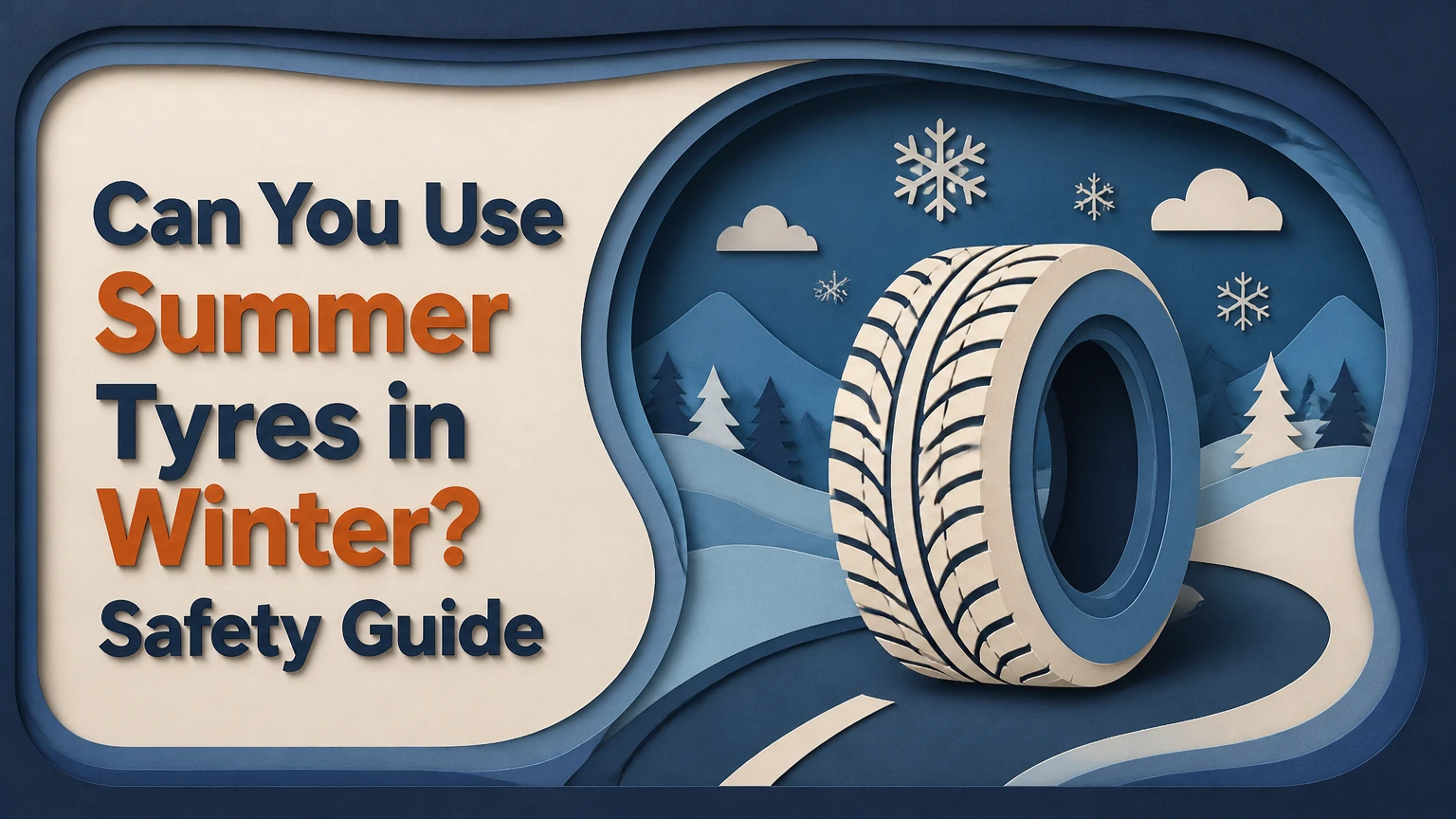
You can physically drive on summer tyres in winter, but summer tyres are unsafe when temperatures stay below about 7°C, especially on snow, ice, slush, or cold rain. Their rubber compound stiffens and their tread lacks winter sipes, so braking and steering performance can deteriorate before the first snowfall.
Key Facts at a Glance
- Summer tyres are engineered primarily for warm roads, with many manufacturers using 7°C as a practical changeover guideline.
- Winter tyres retain greater flexibility in cold conditions and use deeper, heavily siped tread to improve snow and ice traction.
- Four-wheel drive can improve acceleration, but it cannot restore the braking and cornering grip lost by summer tyres.
- Cold weather lowers tyre pressure by approximately 1 psi for every 10°F, or 5.6°C, temperature drop.
- A 3PMSF symbol identifies a tyre that passed a regulated severe-snow performance test; M+S alone does not provide the same assurance.
- Cold exposure does not automatically destroy a summer tyre, but freezing temperatures can make some ultra-high-performance compounds vulnerable to cracking if mishandled.
Can You Use Summer Tyres in Winter?
Summer tyres are acceptable in winter only when roads remain warm and dry enough for their design, which usually means temperatures consistently above approximately 7°C. Summer tyres become a poor safety choice when cold mornings, frost, snow, ice, slush, or near-freezing rain are regular parts of a journey.
The 7°C rule is a practical industry guideline, not a sharp scientific boundary. A summer tyre does not suddenly fail at 6.9°C, and a winter tyre does not become unsuitable at 7.1°C. Road temperature, moisture, sunlight, tyre model, vehicle weight, speed, tread depth, and local law all affect the result.
Michelin describes the rule this way: “When the temperature drops below 7°C, summer tyres begin to lose their effectiveness.” The statement describes a gradual reduction in flexibility and grip, rather than an instant transformation. In a mild coastal climate, a driver may safely keep summer tyres longer than someone travelling at dawn through shaded mountain roads.
The practical decision is simple: change before regular cold weather begins, not after the first snowstorm. Drivers who face overnight frost or temperatures near freezing should prioritize wet braking and emergency steering, because those events occur before roads become visibly wintry.
What Happens to Summer Tyres Below 7°C?
Summer tyres lose cold-weather grip because their rubber compound becomes less compliant as temperature falls. A less flexible tread cannot conform as effectively to small road-surface irregularities, which reduces mechanical keying and increases stopping distance on cold asphalt.
Summer compounds are optimized for warm-road stability, dry cornering, and wet-road water evacuation. Winter compounds use a different balance of polymers, plasticizers, silica, and tread geometry so the contact surface remains more flexible in low temperatures. The exact formulation varies by manufacturer, so one summer tyre can outperform another in cold rain without becoming a winter tyre.
The “glass transition” explanation is often overstated. Tyre rubber has temperature-dependent changes in stiffness, but a normal summer tyre does not generally turn into a literal glass-like, frictionless material at 0°C. The useful conclusion remains valid: cold hardening reduces available grip, while ice and snow reduce it much further.
How do braking and steering compare?
Summer tyres can require materially more distance to stop on snow and cold roads than winter tyres, but no universal number applies to every vehicle or test. Independent results change with speed, tyre brand, tread depth, ABS calibration, road temperature, snow compaction, and whether the test uses new or worn tyres.
A typical comparison from controlled winter-tyre testing shows the scale of the problem:
| Surface and test speed | Summer tyre result, typical range | Winter tyre result, typical range | Main consequence |
|---|---|---|---|
| Packed snow, 50 km/h | 55-70+ metres | 30-40 metres | Summer tyre may add 25-40 metres |
| Cold dry asphalt, 50 km/h | 20-25 metres | 17-21 metres | Winter tyre can retain a modest advantage |
| Wet road, 5°C, 80 km/h | 42-50 metres | 44-54 metres | Summer tyre may equal or beat winter tyre |
| Ice, 30 km/h | 35-50+ metres | 20-35 metres | Both require very low speed |
The wet-road row explains why winter tyres are not automatically superior in every winter condition. A high-quality summer tyre can deliver excellent wet handling above its operating range, while a studless ice tyre may sacrifice warm wet-road braking for cold snow traction. Tyre choice is therefore a climate decision, not a calendar decision.
Steering control also changes. A stiff summer tread can slide across compacted snow when the driver turns, while winter sipes open under load and create additional biting edges. ABS and electronic stability control can manage wheel slip, but they cannot create friction that the tyre-road interface does not have.
Are Summer Tyres Usable on Snow or Ice?
Summer tyres are unsuitable for routine driving on snow or ice because their shallow, lightly siped tread cannot generate the same biting action as a winter tyre. If a summer-tyred car encounters an unexpected snow shower, the safest response is to reduce speed, increase following distance, avoid abrupt inputs, and stop somewhere safe.
Summer tread patterns commonly use large, stable blocks and fewer sipes to support dry-road precision. Winter tread uses more grooves and thousands of small sipes, which help the tyre edges grip compacted snow and remove water from a thin melting layer. Some winter tyres also use specialized ice-grip compounds that remain pliable well below freezing.
Snow performance depends on more than tread depth. A worn winter tyre with 3 mm of tread may perform worse than a new all-weather tyre, even though both carry winter-oriented markings. Tyres with uneven wear, hardened rubber, damaged sidewalls, or incorrect pressure should not be treated as winter-ready.
| Tyre type | Common tread depth when new | Siping level | Snow and ice suitability | Warm-road limitation |
|---|---|---|---|---|
| Summer tyre | 6-8 mm | Low, often under 500 sipes | Poor below freezing | Best above 7°C |
| All-season tyre | 7-9 mm | Moderate | Moderate, model-dependent | Less dry grip than summer |
| All-weather tyre | 8-10 mm | High | Good for moderate winter | More noise and wear in heat |
| Studless winter tyre | 9-11 mm | Very high | Best for snow and ice | Faster wear above 15°C |
| Studded winter tyre | 9-12 mm | High plus metal studs | Strongest on glare ice | Restricted or banned in some regions |
Does Cold Weather Permanently Damage Summer Tyres?
Cold weather does not automatically cause permanent damage to every summer tyre, but some high-performance summer tyres can crack if exposed to freezing temperatures, flexed aggressively, or stored incorrectly. The damage risk is highest for ultra-high-performance compounds and tyres used below their manufacturer-specified storage or operating limits.
A common error is to confuse temporary stiffness with structural failure. A tyre can feel harsh on a freezing morning and return to normal flexibility after warming, whereas sidewall cracks, tread-block fissures, bulges, exposed cords, or persistent vibration indicate possible damage.
Performance-car manufacturers sometimes warn owners not to move summer tyres in freezing conditions. For example, Bridgestone has advised that some high-performance tyres can develop cracks when moved or flexed at very low temperatures. The warning applies to specified tyre models, not every summer tyre on the market.
Inspect tyres after an unexpected cold spell:
- Check both sidewalls for fine radial cracks.
- Examine tread grooves for fissures between blocks.
- Look for bulges, flat spots, cuts, or exposed cords.
- Confirm the tyre has not lost pressure overnight.
- Ask a tyre professional to assess questionable damage before highway use.
Do not bend, mount, inflate rapidly, or drive hard on a tyre that is visibly cracked. Summer tyres stored indoors at a stable temperature are normally protected from the most severe handling-related damage.
Does AWD Make Summer Tyres Safe in Winter?
AWD does not make summer tyres safe on snow or ice because the system controls engine torque, not the friction available for braking or cornering. AWD may help a vehicle pull away from a slippery junction, but all four tyres still determine stopping distance and lateral control.
This distinction matters in heavy SUVs and pickup trucks. Extra weight can increase momentum, and AWD can encourage drivers to travel faster because acceleration feels controlled. When the driver brakes, however, the ABS system still relies on the same four contact patches. If those patches cannot grip, the vehicle slides regardless of the drivetrain.
A front-wheel-drive car with proper winter tyres can stop and turn more reliably than an AWD vehicle fitted with summer tyres. Traction control may reduce wheelspin, but it cannot compensate for a tread pattern that lacks snow-clearing channels or a compound that has stiffened in the cold.
Why should you avoid mixing seasonal tyres?
Mixing summer and winter tyres creates inconsistent grip between axles and can destabilize braking or cornering. Fit four matching seasonal tyres whenever possible, and follow the vehicle manufacturer’s axle, size, load-index, and speed-rating requirements.
Some vehicles use staggered sizes, with wider rear tyres than front tyres. Such vehicles require a compatible winter-tyre plan rather than arbitrary front-to-rear substitution. Tyre shops should check the vehicle placard and owner’s manual before installing a seasonal set.
When Should You Change Summer Tyres?
Change from summer tyres when temperatures regularly fall below approximately 7°C during the hours you drive, or before the local forecast begins producing frost, snow, and freezing rain. Change back when sustained warm conditions return, because winter tyres wear faster and handle less precisely on hot asphalt.
The correct date varies by location and use. A driver who commutes at 6 a.m. in October needs winter capability earlier than a driver who only travels at midday in a warm southern climate. Road temperature can remain lower than air temperature on bridges, shaded bends, and rural routes.
| Driving environment | Typical changeover trigger | Recommended tyre setup | Reason |
|---|---|---|---|
| Warm coastal city | Repeated mornings below 7°C | Summer or all-season | Snow and ice remain rare |
| Mild inland winter | Frequent 0-7°C roads | All-weather 3PMSF | Cold rain and occasional snow |
| Snowbelt suburb | First regular frost, often October-November | Dedicated winter tyres | Daily snow and packed intersections |
| Mountain route | Before overnight freezing | Studless winter tyres | Elevation changes road conditions |
| Southern hot climate | Only during forecast snow or ice | All-season, with chains if legal | Winter tyres may spend most time overheated |
Store removed tyres away from sunlight, ozone sources, moisture, and heat. Clean and dry them, mark their position, place unmounted tyres upright, and keep mounted assemblies flat or suspended without deforming the sidewalls.
Which Alternative Fits a Mild Winter?
All-season or all-weather tyres are usually better alternatives than summer tyres for drivers who experience cold rain, occasional snow, and temperatures below 7°C but do not face prolonged ice or deep snow. Dedicated winter tyres remain the better choice for frequent snow, mountain travel, or persistent sub-zero conditions.
The labels are not interchangeable:
- All-season: A broad North American category with balanced warm and cold performance. Some models have only M+S marking.
- All-weather: A severe-snow-capable category in many markets, usually carrying the 3PMSF symbol and offering stronger winter performance than ordinary all-season tyres.
- Winter tyre: Designed specifically for cold conditions, with the strongest snow and ice focus but greater warm-weather wear.
- M+S: Means mud and snow tread characteristics, but it is not the same as passing the 3PMSF severe-snow test.
- 3PMSF: A mountain symbol containing a snowflake, indicating a regulated severe-snow performance requirement.
| Winter option | 3PMSF status | Typical temperature range | Best use | Typical trade-off |
|---|---|---|---|---|
| Premium all-season | Model-dependent | -5°C to 30°C | Mixed city weather | Limited deep-snow grip |
| All-weather | Usually present | -20°C to 30°C | Mild snow and cold rain | More noise than summer tyres |
| Studless winter | Present | -30°C to 15°C | Snow, ice, mountain roads | Faster warm-weather wear |
| Studded winter | Present where permitted | -30°C to 10°C | Glare ice and packed snow | Road noise and legal limits |
| Summer tyre | Absent | Above 7°C | Warm dry and wet roads | Poor cold and snow traction |
The 3PMSF mark is useful but not a guarantee of equal performance. A touring all-weather tyre and a dedicated ice tyre can both pass the symbol test while behaving differently on glare ice, wet highways, and dry roads.
What Does the Seasonal Setup Cost?
A second seasonal tyre set typically costs about $600-$1,600 before storage, mounting, and vehicle-specific premium sizing, while a single set of all-weather tyres commonly costs about $500-$1,200. Prices vary by wheel diameter, load rating, brand, local labour, and whether the second set includes wheels.
Typical North American service costs look like this:
| Expense | Typical low range | Typical high range | Timing |
|---|---|---|---|
| Four budget winter tyres | $400 | $700 | Every 3-6 seasons |
| Four premium winter tyres | $800 | $1,600 | Every 4-6 seasons |
| Seasonal mount and balance | $80 | $180 | Twice yearly |
| Second wheel set | $400 | $1,200 | One-time purchase |
| Indoor tyre storage | $60 | $180 | Per season |
| All-weather replacement set | $500 | $1,200 | Every 3-5 seasons |
Two sets do not automatically save money. Mounting fees, storage, wheels, and the possibility of age-related replacement can outweigh tread savings for low-mileage drivers. The financial advantage increases when the same vehicle travels many winter miles and both sets age by use rather than by calendar time.
Tyre age still matters. The National Highway Traffic Safety Administration recommends inspecting tyres regularly and following the vehicle or tyre maker’s replacement guidance; many manufacturers recommend replacement at six to ten years regardless of tread, with the date of manufacture shown in the DOT code.
What Legal and Insurance Rules Apply?
Winter-tyre laws vary by country, state, province, road authority, and weather condition, so drivers must check local rules rather than rely on the 7°C guideline. Some jurisdictions require winter tyres during fixed dates, others require them during snow conditions, and some accept approved all-weather tyres with the 3PMSF mark.
Examples illustrate the variation. Quebec requires winter tyres during a defined seasonal period, while many U.S. states have no universal passenger-car winter-tyre mandate but may impose chain or traction-device rules on mountain roads. European countries also differ on tread depth, markings, studs, and dates.
Insurance normally does not become automatically invalid merely because a driver uses summer tyres in winter. A claim can become more complicated if the tyres violate a legal requirement, contradict a policy condition, fail to meet the vehicle’s specifications, or contribute demonstrably to a collision.
Check four sources before winter:
- The local transport authority’s seasonal tyre and chain requirements.
- The insurance policy’s equipment and roadworthiness clauses.
- The vehicle manufacturer’s approved tyre sizes and ratings.
- The tyre manufacturer’s cold-temperature storage and handling guidance.
What Should You Do If Winter Arrives Suddenly?
If snow or freezing rain begins while summer tyres are fitted, postpone unnecessary travel and arrange a tyre change before driving again. If you must reach safety, drive slowly on cleared roads, leave a much larger stopping gap, avoid hills where possible, and never assume electronic aids can prevent a slide.
Check tyre pressure when the tyres are cold and inflate to the vehicle placard specification, not the maximum pressure molded into the sidewall. Cold air reduces pressure by roughly 1 psi per 10°F temperature reduction, although the exact change depends on the tyre’s starting temperature and pressure.
A TPMS warning may reflect normal cooling, but it can also indicate a puncture. Compare all four tyre pressures, inspect for nails or sidewall damage, and stop driving if one tyre is substantially lower than the others.
Do not use one winter tyre or one snow chain on a single side unless the vehicle and chain manufacturer specifically permits that configuration. Uneven grip can create asymmetric braking and handling, particularly during an evasive maneuver.
Can You Use Winter Tyres in Summer?
Winter tyres can be used in summer in an emergency, but they are a poor long-term choice because warm asphalt accelerates tread wear, increases rolling resistance, and reduces steering precision. Studded winter tyres can also damage road surfaces where local rules restrict their use.
The softer compound that helps a winter tyre conform to cold roads becomes too flexible in heat. Tread blocks move more under cornering load, which can create vague handling and irregular wear. Fuel consumption may rise modestly, particularly with aggressive ice-oriented tread.
Drivers should change back to summer or all-season tyres when warm temperatures become consistent. Keeping winter tyres on through one short warm spell is usually less harmful than driving summer tyres through months of freezing weather, but prolonged heat shortens winter-tyre life.
What Are the Most Common Mistakes?
Four mistakes account for many avoidable winter tyre failures:
- Waiting for visible snow: Cold wet roads can reduce grip before snowfall appears. Use the temperature trend and driving schedule as the trigger.
- Installing only two winter tyres: Two winter tyres create an axle-grip imbalance. Install four unless the vehicle maker gives a specific alternative.
- Ignoring tread depth: Legal minimum tread is not the same as strong winter performance. Replace a winter tyre when wear approaches the manufacturer’s winter-service recommendation.
- Using maximum sidewall pressure: The sidewall figure is a maximum operating pressure, not the vehicle’s normal target. Use the door-jamb placard.
- Assuming storage is harmless: Sunlight, ozone, heat, and incorrect stacking accelerate rubber ageing even when the tyres are not driven.
An experienced tyre technician also checks bead seating, valve condition, wheel corrosion, balancing, alignment, and the DOT production date during every seasonal change. A suitable compound cannot compensate for a bent wheel or badly worn suspension.
Which Setup Should You Choose?
Mild urban winter
Choose premium all-season or all-weather tyres if snow is infrequent, roads are promptly cleared, and most journeys occur in town. Select a 3PMSF-marked all-weather tyre when temperatures frequently fall below 7°C and occasional snow is part of the forecast.
Frequent snow and ice
Choose four dedicated winter tyres when roads remain snow-covered, freezing temperatures persist, or your route includes hills and unplowed residential streets. A second wheel set reduces changeover time and lowers the risk of damaging tyre beads during repeated mounting.
Performance or sports car
Choose a manufacturer-approved performance winter tyre and store summer tyres indoors before freezing weather. Some extreme summer compounds have special low-temperature handling warnings, so consult the tyre data sheet rather than assuming a normal seasonal rule applies.
Low-mileage driver
Choose based on the worst road you genuinely expect to drive, not the annual mileage alone. A driver who travels only 2,000 miles but must reach a hospital through snow still needs winter capability or a reliable plan to avoid driving.
Rural or mountain driver
Choose dedicated winter tyres, carry legally approved chains or traction devices, and check road restrictions before departure. Four-wheel drive helps maintain momentum, but winter tyres remain the primary source of braking and steering grip.
FAQ
Can summer tyres be used in winter if there is no snow?
Summer tyres can be used temporarily on clear roads when temperatures remain well above freezing, but cold rain and frost still reduce their operating margin. If daily temperatures regularly fall below about 7°C, all-season, all-weather, or winter tyres provide a safer seasonal fit.
Are summer tyres dangerous in rain during winter?
Summer tyres are not automatically dangerous in cold rain, and a quality summer tyre may brake very well on wet roads above 7°C. Below that temperature, compound stiffening and reduced surface grip can increase braking distance, especially when the road includes frost, slush, or standing water.
How long can summer tyres last if used year-round?
Summer tyres may last 20,000-50,000 miles depending on compound, alignment, driving style, climate, and tread depth, but year-round use can accelerate cold-weather wear and reduce safety before the tread is exhausted. Replace tyres for age, damage, or poor grip rather than mileage alone.
Do summer tyres need lower pressure in cold weather?
Summer tyres do not need a different pressure simply because winter arrives. Inflate every tyre to the vehicle manufacturer’s cold-pressure specification, then recheck monthly and after major temperature changes. Lowering pressure intentionally can worsen handling, increase heat buildup, and damage the shoulder tread.
Can I drive to a tyre shop on summer tyres after snowfall?
Drive only if the route is short, cleared, legally permitted, and unavoidable. Use very low speed, gentle steering and braking, and a large gap, then stop if the vehicle begins sliding. A mobile tyre service or recovery vehicle is safer on untreated snow and ice.
Are all-season tyres as good as winter tyres?
All-season tyres are usually weaker than dedicated winter tyres on ice and deep snow but stronger than summer tyres in mixed, mild conditions. A 3PMSF all-weather tyre narrows the gap, while a dedicated winter tyre remains the better choice for prolonged freezing weather and severe snowfall.
The Bottom Line
You can drive on summer tyres in winter, but that does not make the choice safe. Summer tyres lose cold-weather flexibility below approximately 7°C and perform especially poorly on snow, ice, slush, and freezing rain. Choose four winter tyres for severe conditions, or a 3PMSF all-weather set for milder climates. AWD cannot replace winter grip, and the safest changeover occurs before the first snow. Summer tyres in winter are therefore a short-term emergency compromise, not a sound seasonal plan.