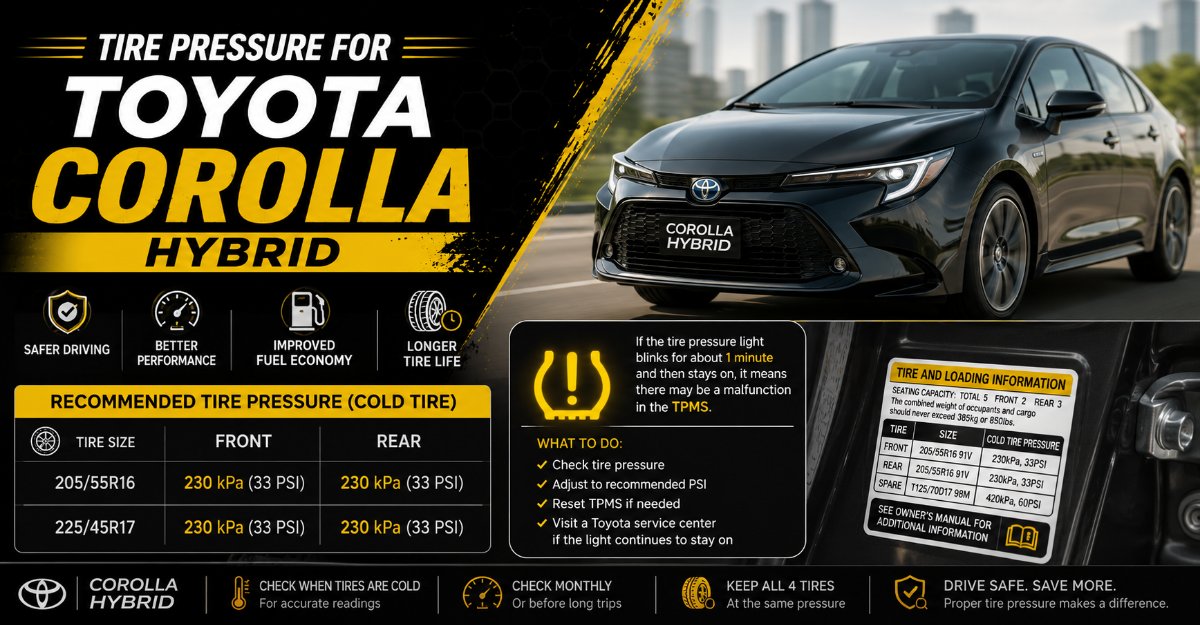
The correct tyre pressure for Toyota Corolla hybrid models generally spans from 32 PSI to 38 PSI (2.2 to 2.6 bar), depending entirely on your factory wheel size. Standard trims utilizing 15-inch or 16-inch wheels require 35 to 38 PSI in the front and 33 to 36 PSI in the rear. Sport and premium trims with 17-inch or 18-inch wheels require a uniform 32 to 35 PSI across all four tyres.
Key Facts At A Glance
- 15-Inch and 16-Inch Wheels: 35 to 38 PSI Front / 33 to 36 PSI Rear.
- 17-Inch and 18-Inch Wheels: 32 to 35 PSI Front and Rear.
- Verification Location: Always check the B-pillar driver-side door jamb sticker.
- Measurement Timing: Only measure pressure after the vehicle has been parked for a minimum of three hours.
- Warning System: The TPMS (Tyre Pressure Monitoring System) triggers an alert when pressure drops 20% below the factory specification.
What Is Tyre Pressure And Why Does It Matter For Hybrids?
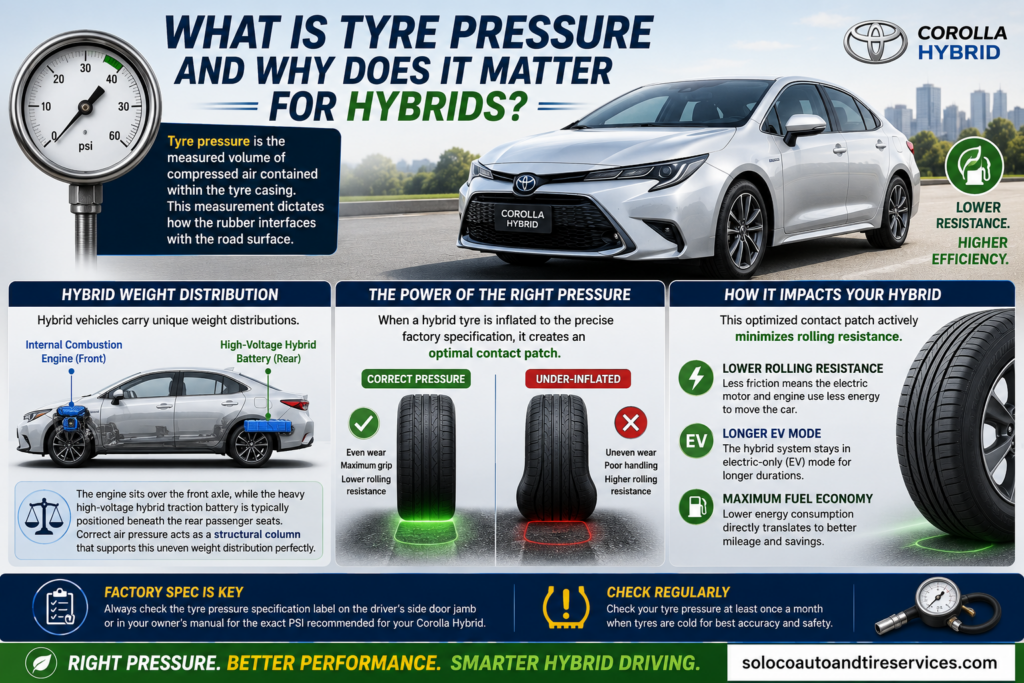
Tyre pressure is the measured volume of compressed air contained within the tyre casing. This measurement dictates how the rubber interfaces with the road surface. For the Toyota Corolla Hybrid, managing this air volume is a critical component of the vehicle’s overall powertrain efficiency.
Hybrid vehicles carry unique weight distributions. The internal combustion engine sits over the front axle, while the heavy high-voltage hybrid traction battery is typically positioned beneath the rear passenger seats. Correct air pressure acts as a structural column that supports this uneven weight distribution perfectly.
When a hybrid tyre is inflated to the precise factory specification, it creates an optimal contact patch. This optimized contact patch actively minimizes rolling resistance. Rolling resistance is the friction the electric motor and engine must continuously overcome to move the vehicle forward. Lower rolling resistance allows the hybrid system to remain in electric-only (EV) mode for longer durations, which directly maximizes your fuel economy.
What Are The Exact Factory Tyre Pressure Specs?
The exact inflation requirements depend on the diameter of the wheel and the profile of the tyre fitted to your specific trim level. Below is the comprehensive baseline specification chart for modern Toyota Corolla hybrid models.
| Wheel Size | Typical Tyre Size | Front Pressure (PSI / Bar) | Rear Pressure (PSI / Bar) |
| 15-Inch | 195/65 R15 | 36 PSI / 2.5 Bar | 35 PSI / 2.4 Bar |
| 16-Inch | 205/55 R16 | 36 PSI / 2.5 Bar | 36 PSI / 2.5 Bar |
| 17-Inch | 225/45 R17 | 33 PSI / 2.3 Bar | 33 PSI / 2.3 Bar |
| 18-Inch | 225/40 R18 | 33 PSI / 2.3 Bar | 33 PSI / 2.3 Bar |
How Do Smaller Wheels Optimize Fuel Economy?
Trims equipped with 15-inch and 16-inch wheels (such as the LE or Icon) utilize high-profile tyres with taller sidewalls. These models often require a staggered setup, where the front tyres hold slightly more pressure than the rear. The higher 35 to 38 PSI range makes the tyre harder, which reduces flexing in the tall sidewall. This stiffness is a deliberate engineering choice to achieve the highest possible MPG ratings.
Why Do Larger Wheels Require Lower Pressure?
Trims featuring 17-inch and 18-inch wheels (such as the SE, XSE, or Excel) utilize low-profile tyres. These tyres have very short, stiff sidewalls. Because the rubber is inherently rigid, Toyota specifies a lower uniform pressure of 32 to 35 PSI all around. Inflating a low-profile tyre to 38 PSI would result in a severely harsh ride, increased cabin noise, and a heightened risk of rim damage when striking potholes.
How Do You Accurately Check And Adjust Your Air?
Checking your inflation levels requires a systematic approach to ensure accurate sensor readings. You should perform this maintenance check once every two weeks or immediately prior to a long highway journey.
- Verify Cold Status: Park your Corolla for at least three hours before taking a measurement. Driving generates severe friction, which heats the air inside the casing and expands it. Checking a hot tyre will give a false reading that is 4 to 6 PSI higher than the true cold pressure.
- Locate the Placard: Open the driver-side door and locate the factory tyre information sticker on the B-pillar frame. Never use the “Max Press” number stamped on the tyre sidewall, as that indicates the structural bursting limit of the rubber, not the safe operating pressure.
- Measure the Volume: Remove the plastic valve cap. Press a high-quality digital or dial gauge squarely onto the metal valve stem. Record the exact number displayed.
- Adjust the Air: Use a 12V portable compressor to add air if the reading is below the placard specification. If the reading is too high, use the rear pin of the gauge to depress the valve core and bleed out the excess air until it matches the specification.
- Calibrate the TPMS: After adjusting the air, you must reset the dashboard computer. Turn the vehicle on. Use the steering wheel controls to navigate to the Gear Icon (Settings), scroll to Vehicle Settings, select TPMS, and hold the “Set Pressure” button until the dashboard tyre light flashes three times.
Should You Use Compressed Air Or Purified Nitrogen?
You can inflate your Corolla tyres with either standard compressed air or purified nitrogen. Choosing between them depends entirely on your maintenance habits and budget.
| Metric | Compressed Air | Purified Nitrogen |
| Composition | 78% Nitrogen, 21% Oxygen, 1% Moisture | 93% to 99% Pure Nitrogen |
| Stability | Fluctuates rapidly with ambient temperature | Highly stable across extreme temperature shifts |
| Permeation | Fast leakage through the rubber casing | Slow leakage due to larger molecular structure |
| Cost | Usually free at fuel stations | Costs up to $10 per tyre at service centers |
Standard compressed air is perfectly safe and universally accessible. However, it contains moisture and oxygen, which permeate through the rubber casing over time. Purified nitrogen utilizes larger molecules that do not leak as quickly. Nitrogen provides a highly stable inflation volume that preserves your hybrid fuel economy metrics longer between top-offs.
What Are The Most Common Inflation Mistakes?
Relying Blindly On Dealership Delivery Pressure
Dealerships routinely receive new vehicles from the factory heavily overinflated to 40 or 45 PSI. This high pressure prevents flat spots from forming while the car is strapped to a transport ship. Technicians occasionally forget to deflate the tyres to the placard specifications during the pre-delivery inspection. Always check your levels the morning after purchasing a new vehicle.
Ignoring Seasonal Temperature Swings
Ambient weather directly dictates internal pressure. For every 5.5 degrees Celsius drop in outside temperature, your tyres will lose approximately 1 PSI of pressure. A sudden winter freeze will drastically underinflate your rubber and trigger the TPMS dashboard warning light. Conversely, summer heat waves will naturally overinflate the casing.
Mismatching Front And Rear Profiles
The Corolla relies on highly specific front-to-rear traction balances to manage the regenerative braking system. Running identical pressures on a 15-inch setup that specifically calls for a front-biased offset can compromise braking distances and cause uneven tread wear over time.
How Do You Diagnose Abnormal Tyre Wear?
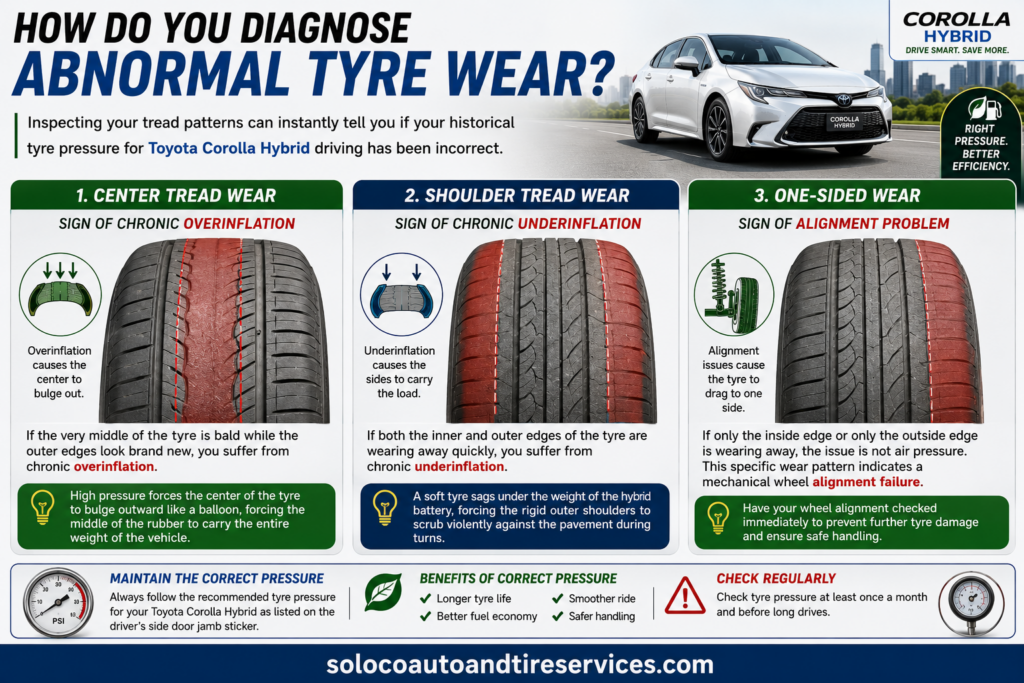
Inspecting your tread patterns can instantly tell you if your historical tyre pressure for Toyota Corolla hybrid driving has been incorrect.
- Center Tread Wear: If the very middle of the tyre is bald while the outer edges look brand new, you suffer from chronic overinflation. High pressure forces the center of the tyre to bulge outward like a balloon, forcing the middle of the rubber to carry the entire weight of the vehicle.
- Shoulder Tread Wear: If both the inner and outer edges of the tyre are wearing away quickly, you suffer from chronic underinflation. A soft tyre sags under the weight of the hybrid battery, forcing the rigid outer shoulders to scrub violently against the pavement during turns.
- One-Sided Wear: If only the inside edge or only the outside edge is wearing away, the issue is not air pressure. This specific wear pattern indicates a mechanical wheel alignment failure.
How Does Tyre Pressure Impact Regenerative Braking?
Regenerative braking is the mechanism that captures kinetic energy during deceleration and feeds it back into the hybrid battery. This system requires consistent, predictable grip from the tyre contact patch.
If the tyres are severely overinflated, the contact patch shrinks. The vehicle’s computer detects this loss of grip and reduces the aggressiveness of the regenerative braking to prevent the wheels from locking up. Consequently, you recapture less electricity, your battery drains faster, and your overall MPG suffers. Maintaining the factory placard pressure ensures the regenerative braking system operates at peak efficiency.
How Does Payload Alter The Tyre Pressure For Toyota Corolla Hybrid Cars?
The baseline numbers on your door placard are engineered for a standard passenger load, typically calculated as two adults and light cargo. If you are preparing for a situation that maxes out the vehicle’s payload limit, you must adjust your strategy.
If you are loading the trunk with heavy luggage and carrying four to five adult passengers, the rear axle takes on massive stress. This physical weight compresses the rear suspension and sags the rear tyres. To counter this structural sagging and prevent dangerous high-speed heat buildup on the highway, inflate the rear tyres by an additional 2 to 3 PSI above the base specification. Always revert to the baseline pressure once the heavy cargo is removed to prevent rapid center-tread wear.
Frequently Asked Questions
What does the TPMS warning light mean on my Corolla Hybrid?
The Tyre Pressure Monitoring System light illuminates as a solid amber horseshoe icon when one or more tyres drop at least 20% below the factory-recommended cold pressure. If the light blinks rapidly for one minute before turning solid, the internal sensor battery has died and the physical sensor inside the wheel must be replaced.
Can I inflate my tyres to the maximum PSI written on the sidewall?
No. The number molded into the rubber sidewall (often 44 or 51 PSI) is the maximum structural pressure the casing can hold before risking a blowout. Driving at this pressure will cause severe center tread wear, compromise your braking distance, and deliver a violently harsh ride.
Do Toyota Corolla Touring Sports (Estate) models require different pressures?
Yes. Because the Touring Sports model features an extended rear cargo area designed to carry heavier loads, the rear tyre pressure specifications are frequently higher than the Hatchback or Saloon variants. Always consult the specific B-pillar placard on your exact chassis.
How does tyre pressure affect the Corolla’s EV mode?
Underinflated tyres create massive rolling resistance. The vehicle must use more torque to push the sluggish rubber forward. The computer senses this high torque demand and immediately turns on the combustion engine to assist. Correct pressure ensures the electric motor can push the car easily, keeping the vehicle in EV mode for longer distances.
Why do my tyres look low even when the pressure is mathematically correct?
Modern radial tyres feature flexible sidewall construction designed to absorb road impacts. When parked on a flat surface, a perfectly inflated radial tyre will naturally bulge slightly at the bottom contact point. Do not judge inflation by visual appearance. Always trust a calibrated digital pressure gauge.
The Bottom Line
Maintaining the correct tyre pressure for Toyota Corolla hybrid models is the most cost-effective maintenance task you can perform. By adhering strictly to the B-pillar placard specifications, you protect the heavy hybrid architecture, maximize your regenerative braking efficiency, and ensure every tank of fuel stretches as far as the engineers intended. Ensure you measure the volume when the rubber is completely cold, calibrate your dashboard TPMS after every adjustment, and manually inspect the tread wear patterns every few months to catch deviations early.


