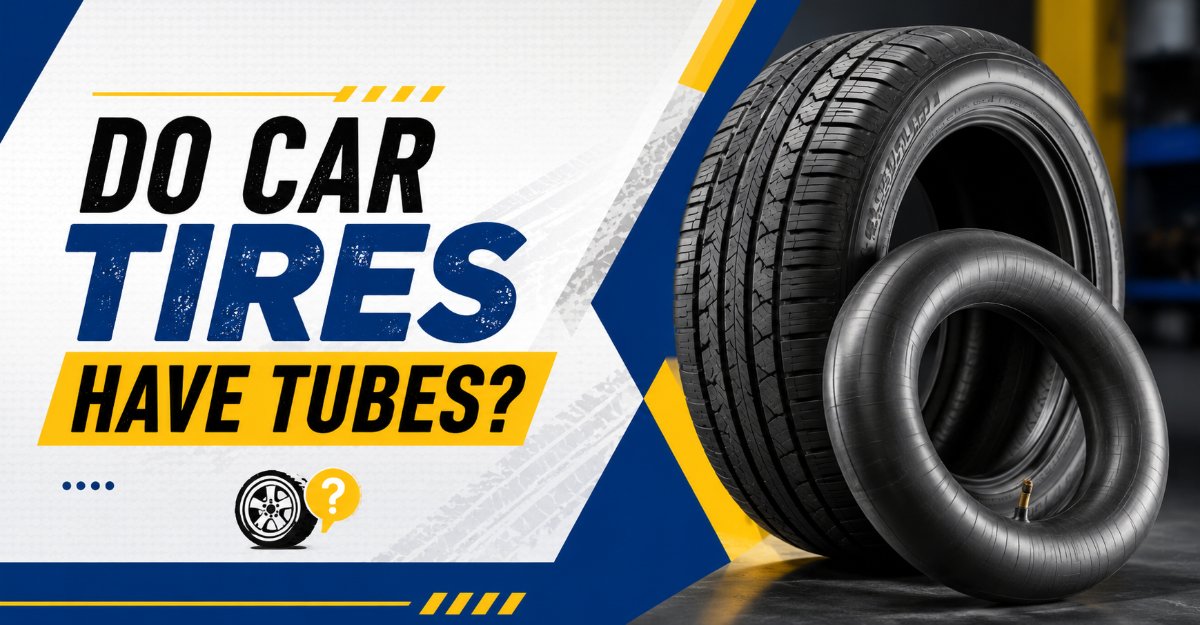
Modern passenger car tires do not have inner tubes. Over ninety-nine percent of vehicles on the road today utilize tubeless tire technology, where the tire assembly and the metal wheel rim form an airtight mechanical seal to retain inflation pressure directly inside the tire cavity without any internal rubber bladder.
At a Glance
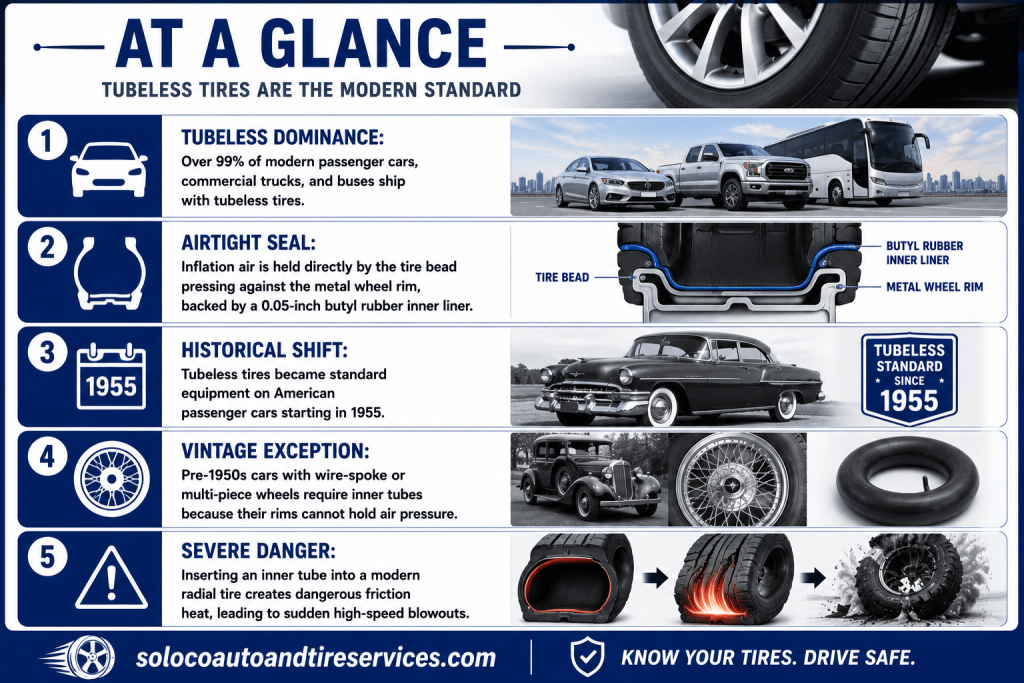
- Tubeless Dominance: Over 99% of modern passenger cars, commercial trucks, and buses ship with tubeless tires.
- Airtight Seal: Inflation air is held directly by the tire bead pressing against the metal wheel rim, backed by a 0.05-inch butyl rubber inner liner.
- Historical Shift: Tubeless tires became standard equipment on American passenger cars starting in 1955.
- Vintage Exception: Pre-1950s cars with wire-spoke or multi-piece wheels require inner tubes because their rims cannot hold air pressure.
- Severe Danger: Inserting an inner tube into a modern radial tire creates dangerous friction heat, leading to sudden high-speed blowouts.
How do tubeless car tires hold air without a tube?
Tubeless car tires retain air through a combination of a specialized rubber bead, a metal wheel rim flange, and an internal chemical liner. The tire bead contains high-tensile steel cables embedded in rubber that are forced outward by inflation pressure to lock tightly against the safety humps of the wheel rim.
To prevent air molecules from escaping directly through the porous structural fabric of the tire casing, manufacturers bond a 0.05-inch thick layer of impermeable butyl rubber to the inner wall. This inner liner acts as a gas barrier, keeping the 30 to 40 PSI of standard operating pressure securely contained inside the wheel assembly without requiring a separate inflatable bladder.
When were inner tubes phased out of passenger cars?
Inner tubes were systematically phased out of passenger vehicles during the mid-1950s, with 1955 marking the watershed year when tubeless tires became standard equipment on new American passenger cars. BFGoodrich patented the first practical passenger car tubeless tire in 1947, and automakers quickly adopted the technology to eliminate the danger of sudden, catastrophic deflation caused by pinched tubes.
By the early 1960s, bias-ply tubed tires were virtually obsolete on new production line vehicles. The subsequent transition from bias-ply to radial construction in the 1970s cemented tubeless technology as the universal standard for automotive safety, handling, and manufacturing efficiency.
What percentage of modern vehicles use tubeless tires?
Approximately 100 percent of modern production passenger cars, light trucks, commercial semi-trucks, and buses utilize tubeless tires. The automotive manufacturing industry completed this transition decades ago due to the superior safety profile, lower weight, and easier maintenance of tubeless assemblies.
The rare exceptions representing the fraction of a percent that still use tubes are restricted entirely to niche categories, such as historical vehicle restorations, agricultural equipment, specialized industrial machinery, and custom aftermarket wire-wheel applications.
Why do some older or vintage cars still need inner tubes?
Vintage and classic cars manufactured before 1950 often require inner tubes because their original wheel rims are structurally incapable of maintaining an airtight seal. Older vehicles frequently feature wire-spoke wheels or multi-piece flat-base rims where individual spoke nipples, rivet holes, or split rings allow air to escape freely.
Because retrofitting these historic wheels to modern tubeless standards is often impossible or sacrifices authentic vehicle restoration, owners must install butyl inner tubes inside compatible tube-type tires to maintain safe operational air pressure.
How can you tell if a car wheel requires an inner tube?
A car wheel requires an inner tube if it is a multi-piece rim design or features exposed wire spokes that penetrate the drop center or well of the wheel barrel. Inspecting the inner rim surface reveals the presence of spoke holes or split locking rings, which immediately signal that air cannot be retained directly against the metal.
Additionally, check the sidewall markings on the tire itself. Tires explicitly stamped with the text TYPE TT (Tube Type) must use an inner tube, whereas tires marked TL (Tubeless) are engineered strictly for tubeless mounting on safety-bead rims.
Can you put an inner tube into a modern tubeless radial tire?
You should never install an inner tube into a modern tubeless radial passenger car tire for daily driving or highway use. While roadside emergency scenarios sometimes compel off-road drivers or stranded motorists to insert a tube as a temporary measure to limp back to civilization, doing so under normal operating conditions violates fundamental tire engineering principles.
Modern radial tires flex extensively at the sidewalls during cornering and braking. Introducing a foreign inner tube into this dynamic environment creates continuous mechanical friction between the tube exterior and the ridged inner liner of the radial tire.
What happens if you use a tube in a radial car tire?
Using an inner tube inside a modern radial tire generates intense internal friction and localized heat buildup during normal driving cycles. Because radial tire casings flex far more than older bias-ply casings, the tube rubs constantly against the interior rubber ribs and cord packages of the tire.
This friction rapidly escalates internal temperatures, causing the rubber of the tube and tire liner to degrade, wrinkle, or delaminate. Ultimately, this thermal degradation leads to rapid air loss, structural compromise, or a sudden, catastrophic blowout at highway speeds.
Why do off-road vehicles sometimes use tubes or beadlocks?
Off-road vehicles and rock crawlers sometimes utilize inner tubes or mechanical beadlock devices to prevent complete tire detachment when operating at extremely low tire pressures. When drivers lower tire pressure below 10 PSI to maximize traction on sand, mud, or rock obstacles, the centrifugal and lateral forces acting on the tire can unseat the rubber bead from the wheel rim, allowing air to escape instantly.
While some off-roaders insert heavy-duty rubber tubes to keep the tire inflated even if the bead unseats, professional builders increasingly rely on external mechanical beadlock rings that physically clamp the tire bead to the wheel.
Can a tube be used to permanently fix a flat tubeless tire?
A rubber tube cannot and shouldnot be used as a permanent repair method for a punctured tubeless car tire. Inserting an inner tube to patch over a sidewall tear, nail puncture, or tread damage in a radial tubeless tire masks the underlying structural damage of the casing.
The structural integrity of the tire remains compromised, moisture can enter the exposed steel belts causing rust, and the friction between the tube and the puncture repair area will inevitably cause the tube to fail prematurely. Permanent repairs require professional patching and plugging by a certified tire technician.
How do you safely repair a punctured tubeless car tire?
Safely repairing a punctured tubeless tire requires a combined plug-and-patch method executed from the inside of the tire cavity. First, the wheel is removed from the vehicle and the tire is dismounted from the rim using a tire changer machine.
Second, the puncture injury is cleaned, reamed, and filled with a vulcanizing rubber stem plug from the inside out. Third, a reinforced rubber patch is cemented over the inner puncture site to permanently seal the butyl liner and restore the airtight integrity of the assembly.
Do commercial trucks, semi-trucks, and buses use inner tubes?
Modern heavy-duty commercial trucks, delivery vans, and transit buses do not use inner tubes. The commercial transportation industry transitioned entirely to heavy-duty tubeless radial tires to maximize fleet uptime, improve fuel efficiency, and eliminate roadside delays caused by sudden tube failures.
Tubeless commercial tires run significantly cooler under heavy loads and long-haul conditions, reducing tread wear and lowering overall fleet operating expenditures across millions of miles of service.
What are the main advantages of tubeless tires over tubed tires?
Tubeless tires offer superior safety, enhanced performance, and lower operating costs compared to older tubed tire designs.
| Performance Metric | Tubeless Tires | Tubed Tires |
| Deflation Speed | Slow air loss on puncture; seals around nails | Instant blowout risk; tube pinches easily |
| Operating Temperature | Runs cooler due to direct rim heat dissipation | Higher friction heat from internal tube rubbing |
| Unsprung Weight | Lighter weight improves handling and fuel economy | Heavier assembly due to added rubber tube |
| Repair Complexity | Simple exterior plugs or internal patch-plugs | Requires dismounting, patching tube, and casing |
How do you maintain proper tire pressure on tubeless setups?
Maintaining proper tire pressure on tubeless assemblies requires monthly pressure checks using a calibrated digital or analog gauge when tires are cold. Tubeless tires naturally lose a small amount of air through normal permeation, typically dropping about 1 to 2 PSI per month, as well as fluctuating with ambient temperature changes.
Ensuring valve cores are equipped with proper sealing caps and checking the tire bead and valve stem base periodically with soapy water helps detect slow leaks before they impact fuel economy or tire wear.
What are the signs of a failing tubeless tire bead seal?
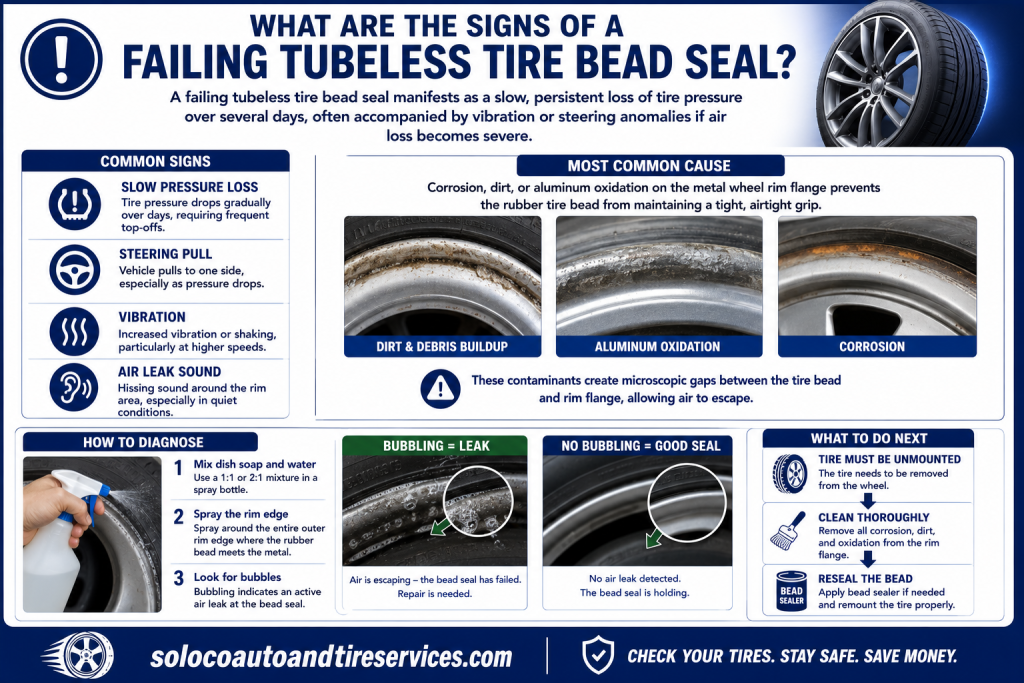
A failing tubeless tire bead seal manifests as a slow, persistent loss of tire pressure over several days, often accompanied by vibration or steering anomalies if air loss becomes severe. The most common cause of bead seal failure is corrosion, dirt, or aluminum oxidation accumulating on the metal wheel rim flange, which prevents the rubber tire bead from maintaining a tight, airtight grip.
To diagnose this issue, spray a mixture of dish soap and water around the outer rim edge where the rubber meets the metal; bubbling indicates an active air leak requiring the tire to be unmounted, cleaned, and resealed with bead sealer.
The Bottom Line
Modern passenger car tires do not use inner tubes, relying instead on an airtight tubeless seal formed directly between the tire bead and the wheel rim. While rare exceptions exist for vintage wire-spoke wheels and emergency off-road recovery, inserting a tube into a modern radial tire creates dangerous friction heat and severe blowout risks. Maintaining proper inflation pressure on a standard tubeless setup ensures optimal safety, fuel efficiency, and tire longevity.