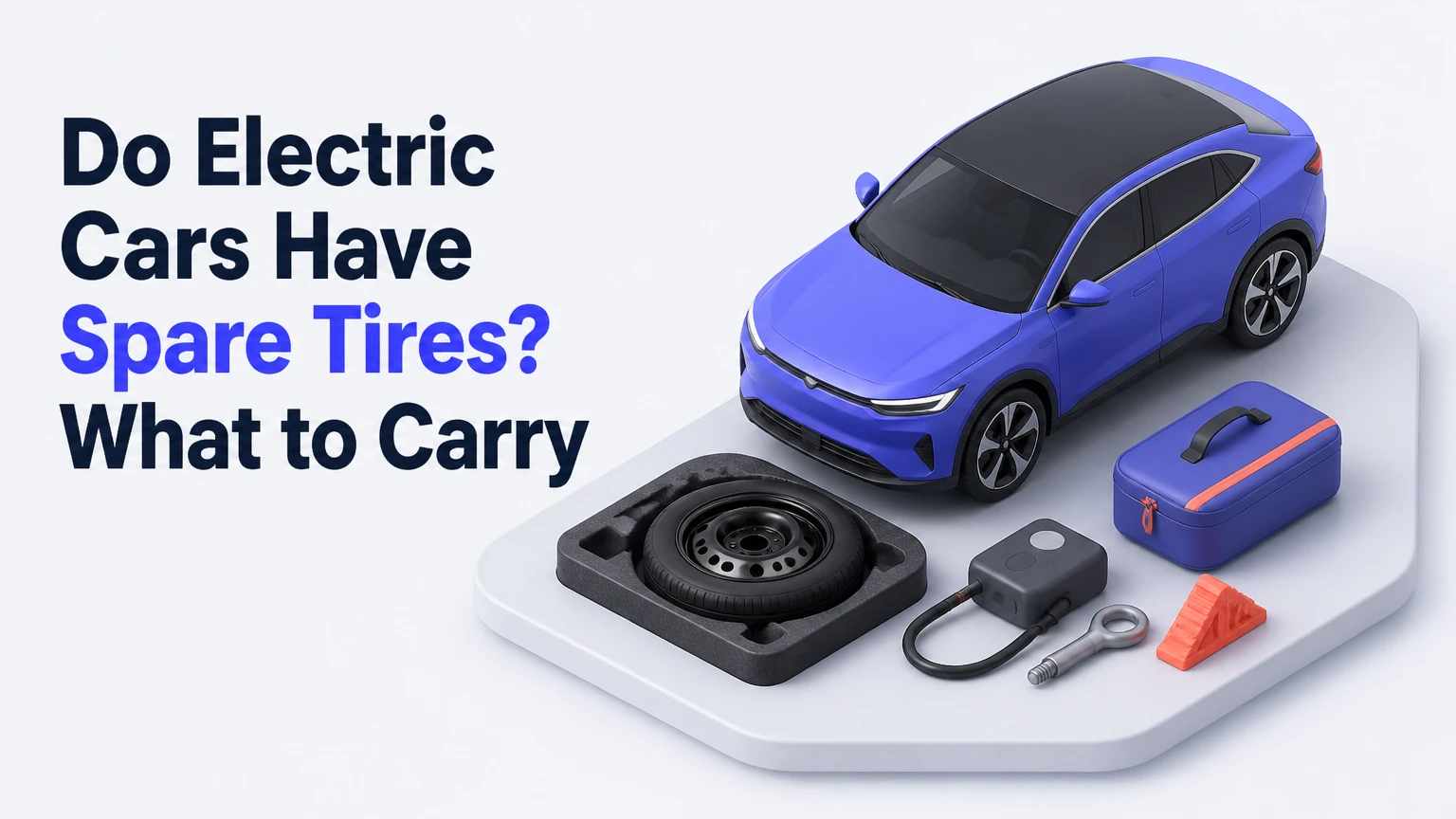
Most electric cars do not include a spare tire from the factory, although a small number of EVs provide a temporary or full-size spare. Electric vehicles usually carry a tire-repair kit, run-flat tires, or roadside-assistance coverage instead. The exact equipment depends on the make, model, year, trim, wheel size, and sales market.
Key Facts at a Glance
- A spare tire is not standard equipment in most new battery-electric vehicles.
- EVs often replace the spare with a 12-volt compressor and liquid sealant.
- Sealant generally handles small tread punctures, not sidewall tears, blowouts, or damaged wheels.
- Run-flat tires can typically travel about 50 miles at no more than 50 mph after pressure loss, but the vehicle manual controls the actual limit.
- An aftermarket spare must match the EV’s hub diameter, offset, brake clearance, tire load rating, and lifting points.
- A factory jack should never be replaced casually, because incorrect lifting can damage the battery enclosure or underbody.
Do Electric Cars Have Spare Tires?
Most electric cars do not have spare tires, but the answer is not universal. Manufacturers omit them on many EVs because the battery pack occupies underfloor space, while weight, aerodynamic efficiency, cargo packaging, and production cost all favor a lighter repair solution.
The same trend affects many gasoline and hybrid vehicles, so the absence of a spare is not uniquely an EV characteristic. Electric cars make the packaging problem more visible because a flat “skateboard” battery platform can occupy the area where older vehicles placed a spare-tire well.
A factory equipment list is more reliable than a general EV rule. Two versions of the same model can differ because of wheel diameter, performance brakes, body style, rear-motor packaging, or regional equipment requirements.
Does every EV include a tire repair kit?
No. Many EVs include a compressor and sealant cartridge, but some provide only roadside assistance, some use self-supporting tires, and some include neither a conventional spare nor a complete repair system. Inspect the cargo floor, owner’s manual, window sticker, and roadside kit before a long trip.
A 12-volt compressor can restore pressure without sealing a hole. A sealant system combines pressure restoration with temporary puncture sealing, but the bottle may expire and the cartridge connection may be model-specific.
Why Do Manufacturers Omit Spare Tires?
Battery packaging is the main EV-specific reason, while efficiency and cost reinforce the decision. A conventional wheel, tire, jack, and tools commonly add roughly 30-50 pounds, although the exact mass varies by vehicle and spare design.
A spare also needs a secure cavity or external mount. On an EV, that space may compete with battery modules, a rear motor, power electronics, crash structures, a subwoofer, or additional cargo storage. The battery does not always physically make a spare impossible, but it often makes a dedicated well expensive or impractical.
| Manufacturer consideration | Typical effect | Why it matters to an EV |
|---|---|---|
| Spare wheel and tools | 30-50 lb added mass | Slightly increases energy use and payload consumption |
| Underfloor battery | Full-width structural packaging | Reduces room for a deep spare-tire well |
| Smooth underbody | Lower airflow disruption | Protects highway efficiency and range |
| Large brake package | 19-22 inch wheel fitment challenge | Limits generic donut-spare compatibility |
| Manufacturing and logistics | One wheel, tire, jack, and tools removed | Lowers parts, shipping, and assembly costs |
| Cargo packaging | 40-80 liters of possible storage | Preserves trunk or sub-trunk capacity |
The weight argument is real but usually modest. Removing 40 pounds does not transform an EV’s range; it produces a small efficiency benefit that becomes more valuable across a large production fleet. Battery structure, brake clearance, and cargo packaging usually determine feasibility first.
The National Highway Traffic Safety Administration states, “A TPMS is designed to monitor the air pressure in your tires.” That warning system helps identify pressure loss, but it does not repair a puncture or replace a spare.
What Replaces a Spare Tire in an EV?
An electric vehicle may replace a spare with a sealant-and-compressor kit, run-flat tires, roadside assistance, or no dedicated emergency equipment. Each solution handles a different failure, so owners should identify the exact system before assuming a minor puncture is repairable.
Sealant and compressor kits
A sealant kit injects a liquid compound through the tire valve while a portable compressor restores inflation pressure. The system is intended for small punctures in the tread, often around 6 millimeters or less, but the allowable hole size belongs to the kit manufacturer.
A typical kit weighs under 4 pounds and costs about $40-$80 to replace. Sealant bottles commonly have a four-to-five-year shelf life, although expiration dates vary by brand and vehicle.
Sealant has important limits. It cannot restore a separated tread, repair a cut sidewall, straighten a bent wheel, or reliably close a large puncture. Some products can also interfere with tire-pressure sensors or require special cleaning, but modern sealants are not automatically guaranteed to destroy every TPMS sensor.
Run-flat tires
Run-flat tires use reinforced sidewalls or an internal support ring to carry vehicle weight after air pressure falls. Many permit approximately 50 miles at up to 50 mph, but temperature, load, tire condition, and road speed can shorten that allowance.
Run-flats reduce the need to stop immediately on a dangerous shoulder. Their disadvantages include a firmer ride, higher replacement prices, limited availability in some sizes, and potentially greater rolling resistance. An EV’s owner manual and tire placard determine whether run-flat replacement is approved.
Roadside assistance
Roadside assistance transfers the repair problem to a service provider. Coverage may come from the manufacturer, an automobile club, insurance policy, lease agreement, or connected-vehicle subscription.
The service may repair a tread puncture, install a customer-provided spare, or tow the vehicle to an authorized tire shop. Coverage limits matter in rural areas, where a flatbed may travel farther and wait times may exceed an hour.
How Do the Main EV Flat-Tire Options Compare?
A sealant kit is the lightest option for small tread punctures, while a physical spare handles the widest range of tire and wheel failures. Roadside assistance is convenient but depends on network coverage, weather, location, and the availability of an EV-capable flatbed.
| Option | Typical cost | Typical limit | Handles sidewall damage? | Main drawback |
|---|---|---|---|---|
| Compressor only | $30-$100 | Pressure restoration only | No | Does not seal a puncture |
| Sealant and compressor | Included to $80 | About 50-100 miles if pressure holds | No | Temporary repair and cleanup |
| Run-flat tire | $250-$450 per tire | About 50 miles at 50 mph | Usually no | Firm ride and costly replacement |
| Temporary spare kit | $250-$500 | About 50-70 miles at 50 mph | Yes, after wheel change | Cargo space and fitment risk |
| Full-size spare | $300-$700 typical aftermarket | Normal tire limits | Yes, after wheel change | Heavy and difficult to store |
| Roadside assistance | $0-$150 yearly typical | Provider and plan limits | Tow or service dependent | Waiting time and connectivity |
These figures are typical consumer-market ranges, not guaranteed prices. A replacement run-flat for a premium EV can cost more than $450, while a model-specific spare kit may exceed $500 after a jack, wheel adapter, and shipping.
Do Any Electric Cars Include a Spare?
Some electric cars include a spare tire, but equipment changes by country, trim, model year, and wheel package. Vehicle listings, owner manuals, and the physical cargo compartment provide stronger evidence than broad lists of EVs with spares.
Examples reported in different markets include certain electric SUVs and trucks with underbody, bed, or cargo-area storage. The Ford F-150 Lightning and Rivian R1T demonstrate why electric trucks can package a spare more easily than low-floor passenger cars: a bed or external compartment creates storage options unavailable beneath a sealed cabin floor.
The Audi Q8 e-tron has been associated in some markets with a collapsible space-saver arrangement, while other EVs may offer no spare at all. The Chery Omoda E5 has been reported with a full-size spare in selected markets. These examples should not be treated as universal trim specifications.
| Verification point | What to inspect | Why it changes the answer |
|---|---|---|
| Model year | Official owner manual | Equipment can change after a facelift |
| Trim | Window sticker and build sheet | Performance trims may delete storage or change brakes |
| Wheel size | Tire and wheel label | A 21-inch brake package may reject a small spare |
| Market | Local manufacturer specification | Australian, European, and North American equipment differs |
| Body style | Cargo floor and underbody | Trucks and SUVs have more storage options |
| Drive system | Rear motor and battery layout | Mechanical packaging changes available cavities |
Can an EV Use an Aftermarket Spare Tire?
An EV can use an aftermarket spare only when the wheel and tire meet the vehicle’s engineering requirements. A generic donut that fits the bolt pattern may still fail because of incorrect offset, insufficient load capacity, brake-caliper interference, or incompatible traction-control behavior.
Confirm these specifications before purchase:
- Load rating: The spare tire and wheel must support the axle load, not merely the vehicle’s curb weight.
- Bolt pattern: The number of fasteners and pitch circle diameter must match.
- Center bore: The wheel must center correctly on the hub or use an approved hub-centric design.
- Offset: Incorrect offset can cause suspension, fender, or brake contact.
- Brake clearance: Test clearance around the caliper, especially with 20-inch or larger performance brakes.
- Overall diameter: A major diameter difference can trigger ABS, traction-control, or all-wheel-drive problems.
- Jack and lifting points: Use the manufacturer’s lifting locations and an EV-compatible adapter.
- Storage restraint: Secure the wheel so it cannot become a projectile during a collision.
All-wheel-drive EVs require extra caution. A large rolling-diameter difference between axles can stress the drivetrain or cause electronic stability systems to intervene. Some manufacturers permit a temporary spare only on a specific axle or prohibit it entirely.
A tire retailer that sells a model-specific kit should provide a written fitment guarantee. “Fits the bolt pattern” is not enough.
What Should You Do After an EV Tire Goes Flat?
After an EV tire goes flat, move to a safe location, identify the damage, and follow the vehicle manual before using sealant or lifting the car. A small tread puncture may accept temporary sealant, while sidewall damage, a blowout, or a damaged wheel requires roadside service.
Step 1: Move away from traffic
Slow down without abrupt steering, activate hazard lights, and stop on level ground away from moving vehicles. Set the parking brake and keep passengers away from the traffic side of the car.
A shoulder is not automatically safe. If the vehicle cannot reach a protected area, call emergency services or roadside assistance rather than attempting a roadside wheel change.
Step 2: Identify the failure
Inspect the tread, sidewall, valve stem, and wheel only when traffic conditions permit. Leave a nail or screw in place if the object is embedded in the tread, because removing it can enlarge the leak.
Do not use sealant for a sidewall cut, bead separation, exposed cords, a cracked wheel, or a tire that came off the rim. Those failures require a tow or wheel replacement.
Step 3: Locate and inspect the kit
Find the compressor, sealant bottle, instructions, towing eye, and any jack equipment. Check the sealant expiration date and inspect the hose for cracks.
A dead 12-volt accessory outlet can prevent the compressor from starting even when the high-voltage battery has substantial charge. Turn the vehicle on according to the manual before operating a compressor.
Step 4: Connect the approved sealant system
Thread the sealant hose onto the valve stem, connect the compressor to the 12-volt outlet, and operate the system exactly as directed. Use the tire-pressure value on the driver-door placard, not a generic EV pressure assumption.
Many EV tires require pressures in the high 30s or low 40s psi, but no universal 40-45 psi rule exists. Tire size, load, temperature, and vehicle design determine the correct value.
Step 5: Drive only if pressure stabilizes
If the kit instructions require movement, drive the specified distance, often 1-4 miles, at low speed. Stop and recheck pressure with a gauge.
Do not exceed the kit’s stated speed or distance. A temporary seal is a route to a tire shop, not permission to complete a normal road trip.
Step 6: Tell the tire shop about the sealant
Inform the technician that sealant entered the tire. The shop may need to clean the wheel, inspect the TPMS sensor, and determine whether the tire complies with local repair standards.
Some tires can be professionally repaired after approved sealant use, while others must be replaced. The puncture’s location and internal condition control the decision.
When Should You Not Use an EV Tire Repair Kit?
Do not use an EV tire repair kit when the damage involves the sidewall, bead, wheel, valve stem, or a hole larger than the kit specification. A repair kit cannot restore the tire’s structural strength after a blowout or severe pothole impact.
| Symptom | Likely cause | Safe response |
|---|---|---|
| Loud bang and instant pressure loss | Blowout or major tread separation | Stop safely and request a flatbed |
| Visible sidewall slash | Curb or road-debris damage | Do not inject sealant |
| Wheel visibly bent | Pothole impact | Tow for wheel and suspension inspection |
| Pressure falls within minutes | Oversized puncture or valve leak | Stop driving and call assistance |
| Compressor stays silent | Fuse, outlet, plug, or compressor fault | Check power safely, then request service |
| Tire will not seat on rim | Bead or wheel damage | Do not drive on the tire |
| TPMS warning remains after inflation | Sensor, leak, or reset issue | Verify pressure with a gauge and inspect |
An expert rule of thumb is simple: sealant is appropriate for a small tread puncture when the tire remains structurally intact. It is not a solution for impact damage.
What Are the Towing and Lifting Risks for EVs?
Electric vehicles should be lifted only at the manufacturer-designated points, because the battery enclosure and high-voltage components sit close to the underbody. A tow operator should use the vehicle’s published recovery procedure and a flatbed when the drive wheels cannot safely roll.
Never place a jack under the battery tray, rocker panel, or an unmarked underbody crossmember. Crushing the battery case can create expensive structural and electrical damage, even when no immediate warning appears.
A flatbed is usually the safest choice after a locked wheel, drivetrain fault, collision, or non-rolling tire. Some vehicles permit wheel-lift towing for limited distances, but the owner manual controls that procedure. Towing an all-wheel-drive EV with driven wheels on the ground can damage motors or reduction gears.
What Does an EV Spare Setup Cost?
A complete aftermarket temporary-spare setup typically costs $250-$500, while a full-size spare can cost about $300-$700 before any storage solution. Sealant, compressors, and roadside plans cost less initially, but they may not solve severe tire damage.
| Purchase | Typical upfront cost | Replacement interval or event | Best use |
|---|---|---|---|
| Sealant cartridge | $40-$80 | Every 4-5 years or after use | Small tread punctures |
| Portable compressor | $30-$100 | Replace when defective | Pressure loss and inflation |
| Temporary spare package | $250-$500 | Replace tire when worn or aged | Remote travel and sidewall failures |
| Full-size wheel and tire | $300-$700 | Tire age and tread condition | Maximum independence |
| EV-rated jack and adapter | $80-$200 | Inspect before every use | Emergency wheel changes |
| Roadside membership | $50-$150 per year typical | Annual renewal | Urban and connected routes |
Tire age matters even when tread looks healthy. The Tire Industry Association and major tire manufacturers commonly advise inspection of older tires, while some manufacturers specify replacement at six or ten years regardless of tread. Follow the tire maker’s date guidance.
Which Setup Fits Your Driving Pattern?
Urban drivers usually need the factory kit and verified roadside coverage, while rural drivers, winter travelers, and remote-road users gain more from a properly fitted temporary spare. The correct choice depends on distance from tire shops, cell coverage, weather exposure, cargo space, and tolerance for waiting.
City commuter
Keep the factory compressor and an unexpired sealant cartridge. Confirm that your manufacturer’s roadside program covers tire damage and towing to a suitable EV tire shop.
A physical spare may consume valuable sub-trunk space for a problem that roadside service can solve within an hour. Check the plan’s mileage limit before relying on it.
Highway and road-trip driver
Carry a pressure gauge, plug-compatible compressor if approved, reflective equipment, gloves, and the factory kit. A model-specific temporary spare becomes more attractive when routes cross regions with limited tire inventory.
Do not assume the nearest shop stocks an EV’s acoustic foam-lined tire, reinforced sidewall, or uncommon 21-inch size. A physical spare can protect the trip from a shredded sidewall that sealant cannot address.
Rural or poor-cell-coverage driver
Choose a tested spare kit if the vehicle accepts one, and store it securely with the correct jack adapter and torque tool. Download roadside numbers and route maps before leaving coverage.
Cold weather reduces tire pressure and can make sealant less effective or slower to flow. Carry a pressure gauge that works in low temperatures and inspect the spare before departure.
Winter and severe-weather driver
Verify that the spare’s tire compound, speed rating, and traction-control compatibility suit the season. A temporary spare may provide less grip than the vehicle’s matched winter tires, so drive only far enough to reach a safe repair location.
Expert Rules That Prevent Expensive Mistakes
Check the spare with the largest brake package. A wheel that clears a base-trim brake caliper may not clear a performance-trim caliper. Fitment must be tested against the exact vehicle configuration.
Do not confuse a compressor with a repair kit. A compressor restores air but cannot close a hole. Sealant closes only certain punctures and may have a short expiration window.
Treat the tire placard as the pressure authority. Generic advice that EVs need 40-45 psi can overinflate one model and underinflate another. Door-placard pressure is vehicle-specific.
Secure every loose wheel. A 50-pound wheel and tire can become dangerous cargo in a crash. Use the original anchor, a rated strap, or a purpose-built storage bag.
Recheck pressure after temperature changes. Tire pressure commonly changes by roughly 1 psi for each 10-degree Fahrenheit change in temperature, so a correct summer reading may drop in winter.
Frequently Asked Questions
Can you plug an electric-car tire?
A puncture in an EV tire can sometimes receive a professional plug-and-patch repair when the damage is in the central tread and within the tire manufacturer’s limits. Many tire organizations prefer an internal repair rather than an external rope plug alone. Sidewall and shoulder damage generally require replacement.
Does sealant permanently repair an EV tire?
No, tire sealant provides a temporary repair for qualifying small punctures. The vehicle should travel only within the kit’s speed and distance limits until a tire professional inspects it. The technician must check the tire interior, wheel, valve, and TPMS sensor before deciding whether the tire can remain in service.
Can an EV drive with one low tire?
An EV should not continue driving on a substantially underinflated tire unless the vehicle uses approved run-flat tires and the owner manual permits the stated distance. Driving on a conventional low tire can destroy the sidewall, damage the wheel, and reduce control before the dashboard warning becomes urgent.
Do electric cars get more flat tires than gasoline cars?
Electric cars do not automatically get more punctures, but their higher curb weight, instant torque, and specialized low-rolling-resistance tires can increase tire wear or impact consequences. Correct inflation, regular rotation, alignment checks, and gradual acceleration reduce avoidable tire problems.
Does charging an EV affect tire pressure?
Charging does not directly change tire pressure. Ambient temperature, solar heating, load, speed, and slow leakage change pressure while the vehicle is parked or driving. Check cold tire pressure monthly and before long trips, using the door-placard specification.
The Bottom Line
Do electric cars have spare tires? Usually not, but some electric cars include temporary or full-size spares depending on model, trim, market, and wheel configuration. For most owners, the safest plan is an unexpired factory repair kit, a working compressor, verified roadside coverage, and a model-specific spare only when rural or remote driving justifies the cargo and cost.