No, most North American Honda CR-V Hybrid models are sold without a factory spare tire. Honda typically supplies a Tire Repair Kit with sealant and a 12V compressor instead, although equipment can vary by model year, trim, market, or dealer-installed accessories. Verify the kit in your vehicle before relying on it.
Key Facts at a Glance
Most U.S. Honda CR-V Hybrids use a tire repair kit instead of a spare wheel.
The factory kit normally contains a sealant bottle, hose, compressor, pressure gauge, and instructions.
Sealant is intended for a small tread puncture, not a sidewall tear, blowout, bent wheel, or large hole.
A compact spare must clear the CR-V Hybrid’s brake components and match the vehicle’s tire diameter closely.
A used sealant bottle can contaminate the tire-pressure sensor and must be replaced after activation.
Model-year and regional equipment can differ, so the owner’s manual and cargo-area inspection are the final authorities.
Do Honda CR-V Hybrids Have a Spare Tire?
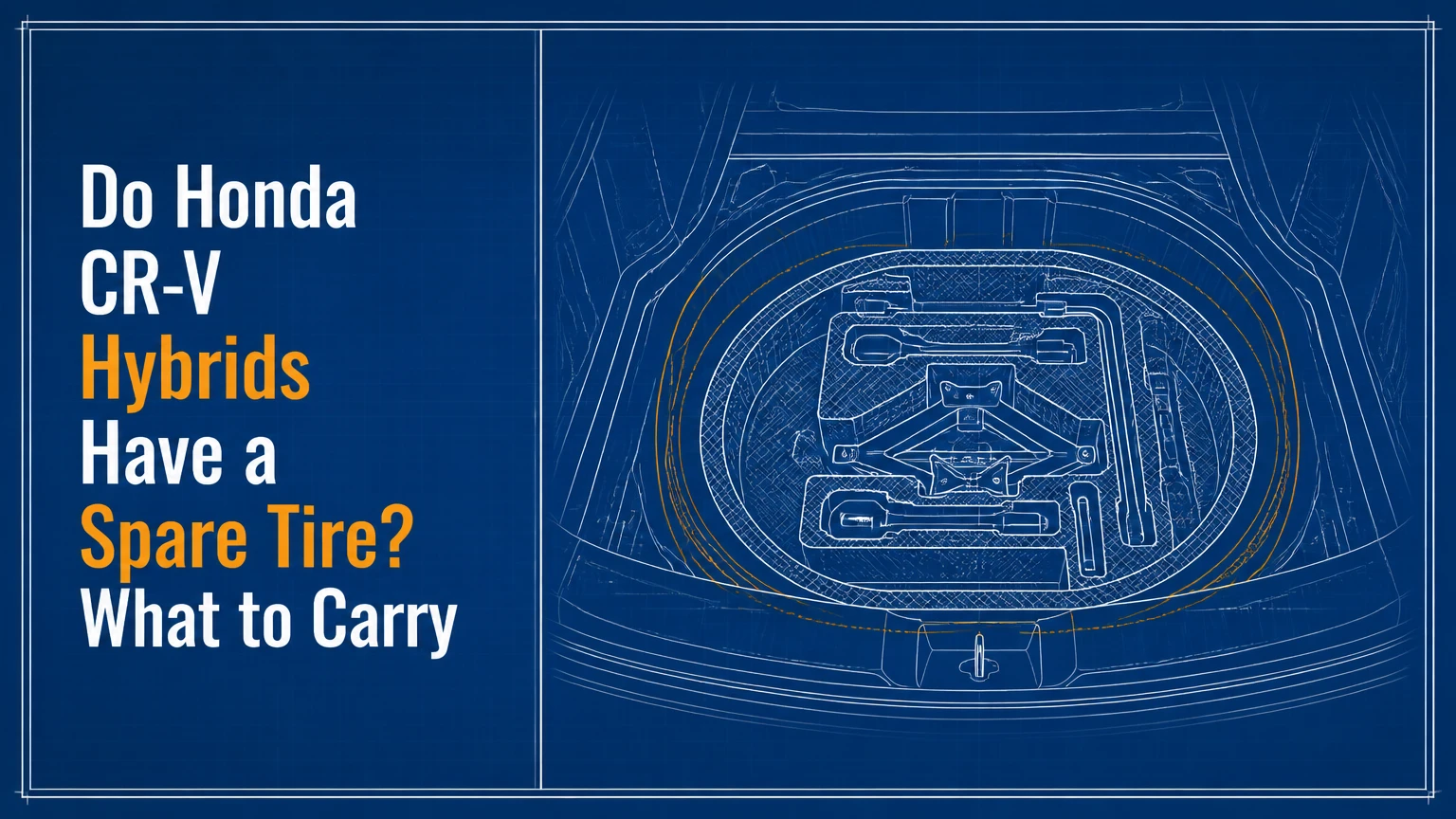
Most Honda CR-V Hybrids do not have a spare tire from the factory, particularly U.S.-market hybrids from the 2020 introduction through recent generations. The normal substitute is a Tire Repair Kit, often abbreviated TRK, stored beneath or around the luggage-area floor.
The answer is not universal across every country and production year. Honda can change emergency equipment between markets, and a used vehicle may have lost its kit or gained an aftermarket wheel. Inspect the cargo floor, check the vehicle’s original equipment list, and search the model-specific owner’s manual before purchasing replacement equipment.
A useful distinction is that “no spare tire” does not mean “no flat-tire equipment.” The CR-V Hybrid generally has equipment for inflating and temporarily sealing a repairable puncture, but it does not provide the independent wheel-and-tire assembly needed for a conventional tire change.
Why does Honda omit the spare wheel?
Honda’s likely design goals are lower vehicle mass, more cargo-floor flexibility, and packaging efficiency. Hybrid powertrain components occupy space that conventional SUVs may use for underfloor storage, although the exact battery location and cargo architecture vary by generation.
A spare wheel, tire, jack, and wrench add substantial mass. Removing those parts can reduce manufacturing cost and rolling weight, while the smaller repair kit occupies less space. The trade-off is transferred to the driver: a puncture outside the kit’s limits requires roadside assistance or a tow.
Do not assume that every missing spare is caused only by the high-voltage battery. Manufacturers make packaging, weight, cost, and market-equipment decisions together. Honda documentation and the actual cargo compartment provide stronger evidence than a generic explanation based on battery placement.
What comes in the Honda CR-V Hybrid tire repair kit?
The Honda CR-V Hybrid tire repair kit normally includes a 12V electric compressor, a sealant container, a delivery hose, an air hose or valve connection, a pressure gauge, and operating instructions. Exact contents differ by model year and market, so compare the physical kit with the owner’s manual.
The compressor draws power from the vehicle’s 12V accessory socket. It does not connect to the high-voltage hybrid battery directly. The hybrid system must be placed in the operating state specified by Honda so the 12V system can supply the compressor without unnecessarily draining the auxiliary battery.
| Kit component | Typical function | Important limitation |
|---|---|---|
| Sealant bottle | Coats and plugs a small tread puncture | Expires and usually requires replacement after use |
| 12V compressor | Pushes sealant and air into the tire | Needs a functioning accessory socket and 12V system |
| Valve hose | Connects the bottle or compressor to the tire valve | Must be tightened without cross-threading |
| Pressure gauge | Confirms inflation pressure | A rising reading does not prove the repair will hold |
| Instruction card | Gives model-specific sequence and warnings | Vehicle manual remains the controlling reference |
The sealant bottle is a consumable. Sealant typically has a shelf life of about four to five years, but the date printed on the container controls. An expired bottle can separate, harden, or fail to seal reliably.
Is the Honda sealant a permanent tire repair?
No. Honda tire sealant is a temporary roadside measure, not a permanent repair. It is intended to help the driver reach a tire professional, who should inspect the tire internally and determine whether a compliant repair or replacement is possible.
The Tire Industry Association and major tire manufacturers generally limit permanent puncture repairs to the tread area, after internal inspection, with the tire removed from the wheel. A plug inserted from outside without inspection is not equivalent to a professional repair.
Sealant can also make later servicing messy. Tell the tire shop that chemical sealant entered the tire, because the technician may need special cleanup and the tire-pressure monitoring system sensor may require inspection.
How do you use the CR-V Hybrid tire repair kit?
Use the repair kit only for a small puncture in the tread, away from the sidewall, and only where the tire remains structurally intact. The complete process commonly takes 10-20 minutes, but the most important success factor is stopping immediately when the tire or wheel has serious damage.
Before you start
| Requirement | Typical value or condition | Why it matters |
|---|---|---|
| Working time | 10-20 minutes | Includes setup and initial inflation |
| Safe location | Level ground, away from traffic | Reduces collision and vehicle-movement risk |
| Vehicle state | Ignition or hybrid system in Honda-specified operating mode | Powers the 12V compressor |
| Target pressure | Door-jamb placard value, often about 33-35 psi | The placard overrides generic pressure figures |
| Required equipment | Repair kit, gloves, hazard lights, phone | Supports safe operation and cleanup |
Step 1: Move to a safe location
Pull as far from traffic as possible, switch on the hazard lights, select Park, and apply the parking brake. Do not work beside a live traffic lane if the shoulder is narrow, unstable, or exposed to fast vehicles.
If the tire is shredded, the wheel is bent, or the vehicle pulls sharply, do not attempt to inflate it. Call roadside assistance instead.
Step 2: Inspect the tire without removing it
Look for a nail, screw, or small object in the tread. Do not remove the object before using the kit, because removing it can enlarge the leak.
Reject sealant use when damage appears on the sidewall or shoulder, the tread has separated, the valve stem is damaged, or the wheel has visibly cracked. Sealant cannot restore tire structure.
Step 3: Connect the sealant bottle
Follow the kit’s printed sequence, attach the sealant hose to the tire valve, and keep the bottle in the orientation specified by Honda. Tighten connections by hand until secure.
Do not open or puncture the bottle manually. Chemical sealant can irritate skin and eyes, and spilled product can damage vehicle interiors or clothing.
Step 4: Power the compressor
Plug the compressor into the CR-V Hybrid’s 12V accessory outlet. Use the operating mode identified in the owner’s manual, close unnecessary electrical loads, and keep the engine or hybrid system operating if Honda requires it for accessory power.
Never use an extension cord or an improvised power source. A compressor that repeatedly trips the outlet can indicate an electrical problem or excessive load.
Step 5: Inflate to the placard pressure
Turn on the compressor and watch the gauge. Inflate to the pressure on the driver-door placard, commonly around 33-35 psi on many CR-V configurations, rather than using the maximum pressure molded into the tire sidewall.
A pressure reading that does not rise after several minutes is a stop condition. Continuing to run the compressor can overheat it without repairing the puncture.
Step 6: Drive briefly and recheck
If the kit instructions permit driving, move immediately and cautiously for the stated distance and speed. Many sealant systems call for roughly 3-5 miles at less than 50 mph so sealant can circulate through the puncture.
Stop in a safe location and recheck pressure. If pressure falls substantially, do not continue driving. Arrange a tow or roadside tire service.
What pressure and distance limits apply?
The tire placard supplies the correct inflation pressure, while the kit label supplies the speed and distance limits. Typical sealant guidance allows no more than 50-100 miles and less than 50 mph, but those figures are not a promise that the repair will last that long.
Sealant is a bridge to professional service. Drive only far enough to reach a safe repair location, avoid hard cornering and high speed, and tell the technician exactly when and how the kit was used.
Can you add a spare tire to a Honda CR-V Hybrid?
Yes, owners can add an aftermarket compact spare or full-size wheel, but fitment must be verified for the exact generation, trim, drivetrain, wheel diameter, and brake package. A generic Honda wheel is not automatically safe because brake-caliper clearance and tire diameter can differ.
A complete emergency kit should include the wheel and tire, a compatible jack, a lug wrench, a means of securing the load, and instructions. Confirm the spare’s load rating and overall diameter with a qualified tire retailer or Honda dealer.
| Replacement option | Typical purchase cost | Roadside use | Main limitation |
|---|---|---|---|
| Factory sealant replacement | $40-$60 | Small tread puncture | Cannot replace a damaged tire |
| Compact spare kit | $350-$450 | Wheel change after many punctures | Requires verified brake clearance |
| Full-size matching wheel | $400-$700 | Normal tire-size operation | Uses more cargo space and weighs more |
| Roadside membership | $50-$150 per year | Technician or tow dispatch | Depends on coverage and location |
Prices are typical U.S. retail ranges, not Honda list prices. Wheel finish, tire brand, jack hardware, shipping, and installation can change the final total.
Where does an added spare tire go?
A compact spare commonly sits on top of the cargo floor, inside a soft case, in a cargo bag, or on an exterior carrier. Many aftermarket kits do not fit in the original underfloor cavity because the hybrid cargo architecture lacks the required depth or wheel well.
A full-size wheel consumes more vertical and horizontal cargo volume. Secure any wheel so it cannot become a projectile during hard braking, and avoid placing heavy tools where they can damage the hybrid battery access panels or wiring.
Is a compact spare compatible with all CR-V Hybrids?
No. Compatibility is generation-specific. The 2020-2022 CR-V Hybrid and the redesigned 2023-and-newer CR-V Hybrid can have different wheel dimensions, brake clearances, offset requirements, and electronic-system considerations.
An aftermarket seller’s fitment chart should identify the exact model year and trim. Ask for confirmation that the wheel clears the front brake caliper, not merely that its bolt pattern matches. A wheel that mounts to the hub can still fail to rotate safely.
Which flat-tire solution is best for each driver?
The best choice depends on distance from assistance, cargo priorities, and willingness to change a wheel. A repair kit suits short urban trips, a compact spare improves self-reliance for remote travel, and a full-size wheel offers the fewest driving restrictions at the cost of weight and space.
| Driver situation | Recommended setup | Typical cost | Reason |
|---|---|---|---|
| Urban commuter within 20 miles of help | Factory kit plus roadside coverage | $0-$150 yearly | Preserves cargo room and limits equipment cost |
| Long-distance highway traveler | Verified compact spare kit | $350-$450 | Handles punctures that sealant cannot treat |
| Remote camper or rural driver | Compact spare plus tire plug inspection tools | $375-$500 | Reduces dependence on cell service and local shops |
| Maximum normal-driving capability | Matching full-size wheel and tire | $400-$700 | Avoids temporary-spare speed and distance limits |
| Fleet or shared vehicle | Factory kit, inspection schedule, roadside policy | $40-$150 yearly | Standardizes training and replacement intervals |
Run-flat tires are another possibility, but they are not a simple spare-tire substitute. The wheel, tire-pressure monitoring system, ride characteristics, load rating, and manufacturer approval all matter. A run-flat tire can also be difficult to repair and more expensive to replace.
What should road-trip drivers carry?
A prepared CR-V Hybrid driver should carry the verified repair kit, a current sealant bottle, a 12V-compatible compressor if the original unit is missing, gloves, a reflective warning device, and a charged phone. A compact spare adds more protection when routes include remote highways or limited overnight service.
Check tire pressure before departure, including the pressure of an aftermarket spare. Inspect the tread for embedded objects and confirm that the jack and lug wrench actually fit the vehicle before an emergency occurs.
One practitioner rule is simple: test-fit emergency hardware in daylight. Discovering that the jack head does not contact the CR-V’s lifting point during rain at night is avoidable.
What damage can the sealant not fix?
Honda’s tire repair kit cannot safely fix a sidewall puncture, a shoulder cut, a blowout, a separated tread, a bent wheel, a cracked wheel, or a puncture too large for the sealant system. Driving on a flat tire can also destroy the internal casing even when the original puncture was small.
| Damage condition | Sealant response | Correct action |
|---|---|---|
| Small tread puncture | May seal temporarily | Use kit, then seek inspection |
| Sidewall tear | Does not restore structure | Request roadside assistance |
| Bent or cracked wheel | Cannot seal rim damage | Tow the vehicle |
| Valve-stem failure | Usually cannot seal the valve | Replace valve or obtain service |
| Tire driven flat | Internal damage may be invisible | Remove and inspect professionally |
| Large hole or blowout | Compressor cannot maintain pressure | Do not drive, arrange a tow |
The most counterintuitive risk is a slow pressure rise. A compressor may inflate a severely damaged tire for several minutes, but an apparent pressure reading does not prove that the casing is safe or that the sealant will hold.
How do you troubleshoot the repair kit?
A compressor that does not start usually points to vehicle power state, the 12V outlet, a fuse, or a loose connection. A compressor that runs without raising pressure usually indicates damage beyond the kit’s design or an improperly connected hose.
| Symptom | Likely cause | Immediate check |
|---|---|---|
| Compressor is silent | Vehicle not in operating mode | Follow Honda’s ignition or READY instruction |
| Compressor stops quickly | Outlet overload or low 12V voltage | Check plug, fuse, and accessory loads |
| Pressure stays near zero | Loose valve or hose connection | Reconnect and inspect for audible leaks |
| Pressure rises then falls | Large puncture or damaged casing | Stop driving and call for service |
| Sealant will not flow | Expired or hardened bottle | Replace the bottle, do not force it |
| TPMS warning remains | Sensor needs reset or inspection | Verify pressure and follow reset procedure |
Do not repeatedly restart an overheated compressor. Allow it to cool according to the kit instructions, and never place the vehicle in an unsafe location merely to complete a temporary repair.
Chemical sealant can affect the TPMS sensor. Replacement sensor costs vary, but a typical aftermarket sensor may cost about $50-$100 installed, while dealer pricing can be higher. The shop must know which product entered the tire.
How can you verify your specific CR-V Hybrid equipment?
Open the luggage-area floor and identify the compressor, sealant bottle, jack hardware, and storage tray. Then compare the equipment with the owner’s manual for the exact model year, because a missing kit can look like a factory omission.
Use these checks before a trip:
- Read the driver-door tire placard for pressure and tire size.
- Find the sealant expiration date.
- Confirm that the compressor plug fits the 12V accessory socket.
- Read the emergency tire procedure in the owner’s manual.
- Photograph the kit instructions for offline access.
- If buying a spare, provide the seller with the VIN and exact trim.
- Ask a tire shop to verify brake clearance and load rating.
Honda’s owner information should take priority over a dealer advertisement, marketplace listing, or generic CR-V forum post. Used vehicles frequently have missing compressors, expired bottles, nonmatching wheels, or accessories removed by previous owners.
Frequently Asked Questions
Does the Honda CR-V Hybrid have a jack?
Most CR-V Hybrids supplied with a tire repair kit do not include the complete jack and lug-wrench setup used for changing a factory spare. Equipment varies by market and trim, so inspect the cargo compartment and confirm against the vehicle’s manual before assuming a jack is present.
Can I use a Honda CR-V gas-model spare on a hybrid?
A gasoline CR-V spare may or may not fit a CR-V Hybrid. Bolt pattern alone is insufficient because wheel offset, diameter, brake-caliper clearance, tire circumference, load rating, and drivetrain requirements must also match. Verify the exact model year and trim with Honda or a qualified wheel supplier.
Does a flat tire disable the CR-V Hybrid system?
A flat tire does not normally disable the hybrid powertrain, but driving on it can damage the tire, wheel, suspension, and vehicle-control systems. Stop safely, inspect the damage, and use the repair kit only when the puncture is small and located in the repairable tread area.
Can Honda sealant be reused after opening?
Honda tire sealant should be treated as a single-use consumable unless the bottle manufacturer explicitly permits reuse. Replace the container after activation and observe its expiration date. A partially used bottle may lose pressure, dry internally, or lack enough material for a later puncture.
Should I repair a tire after using sealant?
Yes. Take the tire to a qualified tire professional as soon as possible after using sealant. Tell the technician the sealant brand and product type, because the tire must be inspected internally and the TPMS sensor, valve, wheel, and casing may need cleaning or replacement.
Does all-wheel drive change the spare-tire decision?
Yes. AWD systems can be sensitive to tire-circumference differences, especially when one tire has substantially different tread depth or diameter from the others. Use only a spare approved for the specific CR-V Hybrid and follow Honda’s speed, distance, and drivetrain instructions.
The Bottom Line
For the query “do Honda CR-V hybrids have a spare tire,” the practical answer is no for most North American models: Honda supplies a Tire Repair Kit rather than a factory spare wheel. The kit can address a small tread puncture temporarily, but it cannot replace a damaged tire or wheel.
City drivers may reasonably keep the factory kit and roadside coverage. Highway travelers, campers, and rural drivers gain more resilience from a verified compact spare, while owners who want unrestricted normal driving can carry a matching full-size wheel. Confirm your model-year equipment, replace expired sealant, and verify wheel fitment before an emergency.