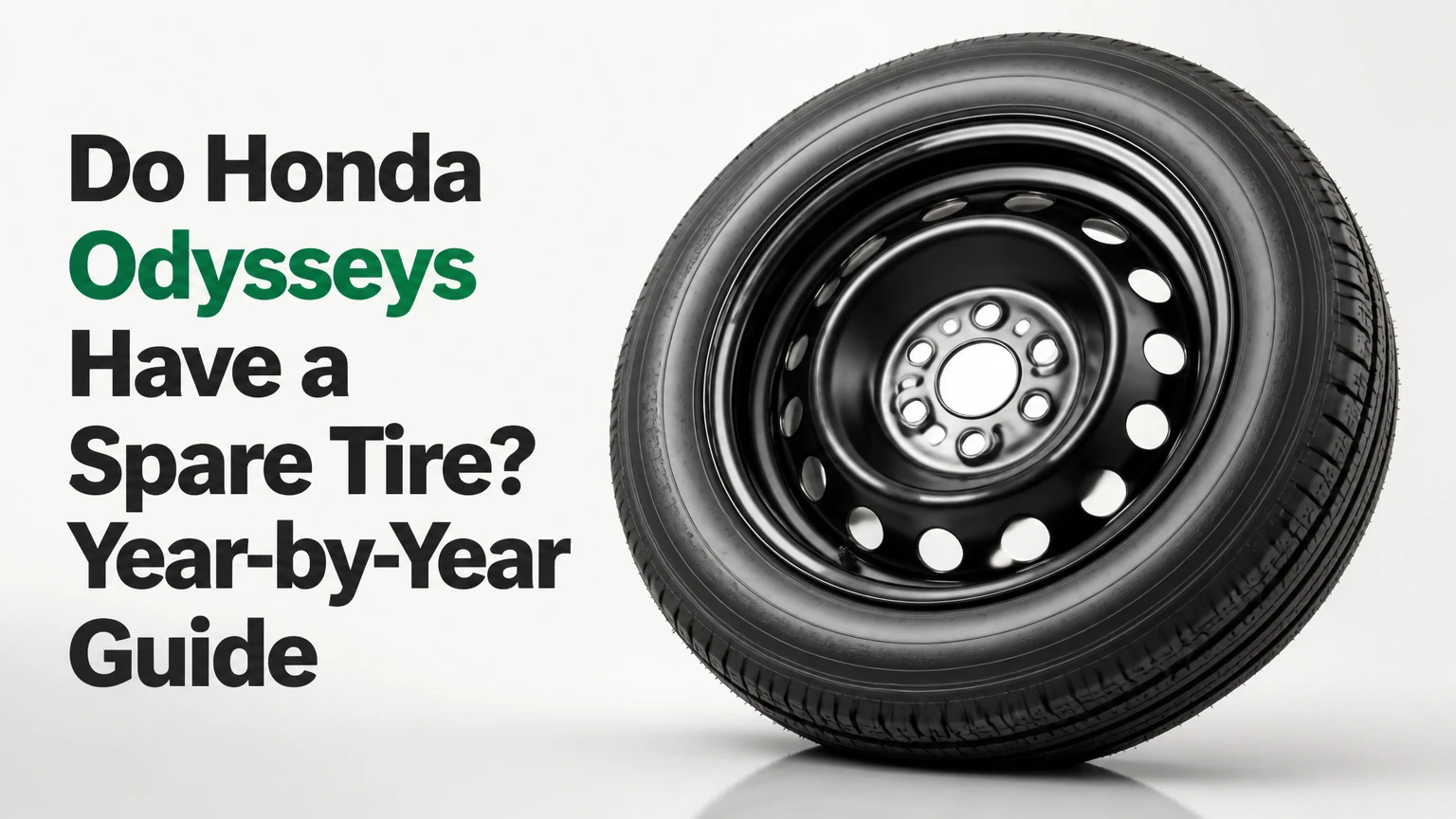
Most North American Honda Odysseys have a compact spare tire, but the answer depends on model year, trim, and whether the original equipment is still present. The major exception is the 2005-2010 Odyssey Touring, which commonly used Michelin PAX run-flat tires and generally did not include a conventional spare.
Key Facts at a Glance
- Honda Odyssey model years 2011-2025 usually store the compact spare under a second-row floor panel.
- Honda Odyssey models from 1999-2004 usually store the spare beneath the rear cargo floor.
- Standard-tire 2005-2010 Odyssey models usually store the spare behind a driver-side rear cargo-wall panel.
- The 2005-2010 Odyssey Touring commonly used the Michelin PAX system without a standard spare.
- A temporary spare commonly requires 60 psi and a maximum speed of 50 mph, but the owner’s manual remains authoritative.
- A full-size flat tire usually will not fit back into the Odyssey’s compact-spare compartment.
Do Honda Odysseys Have a Spare Tire?
Yes, most Honda Odysseys were sold with a temporary compact spare, jack, and lug wrench. The answer changes for certain trim levels, especially the 2005-2010 Touring, and a used Odyssey may also be missing its original tire or tools after a previous roadside repair.
Honda’s packaging strategy moved the spare between generations. Newer vans hide it inside the passenger compartment under the second-row floor, while older vans place it in the rear cargo area. Checking the storage location is more reliable than assuming the spare is present.
A dealer-installed wheel, a previous PAX conversion, or an incomplete used-vehicle sale can also change what you find. Inspect the tire, wheel, jack, wrench, retaining hardware, and inflation label before a long trip.
Which Odyssey Years Have a Spare Tire?
The model year gives the best first indication, but trim equipment still matters. The following table describes typical North American configurations, not every vehicle imported or modified by a previous owner.
| Odyssey model years | Generation | Typical spare location | Main qualification |
|---|---|---|---|
| 1999-2004 | Second generation | Under rear cargo floor | Confirm the tire and jack are still present |
| 2005-2010 standard trims | Third generation | Driver-side rear cargo wall | Touring PAX models are the major exception |
| 2005-2010 Touring | Third generation | Usually no conventional spare | Michelin PAX equipment commonly replaced the spare |
| 2011-2017 | Fourth generation | Under second-row floor | Storage is inside the cabin |
| 2018-2025 | Fifth generation | Under second-row floor | Wheel package and trim should be verified |
Honda’s official owner information is the final authority for a specific vehicle because equipment can vary by trim and market. The vehicle identification number, original wheel size, and tire label can resolve uncertainty when an online parts listing does not.
Where Is the Spare Tire on a 2011-2025 Odyssey?
The 2011-2025 Honda Odyssey usually stores its compact spare beneath a second-row floor panel, between the front seats and the second-row seats. The location surprises owners because the tire is inside the cabin rather than beneath the rear cargo floor.
Move the floor mats and look for a rectangular carpet seam or pull tab. Under the carpet is a rigid cover, normally secured by a fastener or removable fitting; below that cover, a wing nut holds the spare wheel in place.
The jack and lug wrench may be in the same general compartment or in a nearby rear side-storage area, depending on year and trim. A HondaVac-equipped van can have additional equipment in the cargo wall, but HondaVac does not normally occupy the second-row spare-tire well.
How Do You Remove the Newer Odyssey Spare?
Use these steps on a level surface before an emergency, because a familiar compartment is easier to operate at night or beside a busy road.
- Clear the second-row floor. Remove mats, loose objects, and seat-mounted accessories around the access panel.
- Lift the carpeted panel. Use the tab or finger recess at the rectangular seam.
- Remove the hard cover. Release the retaining fastener without forcing the panel against the seat rails.
- Unscrew the wing nut. Turn the retaining nut counterclockwise and keep it with the cover.
- Lift the wheel out. Rock the tire gently if storage debris has bonded rubber to the well.
- Locate the tools. Confirm that the jack, handle, and lug wrench are all present before replacing the cover.
You will know the compartment is ready when the wheel lifts without the retaining nut and the jack handle fits its designated storage point. Do not pry against wiring, seat tracks, plastic trim, or the fuel-system components beneath the floor.
Where Is the Spare Tire on a 2005-2010 Odyssey?
A standard-tire 2005-2010 Honda Odyssey usually stores its compact spare behind a removable panel on the driver-side wall of the rear cargo area. Open the liftgate, inspect the left interior trim, and look for a plastic access cover with a release point or handle.
Remove the panel, then loosen the mounting hardware that secures the wheel. Some vehicles have a threaded retainer or bolt rather than the wing nut found in newer vans. The jack and lug wrench are typically stored near the rear side compartment or with the spare assembly.
The Touring trim requires separate verification. A PAX-equipped Touring Odyssey generally used a run-flat tire-and-wheel package instead of a conventional spare, so an empty wall compartment may be normal rather than evidence that a tire was stolen.
Why Do 2005-2010 Touring Models Need Special Checking?
The 2005-2010 Odyssey Touring commonly came with Michelin PAX run-flat technology, an integrated tire, support ring, and wheel system designed to permit limited travel after pressure loss. Honda did not generally provide a normal donut spare in that configuration.
The PAX system is now difficult and expensive to service because compatible tires and specialized mounting equipment are less common. Many owners replace the PAX wheels with conventional wheels and tires, a process commonly called a de-PAX conversion.
A conversion does not automatically provide a spare. The owner must confirm whether the replacement package included a compatible compact spare, jack, lug wrench, and retaining hardware. Honda parts listings and salvage-yard assemblies can be confusing because a kit intended for a standard-tire Odyssey may not match the vehicle’s conversion.
What Size and Pressure Does the Spare Need?
A Honda Odyssey compact spare commonly uses a temporary tire such as T135/80D17, inflated to about 60 psi when cold. The exact tire size, wheel specification, pressure, and lug torque can vary, so the driver’s door-jamb label and owner’s manual override generic specifications.
| Item | Typical Odyssey value | Where to verify | Why it matters |
|---|---|---|---|
| Spare type | Compact temporary tire | Owner’s manual | It is not a normal full-distance tire |
| Example spare size | T135/80D17 | Sidewall and manual | The wheel must clear the brake assembly |
| Inflation pressure | 60 psi cold | Tire sidewall or manual | Low pressure can destabilize the van |
| Temporary maximum speed | 50 mph | Sidewall or manual | Higher speed increases heat and handling risk |
| Typical lug torque | 94 ft-lb | Owner’s manual | Incorrect torque can damage studs or loosen hardware |
| TPMS status | Often no active sensor | Vehicle display and tire shop | The warning light may remain illuminated |
Honda owner manuals commonly state, “Do not drive faster than 50 mph (80 km/h)” when describing temporary-spare use. That instruction is a safety limit, not a target speed. Tire manufacturers also recommend replacing old unused spares because rubber ages while the tire sits in storage.
How Far and How Fast Can You Drive?
Drive no faster than 50 mph and use a temporary spare only long enough to reach a tire shop, with 50 miles often treated as a practical maximum. Honda’s manual for the specific model controls if it gives a stricter distance or speed instruction.
A compact spare changes the Odyssey’s braking, steering, cornering, and electronic-control behavior. Drive more slowly in rain, avoid abrupt lane changes, and keep the van lightly loaded when possible. Do not tow with a temporary spare unless the manual explicitly permits it.
The 50-mile figure is not a guarantee. A tire shop 8 miles away on dry roads is a different situation from a 45-mile trip through heavy rain with a fully loaded van. Replace or repair the damaged full-size tire promptly.
How Do You Change a Flat Tire on an Odyssey?
Changing a Honda Odyssey tire requires a safe stopping location, the parking brake, wheel chocks when available, the factory jack, and the lug wrench. The process usually takes 20-40 minutes for a prepared driver, but traffic, seized lug nuts, corrosion, darkness, and an overloaded vehicle can make roadside assistance safer.
Step 1: Secure the Van
Move as far from traffic as the road permits, switch on the hazard lamps, engage Park, set the parking brake, and have passengers exit on the side away from traffic. Place warning triangles or flares only when doing so does not expose you to moving vehicles.
Step 2: Retrieve the Tools and Spare
Remove the spare, jack, handle, and wrench from their storage compartments. Check that the spare has visible tread and is not severely cracked before raising the vehicle.
Step 3: Loosen the Lug Nuts
Loosen each lug nut about one turn while the damaged wheel remains on the ground. Do not remove the nuts yet, and do not stand on the wrench because a slipping tool can cause injury.
Step 4: Raise the Odyssey
Position the jack only at the designated lifting point identified in the owner’s manual. Raise the van until the flat tire clears the pavement, keeping every part of your body outside the space beneath the vehicle.
Step 5: Install the Compact Spare
Remove the lug nuts, pull off the damaged wheel, and install the spare with the valve stem facing outward. Tighten the nuts by hand in a crisscross pattern before lowering the van.
Step 6: Torque and Check the Tire
Lower the Odyssey until the tire contacts the ground, then tighten the lug nuts in a star pattern. A torque wrench set to the manual’s specification, commonly 94 ft-lb, provides a better result than relying on arm strength.
You will know the installation is complete when the wheel sits flush, each nut is tightened evenly, and the spare measures its specified cold pressure. A tire shop should recheck torque after the first short drive.
What Are the Main Spare-Tire Problems?
The most common Odyssey spare-tire problems are an absent wheel, an underinflated tire, missing tools, a seized retainer, and a spare that is too old for reliable emergency use. Storage makes inspection easy to forget, so the tire can be unusable even when the owner believes a spare is included.
| Problem | Typical cause | Immediate check | Corrective action |
|---|---|---|---|
| Spare missing | Previous owner used it | Inspect the storage well | Buy the exact wheel and tire assembly |
| Tire below 60 psi | Years without inspection | Measure with a pressure gauge | Inflate cold to the manual value |
| Jack missing | Separate roadside repair | Inventory the tool compartment | Replace jack, handle, and wrench as a set |
| Wheel stuck in well | Dirt, spills, corrosion | Remove retainer first | Use gentle rubber contact, not a metal pry bar |
| Wrong spare | Trim or conversion mismatch | Compare bolt pattern and diameter | Confirm fitment with Honda or a tire shop |
| Old rubber | Long storage period | Read DOT date code | Replace aged or cracked tire |
A spare tire’s inflation pressure should be checked at least every six months and before extended travel. Pressure falls naturally over time, and a 60-psi compact spare can become dangerously soft without looking flat.
What If the Spare Is Stuck?
Remove the retainer completely, check for trapped cargo or trim, and rock the tire by hand before applying controlled force. A rubber mallet can help break a light bond between the tire and floor, but striking the wheel, fuel components, wiring, or plastic panels can create expensive damage.
Sticky drinks, food debris, sand, and moisture can glue the tire to the storage well in newer Odysseys. A plastic trim tool is safer than a screwdriver, while a roadside technician is the better choice if the tire remains immovable or the retaining hardware is corroded.
What If the Spare Is Missing?
Do not assume that any 17-inch Honda wheel is a suitable replacement. Confirm the bolt pattern, offset, brake-clearance requirements, tire dimensions, load rating, and retaining hardware for the exact Odyssey year and trim.
A used compact spare can cost less, but inspect its DOT date code, sidewall condition, tread, valve stem, and wheel corrosion. A tire that has spent 15 years in a hot cargo compartment may be unsuitable even if it has never touched pavement.
Where Does the Full-Size Flat Tire Go?
The full-size flat tire normally does not fit inside the Honda Odyssey’s compact-spare compartment. Store the damaged wheel in the rear cargo area, behind a seat, or in another secured location, using a heavy plastic bag or cargo liner to protect the interior.
This limitation matters for families carrying luggage or using all three seating rows. Before a road trip, pack a large contractor bag, gloves, and a method to secure the wheel so the flat tire cannot roll during braking.
Do not leave a heavy wheel loose inside the cabin. A full-size Odyssey wheel and tire can weigh roughly 50-70 pounds depending on the tire and wheel, creating a serious projectile risk during a collision.
Should You Carry a Repair Kit Instead?
A tire inflator and sealant kit is useful as a supplement, but it is not a complete replacement for a compact spare. Sealant generally handles a small tread puncture, while a sidewall cut, bent wheel, bead failure, or large tread separation still requires a spare or a tow.
| Emergency option | Typical purchase cost | Handles small tread puncture | Handles sidewall blowout | Main limitation |
|---|---|---|---|---|
| Factory compact spare | $150-$250 new | Yes | Yes, if correctly installed | 50 mph and temporary-use limits |
| Used compact spare | $40-$100 | Yes | Yes, if serviceable | Age and unknown storage history |
| Inflator and sealant | $30-$100 | Often | No | Sealant may affect TPMS and tire repair |
| Plug and inflator kit | $20-$60 | Sometimes | No | Requires roadside tire-repair skill |
| Roadside tow | $75-$200 typical | Not applicable | Yes | Waiting time and coverage limits |
Sealant can also complicate a later repair and may contaminate a tire-pressure sensor. Check the sealant’s expiration date, because an unopened bottle can still become unusable after several years.
Should You De-PAX a Touring Odyssey?
A de-PAX conversion can make a 2005-2010 Odyssey Touring easier and less expensive to maintain, but it should be treated as a complete wheel-and-tire conversion rather than a simple tire swap. The replacement wheels must clear the brakes, match the hub and lug requirements, and support the van’s rated load.
| Ownership choice | Typical cost range | Roadside convenience | Long-term serviceability | Best fit |
|---|---|---|---|---|
| Keep PAX system | $1,200-$2,500 for four tires | Run-flat capability | Limited specialist availability | Originality-focused owners |
| Standard-wheel conversion | $800-$1,800 | Conventional tire repair | Broad tire-shop support | Long-term daily use |
| Conversion plus spare kit | $950-$2,100 | Full emergency backup | Broad support | Families traveling long distances |
| Roadside membership only | $50-$150 per year | Tow or mobile help | Depends on location | Drivers near service areas |
Prices are typical United States ranges and vary by wheel brand, tire size, labor, and location. The owner must also account for the cost of a jack, lug wrench, spare retainer, and storage solution if the conversion did not include them.
A de-PAX setup can reduce tire scarcity, but it may alter ride quality, tire-load characteristics, and the vehicle’s original equipment specification. Have a reputable tire shop verify the complete package before buying parts from multiple sellers.
What Does a Replacement Odyssey Spare Cost?
A new Honda Odyssey compact spare commonly costs about $150-$250, while a used salvage-yard assembly often costs $40-$100 before shipping or installation. A complete factory jack-and-tool set can add $50-$200, and roadside tire service commonly costs $75-$200 without a membership or warranty benefit.
The lowest purchase price is not always the lowest safe cost. A used tire with an old DOT date, damaged sidewall, bent wheel, or incorrect load rating can fail when needed.
Ask for the tire size, wheel diameter, bolt pattern, manufacturing date, pressure requirement, jack, wrench, and retainer before ordering. Parts catalogs can list several Odyssey configurations under one model-year range, especially across PAX and standard-wheel vehicles.
What Should You Check Before Traveling?
Inspect the entire emergency-tire system before a long trip, not only the visible tread. A five-minute inventory can identify a missing tool that would otherwise turn a puncture into a tow.
Use this checklist:
- Confirm that the spare wheel matches the Odyssey’s bolt pattern and brake clearance.
- Measure cold pressure with a gauge, commonly 60 psi for the temporary tire.
- Read the DOT date code and replace visibly aged, cracked, or damaged rubber.
- Verify that the jack, handle, lug wrench, and retaining nut are present.
- Practice opening the access panel without damaging the trim.
- Pack gloves, a flashlight, a reflective vest, a tire gauge, and a heavy plastic bag.
- Check roadside-assistance coverage, towing distance, and service restrictions.
- Keep luggage arranged so the spare and tools remain accessible.
An expert rule of thumb is to inspect the spare whenever the Odyssey receives an oil change, then perform a pressure check before vacations or winter travel. The spare’s location determines whether cargo must be unloaded during an emergency, so access is part of preparedness.
Frequently Asked Questions
Does the 2018 Honda Odyssey have a spare tire?
Most 2018 Honda Odyssey configurations have a compact spare stored beneath the second-row floor. The tire is inside the passenger compartment, not under the rear bumper. Verify the wheel, jack, and wrench because a used vehicle may have lost equipment after a previous puncture or may have received aftermarket wheels.
Does a Honda Odyssey have a full-size spare?
A Honda Odyssey normally has a temporary compact spare rather than a full-size spare. The compact wheel saves interior space and weight but limits speed, distance, handling, and load flexibility. A full-size replacement wheel usually must ride in the cargo area because it does not fit the compact-spare well.
Can I drive an Odyssey with a flat tire?
Do not drive a Honda Odyssey on a completely flat tire unless moving it a few feet to a safer position. Driving on the flat can destroy the tire, bend the wheel, damage suspension components, and reduce control. Install the spare, use an approved repair, or call roadside assistance.
Does the Odyssey spare tire have TPMS?
The temporary spare may not have a functioning tire-pressure monitoring sensor, so the TPMS warning light can remain illuminated after installation. The exact behavior depends on model year and sensor configuration. Tell the tire technician that the spare is installed, then restore the regular wheel and correct pressures promptly.
Can I use a different Honda donut spare?
Do not use a different Honda compact spare solely because it appears to fit. The replacement must match the Odyssey’s bolt pattern, wheel offset, brake clearance, tire load rating, and temporary-use requirements. A Honda dealer or qualified tire shop can verify compatibility using the vehicle identification number and exact model year.
The Bottom Line
Most Honda Odysseys have a compact spare, but location and availability depend on year and trim. The spare is usually under the second-row floor in 2011-2025 vans, behind the driver-side cargo panel in standard 2005-2010 models, and beneath the rear cargo floor in 1999-2004 models.
The 2005-2010 Touring is the key exception because its Michelin PAX system commonly replaced the conventional spare. Before traveling, inspect the tire, pressure, tools, age, and access panel. For the question “do Honda Odysseys have a spare tire,” the safest answer is yes for most vehicles, but verify the exact Odyssey in front of you.