You do not automatically need a wheel alignment when you get new tires, because tire replacement does not alter suspension geometry. However, an alignment check is usually wise, especially when the old tires wore unevenly, the vehicle pulls, the steering wheel is off-center, or the car recently struck a pothole. Correcting misalignment protects the new tires from premature wear.
Key Facts at a Glance
- New tires do not correct or cause wheel misalignment; they only replace the tire and wheel assemblies.
- Wheel alignment adjusts suspension geometry, while wheel balancing corrects uneven weight around the tire and wheel.
- Uneven inner-edge or outer-edge wear, pulling, and a crooked steering wheel justify an alignment inspection.
- A typical alignment costs about $75-$200 in the United States and takes 45-90 minutes when no parts require repair.
- A four-wheel measurement is appropriate for most modern vehicles, even when only the front wheels steer.
- A technician should inspect steering and suspension components before adjusting alignment angles.
Do I Need an Alignment When I Get New Tires?
Most drivers should request an alignment check with new tires, but a paid adjustment is not mandatory when the vehicle has even tire wear, centered steering, stable tracking, and no recent impact. The strongest reason to align immediately is not the new tire itself. The reason is the possibility that the vehicle already has incorrect geometry.
A new tire has unworn tread and a substantial replacement cost. If excessive toe or camber scrubs that tread across the pavement, the visible damage can develop long before the tire reaches its expected mileage. Tire manufacturers such as Michelin and Continental describe alignment as a factor in irregular wear, handling, and tire service life, while the vehicle manufacturer remains the authority for alignment specifications.
The practical decision is simple:
- Get an alignment measurement and adjustment when symptoms or old-tire wear indicate a problem.
- Get a measurement, then approve only needed work when the vehicle has no symptoms but the tires are expensive or the car has high mileage.
- Skip a paid adjustment after a documented in-spec check when the vehicle tracks correctly and the suspension is healthy.
A measurement is not the same as an adjustment. A reputable shop should show the readings before recommending paid work.
Is Tire Balancing the Same as Wheel Alignment?
Tire balancing and wheel alignment are different services with different symptoms. Balancing corrects weight variation in a mounted tire and wheel, while alignment corrects the angles and directional relationship of the wheels to the vehicle.
| Service | What the technician changes | Typical symptom | Usual timing |
|---|---|---|---|
| Tire mounting | Installs a tire on a wheel | Old tire replacement | Every new tire |
| Wheel balancing | Adds or moves wheel weights | Vibration at 45-75 mph | Every mounted tire |
| Wheel alignment | Adjusts suspension geometry | Pulling or uneven tread wear | After symptoms or impact |
| Tire rotation | Moves tires between positions | Uneven wear prevention | Often every 5,000-8,000 miles |
New tires normally require balancing because the tire and wheel assembly must rotate smoothly. New tires do not automatically require alignment, although the shop may discover that the vehicle needs one during installation.
A vibration that appears only at highway speed usually points first toward balance, a bent wheel, a tire defect, or a separated belt. An alignment rarely cures a speed-specific vibration. Paying for alignment when the actual fault is imbalance wastes money and leaves the vibration unresolved.
What Does Wheel Alignment Change?
Wheel alignment changes suspension geometry so the tires contact the road at the intended angles and the vehicle follows its geometric centerline. Technicians may adjust tie rods, eccentric bolts, shims, control-arm positions, or other manufacturer-approved components, but the available adjustments vary by vehicle.
Alignment equipment measures each wheel against the vehicle’s reference geometry. The relevant values include individual toe, total toe, camber, caster, steering-axis inclination, and rear thrust angle. Factory specifications normally provide an acceptable range rather than one universal number.
The goal is not literally to make every wheel perfectly parallel and perpendicular. That simplified description can mislead because production vehicles use designed camber, caster, and toe values to balance handling, tire wear, steering return, load changes, and road conditions.
How Do Camber, Toe, and Caster Affect Tires?
Camber affects the inward or outward tilt of a wheel viewed from the front, toe describes the wheel’s direction viewed from above, and caster describes steering-axis tilt viewed from the side. Toe errors commonly create fast, feathered tread wear, while camber errors commonly concentrate wear on an inner or outer shoulder.
| Angle | Viewing direction | Main effect | Typical wear or handling clue |
|---|---|---|---|
| Camber | Front of vehicle | Tread tilt and cornering contact | Inner or outer shoulder wear |
| Toe | Above vehicle | Tire scrub and tracking | Feathering, scuffing, rapid wear |
| Caster | Side of vehicle | Stability and steering return | Pull, poor return, unequal steering feel |
| Thrust angle | Above vehicle | Rear axle direction | Dog-tracking or crooked steering wheel |
Caster is not correctly described as having no relationship to tire wear in every situation. Unequal caster can cause a vehicle to pull, and the driver may compensate with steering input that changes tire loading. Toe remains the angle most directly associated with rapid tread scrubbing.
Alignment readings should be compared with the vehicle manufacturer’s specifications, not a generic green zone alone. Modified suspension, lowered ride height, heavy loads, and performance driving may justify a different target, but those choices can reduce straight-line tire life.
Which Alignment Type Does a New-Tire Installation Need?
Most modern cars need a four-wheel alignment measurement, even when a front-wheel-drive system sends power through the front wheels. The correct service depends on the rear suspension, available adjustments, and the vehicle’s thrust angle, not simply on whether the car is front-wheel drive or rear-wheel drive.
| Alignment type | Wheels measured | Suitable application | Important limitation |
|---|---|---|---|
| Front-end alignment | Usually front axle | Some older vehicles with rigid rear axles | Misses rear toe and thrust angle |
| Four-wheel alignment | All four wheels | Most modern passenger cars | Rear adjustments may require special parts |
| Thrust-angle alignment | Front alignment referenced to rear axle | Vehicles with non-adjustable rear geometry | Cannot repair a bent or damaged rear axle |
| Performance alignment | All relevant angles to selected targets | Track, autocross, or modified vehicles | Higher camber can shorten street-tire life |
A front-wheel-drive vehicle can still have adjustable rear toe or camber. If the rear wheels point away from the vehicle centerline, the car may travel diagonally while the steering wheel appears off-center. That condition is commonly called dog-tracking.
Ask for a four-wheel measurement and a before-and-after printout unless the vehicle manufacturer specifies another procedure. A shop may adjust only the front axle when the rear design is fixed, but it should still account for the rear axle’s direction.
What Signs Mean I Should Align New Tires?
A crooked steering wheel, vehicle pull, uneven tread wear, or repeated tire scrubbing indicates that an alignment inspection is appropriate. These symptoms do not prove misalignment because tire pressure, road crown, brake drag, tire conicity, and worn suspension parts can produce similar behavior.
Check tire pressures cold before interpreting pulling. A difference of several pounds per square inch between left and right tires can change rolling resistance enough to mimic an alignment fault, and many roads slope toward the drainage side.
Look for these specific wear patterns:
- Inner shoulder wear: Often associated with excessive negative camber or toe error, but worn bushings can produce the same pattern.
- Outer shoulder wear: May result from positive camber, low inflation, hard cornering, or an overloaded vehicle.
- Feathered tread blocks: A classic toe-related clue, detected by sliding a hand lightly across the tread.
- Cupping or scalloping: More often linked to worn shocks, wheel imbalance, or suspension looseness than alignment alone.
- A diagonal rear-tire pattern: Can indicate thrust-angle or rear-suspension problems.
A vehicle that pulls only while braking needs brake and suspension diagnosis as well as alignment measurement. An alignment cannot repair a seized caliper, a bent wheel, a broken spring, or a loose ball joint.
Should I Align After Two New Tires?
Install two new tires only after confirming the axle placement recommended by the tire and vehicle manufacturers, then check alignment if the old pair showed uneven wear or the car has handling symptoms. On many passenger vehicles, matching tires are preferred on the rear axle, but the correct placement depends on tire type, drivetrain, tread depth, and manufacturer guidance.
| Situation | Alignment decision | Additional check |
|---|---|---|
| Four new tires, no symptoms | Measure if practical; adjust only if out of specification | Verify pressure and balance |
| Two new tires, uneven old pair | Align before significant driving | Confirm correct axle placement |
| Two new tires, pothole history | Align after inspecting wheel and suspension | Check for bent rim |
| One replacement tire | Alignment only if wear or handling indicates it | Match size, type, and tread limits |
| Used tires with unknown history | Inspect and measure before installation | Check age, damage, and tread depth |
Replacing only two tires can expose an existing alignment issue because the new tires have sharper tread and different grip from the worn pair. A car may feel different even when alignment readings are acceptable, so the technician should verify tire pressure, size, rotation direction, and tread-depth difference.
Do not use an alignment to compensate for mismatched tires. Incorrect tire size, substantially different tread depth, or incompatible run-flat construction requires tire correction first.
How Much Does an Alignment Cost With New Tires?
A typical United States wheel alignment costs approximately $75-$130 for a front-end service and $100-$200 for a four-wheel service, excluding replacement suspension parts and separate ADAS calibration. Prices vary by region, vehicle design, rust, labor rate, and whether the shop includes a measurement with tire installation.
| Service or condition | Typical price range | Typical time | What changes the price |
|---|---|---|---|
| Alignment check only | $0-$50 | 10-20 minutes | Promotion or tire package |
| Two-wheel adjustment | $75-$130 | 45-60 minutes | Rust and adjustment access |
| Four-wheel alignment | $100-$200 | 45-90 minutes | Rear adjustability and vehicle size |
| Lifetime alignment plan | $200-$300 | Multiple visits | Contract terms and exclusions |
| ADAS calibration | $250-$600 or more | 1-3 hours | Sensors, targets, and OEM procedure |
These are typical practitioner ranges, not a guaranteed quote. A shop may charge additional labor when seized adjusters must be heated or replaced, and a calibration provider may price camera or radar work separately from mechanical alignment.
A low advertised price can cover only toe adjustment or a limited front-end service. Before authorizing work, ask whether the price includes all four measurements, adjustments, a steering-wheel centering procedure, and a printed report.
How Often Should I Get an Alignment?
There is no universal mileage interval that makes every vehicle require alignment. Check alignment after a significant pothole or curb impact, suspension repair, abnormal tire wear, steering changes, or a new pulling symptom; otherwise, follow the vehicle manufacturer’s maintenance guidance and inspect the tires at each rotation.
An annual check or measurement around 12,000 miles can be reasonable for vehicles driven on rough urban roads, but it is not a substitute for symptom-based inspection. A car can remain within specification for years on smooth roads, while one pothole can bend a wheel or shift a suspension component immediately.
A practical schedule is:
- At every new-tire installation, inspect wear and ask whether a measurement is included.
- At each tire rotation, examine inner shoulders because they are difficult to see.
- After impact, check pressure first, then inspect the wheel, tire, and suspension.
- After steering or suspension work, align after all parts are installed and ride height is correct.
- Before a mileage warranty claim, document tread depth and obtain alignment records if required.
Tire pressure should be set to the placard value on the driver’s door jamb, not the maximum pressure molded into the tire sidewall. Incorrect inflation can destroy new tires even when alignment is perfect.
What Happens During a Professional Alignment?
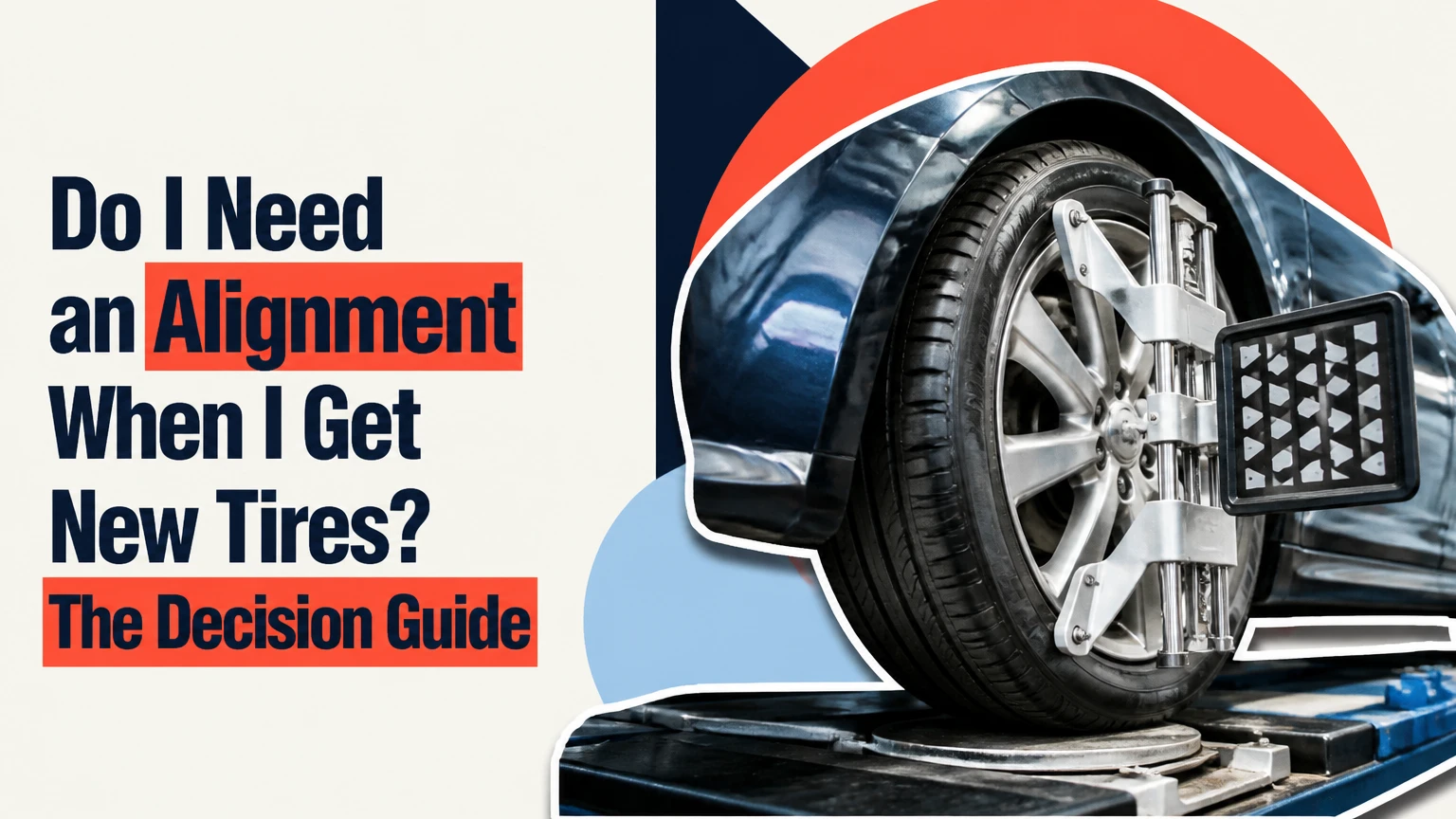
A professional alignment normally includes inspection, measurements, adjustment, and verification, and the complete visit typically takes 45-90 minutes when parts are serviceable. The technician should center the steering wheel, measure all relevant wheels, adjust within manufacturer specifications, tighten hardware, and provide final readings.
Step 1: Inspect Tires, Wheels, and Suspension
The technician checks inflation, tire condition, wheel runout, ball joints, tie rods, control-arm bushings, wheel bearings, springs, and shocks. Loose or damaged parts must be repaired before alignment because they allow the measured angles to change during driving.
Success checkpoint: No unsafe looseness or damaged component remains.
Common mistake: Approving alignment before replacing a worn tie rod.
Step 2: Measure the Vehicle
The vehicle sits on an alignment rack with steering and suspension settled according to the equipment procedure. Cameras, sensors, or targets measure camber, toe, caster, and rear thrust angle against the correct vehicle specification.
Success checkpoint: The report identifies the vehicle and displays before readings.
Common mistake: Accepting a generic specification for a modified or heavily loaded vehicle.
Step 3: Adjust the Available Angles
The technician adjusts tie rods, cams, shims, or other approved components, then centers the steering wheel while setting toe. Not every vehicle provides factory adjustment for every angle, so a red reading may require a replacement part rather than an adjustment.
Success checkpoint: Adjustable readings fall within the appropriate specification range.
Common mistake: Installing aftermarket “camber kits” without diagnosing bent or damaged components.
Step 4: Lock Hardware and Verify
Fasteners are tightened to the manufacturer’s torque requirements, readings are captured again, and the vehicle receives a road test. The final report should show whether the steering wheel is centered and whether the rear thrust angle is acceptable.
Success checkpoint: The car tracks normally and the final report documents corrected values.
Common mistake: Leaving with a crooked steering wheel because the numeric readings look acceptable.
Can a Bad Suspension Part Make Alignment Useless?
A worn or bent steering or suspension part can make an alignment temporary or impossible. Ball joints, tie rods, control-arm bushings, wheel bearings, springs, and subframes can allow wheel angles to move after the vehicle leaves the alignment rack.
A technician may identify three different conditions:
| Finding | Alignment result | Correct next action |
|---|---|---|
| Adjustment available and hardware sound | Reading can be corrected | Perform alignment |
| Part loose or damaged | Reading will not remain stable | Repair part first |
| Angle outside range with no adjustment | Geometry remains incorrect | Diagnose bend, ride height, or aftermarket need |
| Rusted adjuster | Adjustment may be unsafe or incomplete | Quote hardware and labor before proceeding |
An alignment does not straighten a bent subframe. It does not restore a collapsed bushing or compensate safely for a broken spring. The honest repair order is suspension diagnosis, part replacement, ride-height verification, and alignment last.
One practitioner rule matters here: if a shop recommends alignment but cannot explain which angle is out of specification, which component adjusts it, and what the final reading will be, request the report before authorizing the service.
Do Modern Cars Need ADAS Calibration After Alignment?
A routine wheel alignment does not automatically require full ADAS calibration, but some vehicles require steering-angle sensor procedures or camera and radar checks when alignment changes the vehicle’s direction of travel. The vehicle manufacturer’s repair procedure determines whether calibration is static, dynamic, scan-tool based, or unnecessary.
ADAS includes lane-centering, lane-departure warning, adaptive cruise control, and automatic emergency braking. A rear-thrust or steering-wheel error can affect how a forward-facing camera interprets lane position, while radar alignment depends on sensor mounting and vehicle-specific targets.
Ask the shop:
- Does the vehicle require a steering-angle sensor reset after alignment?
- Does the manufacturer call for ADAS calibration after this repair?
- Can the shop perform the required scan-tool or target procedure?
- Will the invoice identify calibration separately from mechanical alignment?
Calibration is especially relevant after collision repair, windshield replacement involving a camera, suspension-height changes, radar removal, or sensor-bracket damage. A tire change alone usually does not trigger ADAS calibration.
Should I Buy a Lifetime Alignment Package?
A lifetime alignment package can make financial sense for drivers who encounter frequent potholes, own a vehicle with adjustable alignment, or expect several years of service from the same shop. It is usually poor value for a low-mileage driver whose car remains within specification and rarely needs adjustment.
Typical package prices range from $200-$300, so the break-even point is often the second or third paid visit, depending on local alignment pricing. Contract restrictions may include vehicle ownership, appointment fees, excluded repairs, commercial use, lifted vehicles, or a required interval between visits.
| Driver profile | Likely best choice | Reason |
|---|---|---|
| Smooth-road commuter | Pay per inspection or adjustment | Low expected frequency |
| Pothole-heavy city driver | Lifetime plan after terms review | Repeated impact risk |
| Modified suspension owner | Specialist alignment service | Generic package may exclude modifications |
| Track or autocross driver | Custom per-event alignment | Targets change with setup |
| Short-term owner | One documented alignment | Package may not transfer |
A package does not prevent tire damage from incorrect pressure or bad suspension parts. It also does not guarantee that a shop can correct an angle outside the vehicle’s adjustment range.
What Are the Most Common Alignment Mistakes?
The most expensive mistakes involve diagnosing the wrong service, ignoring the rear axle, and treating a damaged suspension component as an alignment setting. Correcting those errors requires documented measurements and a complete inspection rather than a generic “tracking” service.
- Confusing balance with alignment: Highway vibration points toward balance, wheel damage, or tire condition before alignment.
- Skipping the rear measurement: Front-wheel drive does not eliminate rear toe or thrust-angle problems.
- Using tire wear as the only diagnosis: Pressure, rotation history, overload, shocks, and tire construction also shape tread wear.
- Aligning before repairs: Loose joints and bushings invalidate the adjustment.
- Ignoring the steering wheel: A centered numeric reading with a crooked wheel indicates an incomplete procedure or incorrect reference setup.
- Requesting maximum factory adjustment: The best target is the manufacturer’s specification, not automatically the greenest possible number.
- Failing to document the result: Tire mileage warranties may require proof of rotation, inflation maintenance, and alignment.
A second practitioner rule is to compare left and right readings, not merely whether each number falls inside a broad range. Large cross-caster or cross-camber differences can create a pull even when both sides technically remain within limits.
Which Drivers Should Align Immediately With New Tires?
Drivers with uneven wear, a crooked steering wheel, pulling, impact history, or recently replaced steering parts should align immediately with new tires. Drivers without those conditions can request a check and use the result to decide whether adjustment is justified.
The Budget Commuter
Request a free or low-cost four-wheel check if available, then approve adjustment only with documented out-of-spec readings. Correct tire pressure and inspect tread at each rotation.
The Rough-Road Driver
Align after pothole impacts and consider a lifetime package if local pricing makes the second or third visit economical. Inspect wheels for bends because an alignment cannot repair wheel runout.
The AWD Vehicle Owner
Use the vehicle manufacturer’s four-wheel procedure. AWD does not create a separate universal alignment angle, but independent rear suspension and tire-diameter requirements make matching tires and rear geometry especially important.
The Performance Driver
Use manufacturer or specialist targets based on tire type, track use, ride height, and cornering goals. More negative camber can improve cornering contact while increasing inner-edge street wear.
The Owner With ADAS
Choose a facility that can perform the required steering-angle reset and follow the manufacturer’s calibration procedure. Mechanical alignment and ADAS calibration should appear as separate operations on the estimate.
FAQ
Can new tires cause a car to pull?
New tires can reveal or alter the feel of an existing pull, but properly installed tires do not normally change suspension alignment. Unequal pressure, tire conicity, different tread designs, or a defective tire can create pulling after installation. Verify cold pressures, swap tires according to the manufacturer’s procedure, and request alignment readings if the pull persists.
Do tire shops include alignment with new tires?
Some tire shops include an alignment check, while others charge separately for measurement and adjustment. The installation price commonly includes mounting, balancing, valve service, and disposal, but alignment is often an add-on. Ask whether the advertised service measures all four wheels and supplies a before-and-after report.
Can I drive with a crooked steering wheel after new tires?
A short drive to a repair facility is usually reasonable if the vehicle remains controllable, but a crooked steering wheel should not be ignored. It can indicate toe error, rear thrust-angle misalignment, a steering-angle sensor issue, or a damaged suspension component. Avoid high-speed driving until the cause is identified.
Does alignment improve fuel economy?
Correct alignment can reduce tire scrub and rolling resistance when the vehicle was significantly misaligned, but the fuel-economy change is not a guaranteed fixed percentage. Tire pressure, tire compound, speed, load, weather, and driving style often have larger effects. Alignment’s most reliable benefits are stable tracking and reduced irregular wear.
Do I need an alignment after replacing shocks or struts?
An alignment check is recommended after replacing struts, and it is often appropriate after suspension work that changes ride height or disturbs steering geometry. Shock absorbers alone may not alter alignment, but strut removal can change camber or toe on many vehicles. Complete the alignment after all suspension repairs are finished.
Can an alignment fix uneven tire wear?
An alignment can stop new irregular wear when incorrect wheel angles caused the pattern, but it cannot restore rubber already removed from the tread. The technician must also check tire pressure, rotation history, wheel balance, shocks, bearings, and suspension looseness. Replace a tire when wear reaches the legal or manufacturer limit.
The Bottom Line
You do not strictly need an alignment every time you get new tires, because tire replacement does not change wheel geometry. You should request an alignment check when the old tires wore unevenly, the vehicle pulls, the steering wheel is crooked, or the car experienced an impact or suspension repair.
Ask for a four-wheel measurement when appropriate, insist on a suspension inspection, and compare the before-and-after readings with the vehicle manufacturer’s specifications. Do not substitute alignment for balancing, tire-pressure correction, or suspension repair. When those distinctions are clear, the answer to “do I need an alignment when i get new tires” becomes a defensible maintenance decision rather than an automatic upsell.