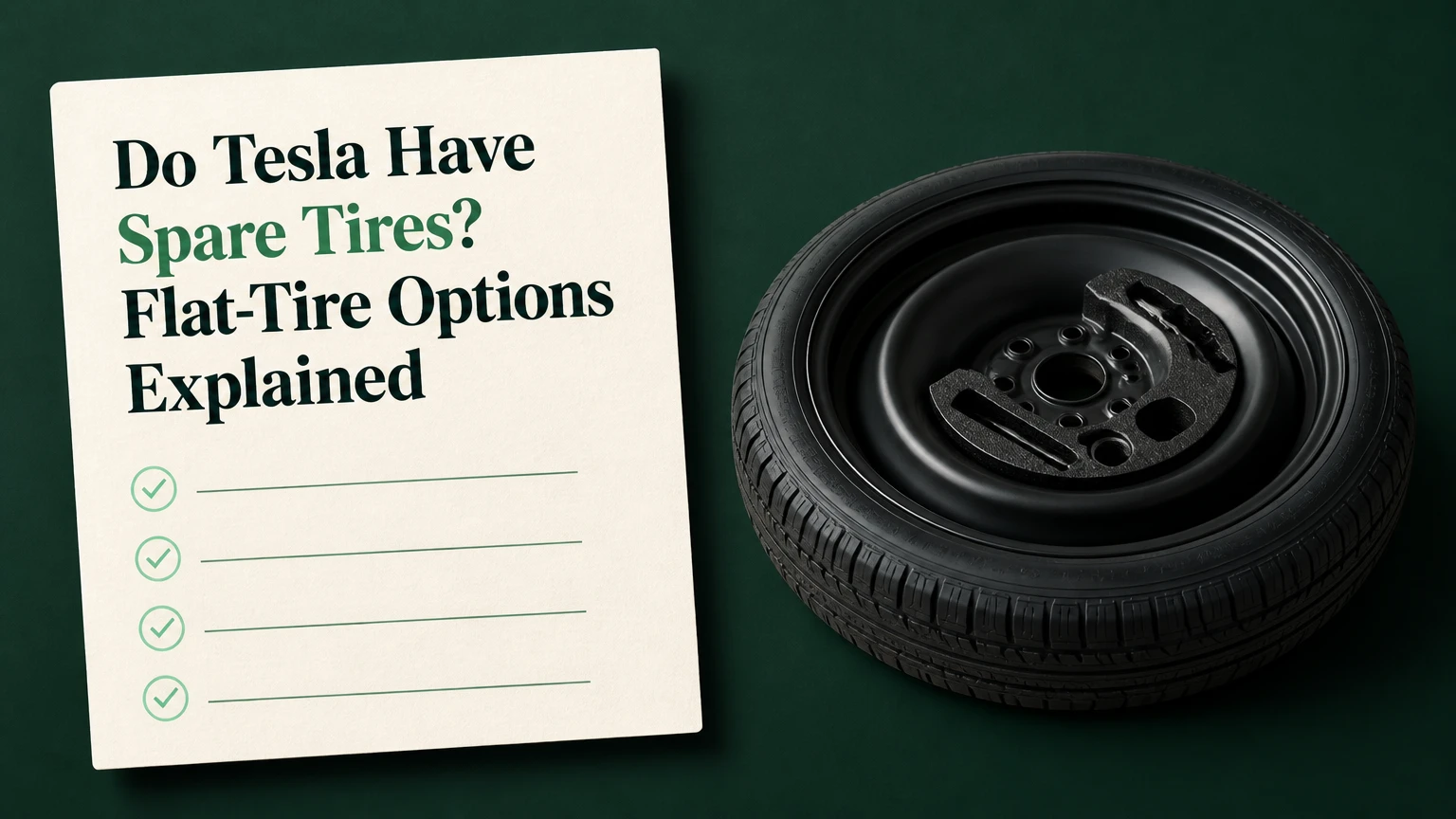
No, Tesla vehicles generally do not come with a factory-installed spare tire. Tesla instead relies on tire-pressure monitoring, roadside assistance, and, for some vehicles or markets, a tire repair kit containing an air compressor and sealant. Owners who regularly drive remotely can carry a model-specific aftermarket spare, jack, and jack pucks.
Key Facts at a Glance
- Tesla Model 3, Model Y, Model S, and Model X deliveries generally exclude a spare wheel and tire.
- Tesla tire repair kits vary by model, market, delivery date, and vehicle equipment.
- Sealant kits usually address small tread punctures, not sidewall cuts, shoulder damage, or bent wheels.
- Most Tesla tires are not run-flat tires, so driving on a fully deflated tire can damage the tire and wheel.
- A Tesla aftermarket spare must clear the vehicle’s brake calipers and meet its load requirements.
- Tesla roadside coverage, eligibility, towing distance, and tire-service charges vary by country and warranty terms.
Do Tesla Vehicles Have Spare Tires From the Factory?
Tesla vehicles generally have no spare tire, temporary donut, jack, or lug wrench in the standard delivery equipment. That answer applies across the main Tesla range, including Model 3, Model Y, Model S, and Model X, although supplied accessories can change by market, production period, and purchase package.
Tesla’s design choice follows the wider automotive trend of deleting spare wheels. A spare assembly can weigh approximately 15-30 kilograms, occupies underfloor or trunk volume, and requires a jack, tools, mounting hardware, and crash-storage provisions. In an electric vehicle, reducing mass can improve efficiency, while eliminating the wheel creates additional storage space around the cabin and cargo areas.
The factory decision does not mean Tesla owners have no flat-tire options. It means the owner must plan for an immobilizing puncture through a repair kit, mobile tire service, a tow provider, or a compatible spare kit.
Which Tesla Models Need Separate Flat-Tire Equipment?
Every Tesla model should be treated as a no-spare vehicle unless the owner has verified a separately purchased wheel and tire. Model 3 and Model Y owners have many aftermarket choices, while Model S and Model X owners need especially careful brake-clearance and load-rating checks because wheel sizes and performance brakes vary.
| Tesla vehicle | Factory spare status | Common aftermarket approach | Main fitment concern |
|---|---|---|---|
| Model 3 | Normally no spare | Compact spare kit or tire-service equipment | Performance brake clearance |
| Model Y | Normally no spare | Model-specific compact spare | Wheel diameter, load rating, cargo storage |
| Model S | Normally no spare | Larger fitted spare kit | Brake package and tire circumference |
| Model X | Normally no spare | Heavy-duty compatible spare | Vehicle mass and caliper clearance |
| Cybertruck | Equipment varies by configuration | Specialized full-size or temporary spare | Extreme weight, wheel design, and availability |
Owners of used Teslas should inspect the front trunk, trunk well, and side storage before buying equipment. A previous owner may have left a compressor, plug kit, jack pucks, or a spare, but those items should not be assumed to fit the current vehicle.
Why Does Tesla Omit the Spare Wheel?
Tesla omits the spare wheel to reduce vehicle mass, preserve cargo volume, simplify production, and avoid storing a large wheel near the high-voltage battery enclosure. The trade-off is practical rather than mysterious: a Tesla owner gains space and efficiency but loses immediate self-recovery after a severe puncture.
A spare tire is also less useful when tire sizes differ between axles or when a vehicle uses large performance brakes. Tesla would need to validate wheel clearance, tire circumference, load capacity, and handling behavior across multiple wheel packages. One universal spare would not safely fit every Model 3, Model Y, Model S, or Model X configuration.
The deletion also reflects changes in roadside-service expectations. Manufacturers increasingly expect drivers to use inflators, sealant, mobile repair, or towing. That arrangement works well in dense urban areas, but it becomes less convenient on remote highways, during severe weather, or when a vehicle suffers two damaged tires.
What Comes With a Tesla for a Flat Tire?
A Tesla may include no flat-tire repair equipment, or it may include a tire mobility kit depending on the vehicle’s market and delivery configuration. The kit typically contains a 12-volt compressor, a sealant container, a hose, and instructions; owners should verify the actual contents in the vehicle or Tesla account rather than relying on another model’s equipment.
A compressor alone only restores air temporarily when the tire still holds pressure. Sealant adds a chemical plugging function, but it cannot restore a tire with a torn sidewall, separated tread, severely damaged bead, or bent wheel.
Tesla Model 3 Owner’s Manual guidance states: “Do not drive with a flat or damaged tire, even if the tire is not completely deflated.” That warning matters because a tire can look repairable while its sidewall and wheel are already suffering internal damage.
What Does a Tire Mobility Kit Actually Fix?
A tire mobility kit is intended for a small puncture in the central tread area. Typical manufacturer limits are approximately 6 millimeters for the puncture diameter and 100 kilometers, or 62 miles, of cautious travel after inflation, but the exact limits belong to the supplied kit’s instructions.
| Damage condition | Sealant kit result | Recommended action | Typical outcome |
|---|---|---|---|
| Nail in central tread | May seal temporarily | Inflate and drive to tire shop | Inspection and likely replacement or repair |
| Screw hole, 3-5 mm | May seal temporarily | Follow kit limit | Temporary mobility only |
| Sidewall cut | Will not safely repair | Tow vehicle | Tire replacement |
| Bent wheel | Cannot repair wheel | Tow or wheel service | Wheel repair or replacement |
| Two flat tires | One kit is insufficient | Request towing or mobile service | Vehicle recovery required |
Sealant can contaminate the tire’s interior and complicate later inspection. Some products can also interfere with a tire-pressure monitoring system sensor. A tire shop may charge for cleaning, sensor replacement, or disposal in addition to fitting a new tire.
Can You Plug a Tesla Tire Instead of Using Sealant?
A puncture plug can be a useful roadside measure for a small tread hole, but an externally inserted plug is not automatically a permanent tire repair. The tire must be removed and inspected internally by a qualified technician, who decides whether a combination patch-plug repair is permitted.
A plug kit, often called a bacon-strip kit, uses a reaming tool, insertion tool, rubber plug, and cement. It avoids liquid sealant and usually does not contaminate the TPMS sensor, but it requires enough force to prepare and fill the puncture. The method is unsuitable for sidewalls, shoulders, overlapping punctures, exposed cords, or tires driven while flat.
The U.S. Tire Manufacturers Association recommends professional internal inspection for puncture repairs and limits repairable damage to the tread area under defined conditions. A plug can restore mobility; it does not prove the casing is safe.
Which Emergency Repair Method Is Better?
The best emergency method depends on puncture location, owner skill, and access to a tire shop. A compressor is the least invasive tool, a plug can preserve the tire when correctly applied, and sealant is the fastest option for an owner who cannot safely perform a mechanical repair.
| Emergency option | Typical cost | Setup time | Best use | Main limitation |
|---|---|---|---|---|
| 12-volt compressor | $30-$100 | 5-15 minutes | Slow leak or low pressure | Cannot seal a hole |
| Plug kit | $15-$40 | 15-30 minutes | Small central tread puncture | Requires tools and inspection |
| Sealant kit | $50-$125 | 10-20 minutes | Temporary mobility | May contaminate tire and sensor |
| Mobile tire service | $80-$250 typical callout | 30-120 minutes | Repair or replacement roadside | Availability varies by location |
| Tow truck | $100-$300 typical out-of-pocket range | 1-4 hours | Severe damage or no safe repair | Cost and wait time can increase |
A practical owner’s kit contains a compressor, pressure gauge, plug kit, flashlight, gloves, reflective warning equipment, and jack pucks if the owner carries a spare. Sealant is a backup rather than a substitute for a recovery plan.
How Much Does a Tesla Spare Tire Setup Cost?
A complete aftermarket Tesla spare setup typically costs about $350-$700, depending on the wheel, tire, jack, storage bag, and vehicle model. A basic compressor and plug kit usually costs $45-$140, while roadside towing can cost more than either option when coverage excludes tire damage.
Modern Spare and T Sportline are examples of aftermarket suppliers that offer Tesla-oriented wheel-and-tire packages. Product specifications are not interchangeable: a kit designed for a Model 3 may not clear a Model 3 Performance brake assembly, and a Model Y kit may not meet the needs of a Model X.
| Purchase or service | Typical price | What the price includes | Important variable |
|---|---|---|---|
| Compressor | $30-$100 | 12-volt inflator | Inflation speed and power cable length |
| Sealant mobility kit | $50-$125 | Compressor and sealant bottle | Vehicle market and replacement cartridge |
| Plug kit | $15-$40 | Tools, plugs, cement | Tool quality and user skill |
| Compact spare kit | $350-$700 | Wheel and tire, sometimes tools | Tesla model, brake clearance, accessories |
| Replacement tire | $180-$600 each | Tire only | Size, brand, speed rating, acoustic foam |
| Roadside tow | $100-$300 typical | Local recovery service | Distance, region, membership, coverage |
Prices are typical U.S. consumer ranges, not Tesla-guaranteed prices. Tire replacement can become expensive when a damaged tire must be matched closely to the remaining tires, especially on all-wheel-drive vehicles.
Does Tesla Roadside Assistance Bring a Spare Wheel?
Tesla Roadside Assistance may provide towing or mobile tire support, but owners should not assume that a technician will bring a compatible loaner wheel. Coverage, service limits, charges, and available equipment vary by country, vehicle warranty, tire-hazard policy, and local contractor inventory.
Tesla generally directs owners to request roadside help through the Tesla app. The service may arrange a tow to a Tesla Service Center or another approved location. Some regions have mobile tire support or temporary loaner wheels, but those resources are limited and cannot be treated as guaranteed spare-tire delivery.
A flat caused by a road hazard may fall outside the vehicle warranty even when the vehicle itself remains under warranty. Tesla’s regional roadside terms should be checked before a trip, particularly for towing distance, trip interruption, tire damage, and after-hours service.
What Should You Tell Roadside Assistance?
Give the operator the Tesla model, exact location, direction of travel, tire position, damage type, and whether the wheel is touching the ground. State that the vehicle is electric and requires correct lifting points and suitable wheel protection.
Use the Tesla app when possible because it can transmit vehicle location and identification. If the vehicle blocks a traffic lane, move occupants behind a barrier when safe, activate hazard lights, and call emergency services for immediate roadway danger.
Can You Install an Aftermarket Spare on a Tesla?
You can install an aftermarket spare on some Tesla vehicles, provided the wheel clears the brake caliper, supports the axle load, uses the correct bolt pattern and hub fit, and has a compatible tire circumference. Compatibility must be verified for the exact model, wheel package, drivetrain, and performance-brake configuration.
A temporary spare changes handling and may alter traction-control behavior. Manufacturers commonly impose a reduced speed limit, often 50 mph or the spare supplier’s stated limit, even when a particular product advertises a higher rating. The vehicle owner’s manual and spare manufacturer’s instructions control.
A compact spare should be used only to reach a tire shop. It is not a replacement for four matching tires, and it should not be used for extended high-speed travel, towing, aggressive cornering, or prolonged all-wheel-drive operation unless the manufacturer explicitly permits those conditions.
What Tools Are Needed to Change a Tesla Wheel?
A safe wheel change requires a model-compatible spare, jack, lug-nut socket, torque wrench, wheel chocks, gloves, and correctly sized jack pucks. Tesla vehicles have designated lift points, and the puck prevents the jack from contacting sensitive underbody structures or the battery enclosure.
| Tool or item | Typical specification | Why it matters | Common failure |
|---|---|---|---|
| Jack pucks | Model-specific lift-point adapter | Protects the lift point | Jacking under the battery tray |
| Floor or scissor jack | Capacity above vehicle axle load | Raises the vehicle | Unstable or undersized jack |
| Torque wrench | Common range 100-200 Nm | Controls lug tightening | Over-tightened or loose fasteners |
| Chocks | Rubber or metal pair | Prevents movement | Vehicle rolls during lifting |
| Spare wheel | Verified brake clearance | Provides temporary mobility | Caliper interference |
| Pressure gauge | Accurate to at least 1 psi | Confirms inflation | Driving an underinflated spare |
Tesla wheel torque specifications differ by model and wheel hardware. The often-cited 175 Nm, or 129 lb-ft, figure applies to some Model 3 and Model Y configurations, but owners must use the current manual for their vehicle rather than applying that number universally.
How Do You Change a Tesla Tire With a Spare?
Change a Tesla wheel only on firm, level ground away from traffic, and use the prescribed lift point with a jack puck. The basic process is to secure the vehicle, loosen the lug nuts, lift the correct point, replace the wheel, lower the car, and torque the fasteners to the model-specific specification.
- Secure the Tesla. Park away from traffic, select Park, activate the parking brake, switch on hazard lights, and place chocks on the opposite side.
- Check the damage. Do not jack the vehicle if the tire is unstable, the wheel is cracked, or the vehicle sits on a dangerous shoulder.
- Loosen the lug nuts. Break each nut loose slightly while the wheel remains on the ground. Do not remove them yet.
- Position the jack puck. Place the puck in the designated lift point and center the jack beneath it. Never lift under the battery tray, suspension arm, or rocker panel.
- Raise the vehicle. Lift only until the damaged tire clears the ground. Keep all body parts outside the underside area.
- Install the spare. Fit the wheel, start every lug nut by hand, and tighten in a star pattern.
- Lower and torque. Lower the vehicle fully, then use a calibrated torque wrench at the manual’s specification.
- Confirm the result. Inflate the spare to its stated pressure, drive slowly, and check for vibration, warning messages, rubbing, or loose hardware after a short distance.
The success checkpoint is a stable wheel with correct pressure, no brake interference, and no vibration. A common mistake is treating the jack puck as optional. It is not optional.
Are Tesla Tires Run-Flat Tires?
Most Tesla tires are not run-flat tires, although a particular vehicle may have specially marked tires or a tire package with limited self-support capability. Owners should inspect the sidewall for run-flat markings and verify the tire specification instead of assuming that electric vehicles use run-flat construction.
A conventional tire loses structural support when fully deflated. Driving even a short distance can destroy the sidewall, unseat the bead, damage the rim, and create a tire that cannot be repaired. Acoustic foam inside some Tesla tires reduces cabin noise but does not make the tire run-flat.
Foam-lined tires can create an additional service issue. A puncture repair may require the technician to manage detached or cut foam, and the shop may recommend replacement if the foam or casing has been damaged.
What Happens if a Tesla Gets a Flat on a Road Trip?
A road-trip Tesla should carry an air compressor, puncture kit, emergency lighting, and either a verified spare or a recovery plan that works outside urban service areas. Remote drivers face longer tow waits, limited tire inventories, weak cellular coverage, and repair shops that may not stock Tesla tire sizes.
A spare kit offers the fastest route back onto the road after a repairable wheel change, but it consumes cargo space and adds weight on every trip. Roadside assistance reduces equipment burden but transfers the risk to response time and local service capacity.
Which Flat-Tire Setup Fits Each Driver?
| Driver situation | Recommended equipment | Typical reason | Backup requirement |
|---|---|---|---|
| Urban commuter | Compressor and plug kit | Shops and towing are usually nearby | App access and roadside plan |
| Rural road-tripper | Model-specific spare kit | Tow distances can exceed 100 miles | Correct pucks and torque wrench |
| Family traveling with children | Spare, compressor, warning gear | Minimizes roadside exposure time | Confirm cargo storage |
| Winter mountain traveler | Spare plus winter-rated recovery gear | Cold reduces pressure and delays service | Chains or traction equipment where legal |
| Used-Tesla buyer | Pressure gauge and inspected kit | Existing equipment may be missing or expired | Check tire age and roadside terms |
A spare is most valuable when the consequence of waiting is high. That includes remote travel, overnight driving, extreme weather, limited phone service, and journeys where a delayed arrival creates safety or financial problems.
What Are the Most Common Tesla Flat-Tire Mistakes?
The most expensive Tesla flat-tire mistakes involve driving on a deflated tire, using the wrong lift point, assuming a sealant kit fixes every puncture, and buying a spare without checking brake clearance. Each error can turn a manageable tire problem into wheel, suspension, sensor, or battery-related damage.
- Driving several miles on low pressure: Stop as soon as safely possible. Inspect the sidewall and wheel before attempting inflation.
- Using a generic jack point: Require the tow operator or shop to use Tesla-approved lift locations and suitable adapters.
- Repairing sidewall damage with sealant: Replace the tire or arrange a tow. Sidewall damage is not a safe sealant repair.
- Buying by model name alone: Confirm wheel diameter, brake package, bolt pattern, hub bore, load rating, and tire circumference.
- Ignoring tire age: Sealant cartridges expire, compressors fail, and spare tires age even when unused.
- Using a temporary spare for normal driving: Travel directly to a tire shop and follow the supplier’s speed limit.
- Failing to check pressure after storage: A spare stored for months can lose pressure and become unusable when needed.
One practitioner rule is worth remembering: test every emergency tool before a long trip. Inflate a tire with the compressor, inspect the plug tools, locate the pucks, and verify that the torque wrench operates correctly.
How Should You Prepare a Tesla for Flat-Tire Emergencies?
Prepare a Tesla by checking tire pressures monthly, inspecting tread and sidewalls, recording the tire size, confirming roadside coverage, and storing recovery tools where they remain accessible with a full cargo area. Preparation takes about 20 minutes and costs roughly $50 for basic equipment or $350-$700 for a complete spare system.
Check the driver-door label for the recommended cold pressure. Tesla’s touchscreen reports pressure, but a separate gauge helps confirm a reading when a sensor or display is unreliable.
Before a long journey, verify that:
- The tire tread has no exposed cords, bulges, or irregular wear.
- The compressor reaches the tire’s required pressure.
- The sealant cartridge is within its expiration date.
- The spare fits the vehicle’s brakes and has adequate pressure.
- Jack pucks, tools, gloves, and warning devices are present.
- Tesla roadside terms apply to the country and route.
- A second damaged tire would not leave the recovery plan unusable.
Tesla vehicles gain storage and efficiency by omitting the factory spare, but the owner assumes more responsibility for recovery planning. The right choice depends on where the car travels, not merely how often it has suffered a puncture.
FAQ
Can I buy a Tesla spare tire directly from Tesla?
Tesla generally does not provide a universal factory spare-tire package for its current passenger vehicles. Owners usually buy a model-specific aftermarket wheel and tire from a specialist supplier, then verify brake clearance, load rating, pressure, and instructions for the exact Tesla configuration.
Does Tesla pay for a flat tire under warranty?
A standard vehicle warranty does not automatically cover punctures caused by nails, screws, potholes, or other road hazards. Tesla roadside terms and any separate tire-hazard coverage determine whether towing or tire service is free, discounted, or chargeable in a specific market.
Can I drive a Tesla with a nail in the tire?
Drive only far enough to reach a safe stopping location if pressure remains stable and the tire is not visibly damaged. Do not continue normal driving on a leaking tire. A tire professional must inspect the puncture, because location, depth, internal damage, and previous low-pressure driving determine repairability.
Does Tesla include a jack?
Tesla passenger vehicles generally do not include a conventional jack for routine owner tire changes. An aftermarket spare package may include a jack, but owners still need compatible jack pucks and must use the lift points specified for the vehicle.
Will a Tesla spare trigger warning lights?
Installing a spare with a different tire circumference or a wheel without a recognized TPMS sensor can trigger tire-pressure or traction-control warnings. The vehicle may need time to recognize the new sensor, and some temporary spares may require manual pressure monitoring until the original wheel is restored.
Should I carry sealant or a plug kit in a Tesla?
Carry a compressor first, then choose a plug kit, sealant, or both according to your skills and travel area. A plug avoids liquid contamination but requires correct insertion and later internal inspection, while sealant is simpler but can complicate tire and TPMS service. A remote traveler should add a compatible spare.