Yes, many original-equipment Tesla tires contain a strip of acoustic polyurethane foam bonded to the inside of the tread area. The foam reduces tire cavity resonance and road noise, but Tesla does not put foam in every tire, and replacement tires may use different construction. A sidewall marking, tire model, and physical inspection provide the reliable answer.
Key Facts at a Glance
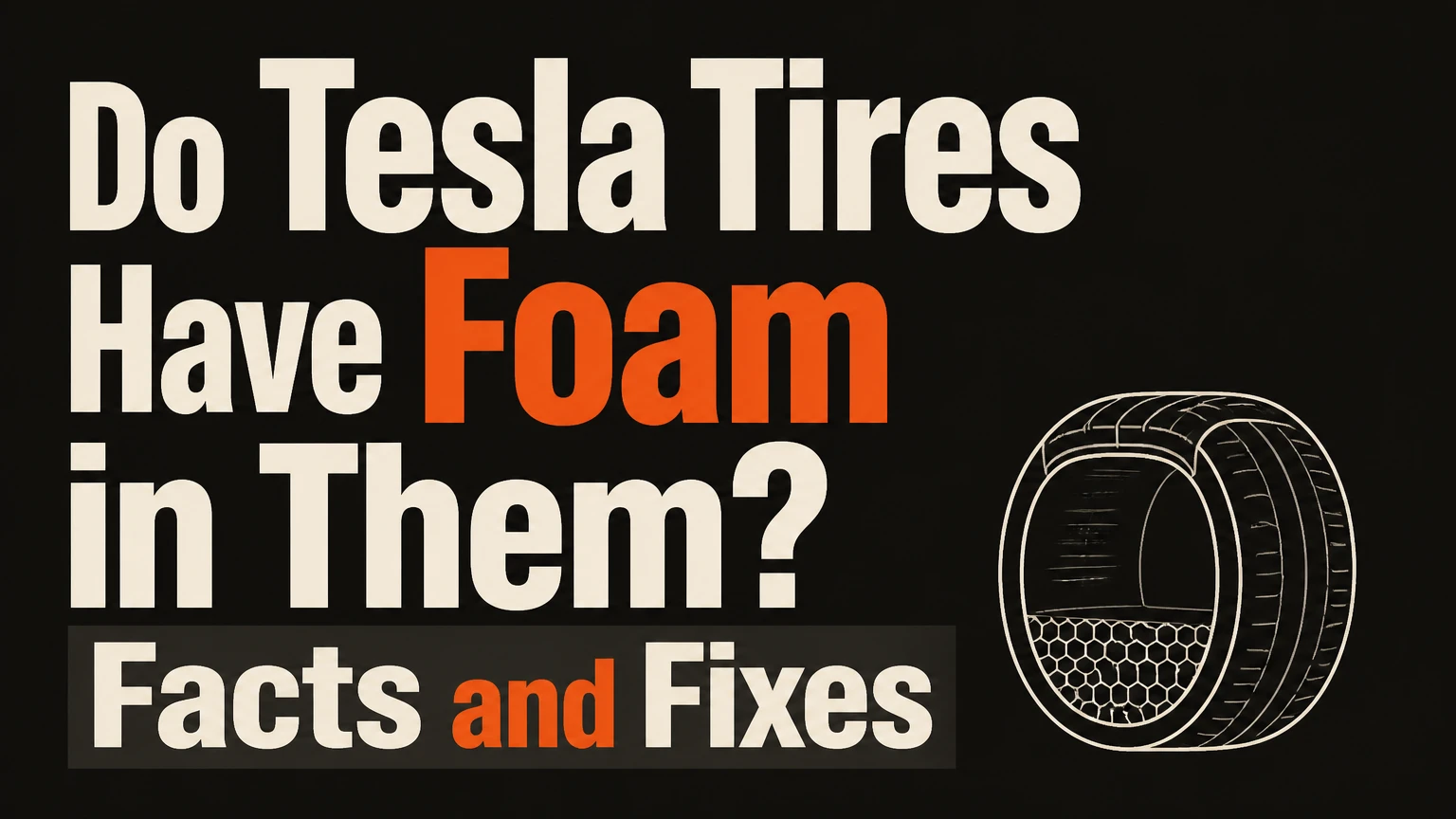
Acoustic foam in a Tesla tire is usually an open-cell polyurethane strip glued to the inner liner beneath the tread.
The foam reduces resonance from air vibrating inside the tire, rather than improving traction, braking, or puncture resistance.
Tesla-approved tires may carry T0, T1, or T2 markings, while manufacturers use names such as Michelin Acoustic Technology, ContiSilent, PNCS, and SoundComfort.
A foam-lined tire can sometimes be repaired, but the tire must first pass the same puncture-location, size, and structural-damage checks as any other tire.
Typical replacement pricing ranges from about $180 to $475 per tire, depending on model, size, performance rating, and location.
Detached foam can create a high-speed vibration that resembles severe wheel imbalance.
What Is Tesla Acoustic Tire Foam?
Tesla acoustic tire foam is a lightweight polyurethane insert attached to the tire’s inner liner. The insert usually forms a wide strip around part of the circumference beneath the tread, where it interacts with the air cavity rather than the road surface.
A foam-lined tire is still an ordinary pneumatic tire in its basic safety system. The rubber tread, carcass, belts, bead, air pressure, wheel, and TPMS sensor carry the operating load. The foam does not fill the tire, support the vehicle, seal punctures, or act as run-flat material.
The purpose is acoustic control. A rotating tire creates vibration and causes the air inside the tire to resonate at particular frequencies. That resonance can produce a hollow hum, especially on coarse concrete or at highway speeds. Acoustic foam absorbs some of that energy before it reaches the wheel and suspension.
The feature matters more in an EV because an electric drivetrain produces less continuous background noise than an internal-combustion engine. Tesla therefore makes tire, wheel, suspension, and sealing choices that can make road noise more noticeable inside the cabin.
Is the foam inside the tire dangerous?
No, properly bonded acoustic foam is not inherently dangerous, and it does not touch the pressurized air cavity in the way an inner tube would. The safety issue arises when the foam separates, a tire is damaged, or an unqualified repair changes the tire’s structure.
Foam also does not make a tire puncture-proof. A nail can still penetrate the tread, and driving while underinflated can still damage the sidewall and internal cords.
Do All Tesla Tires Have Foam?
No, all Tesla tires do not have foam. Many Tesla vehicles leave the factory with acoustic tires, but the exact fitment varies by model year, wheel package, market, tire supplier, performance version, and replacement history.
A Tesla Model 3, Model Y, Model S, or Model X can have different original-equipment tire specifications across production periods. A vehicle that originally used a foam-lined Michelin or Continental tire may later receive a non-acoustic replacement because the owner selected a different model or because the original tire was unavailable.
Tesla-approved marking and acoustic construction are related but not identical concepts. A tire can have an automaker approval code without the same acoustic insert found on another fitment, so buyers should verify the complete tire model and specification rather than relying on one letter or number.
How can you tell if a Tesla tire has foam?
The fastest method is to read the sidewall and identify the complete tire model. Look for an acoustic technology name or a manufacturer-specific designation, then confirm the product page or technical data for the exact size.
| Tire manufacturer | Acoustic technology name | What to check |
|---|---|---|
| Michelin | Acoustic Technology, often abbreviated MAT | Exact model, size, and acoustic suffix |
| Continental | ContiSilent | Product listing for the specific Tesla fitment |
| Pirelli | PNCS | Tire model and complete sidewall specification |
| Goodyear | SoundComfort | Exact product family and OE application |
| Hankook | Sound Absorber | Model name, size, and load rating |
| Tesla OE fitment | T0, T1, or T2 marking | Approval code plus the complete tire model |
The most certain physical method requires tire removal from the wheel. A technician can inspect the inner liner and see whether a bonded foam strip is present. Do not attempt to unseat a tire at home, because demounting requires proper equipment and can damage the bead or wheel.
How Does the Foam Reduce Road Noise?
Acoustic foam reduces tire cavity noise by damping pressure waves inside the tire. As the tread contacts the road, the casing flexes and the air volume inside the tire vibrates; the foam absorbs part of that vibration and reduces the resulting resonance transmitted through the wheel.
The strongest effect usually occurs around a narrow band of frequencies rather than across the entire sound spectrum. That is why a driver may notice less low-frequency drumming without experiencing a dramatic reduction in every road sound.
Published and manufacturer-linked descriptions commonly report reductions of approximately 3-9 decibels at selected frequencies, but that figure is not a guaranteed cabin-noise reduction. Road surface, tire wear, inflation pressure, speed, vehicle insulation, wheel size, and measurement position can change the result substantially.
A 3 dB reduction represents less acoustic energy, while a 9 dB change at a particular frequency can sound substantial. Neither number means the entire cabin becomes three to nine decibels quieter under every driving condition.
Does acoustic foam improve ride quality or range?
Acoustic foam primarily targets noise, not ride comfort or driving range. A quieter tire may feel more refined, but sidewall stiffness, tire pressure, wheel diameter, compound, and suspension tuning determine most ride-quality differences.
The foam’s mass is typically small, often estimated at roughly 0.45 kg, or 1 pound, per tire. That amount has a negligible range effect compared with tire compound, tread depth, temperature, speed, weather, and aerodynamic conditions. Acoustic foam should not be selected as a range-extending feature.
What Specifications Matter When Replacing Them?
The replacement must match the Tesla’s required tire size, load index, speed rating, construction, and seasonal use. Acoustic branding is secondary to those safety and fitment requirements.
| Specification | Example value | Why it matters |
|---|---|---|
| Tire size | 255/45R19 | Must match wheel diameter and approved section dimensions |
| Load index | 104 | Sets the rated load capacity for the vehicle axle |
| Speed rating | W, 168 mph | Must meet or exceed the vehicle’s required rating |
| Construction | XL, extra load | Supports higher vehicle mass and operating load |
| Treadwear rating | 500 | Gives a comparative wear category, not a mileage guarantee |
| Season designation | M+S or 3PMSF | Indicates all-season or severe-snow capability |
| Acoustic feature | ContiSilent, PNCS, MAT | Controls resonance, not load or puncture safety |
EVs can be heavier than comparable gasoline vehicles because of their battery packs. Instant motor torque can also place high demands on tread compound and traction. A tire with the correct physical size but an insufficient load index is not an acceptable substitute.
Tesla-approved T0, T1, and T2 versions may include changes to compound, casing, rolling resistance, noise tuning, or handling. Those versions can be useful when replacing one worn tire, but the vehicle’s tire placard and the tire manufacturer’s fitment data remain the primary references.
Are Tesla Acoustic Tires Worth Buying?
Tesla acoustic tires are usually worth the extra cost for drivers who prioritize low cabin noise, drive frequently on coarse pavement, or want to preserve the vehicle’s original noise characteristics. Standard tires can be the better choice for owners who prioritize local availability, lower purchase price, and easier service.
| Decision factor | Acoustic tire | Standard tire | Practical consequence |
|---|---|---|---|
| Typical tire price | $180-$475 | $150-$425 | Acoustic construction may add roughly $20-$50 per tire |
| Highway resonance | Lower at target frequencies | More audible on some surfaces | Difference is clearest in quiet cabins |
| Repair access | Fewer willing shops | Nearly universal tire-service access | Foam may require a specialist |
| Range effect | Usually negligible mass penalty | No foam mass | Compound and pressure matter more |
| Replacement availability | Exact OE model may be limited | More aftermarket choices | Non-OE options can reduce wait time |
| Best use case | Long highway trips and quiet-cabin preference | Budget, convenience, and broad service access | Match the choice to driving priorities |
The cost premium is not automatically justified for every Tesla. Tire noise can be masked by music, traffic, or urban speeds, while the same vehicle can expose the difference immediately on grooved concrete at 70 mph.
Acoustic foam also cannot compensate for an unsuitable tire. A quiet but poorly matched tire with the wrong load rating is a worse choice than a correctly specified conventional tire.
Which Tesla tire type suits each driver?
- Quiet-cabin driver: Choose the correct acoustic OE specification, such as a verified MAT, ContiSilent, PNCS, or SoundComfort fitment.
- Budget commuter: Consider a correctly rated conventional tire when local road noise and long-distance comfort are less important.
- High-mileage driver: Give greater weight to treadwear, repair access, warranty terms, and regional availability.
- Snow-belt driver: Choose a dedicated winter tire or 3PMSF-rated option based on temperature and snow conditions, whether or not it contains foam.
- Performance driver: Prioritize load index, speed rating, dry and wet grip, alignment, and heat tolerance before acoustic construction.
Can a Tire Shop Repair a Tesla Tire With Foam?
A qualified tire shop can sometimes repair a foam-lined Tesla tire, but the tire must meet normal repair criteria and the technician must follow the tire maker’s procedures. Shops may refuse because accessing the inner liner can require moving or cutting the foam, and some businesses prohibit any modification to the acoustic insert.
A repair is generally considered only when the puncture lies in the repairable tread area, the hole is within the manufacturer’s permitted size, the tire was not driven severely underinflated, and the internal structure is undamaged. Sidewall, shoulder, bead, belt, and run-flat-like damage normally require replacement rather than repair.
The preferred professional repair is an internal plug-patch or combination repair after the tire is removed and inspected. An external string plug may provide temporary roadside mobility, but it is not a universal substitute for an internal inspection.
What happens during a professional repair?
- Remove and inspect the tire. The technician locates the puncture and checks the tread, inner liner, belts, bead, and evidence of low-pressure driving.
- Expose the repair area. A small section of foam may be moved, trimmed, or removed to reach clean rubber.
- Prepare the injury. The technician follows the repair manufacturer’s reaming and buffing requirements.
- Install an approved repair. An internal patch or plug-patch seals the injury from inside and fills the puncture channel.
- Rebalance and leak-test the assembly. The tire is inflated to specification, checked for leaks, and balanced before refitting.
- Document the result. The owner should receive confirmation that the tire remains within repair limits.
Do not instruct a technician to repair a tire merely because the hole looks small from outside. Internal belt damage can exist without an obvious external symptom.
What Happens When Tesla Tire Foam Comes Loose?
Detached acoustic foam can produce a repeating vibration that feels like wheel imbalance, especially at highway speed. The foam may separate from its adhesive, fold into a heavy clump, and shift position as the tire rotates.
A driver may notice steering-wheel shake, seat vibration, or a vibration that appears within a narrow speed range. The symptom can resemble a bent wheel, missing balance weight, tire belt separation, or uneven tread wear, so foam detachment should not be assumed without inspection.
A technician should inspect the tire internally and balance the wheel. If the foam has detached extensively, the usual correction is to remove the loose foam completely, inspect the tire for damage, repair or replace the tire as appropriate, and rebalance the assembly.
| Vibration cause | Typical onset or clue | Correct diagnostic action |
|---|---|---|
| Detached acoustic foam | Highway-speed shake after foam separation | Demount and inspect the inner liner |
| Lost wheel weight | Vibration begins after wheel service or impact | Check balance weights and rebalance |
| Bent wheel | Persistent shake after pothole impact | Measure wheel runout |
| Belt separation | Wobble, bulge, or changing tread shape | Remove tire from service immediately |
| Uneven wear | Rhythmic hum and tread cupping | Inspect alignment, rotation, and suspension |
| Low pressure | Pulling, heavy steering, or warning light | Check pressure before driving farther |
Removing foam does not restore the tire’s acoustic performance. A tire can often operate without the foam if the casing and tread remain sound, but the final decision belongs to the tire manufacturer’s guidance and the inspecting technician.
How Much Do Tesla Foam Tires Cost?
A typical Tesla acoustic replacement tire costs about $180-$475 before or after installation, depending on size, performance category, brand, market, taxes, and availability. Large Model S and Model X performance fitments can exceed that range, while smaller Model 3 or Model Y sizes may cost less.
| Tesla vehicle example | Common wheel size | Typical acoustic tire price | Typical installed set |
|---|---|---|---|
| Model 3 standard fitment | 18 inches | $150-$260 | $700-$1,150 |
| Model 3 performance fitment | 20 inches | $250-$425 | $1,150-$1,850 |
| Model Y standard fitment | 19 inches | $190-$320 | $850-$1,400 |
| Model Y larger fitment | 21 inches | $275-$475 | $1,250-$2,050 |
| Model S or Model X performance | 20-22 inches | $300-$600 | $1,400-$2,600 |
These are typical market ranges, not Tesla price guarantees. Installation can add $25-$60 per tire, while disposal, alignment, road-hazard coverage, mobile service, and expedited ordering can increase the invoice.
Replacing one tire can also create a tread-depth mismatch. If the remaining tires are significantly worn, a shop or manufacturer may recommend replacing two tires on one axle or using a permitted tire-shaving service. The correct decision depends on drivetrain requirements, tread difference, and the tire maker’s limits.
Can You Replace Foam Tires With Regular Tires?
Yes, a correctly sized and rated Tesla can use a conventional non-foam tire when the replacement meets the vehicle’s load, speed, construction, seasonal, and fitment requirements. The main trade-off is potentially greater road noise, not an automatic loss of vehicle safety.
A standard tire may be preferable when an acoustic model is unavailable, costs substantially more, or cannot be serviced locally. The replacement should still have an appropriate load index, speed rating, casing design, and EV-compatible wear and torque characteristics.
Avoid mixing unlike tires casually. One foam tire and one conventional tire on the same axle may create an uneven acoustic experience, but noise is less important than matching size, construction, load capacity, tread pattern, and manufacturer restrictions.
For a two-tire replacement, follow the tire retailer’s axle-placement guidance. Many vehicles perform best with the newest tires on the rear axle, but Tesla-specific fitment and all-wheel-drive requirements should control the final arrangement.
What About Winter and Aftermarket Tesla Tires?
Winter tires do not automatically contain acoustic foam. Some premium winter products offer acoustic versions, while many conventional winter tires do not because their tread blocks, compounds, and seasonal use already produce a different noise profile.
Aftermarket tires are acceptable only when their specifications suit the vehicle and driving conditions. A non-OE tire can deliver better snow traction, longer tread life, or lower cost, but those benefits may come with more noise, different steering response, or altered energy consumption.
Used tires require extra caution. Check the DOT date code, remaining tread, repair history, sidewall condition, bead damage, uneven wear, and whether the tire has previously experienced a foam separation event. A used acoustic tire with hidden internal damage is not a bargain.
What should you carry after choosing non-foam tires?
A portable compressor and a pressure gauge are useful for any Tesla, regardless of foam. A tire plug kit can help with temporary roadside mobility for a suitable tread puncture, but it does not replace professional inspection or authorize repair of a shoulder or sidewall injury.
Tesla vehicles may not include a conventional spare tire. Confirm roadside-assistance coverage, understand the vehicle’s lifting points, and keep the correct tire-pressure specification available in the vehicle touchscreen or owner documentation.
How Should Tesla Acoustic Tires Be Maintained?
Maintain Tesla tires at the cold pressure listed on the vehicle’s tire-information label or owner documentation, inspect them monthly, and respond promptly to TPMS warnings. Correct pressure reduces heat buildup, uneven wear, rolling resistance, and the risk of casing damage.
Rotation intervals depend on tread wear, tire design, and Tesla guidance. Directional, staggered, and asymmetric fitments may limit rotation, so a tire shop should verify the permitted pattern rather than automatically moving every tire to a different corner.
Have the assembly balanced whenever a tire is mounted, a wheel suffers an impact, or a new vibration develops. Foam does not cause ordinary imbalance when securely bonded, and repeated balancing without inspecting a suspected loose insert can waste time.
Three practitioner rules prevent most mistakes
- Match the complete tire specification, not only the size. The same 255/45R19 dimensions can appear with different load indexes, speed ratings, compounds, and OE approvals.
- Treat a new highway vibration as a tire inspection issue. Do not keep adding wheel weights when a detached insert, belt defect, or bent wheel may be responsible.
- Ask about repair policy before buying from a distant seller. A low tire price can become expensive if local shops will not mount, repair, or warranty that construction.
Frequently Asked Questions
Does Tesla put foam in the tire or the wheel?
Tesla acoustic foam is bonded inside the tire, beneath the tread area, rather than placed inside the wheel. The wheel remains a conventional alloy or aluminum wheel with a separate TPMS sensor, while the foam adheres to the tire’s inner liner and damps cavity resonance.
Can you hear a difference after removing the foam?
Some drivers notice more low-frequency road hum after foam removal, particularly on concrete highways and at higher speeds. The change varies with vehicle insulation, tire model, tread wear, pressure, road surface, and audio use, so removal does not guarantee an obvious noise increase.
Does tire foam affect TPMS operation?
Acoustic foam normally does not interfere with the Tesla TPMS sensor because the insert and sensor occupy different parts of the tire assembly. Incorrect pressure, sensor damage during demounting, or an incompatible replacement sensor can still trigger a pressure warning after tire service.
Is foam inside a tire the same as a run-flat tire?
No. Acoustic foam reduces selected noise frequencies, while a run-flat tire uses reinforced construction to support limited driving after pressure loss. Tesla acoustic foam does not permit continued driving on a flat tire and does not replace pressure monitoring.
Should all four Tesla tires have acoustic foam?
All four tires do not have to contain foam for the vehicle to operate, but matching the tire type across an axle or across the vehicle can preserve consistent noise, handling, and wear behavior. Load index, speed rating, size, and condition take priority over acoustic matching.
The Bottom Line
The answer to “do Tesla tires have foam in them” is yes for many original-equipment Tesla fitments, but no for every Tesla tire. Acoustic polyurethane foam reduces cavity resonance and may make the cabin quieter, while adding little weight and no puncture protection. Confirm the exact tire model and markings, use a qualified shop for repairs, and choose replacements by complete vehicle specification rather than foam alone.