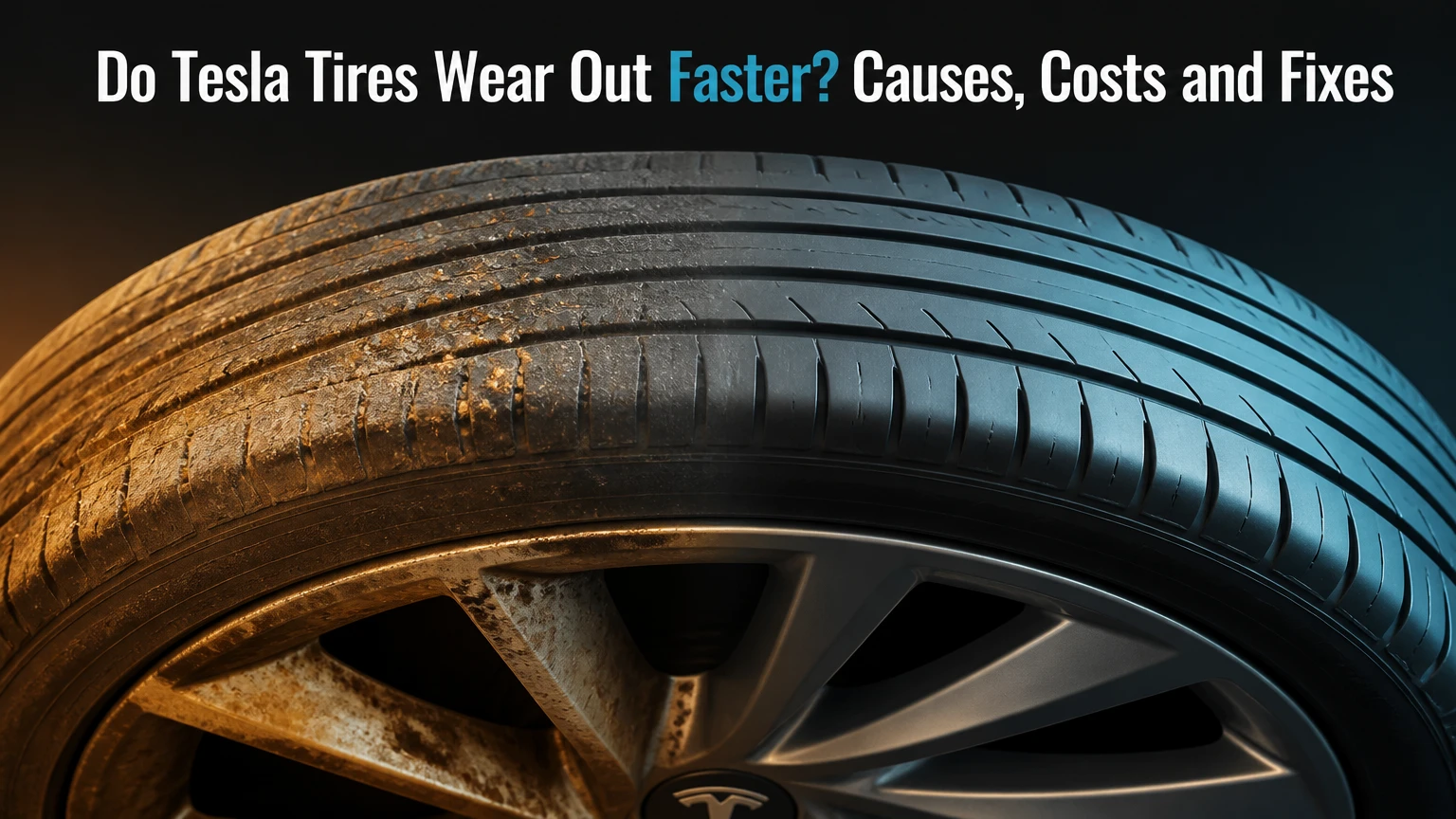
Yes, Tesla tires often wear faster than tires on a lighter, lower-powered gasoline car, but the difference is not a fixed 20-30 percent. A Tesla Model 3 or Model Y may use tires for roughly 20,000-40,000 miles, while a well-maintained commuter sedan may reach 45,000-60,000 miles. Tire compound, wheel size, acceleration, alignment, pressure, and road conditions determine the result.
Key facts at a glance
A Tesla does not automatically require replacement tires after 20,000 miles; touring tires and gentle driving can produce substantially longer life.
Battery weight increases the load each tire carries, especially on heavier Model Y, Model X, and Performance variants.
Instant electric torque can accelerate tread wear when the driver launches hard, spins the tires, or uses frequent high-power acceleration.
Regenerative braking is not normally the main cause of tire wear; it often reduces brake-pad wear while slowing the vehicle through the driven wheels.
Tesla’s owner manuals commonly specify tire rotation at 6,250 miles or when tread-depth difference reaches 2/32 inch, but the manual for the exact vehicle controls.
The correct pressure is the number on the Tesla tire-and-loading label, not a universal 42-45 PSI recommendation.
How long do Tesla tires last?
Tesla tires typically last 20,000-40,000 miles on Model 3 and Model Y vehicles, although approximately 15,000 miles is possible with soft performance tires and aggressive driving, while 40,000-60,000 miles is achievable with durable touring tires and consistent maintenance. The treadwear warranty, tire compound, wheel size, climate, and alignment determine the useful range.
A 19-inch or 20-inch Performance setup usually sacrifices tread life for cornering grip. A base rear-wheel-drive car fitted with a higher-treadwear all-season tire can produce a very different result. Owner reports are useful for identifying patterns, but they are not controlled durability tests because drivers, roads, tire pressures, and replacement thresholds vary.
Tesla tire life is also limited by more than tread depth. A tire can become unsafe because of an exposed belt, sidewall damage, cracking, a puncture near the shoulder, or severe inner-edge wear while the visible outer tread still appears acceptable.
| Tesla setup | Typical replacement range | Main wear pressure | Common tire category |
|---|---|---|---|
| Model 3 Performance, 20-inch wheels | 15,000-25,000 miles | Soft compound and high torque | Max-performance summer |
| Model 3 Long Range, 18-inch wheels | 25,000-45,000 miles | Mixed driving and pressure maintenance | Grand touring all-season |
| Model Y Performance, 21-inch wheels | 15,000-30,000 miles | Vehicle mass and staggered fitment | Performance summer or all-season |
| Model Y Long Range, 19-inch wheels | 25,000-45,000 miles | Weight, alignment, and rear-drive torque | Touring all-season |
| Model S or Model X | 20,000-40,000 miles | High curb weight and wide tires | XL or high-load performance |
These are typical planning ranges, not manufacturer guarantees. Tire manufacturers’ mileage warranties also do not promise that a Tesla will achieve the advertised mileage because exclusions can apply to irregular wear, misalignment, underinflation, high-performance use, and tires installed on vehicles with different original specifications.
Why do Tesla tires wear faster?
Tesla tires wear faster mainly because many Tesla vehicles combine high curb weight, strong electric torque, wide low-profile tires, and firm chassis alignment. These factors increase tread temperature and shear force during acceleration, cornering, and braking, but the effect is greatest when the driver uses the available performance repeatedly.
How does battery weight affect tire wear?
Battery weight increases the vertical load on every tire, which raises the tire’s workload during cornering, acceleration, and impact events. The effect is real, but the common claim that every Tesla is more than 1,000 pounds heavier than a comparable gasoline car is too broad: a Model 3 may be close to some larger sedans, whereas a Model X is substantially heavier than a compact sedan.
A tire’s load index identifies the maximum load it can carry at its rated pressure. Tesla-approved replacement tires often use an XL, or extra-load, construction to support the vehicle’s axle loads without excessive sidewall flex. Greater load capacity does not make a tire immune to wear; it makes correct fitment and inflation more important.
Heavy vehicles also carry more kinetic energy at the same speed. That energy must be managed by tire deformation, regenerative braking, friction braking, and suspension movement. Potholes and sharp road edges therefore create a higher risk of impact damage, particularly with short sidewalls on 20-inch and 21-inch wheels.
Does instant torque damage Tesla tires?
Instant torque can increase Tesla tire wear when the driver requests high acceleration before the tread has established full grip. Wheel slip is especially damaging because the contact patch alternates rapidly between gripping and sliding, generating heat and removing rubber from the tread surface.
The motor does not shred tires during every ordinary launch. Traction control, torque management, tire temperature, road texture, and throttle position limit the force reaching the pavement. Chill Mode can reduce the frequency of high-force launches, but it cannot compensate for incorrect pressure or an alignment fault.
Rear tires often wear faster on rear-wheel-drive vehicles because the rear axle transmits propulsion force. All-wheel-drive Teslas distribute torque across both axles, yet their greater mass and strong combined output can still produce rapid wear when driven hard.
Does regenerative braking cause tire wear?
Regenerative braking does not automatically make Tesla tires wear twice as fast. Regeneration slows the driven wheels by converting some vehicle motion into electrical energy, and it normally reduces friction-brake use; tire wear depends on the longitudinal force at the contact patch, not simply on whether the force came from an engine or a motor.
Strong lift-off regeneration can create noticeable deceleration, especially on a cold or wet road. If the driven tires lose grip, the stability systems intervene, but repeated aggressive transitions can raise tread temperature. Smooth pedal inputs are more protective than switching abruptly between maximum acceleration and maximum regeneration.
Regenerative braking may increase wear on the driven axle relative to a free-coasting driving style, but the effect is usually smaller than the effects of tire compound, cornering speed, wheel spin, pressure, and alignment. The “working twice as hard” explanation is therefore an oversimplification.
Does negative camber wear the inside edge?
Negative camber can wear the inner shoulder when the wheel has too much inward tilt, when toe is incorrect, or when the suspension has moved out of specification. Factory camber is not itself proof of a defect, and Tesla does not use one identical alignment setting across every model, wheel package, load condition, or suspension design.
Toe misalignment often destroys a tire faster than a modest camber difference because the tread is forced to scrub across the road. A tire with a smooth inner rib, feathered tread blocks, or a sawtooth texture deserves an alignment measurement rather than a visual guess.
Inner-edge wear is easy to miss because the damaged area faces the suspension. Turning the front wheels fully outward helps inspection, but a tread-depth gauge across the inner, center, and outer grooves provides a more reliable diagnosis.
Are Tesla-approved tires different?
Tesla-approved tires are tires tested or specified for a particular Tesla application, often identified by a manufacturer marking such as T0 or T1. The marking can indicate changes to noise control, rolling resistance, carcass construction, load capability, or vehicle tuning, but it does not mean every unmarked tire is unsafe or every marked tire will last longer.
Many original-equipment Tesla tires include acoustic foam bonded inside the casing. Foam can reduce certain cavity resonances transmitted into the cabin, which matters in an EV because the quiet powertrain makes road noise more noticeable. Foam does not inherently increase tread life, and a foam-equipped tire may cost more without providing a measurable durability benefit.
The replacement tire must still match the vehicle’s size, load index, speed rating, seasonal performance, and wheel requirements. A tire retailer should confirm the exact door-label specification and whether the vehicle uses a staggered setup, where front and rear sizes differ.
| Tire attribute | Tesla-approved design | Standard compatible replacement | Ownership consequence |
|---|---|---|---|
| Acoustic foam | Often included | Optional or absent | Lower cabin resonance with foam |
| Load construction | Frequently XL or high-load | Must meet door-label load index | Incorrect rating risks heat and damage |
| Rolling resistance | Often optimized for range | Varies by tread and compound | Approximately 1-5% range difference is typical |
| Treadwear rating | May prioritize grip and noise | Touring options often higher | Higher UTQG can support longer life |
| Price per tire | Commonly $250-$450 | Approximately $180-$350 | A full set may differ by $280-$400 |
| Repair procedure | Same puncture rules apply | Same puncture rules apply | Foam does not make a tire self-sealing |
Tesla approval is a useful fitment clue, not a durability ranking. An unmarked tire with the correct load and speed ratings can be a reasonable choice, although range, noise, warranty, and wet-weather behavior may change.
What does Tesla tire replacement cost?
A Tesla tire replacement usually costs about $900-$1,800 for four tires, including mounting and balancing, while 20-inch and 21-inch performance sets can exceed $2,000. The total depends on tire size, brand, foam, seasonal rating, local labor, taxes, alignment, and whether one or four tires must be replaced.
A single replacement can create a tread-depth mismatch. On an all-wheel-drive Tesla, a large difference between tires may affect traction control and drivetrain behavior, so the retailer should measure all four tires before replacing only one. Some tire manufacturers permit shaving a replacement tire to match the remaining tread, but that decision requires professional confirmation.
Cost per mile gives a better comparison than the invoice alone. For example, a $1,400 set lasting 25,000 miles costs $56 per 1,000 miles, while a $1,100 set lasting 40,000 miles costs $27.50 per 1,000 miles.
| Scenario | Set price | Expected life | Tire cost per 1,000 miles |
|---|---|---|---|
| Gasoline sedan touring tires | $750 | 50,000 miles | $15.00 |
| Tesla touring all-season set | $1,100 | 40,000 miles | $27.50 |
| Tesla original-equipment all-season set | $1,400 | 30,000 miles | $46.67 |
| Tesla Performance summer set | $1,700 | 20,000 miles | $85.00 |
| Tesla winter tire set | $1,300 | 25,000 seasonal miles | $52.00 |
The calculation excludes alignment, rotations, puncture repairs, seasonal storage, and road-hazard coverage. EV operating costs can still be lower overall because electricity and routine brake service may cost less, but tire expense should be included in the ownership budget.
What tire pressure should a Tesla use?
A Tesla should use the cold tire pressure printed on the driver-side door jamb or shown in the owner’s manual for that exact configuration. Many Tesla models specify pressures in the low-to-mid 40 PSI range, but owners should not inflate every Tesla to 42, 45, or any other universal number without checking the vehicle label.
Pressure changes with temperature. A tire can lose approximately 1 PSI for each 10 degrees Fahrenheit decrease in ambient temperature, although the exact change depends on conditions and measurement timing. Check all tires when cold, use a reliable gauge, and reset the vehicle’s TPMS reading after adjustment if the manual requires it.
Underinflation increases sidewall flex, heat, rolling resistance, and shoulder wear. Overinflation can reduce the contact patch on some surfaces, worsen ride quality, and make impact damage more likely. The maximum PSI molded into the sidewall is not the normal operating pressure.
Tesla’s owner guidance is more useful than generic internet advice. Tesla states in its Model Y owner manual: “Tesla recommends rotating the tires every 6,250 miles (10,000 km) or if tread depth difference is 2/32 in (1.5 mm) or greater, whichever comes first.” The exact manual for the model and year takes priority.
When should Tesla tires be rotated?
Tesla tires should generally be checked at every service visit and rotated at about 6,250 miles when the tire sizes and tread direction permit rotation. Tesla vehicles with staggered front and rear sizes cannot use a normal front-to-rear rotation, and directional tires may only move front-to-back on the same side.
Rotation is not a substitute for alignment. If the inside shoulder is already worn, moving that tire to another axle hides the problem and can leave the vehicle with less wet-weather safety. Measure tread depth before rotating, then record the mileage and position.
Use this inspection routine:
- Measure the inner, middle, and outer tread grooves on all four tires.
- Compare left and right tires on the same axle.
- Check for feathering, cupping, bubbles, cuts, and exposed cords.
- Confirm cold pressure against the door-label value.
- Rotate only when size, direction, and tread condition allow it.
- Recheck pressure and update the TPMS setting if required.
The practitioner rule is simple: a difference of 2/32 inch across an axle is a diagnostic signal, not merely a rotation reminder. Find the cause before installing expensive replacement rubber.
Which replacement tires last longest?
Grand-touring and high-treadwear all-season tires usually last longer on a Tesla than max-performance summer tires, provided the tire has the required load index, speed rating, size, and seasonal capability. EV-specific tires can reduce noise and rolling resistance, but “EV” branding alone does not prove superior tread life.
Michelin CrossClimate 2, Hankook iON evo AS, Continental PureContact LS, Pirelli Scorpion Verde All Season SF, and comparable high-quality touring products may suit different Tesla configurations, but availability and approved sizes vary by market. The best selection depends on climate and the owner’s priorities.
| Tire type | Typical tread-life target | Typical price each | Best use | Main compromise |
|---|---|---|---|---|
| Max-performance summer | 15,000-25,000 miles | $300-$450 | Warm-weather handling | Fast wear and poor cold grip |
| Performance all-season | 25,000-35,000 miles | $250-$400 | Mixed driving with responsive steering | Higher cost than touring tires |
| Grand touring all-season | 35,000-55,000 miles | $200-$350 | Daily commuting and highway travel | Less steering sharpness |
| All-weather severe-snow tire | 30,000-50,000 miles | $220-$380 | Rain, cold, and occasional snow | More noise and range loss |
| Dedicated winter tire | 15,000-30,000 seasonal miles | $220-$400 | Frequent snow and ice | Seasonal changeover and storage |
Treadwear numbers such as UTQG 500 or 700 help compare tires within a brand’s range, but UTQG is not a universal mileage promise. A 700-rated tire driven aggressively can wear sooner than a 500-rated tire driven gently.
Acoustic foam is optional for many owners. Removing it may produce a small increase in road noise, while choosing a durable touring compound can reduce replacement frequency. A commuter should normally prioritize wet braking, load index, warranty terms, and treadwear over the Tesla marking alone.
Why do rear Tesla tires wear quickly?
Rear Tesla tires wear quickly when the rear axle supplies propulsion torque, the vehicle carries a heavy rear load, or the alignment has excessive toe or camber. Model 3 and Model Y Performance versions can combine all three conditions with a soft compound, making rear replacement at 15,000-25,000 miles possible.
A rear-wheel-drive Tesla concentrates acceleration force at the rear tires. An all-wheel-drive Tesla shares that force, but rear tires may still wear faster because of torque distribution, suspension geometry, or more frequent rear-axle load transfer during acceleration.
Rapid rear wear is not normal if the inner tread reaches the wear bars while the center remains deep. Ask a tire shop for a four-wheel alignment printout, including camber and toe before and after adjustment. A printout is more useful than a verbal claim that “Tesla camber is aggressive.”
What does uneven wear reveal?
- Inner shoulder worn: excessive camber, toe, worn bushings, or a bent component.
- Both outer shoulders worn: chronic underinflation or heavy cornering.
- Center rib worn: sustained overinflation.
- Diagonal feathering: toe error or suspension movement.
- Cupped patches: imbalance, worn damper, or tire uniformity issue.
- One isolated tire damaged: puncture, pothole impact, or localized alignment fault.
Do not wait for a tire-pressure warning to detect wear. TPMS can report pressure accurately while a tire is losing tread from alignment or driving forces.
How do weather and roads change Tesla tire life?
Cold weather hardens many summer compounds and reduces grip, while hot pavement accelerates tread temperature and wear. Rain does not directly consume rubber faster, but standing water, rough chip-seal roads, potholes, and repeated traction-control events can shorten tire life.
Winter range loss can also change driver behavior. Reduced traction on cold pavement makes abrupt accelerator inputs more likely to trigger slip, while heavy rain exposes worn grooves that still appear acceptable in dry conditions. A tire with 4/32 inch of tread may remain legal in some jurisdictions but offer less hydroplaning margin than a new tire.
Road surface matters more than many owners expect. Coarse asphalt can remove tread quickly, and urban routes with tight turns and frequent stops create more scrub than steady highway driving. Mountain roads add cornering load even when the odometer shows relatively few miles.
Tesla owners in snow regions should use tires with appropriate cold-weather performance, not simply a high-treadwear summer alternative. Check the tire’s severe-snow symbol, speed rating, load rating, and compatibility with the vehicle’s wheel size.
Can a punctured Tesla tire be repaired?
A Tesla tire can often be repaired when the puncture is in the central tread area, measures within the repairable diameter specified by the tire manufacturer, and the tire was not driven substantially while flat. A shoulder or sidewall puncture, exposed cord, bulge, or run-flat damage generally requires replacement.
Tesla vehicles commonly lack a conventional spare tire, so a portable inflator and a suitable temporary sealant kit can help reach a repair facility. Sealant can interfere with TPMS sensors and may have a limited operating distance or speed, so follow the product instructions and treat it as temporary.
A plug inserted from outside is not the preferred permanent repair by major tire-industry practice. A professional repair normally involves removing the tire, inspecting the inside, and installing an approved combination plug-patch when the damage qualifies.
Road-hazard coverage may pay for some punctures, but ordinary tread wear is usually excluded or prorated. Read the retailer’s certificate before purchase, especially for performance tires with high replacement prices.
Which Tesla tire strategy fits each driver?
A daily commuter should choose a high-quality grand-touring or EV-oriented all-season tire with the correct load rating, then preserve it with cold-pressure checks and moderate acceleration. This combination usually costs less per mile than repeatedly buying soft performance tires.
A performance driver should accept shorter life as the price of dry grip, but should still monitor inner shoulders and tire temperatures. A max-performance tire is not a sensible choice for an owner whose priority is 50,000-mile service life.
A winter-region owner should prioritize cold-weather braking and snow traction over a small efficiency gain. A dedicated winter set can preserve the summer tires and improve control, even though the annual tire budget increases.
A budget-focused owner can buy a compatible non-foam touring tire, but should not downgrade the load index, speed rating, wet-grip capability, or diameter. The cheapest tire becomes expensive if an incorrect alignment destroys it in 1,000 miles.
| Driver profile | Recommended priority | Reasonable tire direction | Avoid |
|---|---|---|---|
| Highway commuter | Tread life and wet braking | Grand touring all-season | Ultra-soft summer compound |
| Performance driver | Dry grip and steering response | Performance summer | Expecting 50,000 miles |
| Snow-belt owner | Cold and snow traction | Severe-snow all-weather or winter | Summer tire below cold conditions |
| Cost-sensitive owner | Price per 1,000 miles | Compatible high-UTQG touring tire | Ignoring load index and alignment |
| Quiet-cabin owner | Acoustic comfort and efficiency | Tesla-marked acoustic tire | Assuming foam increases tread life |
What is the fastest way to reduce Tesla tire wear?
The fastest reliable improvement is to correct pressure and alignment, then reduce wheel spin and rotate according to the exact Tesla manual. Driving in Chill Mode can smooth accelerator response, but settings alone will not fix a bent suspension component, excessive toe, or an underinflated tire.
Use the following maintenance schedule:
- Check cold pressure monthly and before long trips.
- Inspect inner shoulders every 3,000-5,000 miles.
- Measure tread depth at each rotation or tire service.
- Rotate near 6,250 miles when the fitment permits it.
- Request an alignment after a strong pothole impact or new uneven wear.
- Replace tires at the legal wear-bar limit, earlier when wet-weather performance has materially declined.
- Recheck pressure after seasonal temperature changes.
- Accelerate smoothly until the tires reach operating temperature.
Three practitioner mistakes account for many premature replacements. Owners inspect only the outside shoulder, assume the sidewall maximum is the correct pressure, and replace a single AWD tire without comparing tread depth across the axle. Each mistake can create a second problem after the original wear is noticed.
What should owners inspect before buying tires?
Confirm the exact tire size, load index, speed rating, seasonal rating, and whether the vehicle requires a staggered fitment. Compare the manufacturer’s warranty exclusions, acoustic construction, rolling-resistance claims, wet braking tests, and local availability rather than relying on an “EV tire” label.
Ask for a written alignment measurement if the old set has inner-edge wear. A new tire cannot correct a mechanical or geometry problem. If a shop cannot explain the wear pattern, obtain a second inspection before spending $1,000 or more.
FAQ
Are Tesla tires more expensive than normal car tires?
Tesla tires often cost more because Model 3 and Model Y configurations may use XL construction, large diameters, acoustic foam, high speed ratings, or performance compounds. A typical compatible set costs approximately $900-$1,800, compared with roughly $600-$1,000 for many gasoline sedans, although local prices and tire brands can reverse that comparison.
Should I replace all four Tesla tires at once?
Replace all four Tesla tires when tread depths differ significantly, the vehicle uses all-wheel drive, or the remaining tires show irregular wear. Replacing one tire can be acceptable when the difference is small and the tire shop confirms compatibility, but the exact AWD and tire-manufacturer limits should guide the decision.
Can I put regular tires on a Tesla?
A Tesla can use a non-Tesla-marked tire when the replacement matches the required size, load index, speed rating, pressure specification, and seasonal needs. The owner may notice more road noise or a small range change without acoustic foam, but the absence of a T0 or T1 marking does not automatically make a tire unsuitable.
How much tread is safe on a Tesla tire?
A new passenger tire often begins with about 10/32-11/32 inch of tread, while legal wear bars sit at 2/32 inch in the United States. Replace sooner when wet-weather grip is poor, the inner edge is nearly worn, tread is uneven, or the tire has damage, because the visible center groove may hide a dangerous shoulder.
Does driving in Chill Mode double Tesla tire life?
Chill Mode cannot reliably double Tesla tire life. The setting can reduce abrupt torque delivery and wheel spin, which may extend life for an aggressive driver, but pressure, alignment, tire compound, road surface, and cornering speed usually have a larger combined effect.
Are Tesla tires covered by the vehicle warranty?
Tesla’s vehicle warranty generally does not function as a normal tread-wear warranty. Tire defects, road hazards, tread wear, and replacement coverage depend on the tire manufacturer, retailer policy, road-hazard certificate, and local consumer law, so owners should review those terms before purchase.
The Bottom Line
Do Tesla tires wear out faster? Often, yes, especially on heavy Model Y or Model X vehicles, Performance models, wide low-profile wheels, and cars driven with frequent hard acceleration. The battery and electric drivetrain create real load and traction demands, but regenerative braking is not a standalone explanation and factory camber is not proof of abnormal wear.
A Tesla owner can materially reduce tire cost by using the correct door-label pressure, measuring the hidden inner tread, checking alignment after impacts, rotating when permitted, and selecting a durable tire that matches the vehicle’s load and speed requirements. The right comparison is cost per 1,000 miles, not the purchase price alone.