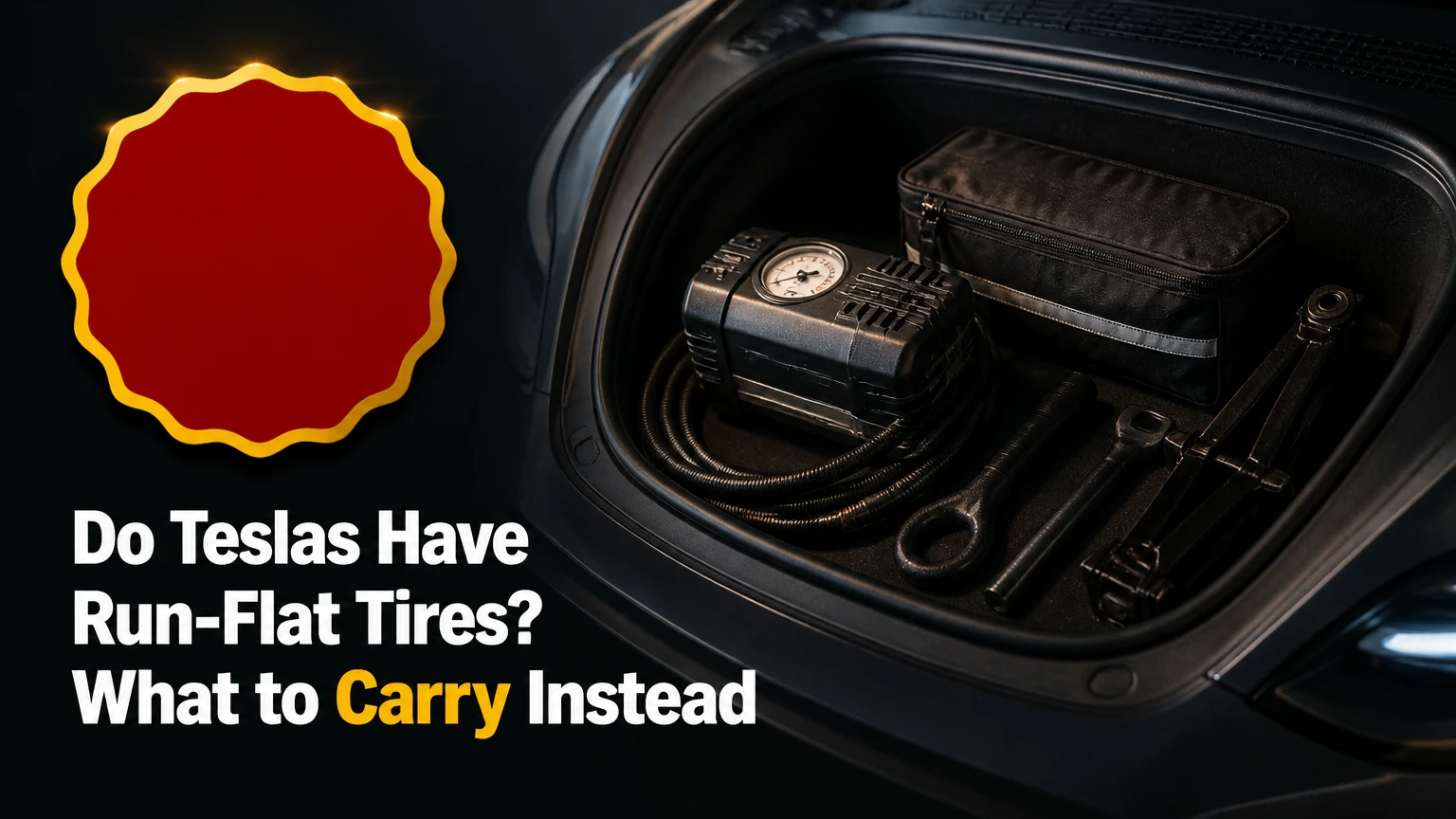
No, Tesla vehicles generally do not come factory-equipped with run-flat tires. Tesla uses conventional pneumatic tires, and some approved tires include an internal acoustic-foam layer for lower road noise. Because most Teslas also lack a conventional spare, a puncture usually requires a repair kit, mobile tire service, or towing rather than continued driving on zero pressure.
Key Facts at a Glance
- Tesla factory tires are normally standard pneumatic tires, not run-flat tires.
- Acoustic foam inside some Tesla tires reduces road noise but does not support the vehicle after deflation.
- A Tesla Tire Pressure Monitoring System warning does not turn an ordinary tire into a run-flat.
- Driving a standard Tesla tire after it loses most or all air can damage the tire, wheel, and suspension.
- Run-flat distance and speed limits are tire-specific, although many self-supporting designs use approximately 50 miles at 50 mph as a limit.
- Tesla’s practical alternatives are a repair kit, mobile roadside assistance, a compatible spare wheel, or a properly selected aftermarket run-flat set.
Do Teslas Have Run-Flat Tires?
Tesla does not generally factory-fit run-flat tires on the Model 3, Model Y, Model S, or Model X. Factory equipment varies by model year, market, wheel package, and tire supplier, but a tire marked with Tesla acoustic foam, such as a manufacturer’s “T0” homologation, is still usually a conventional tire rather than a zero-pressure tire.
The distinction matters because acoustic foam and run-flat reinforcement perform different jobs. Foam is bonded to the inside of the tread to reduce cavity resonance, while run-flat sidewalls or support rings carry vehicle weight after air pressure disappears. A foam-lined tire can become completely undrivable after a puncture.
Tesla’s design choice follows a broader industry pattern among electric vehicles. Run-flat construction adds mass and stiffness, while EV-specific conventional tires can prioritize rolling resistance, load capacity, wet grip, and cabin noise. Tesla then handles immobilizing punctures through roadside support and tire-service procedures rather than a built-in spare or factory run-flat system.
A tire retailer or technician should confirm the sidewall markings before replacement. The words “acoustic,” “sound,” “foam,” or Tesla approval do not mean “run-flat.”
How Do Run-Flat Tires Work?
Run-flat tires use reinforced sidewalls or an internal support ring to carry a vehicle temporarily after inflation pressure falls to zero. The tire remains attached to the wheel, and its reinforced structure prevents the rim from immediately contacting the road, but the driver must reduce speed and travel only as far as the tire maker permits.
Self-Supporting Run-Flats
Self-supporting run-flats use thick, heat-resistant sidewalls. When air pressure disappears, those sidewalls support the wheel load and preserve a limited amount of steering control. Most consumer run-flat tires use this design.
The limitation is heat. Driving without air flexes and heats the reinforced sidewall, so every manufacturer specifies a maximum distance and speed. Bridgestone, Michelin, Goodyear, and Pirelli publish different instructions by tire model, vehicle, load, and damage condition. A 50-mile, 50-mph rule is common, not universal.
Support-Ring Run-Flats
Support-ring systems use a rigid ring attached to the wheel. The deflated tire tread rests on that ring, which carries the load. This design can provide strong zero-pressure support, but it requires a compatible wheel and specialized installation equipment.
A support-ring system is not a practical universal upgrade for a Tesla. Wheel geometry, bead seating, brake clearance, tire size, and electronic monitoring all require professional verification.
What Does Acoustic Foam Do?
Acoustic foam reduces tire-cavity resonance, a low-frequency droning sound that electric vehicles can make more noticeable because they lack engine and exhaust noise. Michelin Acoustic, Pirelli PNCS, Continental ContiSilent, and similar systems use interior foam for noise control.
Acoustic foam does not reinforce the sidewall. It does not seal a puncture, maintain pressure, prevent bead unseating, or permit zero-pressure driving. Removing or transferring the foam is also not a practical repair procedure because the foam is bonded during tire production and replacement tires require their own construction.
What Tires Do Teslas Use?
Tesla tires are conventional pneumatic tires selected for vehicle weight, torque, suspension tuning, wheel diameter, and energy efficiency. The correct replacement must match the door-jamb placard and owner’s manual for size, load index, speed rating, and inflation pressure, rather than matching only the visible diameter.
| Tire attribute | Typical Tesla requirement | Why it matters |
|---|---|---|
| Tire pressure | Approximately 42-45 psi on many passenger configurations | Controls handling, range, and carcass heat |
| Wheel diameter | Commonly 18-22 inches | Determines available sidewall and tire fitment |
| Load index | Often 98-110, depending on model and axle load | Supports a heavy EV and passenger payload |
| Speed rating | Commonly H, W, or Y | Must meet or exceed vehicle specification |
| Construction | Radial, tubeless pneumatic | Requires air pressure for normal load support |
| Acoustic treatment | Optional factory or replacement feature | Reduces cavity noise, not puncture risk |
Tesla-approved tires may carry a manufacturer-specific approval mark. For example, a Tesla-approved version can differ from a visually identical aftermarket tire through compound, casing, noise foam, or rolling-resistance tuning. That approval does not automatically mean the tire is better for every driver, but it helps preserve the suspension and noise characteristics Tesla calibrated.
Why Are EV Tires Different?
Electric vehicles create high tire demands through battery mass and instant motor torque. A replacement tire therefore needs sufficient load capacity, strong bead construction, predictable wet braking, and acceptable rolling resistance.
A heavier or more rigid run-flat can reduce efficiency. The exact change depends on tire size, tread compound, temperature, pressure, alignment, and driving speed, so a universal 2-5 percent range should be treated as a rough estimate rather than a guaranteed Tesla result. Tire Rack’s EV tire guidance likewise emphasizes fitment, load capacity, noise, and rolling resistance rather than a single “EV tire” specification.
Can You Drive a Tesla After a Flat?
You should not drive a Tesla on a standard tire after the tire has lost substantial air pressure. A short movement at walking speed may be necessary to reach a safer position, but driving several miles can destroy the tire and bend an alloy wheel even when the car still feels controllable.
Puncture Response by Tire Condition
| Situation | Safe immediate action | Typical service outcome | Do not do this |
|---|---|---|---|
| Slow leak, 30 psi or higher | Stop and inspect soon | Inflate, inspect, and repair if eligible | Continue for days without checking pressure |
| Low pressure, 15-29 psi | Reduce speed and stop nearby | Inflate and inspect carcass damage | Drive at highway speed |
| Nearly flat tire, below 15 psi | Pull over immediately | Mobile repair or wheel change | Drive to a distant tire shop |
| Sidewall cut or shredded tread | Stop without driving farther | Replacement tire, possible wheel inspection | Inject sealant into a large tear |
| Tire off the bead | Keep vehicle stationary | Professional remount or replacement | Reinflate beside traffic |
| Confirmed run-flat tire | Follow its sidewall and manual limit | Inspect before repair decision | Assume every run-flat allows 50 miles |
A TPMS warning is an early safety signal, not a permission to continue. Tesla’s display can show pressure information and identify a tire losing pressure, but the sensor cannot determine whether the tire’s internal structure has already suffered damage.
Step-by-Step Tesla Flat-Tire Procedure
- Reduce speed smoothly. Avoid sharp steering and heavy braking, then move to a level area away from traffic.
- Inspect without touching unsafe damage. Look for a nail in the tread, a separated tread, a crushed sidewall, or a wheel sitting unusually low.
- Read the TPMS display. Record the affected tire and pressure, but treat the visual inspection as equally important.
- Use a compressor only for a minor tread puncture. Inflate to the door-placard pressure if the tire holds air; do not inflate a torn sidewall.
- Use sealant only when the kit instructions permit it. Sealant can obstruct a tire-pressure sensor and complicate later professional inspection.
- Request assistance through the Tesla app or another provider. Select the flat-tire or roadside option and state whether the wheel is damaged.
- Confirm the transport method. A flatbed or approved wheel-lift method may be needed, especially for all-wheel-drive models and vehicles with a locked or damaged wheel.
You will know the temporary repair is working when the pressure rises to the specified level and remains stable during a short stationary check. A pressure drop, sealant escaping, visible bulging, or vibration means the vehicle should remain parked.
Tesla’s roadside assistance terms and availability vary by country, vehicle warranty status, and cause of failure. A roadside benefit may transport the vehicle, but it is not the same as guaranteed tire replacement, unlimited towing, or coverage for every puncture.
Is a Tesla Tire Repair Kit Worth Carrying?
A tire repair kit is useful for a small tread puncture when a tire remains structurally intact, but it cannot repair sidewall damage, a separated belt, a bent wheel, or a tire driven flat. A compressor and plug kit can be more useful than sealant alone because sealant may contaminate the pressure sensor and tire interior.
| Emergency option | Typical purchase cost | Best use | Main limitation |
|---|---|---|---|
| 12-volt compressor | $30-$100 | Reinflate a slow leak | Cannot repair a cut |
| Plug-and-inflator kit | $40-$120 | Small tread puncture | Requires safe puncture access |
| Sealant and compressor kit | $50-$150 | Temporary small-hole sealing | Limited hole size and cleanup |
| Tesla roadside assistance | Coverage varies by contract | Severe damage or unsafe location | Waiting time and service limits |
| Compatible space-saver spare | Approximately $300-$700 | Remote travel and immediate mobility | Cargo space and speed limit |
| Full-size spare wheel | Approximately $500-$1,000 | Repeated remote-road use | Heavy and difficult to store |
A plug repair is temporary unless performed according to the tire industry’s approved repair method. The Tire Industry Association and tire manufacturers generally distinguish a proper internal patch-plug repair from an exterior string plug used as an emergency measure. The tire must be removed for internal inspection before a permanent repair decision.
Are Aftermarket Run-Flat Tires Compatible With Teslas?
Aftermarket run-flat tires can be compatible with some Tesla wheel and vehicle combinations, but compatibility is not automatic. The tire must match the original size, load index, speed rating, wheel width, bead design, TPMS system, axle requirements, and clearance around suspension and brakes.
A run-flat swap can also alter the vehicle’s behavior. Reinforced sidewalls generally increase impact harshness, steering effort, unsprung mass, and tread-related noise. Tesla’s stability control can work with different tires, but changing only one tire or fitting mismatched construction can create inconsistent grip and rolling circumference.
Ask the installer to verify these items:
- Exact tire size, such as 235/45R18 or 255/45R19.
- Load index and speed rating against the Tesla placard.
- Whether the tire uses a self-supporting run-flat construction.
- Tire-pressure sensor compatibility and relearn procedure.
- Approval for the specific Tesla model, axle, and wheel width.
- Availability of matching replacement tires in the same season and compound.
- Alignment condition before blaming the tire for uneven wear.
Can You Mix Run-Flats and Standard Tires?
Mixing run-flat and conventional tires on the same Tesla is generally a poor practice, especially across the same axle. The two constructions respond differently during cornering, braking, impact absorption, and pressure loss.
Replacing one damaged tire with a different construction can also produce unequal tread depth and rolling circumference. For an all-wheel-drive Tesla, ask a qualified tire professional whether the remaining tires are within the manufacturer’s allowable circumference and tread-depth limits. Some cases require replacing two tires on an axle or shaving a replacement tire to match.
The safest rule is simple: use four tires with the same construction unless Tesla, the tire manufacturer, or a qualified installer gives a model-specific alternative.
Standard Tires Versus Run-Flats: Which Is Better?
Standard Tesla-compatible tires usually provide the better balance of comfort, efficiency, availability, and purchase cost. Run-flats provide limited mobility after a puncture, but they impose higher costs and cannot make severe sidewall or wheel damage drivable.
| Decision factor | Standard EV tire | Aftermarket run-flat | Practical consequence |
|---|---|---|---|
| Zero-pressure mobility | 0 miles intended | Often 50 miles maximum | Run-flat reduces immediate stranding risk |
| Post-puncture speed | Do not continue driving | Often 50 mph maximum | Exact limit depends on tire maker |
| Typical tire price | $180-$450 each | $250-$600 each | Wheel size changes both ranges |
| Ride character | More compliant sidewall | Firmer sidewall | Rough roads feel harsher |
| Repair possibility | Tread puncture may be repairable | Often replacement after zero-pressure driving | Inspection determines outcome |
| Efficiency effect | Baseline for selected EV tire | Often slightly lower | Weight and rolling resistance vary |
| Spare requirement | Repair kit or spare recommended | Still needs roadside help for major damage | Run-flat is not a complete emergency system |
The “winner” for daily urban driving is usually the standard EV tire because nearby tire shops and towing reduce the value of zero-pressure mobility. The “winner” for remote travel is the solution that restores mobility without relying on cell coverage, which may be a spare wheel rather than a run-flat.
What Does a Tesla Tire Replacement Cost?
A typical Tesla tire replacement costs approximately $180-$600 per tire before unusual mobile-service fees, premium wheel sizes, taxes, and alignment. A full set commonly ranges from $800-$2,400, while aftermarket run-flats generally occupy the upper end because of reinforced construction and limited availability.
| Replacement scenario | Typical tire cost | Service cost | Typical total |
|---|---|---|---|
| Model 3 or Model Y, 18-inch standard tire | $180-$280 | $100-$180 per set | $820-$1,300 |
| Model 3 or Model Y, 19-20-inch premium tire | $240-$400 | $120-$220 per set | $1,080-$1,820 |
| Model S or Model X, 20-22-inch tire | $350-$600 | $150-$300 per set | $1,550-$2,700 |
| Aftermarket run-flat set | $300-$600 each | $150-$300 per set | $1,350-$2,700 |
| Single puncture repair | $25-$60 | Included or separate inspection | $25-$100 |
| Mobile emergency callout | $75-$250 | Depends on time and location | $75-$250 before tire cost |
These are typical retail planning ranges, not Tesla price guarantees. Performance tires, winter tires, staggered wheels, foam-lined versions, and unusual locations can raise the total.
Should You Choose a Spare, Run-Flats, or Roadside Assistance?
Choose a compatible spare for remote highways, standard tires plus a repair kit for ordinary commuting, and aftermarket run-flats only when temporary zero-pressure mobility outweighs ride and cost penalties. No option removes the need to stop after sidewall damage, wheel damage, or an unsafe roadside position.
City and Suburban Commuters
Standard tires plus a compressor and a reputable roadside plan are usually the most rational combination. The driver is often within 10-20 miles of a tire shop, and run-flat stiffness affects every mile while helping only during an occasional puncture.
Long-Distance Road-Trippers
A spare wheel kit can be more useful than run-flats when traveling across sparsely serviced roads. Verify that the kit fits the exact Tesla brake package, includes the correct lug hardware, provides a jack or lifting solution, and remains within the manufacturer’s temporary speed and distance limits.
A spare also handles some failures that run-flats cannot, including a large sidewall tear. Its disadvantages are weight, storage, installation effort, and the need to practice safe wheel changes.
Drivers in Remote or Low-Coverage Areas
Run-flats may justify their trade-offs when roadside access is slow, temperatures are severe, or a driver regularly travels beyond reliable cellular coverage. The decision still requires a matching tire set, a working TPMS system, and a plan for damage beyond the run-flat’s limited operating range.
Winter-Tire Users
Winter run-flats are available in some sizes, but availability changes by market and wheel specification. A winter tire must retain the correct load rating and speed rating, and drivers should not assume that a run-flat winter tire has the same snow performance as a conventional winter tire with a softer, more flexible sidewall.
Common Mistakes With Tesla Tire Emergencies
Driving on a Nearly Flat Tire
A Tesla can feel stable for a short distance because the wheel, tire bead, and remaining sidewall still provide temporary support. That apparent stability is deceptive; internal cords can fail before the driver notices a dramatic handling change.
Treating Acoustic Foam as Run-Flat Construction
Foam reduces noise only. Reading the tire’s sidewall markings and manufacturer data prevents the expensive mistake of driving on a deflated acoustic tire.
Using Sealant on a Sidewall Cut
Sealant is intended for limited tread punctures, not structural sidewall damage. A sidewall bubble, slash, exposed cord, or bead leak requires professional inspection and usually replacement.
Replacing Only One Tire Without Checking Circumference
A new tire paired with three heavily worn tires can produce different rolling diameters. On an all-wheel-drive Tesla, that difference may increase drivetrain and traction-control concerns, so tread depth and axle position must be evaluated.
Assuming a 50-Mile Limit Applies Universally
The 50-mile, 50-mph figure is a common run-flat guideline, not a legal or engineering standard for every product. Temperature, vehicle load, prior underinflation, puncture location, and tire manufacturer instructions can reduce the allowable distance.
How Can You Verify Your Tesla’s Tire Type?
Verify the tire type through the sidewall marking, manufacturer product page, and Tesla’s vehicle-specific fitment information. Do not rely on the tire’s appearance, acoustic foam label, or a retailer’s generic “Tesla tire” category.
Check these sources in order:
- Driver-door placard: Confirm size, cold inflation pressure, load requirements, and speed rating.
- Tire sidewall: Look for the exact model name and run-flat symbols, such as manufacturer-specific ZP, RFT, ROF, SSR, or R-F markings.
- Tire manufacturer specification: Confirm whether that exact size is self-supporting, standard, XL, acoustic, or Tesla-approved.
- Vehicle manual: Follow Tesla’s pressure-monitoring, lifting, towing, and temporary-spare instructions.
- Installer confirmation: Ask whether the tire matches the wheel width, TPMS sensor, axle position, and drive configuration.
Model year matters. Tesla has changed wheel packages, tire suppliers, TPMS hardware, and spare-equipment availability over time, so a statement about one Model Y configuration cannot automatically be applied to every Model Y.
FAQ
Do Tesla Tires Have Special Technology?
Many Tesla tires have EV-oriented features such as reinforced casings, low-rolling-resistance compounds, acoustic foam, or manufacturer approval for Tesla fitment. Those features address noise, load, efficiency, or handling. They do not mean the tire can safely operate after complete air loss.
Do Teslas Have Spare Tires?
Most Tesla vehicles are sold without a conventional spare tire and factory jack. Storage, battery packaging, weight reduction, and roadside-service strategy are common reasons. Owners can purchase a model-specific spare kit, but fitment must be checked against wheel diameter, brake clearance, and drive configuration.
Can You Repair a Tesla Tire With a Nail?
A Tesla tire with a small tread puncture may be repairable if it has not been driven underinflated and the puncture lies within the repairable tread area. A tire shop must remove the tire and inspect the inside. Sidewall punctures, shoulder damage, exposed cords, and separated tread usually require replacement.
Does Tesla Roadside Assistance Change the Tire?
Tesla roadside assistance may provide transport, a temporary wheel, or towing depending on location, coverage, vehicle status, and available equipment. Drivers should report the tire condition accurately and ask whether the provider is bringing a compatible wheel or arranging a flatbed.
Are Run-Flat Tires Safer on a Tesla?
Run-flat tires can reduce the risk of immediate roadside stranding after a qualifying tread puncture, but they do not prevent punctures or make severe damage safe to drive on. Their firmer sidewalls, higher cost, possible efficiency penalty, and replacement rules make safety a situation-specific trade-off.
What Pressure Should a Tesla Tire Have?
Use the cold pressure shown on the driver-door placard or Tesla touchscreen for the specific vehicle and wheel configuration. Do not use the maximum pressure molded into the tire sidewall as the vehicle’s normal setting. Check pressure when the tires are cold and after major temperature changes.
The Bottom Line
Do Teslas have run-flat tires? Generally, no. Tesla vehicles normally use conventional pneumatic EV tires, some with acoustic foam, and a puncture requires immediate pressure inspection rather than continued driving. For most owners, a compressor, suitable repair kit, and reliable roadside plan provide the best balance; remote travelers should consider a compatible spare, while run-flats are an aftermarket compromise for drivers who value limited zero-pressure mobility above comfort, efficiency, and cost.


