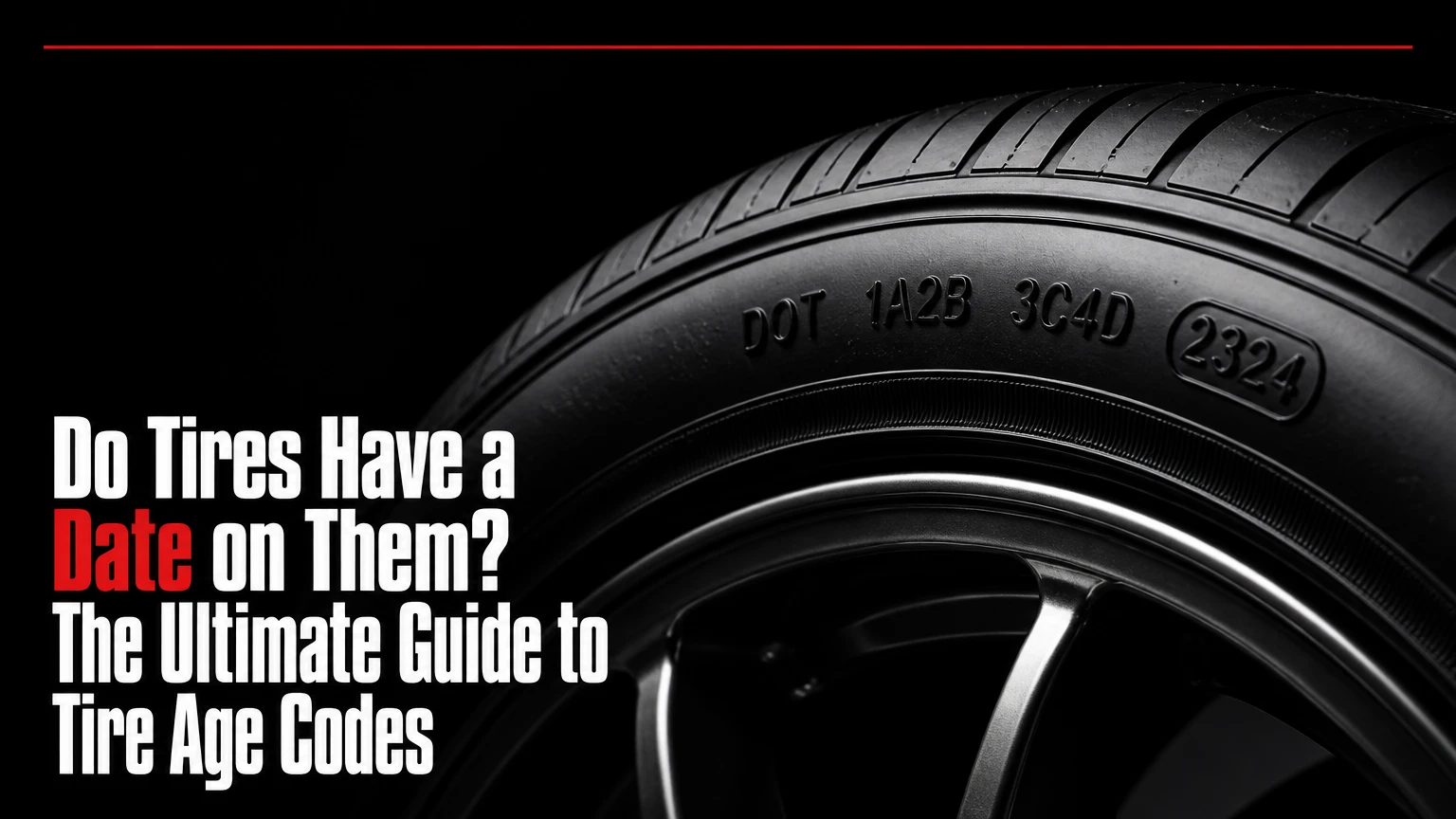
Yes, tires have a mandatory date code molded directly into their sidewall by federal regulation. This four-digit Department of Transportation code tells you the exact week and year the tire was manufactured. However, finding this code requires knowing how to interpret post-2000 formats, handle pre-2000 exceptions, and inspect inward-facing sidewalls where manufacturers often hide the complete serial number.
At a Glance: Essential Tire Date Facts
- Every legal highway tire features a mandatory Department of Transportation safety code ending in a four-digit manufacture stamp.
- The four-digit format uses WWYY, where the first two digits represent the manufacturing week and the last two represent the year.
- Tires manufactured before 2000 use a three-digit code, which presents significant dating ambiguity.
- The full DOT date code only appears on one sidewall of the tire; the opposite side typically shows an incomplete tracking stamp.
- Most tire manufacturers and vehicle makers recommend replacing tires between six and ten years from the production date, regardless of remaining tread depth.
Do tires have a date on them?
Yes, every highway-legal tire sold in North America features a mandatory date code molded into its sidewall. This date code is part of a larger Department of Transportation serial string that identifies the manufacturing plant, tire size, and production period. Consumers can locate this stamp to verify the exact age of any passenger car, light truck, motorcycle, or trailer tire before installation or purchase.
What is the Department of Transportation serial number anatomy?
The Department of Transportation serial number is an alphanumeric code stamped onto the tire sidewall that tracks manufacturing origin and age. The string always begins with the letters DOT followed by a plant code, a size code, an optional manufacturer code, and a final four-digit sequence.
The structural layout of a post-2000 Department of Transportation serial number follows a standardized sequence. The first two characters identify the manufacturing plant where the factory built the tire. The next group of characters represents the tire size and construction design used by the manufacturer. The final four digits represent the production date. This standardized layout allows regulatory bodies and consumers to trace defective products and verify rubber age instantly.
How do you read a post-2000 four-digit tire date code?
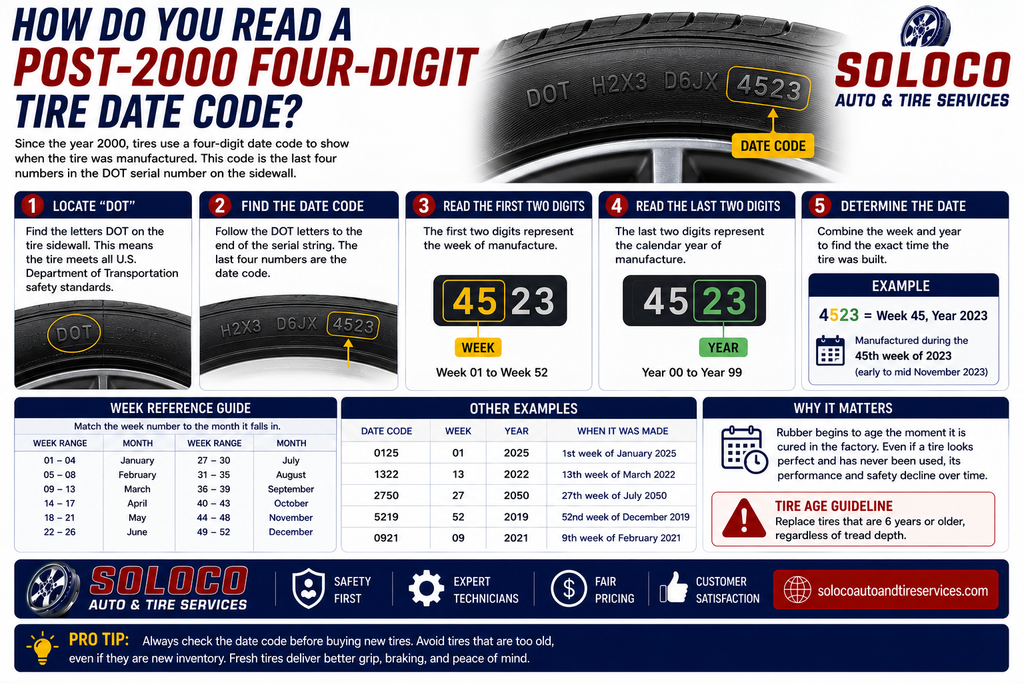
To read a post-2000 tire date code, locate the letters DOT on the sidewall and scan to the end of the serial string for the final four numbers. The first two digits indicate the exact week of manufacture, ranging from zero-one to fifty-two. The final two digits represent the calendar year of production.
For example, a tire stamped with the code forty-five twenty-three was manufactured during the forty-fifth week of the year 2023, which corresponds to November. Because rubber begins to degrade the moment it is cured in the factory mold, reading these four digits correctly ensures that drivers never unknowingly install aged inventory on their vehicles.
How did pre-2000 three-digit tire date codes work and what are their flaws?
Tires manufactured before the year 2000 use a three-digit date code instead of four. The first two digits represent the week of manufacture, while the final single digit represents the year of the decade.
The primary flaw of the three-digit system is chronological ambiguity. A code reading two-four-nine indicates the twenty-fourth week of a year ending in nine, but it provides no indication whether the tire was built in 1999, 1989, or 1979. To resolve this during the late 1990s, manufacturers occasionally added a small triangle symbol after the three digits to denote the nineteen-nineties decade. Because this triangle indicator was never universally mandated, inspecting vintage or collector vehicles requires careful evaluation of overall rubber condition rather than relying solely on ambiguous three-digit stamps.
Why is the full DOT date code missing on one sidewall of my tire?
The full Department of Transportation date code is missing on one sidewall because federal regulations only require the complete serial string to be printed on a single side of the tire. The opposite sidewall features an incomplete, short-form manufacturing tracking number.
When mounting tires, shops frequently face choices regarding which sidewall faces outward. If the tire is mounted with the complete date string facing the inside of the vehicle, the exterior sidewall will display only letters or a truncated number sequence. Inspecting the date on such tires requires looking at the opposite side of the vehicle or using a mirror and flashlight behind the wheel well.
How do asymmetric and directional tire tread designs impact date visibility?
Asymmetric and directional tire tread designs frequently force the full Department of Transportation date code to face inward toward the vehicle suspension. Asymmetric tires feature dedicated inside and outside sidewalls, meaning they cannot be flipped on the wheel rim to display the date outward.
Directional tires must rotate in a specific forward direction to channel water away from the tread. When a tire shop installs directional tires, the side containing the full date code may face outward on the left side of the vehicle while facing inward on the right side. Technicians and vehicle owners must check both sides of the vehicle to ensure they inspect every tire serial number accurately.
Can a brand-new retail tire be several years old before purchase?
Yes, retail tires sold as brand-new can easily sit in distribution warehouses for three to four years before a customer purchases them. The physical aging process of rubber begins the moment the tire is cured in the factory heat press, not when a mechanic bolts the wheel onto your vehicle.
Purchasing aged inventory from discount retailers or online liquidators reduces the operational lifespan of the product significantly. Savvy motorists always inspect the four-digit Department of Transportation code before authorizing a tire installation at any retail shop.
How do spare tires age differently when stored inside a trunk?
Spare tires stored inside a trunk, beneath a truck bed, or mounted on an exterior rear gate experience distinct environmental stressors that accelerate degradation without displaying wear. Although protected from active road friction, spare tires are subjected to extreme temperature fluctuations inside enclosed vehicle compartments.
A twelve-year-old spare tire that looks pristine with full tread depth can experience catastrophic tread separation during emergency highway use. The internal steel belts and rubber compounds oxidize over time, making routine spare tire inspections just as critical as checking primary road tires.
What environmental factors cause rubber degradation faster than the calendar date?
Environmental exposure to high ambient heat, ultraviolet solar radiation, and ozone gas degrades tire rubber significantly faster than simple calendar chronology. A three-year-old tire parked daily under intense desert sunlight can suffer structural breakdown faster than a seven-year-old tire stored inside a climate-controlled garage.
Ozone generated by electrical equipment, electric motors, and heavy traffic attacks the chemical bonds of synthetic and natural rubber compounds. When heat and ozone combine, they break down the flexible polymers within the sidewall, triggering structural failure long before the tread wears out.
How do you identify ozone cracking versus normal weathering?
Ozone cracking appears as sharp, perpendicular splits or micro-fissures within the rubber grooves and sidewalls, whereas normal weathering manifests as dull fading and surface chalking. Ozone attack targets stretched rubber under tension, creating distinct linear cracks that penetrate deep into the casing carcass.
Visual inspection requires running a hand along the tread blocks and flexing the sidewall under bright lighting. If deep check marks or spiderweb cracks appear inside the rubber valleys, the tire is structurally compromised and must be replaced immediately regardless of its manufacturing date.
Do trailer tires and specialty tires have different dating rules?
Trailer tires, specialty light truck tires, and motorcycle tires follow the exact same four-digit Department of Transportation dating convention established for passenger cars. All pneumatic highway-legal tires sold in North America use the standardized week-and-year formatting structure.
Despite sharing the same dating rules, trailer tires often fail faster due to intermittent use, heavy stationary loads, and lack of flexing. Specialty trailer tires should be monitored with strict adherence to age limits, as they frequently degrade from sitting motionless in storage yards rather than wearing out from mileage.
Do winter tires degrade faster than all-season rubber compounds?
Winter tires utilize softer, high-silica rubber compounds designed to remain flexible in freezing temperatures, which can make them more susceptible to rapid degradation if exposed to warm weather. Leaving dedicated winter tires mounted on a vehicle through hot summer months accelerates thermal aging and tread wear.
Motorists who run winter tires should store them off-season in a cool, dark, dry environment away from electric motors to preserve the specialized rubber elasticity. Monitoring the production date on winter tires is vital because hardened, aged winter rubber loses its snow-grip capabilities even with adequate tread depth remaining.
How do you inspect hidden inner sidewall codes safely?
Inspecting hidden inner sidewall codes requires using a telescoping inspection mirror, a high-lumen flashlight, and occasionally elevating the vehicle on a hydraulic lift. Because manufacturers frequently place the complete Department of Transportation serial number on the inboard side of asymmetric or directional tires, direct line-of-sight viewing from a standing position is often impossible.
Technicians kneeling beside the vehicle should slide a handheld mirror behind the tire tread and angle the light source to read the stamped characters reflected in the glass. Wiping away accumulated brake dust and road grime with a rag before inspection ensures the four-digit code is fully legible.
What are the best storage practices to maximize tire rubber life?
Maximizing tire rubber life during off-season storage requires keeping tires in a temperature-controlled, dark indoor environment away from direct sunlight, ozone sources, and chemical solvents. Tires should be cleaned thoroughly with mild soap, dried completely, and placed inside airtight plastic bags to minimize oil evaporation from the rubber compound.
When storing tires without wheel rims, stack them vertically side-by-side rather than horizontally to prevent sidewall distortion. If the tires are mounted on rims, hang them from hooks or stack them horizontally up to four high, reducing the inflation pressure to fifteen pounds per square inch to relieve internal tension.
When should tires be replaced regardless of tread depth?
Tires should be replaced between six and ten years from their manufacture date, regardless of how much tread depth remains on the rubber blocks. Major vehicle manufacturers establish a six-year threshold for mandatory replacement, while leading tire producers set the outer limit at ten years.
Tread depth measures surface friction capability, but it does not measure internal chemical stability. A tire with pristine eight-millimeter tread depth that is twelve years old possesses hardened, brittle internal belts prone to catastrophic blowout at highway speeds.
What are the legal and safety liabilities of driving on aged tires?.
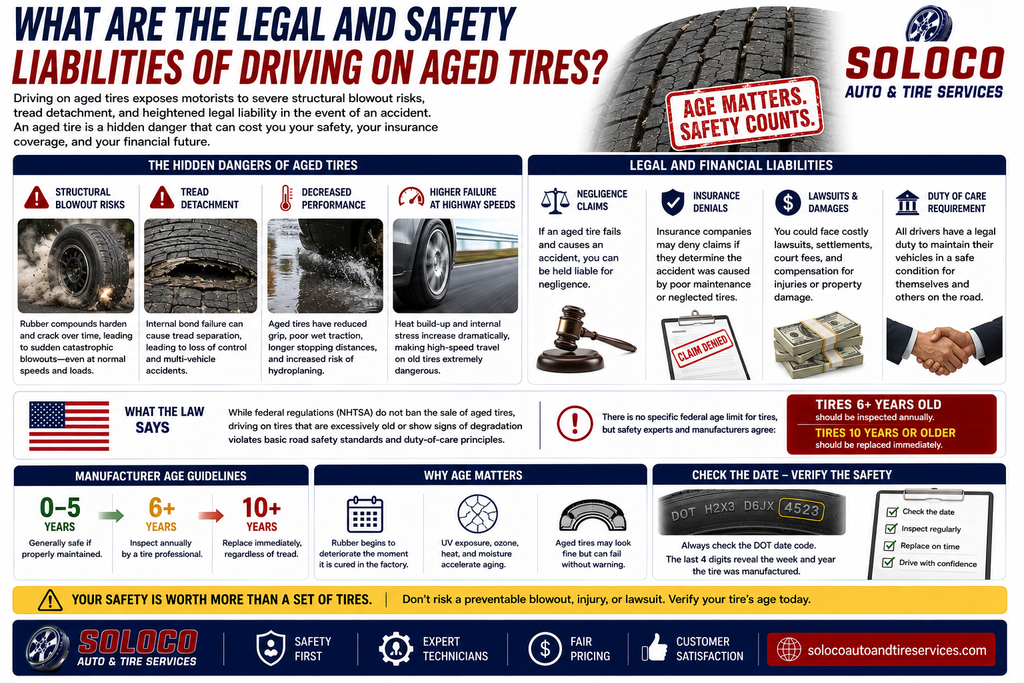
Driving on aged tires exposes motorists to severe structural blowout risks, tread detachment, and heightened legal liability in the event of an accident. While federal regulations do not explicitly ban retail shops from selling aged inventory, operating vehicles with severely degraded rubber violates basic road safety standards and duty-of-care principles.
Commercial fleet operators and private vehicle owners who ignore manufacturer age thresholds face heightened insurance claim denials and negligence litigation if an aged tire fails on public highways. Verifying the Department of Transportation manufacture date remains an essential duty for safeguarding vehicle occupants and maintaining legal compliance.
The Bottom Line
Tires feature a mandatory four-digit Department of Transportation date code on their sidewall indicating the manufacturing week and year. Because rubber degrades from heat, ozone, and time regardless of mileage or tread depth, safety professionals recommend replacing tires within six to ten years of their production date. Always inspect both inner and outer sidewalls to verify actual tire age before installation.


