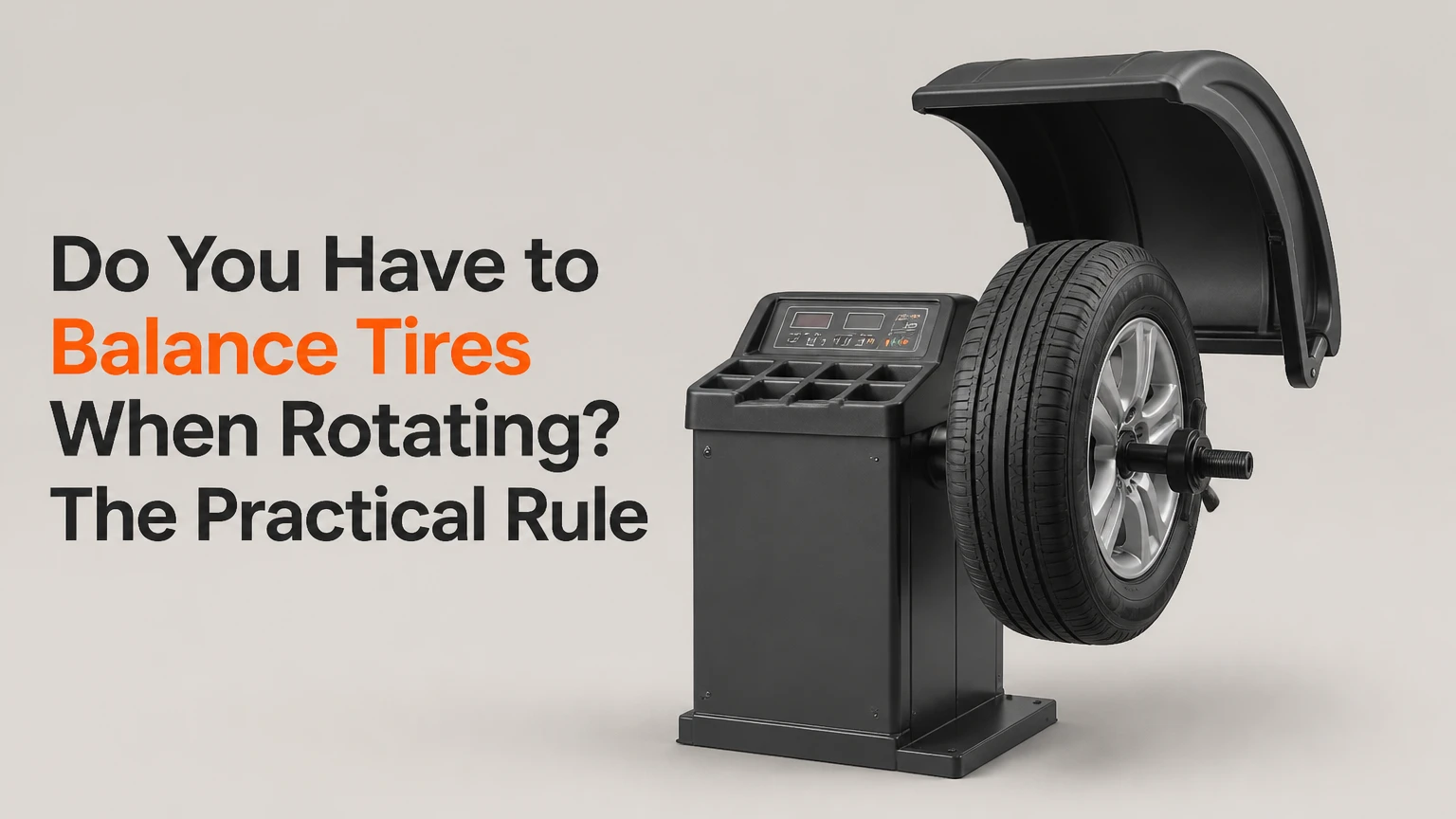
No, you do not have to balance tires every time you rotate them. Tire rotation changes wheel positions to equalize tread wear, while tire balancing corrects uneven weight in a wheel-and-tire assembly; balance the tires when vibration, lost weights, tire mounting, repairs, or wheel damage indicate an imbalance.
Key Facts at a Glance
- Tire rotation and tire balancing are separate services with different purposes.
- Most passenger vehicles need rotation about every 5,000-7,500 miles, following the owner’s manual first.
- A balanced wheel usually does not become unbalanced merely because it moved from the front axle to the rear axle.
- Steering-wheel vibration at roughly 50-70 mph commonly justifies a balance inspection, but brakes, bent wheels, tire defects, and suspension parts can cause similar symptoms.
- A tire mounted on a new wheel, repaired after a puncture, or separated from a wheel weight should be balanced.
- Standard dynamic balancing is usually sufficient; road-force balancing is most useful for persistent vibration after ordinary balancing.
Do You Have to Balance Tires When Rotating?
Tire balancing is not automatically required during every tire rotation, but checking for missing weights, damage, and abnormal wear is sensible. A vehicle with no vibration, no recent tire work, and correctly installed wheels can generally receive a rotation alone when the maintenance schedule calls for it.
Rotation moves complete wheel assemblies. The tire, wheel, valve stem, and attached weights move together, so their relative weight distribution normally remains unchanged. The vehicle may feel different if a slightly imbalanced tire moves onto the steering axle, but the rotation did not create that imbalance.
Balancing becomes appropriate when a wheel weight falls off, a tire is dismounted, a wheel strikes a pothole or curb, a puncture repair changes the assembly, or vibration appears. A shop should diagnose the cause rather than automatically sell balancing at every interval.
What is the difference between rotation and balancing?
Tire rotation changes location; wheel balancing changes weight distribution. Rotation manages differences in tread wear between axles, while balancing adds small clip-on or adhesive weights to counter heavy areas in the tire-and-wheel assembly.
Front tires often experience greater steering and cornering forces, while drive tires can wear faster during acceleration. Rotation distributes those loads over time. Balancing addresses radial or lateral forces produced as an assembly spins.
Michelin describes balancing as “equalizing the weight of a tire and wheel assembly,” which accurately distinguishes the service from rotation. Neither service replaces a wheel alignment, tire inspection, or suspension repair.
How Does Wheel Balance Affect Driving?
Wheel imbalance produces a rotating force that grows rapidly with speed. A heavy section of the tire or wheel pulls outward once per revolution, creating a vertical hop, side-to-side wobble, or both.
Manufacturing variation, uneven tread wear, a bent rim, corrosion between mating surfaces, and a detached wheel weight can all alter the assembly’s balance. The driver may notice a narrow speed band because the rotating disturbance interacts with the vehicle’s suspension and steering system.
A front imbalance is often felt through the steering wheel. A rear imbalance may appear through the seat, floor, or body structure, so the absence of steering shake does not prove that the rear wheels are balanced.
What happens during a professional balance?
A technician removes the wheel assembly, cleans the mounting surfaces and rim, clamps the assembly to a computerized balancer, spins it, and applies the indicated weights. The machine then spins the assembly again to verify the correction.
A competent inspection also checks for a bent wheel, tire bulge, uneven bead seating, damaged valve stem, and excessive radial or lateral runout. Adding weights cannot correct a structurally damaged tire or a severely distorted wheel.
The service should include these checkpoints:
- Remove stones, mud, and loose material from the tread and rim.
- Confirm that the balancer’s cone or adapter centers the wheel correctly.
- Measure both inner and outer planes on a modern dynamic balancer.
- Install weights in locations that do not interfere with brake components.
- Re-test after installation.
- Torque the wheel nuts to the vehicle manufacturer’s specification.
A displayed “zero” reading does not guarantee a good result if the wheel was mounted off-center or the tire has excessive force variation.
Which Type of Tire Balancing Do You Need?
Dynamic balancing is the normal choice for modern passenger vehicles. Road-force balancing is a diagnostic escalation for persistent vibration, while static balancing is mainly suited to narrow, older, or specialized wheel assemblies.
| Balancing method | Measurement | Typical application | Main limitation |
|---|---|---|---|
| Static | One plane, up-and-down force | Narrow older tires, simple wheels | May not correct side-to-side wobble |
| Dynamic | Two planes, radial and lateral force | Passenger cars, SUVs, highway use | Cannot repair a bent wheel or defective tire |
| Road force | Tire stiffness plus wheel runout | Low-profile tires, repeated vibration | Higher price and not a substitute for inspection |
| Bead balancing | Internal moving media | Some off-road or specialty tires | Results vary by tire, speed, and manufacturer approval |
Is road-force balancing worth the extra cost?
Road-force balancing is worth considering when a correctly mounted and dynamically balanced wheel still vibrates. A roller presses against the rotating tire to approximate the load of the vehicle, measuring stiffness variation and wheel runout that ordinary spin balancing may not fully explain.
Road-force equipment can help a technician match the tire’s stiff point to the wheel’s low point. That process may reduce vibration without adding excessive weights. It cannot correct a broken belt, a bent suspension component, a badly damaged wheel, or an unsafe tire.
For an ordinary commuter with no symptoms, road-force service at every rotation is usually unnecessary. For a low-profile performance tire that repeatedly shakes at highway speed, the additional diagnostic information can justify the charge.
When Should Tires Be Rotated and Balanced?
Rotate tires at the interval in the owner’s manual, commonly 5,000-7,500 miles or approximately every six months. Balance the assemblies when symptoms or service events justify it, rather than treating every rotation as an automatic balance interval.
Many tire manufacturers and vehicle makers specify rotation intervals within that range, but the correct pattern depends on drivetrain, tire design, load, and wear. Severe service, frequent towing, aggressive cornering, gravel roads, and all-terrain tread can shorten the useful interval.
| Driving or tire situation | Rotation guideline | Balance guideline | Reason |
|---|---|---|---|
| Front-wheel-drive sedan | 5,000-7,500 miles | At installation or symptoms | Front axle often wears faster |
| Rear-wheel-drive pickup | 5,000-7,500 miles | Inspect at rotation; balance after impacts | Drive axle load varies with cargo |
| AWD crossover | Follow manual, often 5,000-7,500 miles | Match circumference and investigate vibration | Small diameter differences can matter |
| Mud-terrain or large all-terrain tires | About 5,000 miles | Inspect or balance after mud loss and impacts | Large tread blocks change wear and debris load |
| Low-profile performance tires | 3,000-5,000 miles if wear is aggressive | Balance with symptoms or tire work | Stiff sidewalls transmit disturbances clearly |
| Trailer or infrequently driven vehicle | Annual inspection minimum | Balance after mounting or noticeable shake | Time does not remove imbalance |
Balancing every second rotation can be a reasonable shop-maintenance package, but it is not a universal mechanical requirement. The owner’s manual, tire warranty terms, symptoms, and inspection findings should control.
Do new tires need balancing?
New tires need balancing whenever they are mounted on wheels. The tire and wheel have manufacturing tolerances, and technicians must measure the completed assembly rather than assume that either component is perfectly uniform.
A tire installation normally includes mounting, inflation, bead seating, balancing, and wheel installation. If a shop installs a new tire without balancing it, ask whether the price includes the service and request the final machine readings if vibration later develops.
A replacement tire on an existing wheel also needs balancing. The wheel may have been balanced previously, but the old tire’s relationship to the wheel no longer applies after dismounting.
Does a puncture repair require balancing?
An ordinary plug or internal patch does not always require rebalancing if the tire remains mounted and no material is removed. A tire that is dismounted, rotated on the rim, repaired with a substantial patch, or fitted with a new valve should be checked.
A professional tire repair should also inspect the inside for run-flat damage, confirm that the puncture is within the repairable tread area, and follow the tire maker’s repair limits. Balancing is secondary to determining whether the tire is safe to return to service.
What Symptoms Mean a Balance Check Is Needed?
A vibration that increases with vehicle speed and appears without braking commonly merits a balance inspection. The location of the sensation provides clues, but it does not identify the failed part with certainty.
| Driver symptom | Likely area to inspect first | Other possible causes | Recommended action |
|---|---|---|---|
| Steering wheel shakes at 50-70 mph | Front wheel balance | Bent rim, tire defect, worn tie rod | Inspect and dynamically balance front assemblies |
| Seat or floor vibrates at highway speed | Rear wheel balance | Rear tire runout, driveline issue | Inspect rear wheels and tires |
| Shake begins immediately after rotation | Newly relocated wheel | Loose lug nuts, incorrect pressure, damaged tire | Stop if severe; verify torque and inspect |
| Vehicle pulls left or right | Alignment or tire conicity | Brake drag, unequal pressure | Check pressures, then alignment and tires |
| Vibration only while braking | Brake system | Front suspension play | Inspect rotors, calipers, and suspension |
| Rhythmic thumping at low speed | Tire damage or separated belt | Flat spot, debris, wheel damage | Stop and inspect before highway driving |
| Vibration changes after mud accumulation | Debris in wheel | Tire damage or lost weight | Remove debris and recheck balance |
A vibration that starts after rotation may reveal an existing problem rather than prove that the technician caused it. Moving a mildly imbalanced rear wheel to the front steering axle can make a previously unnoticed issue obvious.
Do not continue driving at highway speed with a bulge, exposed cord, separated tread, loose wheel, or severe new vibration. Balance service is not an emergency repair for a tire or wheel that may be unsafe.
Is Tire Balancing the Same as Wheel Alignment?
Tire balancing and wheel alignment are different services. Balancing corrects the distribution of mass in each rotating assembly, while alignment adjusts wheel angles such as toe, camber, and caster relative to the vehicle and road.
| Service | Primary variable | Typical symptom | Corrective method |
|---|---|---|---|
| Rotation | Wheel position | Uneven axle wear | Move assemblies according to tire pattern |
| Balancing | Rotating mass | Speed-related vibration | Add or reposition rim weights |
| Alignment | Wheel geometry | Pulling, off-center wheel, edge wear | Adjust angles to vehicle specification |
| Suspension repair | Mechanical movement | Clunks, instability, irregular wear | Replace worn or damaged components |
Alignment does not remove a heavy spot from a tire. Balancing does not correct excessive toe, a leaning wheel, or a worn ball joint. A vehicle can need both services, but one cannot be used as a substitute for the other.
A simple rule helps: vibration tied to road speed points toward wheel, tire, or driveline investigation; pulling and one-sided tread wear point more strongly toward alignment or suspension inspection.
How Much Does Rotation and Balancing Cost?
Typical United States pricing is about $20-$50 for rotation alone and $15-$50 per wheel for standard balancing. A four-wheel balance therefore commonly costs $60-$200, although tire retailers may include both services in a purchase or lifetime maintenance plan.
Prices vary with wheel diameter, vehicle type, regional labor rates, and whether the shop performs road-force testing. Run-flat tires, oversized truck wheels, seized lug nuts, and corrosion can increase labor time.
| Service | Typical price range | Typical shop time | Usually includes |
|---|---|---|---|
| Rotation only | $20-$50 | 15-30 minutes | Wheel relocation, pressure check |
| Four-wheel dynamic balance | $60-$200 | 30-60 minutes | Spin measurement and rim weights |
| Road-force balance | $100-$240 | 45-90 minutes | Load simulation and force analysis |
| Rotation plus standard balance | $80-$250 | 45-75 minutes | Both services and basic inspection |
| Lifetime tire-store plan | $0 after purchase | 30-75 minutes | Terms vary by retailer and tire purchase |
A low advertised balance price may exclude weight material, oversized-wheel fees, tire removal, or disposal. Ask for the complete out-the-door price before authorizing work.
What Should You Check Before Approving a Balance?
Ask the technician to identify the measured imbalance, missing weight, tire runout, or wheel damage that justifies the service. A credible recommendation connects the repair to a symptom or inspection result rather than claiming that every rotated tire automatically needs balancing.
Use this shop checklist:
- Ask whether all four assemblies were tested or only the vibrating axle.
- Confirm that dirt, stones, and old loose weights were removed first.
- Ask whether the machine performs dynamic balancing.
- Request inspection for bent rims and excessive runout if vibration persists.
- Confirm that wheel nuts will be torqued to the vehicle specification.
- Ask whether adhesive weights are required for alloy wheels.
- Verify that tire pressure and TPMS operation will be checked.
- Request a road-force test only if conventional balancing does not solve the problem.
One practitioner rule is especially useful: repeated balancing with increasingly large weights signals a problem to diagnose, not an invitation to keep adding weights. The tire may be improperly seated, the wheel may be bent, or the tire may have excessive force variation.
What Common Problems Can Make Balancing Fail?
Balancing fails when the machine measures a contaminated, off-center, damaged, or incorrectly assembled wheel. Adding weights to a mechanically defective assembly can reduce one symptom while leaving the underlying hazard untouched.
Dirty wheels
Mud, packed snow, tar, and stones trapped inside a rim alter the rotating mass. The wheel must be cleaned before measurement, particularly after off-road driving or winter storms.
Incorrect balancer mounting
A wheel that is clamped with the wrong adapter can sit off-center on the spindle. The machine may report a precise correction for an inaccurate setup, causing vibration after installation.
Bead seating problems
A tire bead that has not seated evenly creates radial runout. Correct inflation during mounting and a visual bead-line inspection matter before weights are applied.
Lost or loose weights
A missing clip-on weight often produces a sudden vibration, while an adhesive weight can detach after corrosion, wheel cleaning, or impact. Check the rim for a clean rectangular mark where a weight used to sit.
Tire or wheel damage
A bent rim, bulge, belt separation, or severe flat spot may not be repairable through balancing. The correct remedy may be wheel straightening by a qualified specialist or tire replacement.
Worn suspension or steering parts
Loose tie rods, ball joints, wheel bearings, and control-arm bushings can amplify a small imbalance or create their own vibration. A balance result cannot certify the rest of the chassis.
Can Every Vehicle Use the Same Rotation Pattern?
No. Rotation pattern depends on tire direction, tread design, wheel size, drivetrain, and the vehicle maker’s instructions.
- Non-directional, same-size tires: front-to-rear or approved cross patterns may be possible.
- Directional tires: move front-to-rear on the same side unless a shop remounts the tires.
- Staggered fitments: wider rear and narrower front wheels usually cannot swap axles.
- Asymmetric tires: preserve the sidewall markings that specify the outside face.
- AWD vehicles: follow the manufacturer’s allowable tread-depth or circumference difference.
- Tires with different sizes front and rear: use only the rotation positions listed in the manual.
A rotation cannot compensate for a tire that is the wrong size, load index, speed rating, or direction. Tire sidewall markings and the vehicle placard take precedence over a generic shop pattern.
Should You Balance Tires Every Time You Rotate Them?
Balance tires during rotation when vibration exists, a weight is missing, the wheel or tire was recently serviced, or an inspection finds abnormal runout or wear. Otherwise, rotating complete assemblies at the manufacturer’s interval without automatic rebalancing is usually adequate for a properly maintained passenger vehicle.
Drivers with low-profile performance tires, heavily used trucks, frequent pothole impacts, or mud-terrain tires may reasonably balance more often because their assemblies experience greater disturbance. Even in those cases, a symptom-based inspection is more useful than a rigid rule to balance every 5,000 miles.
The best maintenance decision is therefore conditional:
- No symptoms and no tire work: rotate and inspect.
- New tire or wheel: balance during installation.
- New speed-related vibration: inspect and balance, then investigate damage if vibration remains.
- Vibration only during braking: inspect the brake system instead of requesting balance first.
- Persistent vibration after standard balance: consider road-force testing and runout measurement.
Frequently Asked Questions
Can rotating tires cause a vibration?
Tire rotation can expose an existing imbalance when a wheel moves from the rear axle to the steering axle, but rotation normally does not create imbalance. A vibration after service also requires checking wheel-nut torque, tire pressure, wheel seating, damaged tires, and the possibility that a weight was disturbed.
Will balancing tires fix uneven or cupped tread wear?
Balancing can prevent vibration from an imbalance, but it cannot restore cupped tread or erase uneven wear. Cupping may involve worn shocks, incorrect pressure, alignment error, loose suspension parts, or an imbalanced wheel, so the cause must be corrected before installing or rotating tires.
Do rear tires need balancing?
Rear tires need balancing just as front tires do because every wheel assembly generates rotating forces. Rear imbalance often travels through the seat, floor, or cabin instead of the steering wheel, which makes it easier to overlook.
How long does a tire balance last?
A balance can remain correct for the life of the tire if the wheel avoids impacts and retains its weights. Rebalancing may become necessary after a pothole strike, curb impact, tire repair, wheel cleaning that removes adhesive weights, tread loss, or internal tire damage.
Can tire balancing improve fuel economy?
Correct balance can reduce vibration and abnormal wear, but the fuel-economy effect is usually smaller than the effects of tire pressure, alignment, cargo, speed, and driving style. Balance wheels for smooth operation, tire preservation, and safety rather than a guaranteed measurable fuel-saving percentage.
Is balancing needed after tire rotation on an AWD vehicle?
AWD vehicles still do not automatically require balancing after every rotation. AWD systems do require close attention to tire size, circumference, tread depth, and the manufacturer’s rotation schedule, while balancing remains appropriate for vibration, tire mounting, lost weights, and wheel damage.
The Bottom Line
You do not have to balance tires when rotating if the complete wheel assemblies are already balanced and show no symptoms or damage. Rotate tires according to the vehicle manual, balance new or repaired assemblies, and investigate any speed-related vibration instead of paying for automatic balancing at every visit.