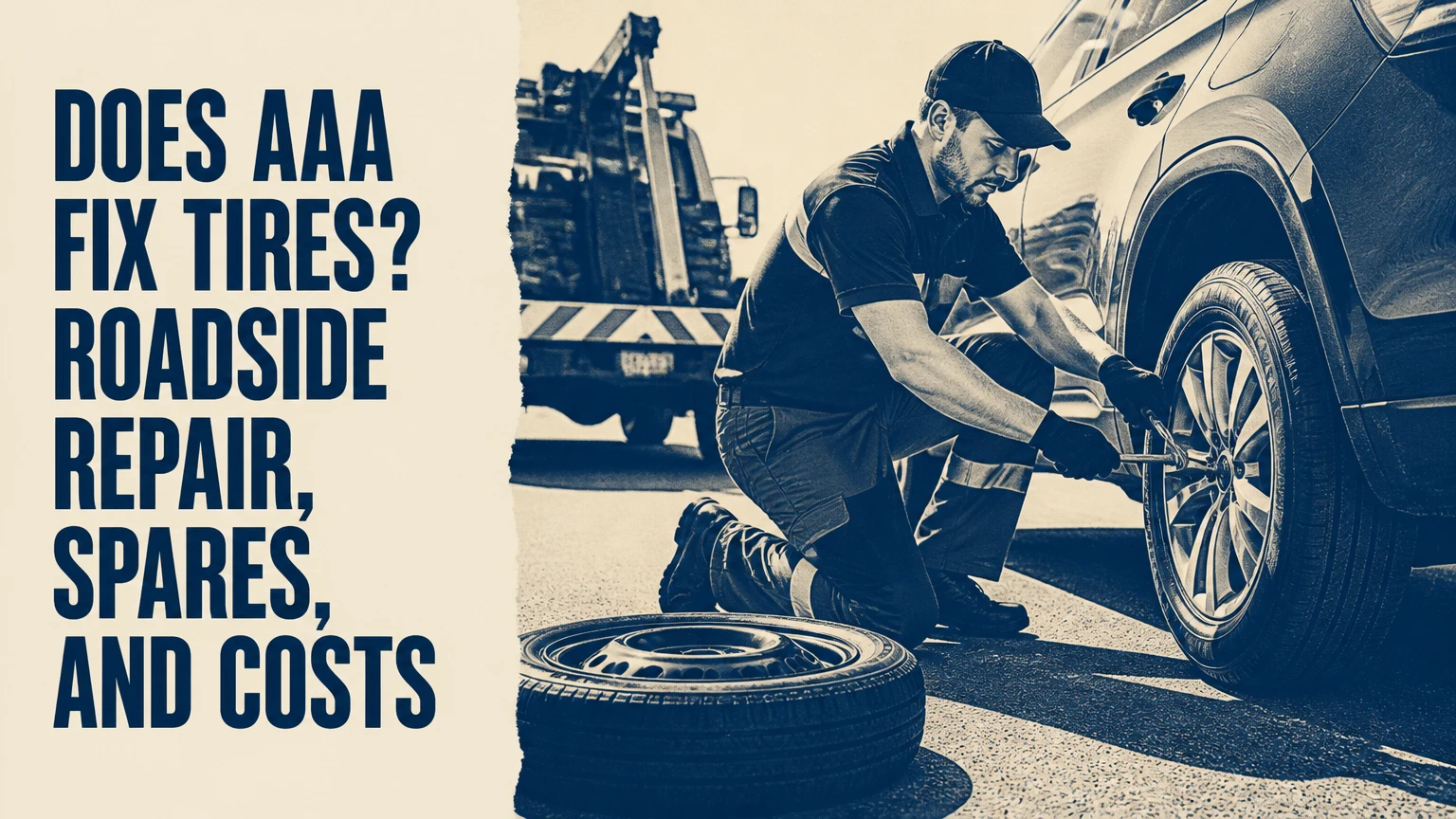
AAA roadside assistance generally does not permanently fix a punctured tire by patching or plugging it at the roadside. AAA usually restores mobility by installing a usable spare tire, adding air when appropriate, or towing the vehicle to a repair facility when a spare is unavailable or unsafe.
Key Facts at a Glance
- AAA roadside technicians normally change a flat tire rather than patch or plug its puncture.
- A usable spare tire is the fastest way for AAA to get most stranded vehicles moving again.
- AAA usually arranges a tow when the vehicle has no safe spare, a damaged wheel, or an unrepairable tire.
- A tire shop must inspect the puncture before deciding whether a permanent repair is safe.
- A tire with sidewall damage, exposed cords, bead damage, or severe separation normally requires replacement.
- Membership benefits, towing mileage, dispatch fees, and mobile tire options vary by AAA club and location.
Does AAA Fix Tires?
AAA usually fixes the immediate mobility problem, not the damaged tire itself. A roadside technician may remove the flat and install the vehicle’s spare, inflate a low tire, or tow the vehicle, but standard roadside service typically does not include puncture repair with a plug-and-patch procedure.
The distinction matters because a roadside tire change and a permanent tire repair have different objectives. AAA’s roadside technician works beside traffic, often with limited lighting and equipment. A tire shop can remove the tire from the wheel, inspect the inner liner, measure the injury, and apply a repair that meets tire-industry procedures.
AAA’s regional clubs do not all offer identical services. Some areas have mobile tire vans that can mount, balance, or sell a replacement tire, but those programs are limited and should not be treated as a nationwide AAA benefit.
What AAA means by roadside tire service
AAA roadside tire service generally includes:
- Changing a flat tire with a serviceable spare
- Inflating a tire that has lost air
- Attempting to make the vehicle safe to drive to a repair facility
- Arranging a tow when the tire or vehicle cannot be safely driven
- Providing limited assistance with a vehicle-supplied inflator kit
AAA roadside service generally does not mean removing the tire for an internal inspection, repairing a puncture permanently, balancing the wheel, or guaranteeing that the damaged tire can be reused.
What Does AAA Roadside Assistance Actually Do?
AAA roadside assistance follows a mobility-first process: dispatch, safety assessment, tire assessment, spare installation or inflation, and towing when the vehicle cannot safely continue. The technician’s final outcome depends mainly on the spare tire, wheel-lock key, tire damage, vehicle clearance, and roadside conditions.
A typical service call begins when the member submits a request through the AAA app, website, or the phone number on the membership card. The dispatcher usually needs the vehicle’s exact location, direction of travel, make and model, license plate, tire position, and information about the spare.
How the roadside process works
- Move to a safe position if possible. Turn on hazard lights and leave the traffic lane. On a freeway shoulder, remain away from moving traffic rather than standing beside the wheel.
- Request service. Tell AAA whether the tire is flat, slowly leaking, shredded, separated, or damaged after a collision.
- Report the vehicle equipment. Confirm whether the trunk contains a full-size spare, temporary spare, inflator kit, run-flat tires, or no replacement tire.
- Wait for the technician. Arrival time varies with traffic, weather, location, contractor availability, and emergency priority. A 20-minute average cannot reliably predict an individual call.
- Allow the technician to inspect the setup. The technician checks the tire, wheel, jack points, spare condition, wheel locks, and safe working space.
- Use the safest available remedy. AAA may install the spare, add air, or arrange towing.
- Drive only within the spare’s limits. Follow the speed and distance printed on the temporary spare or in the vehicle owner’s manual.
- Obtain a tire-shop inspection. The damaged tire needs a permanent repair decision, even if it appears to hold air after inflation.
The strongest practical preparation is simple: tell dispatch that the vehicle lacks a spare or has locking lug nuts. That information can influence whether AAA sends a standard roadside vehicle or a tow-capable truck.
What Happens if You Have No Spare Tire?
If a vehicle has no usable spare, AAA may inflate the damaged tire if the condition appears suitable for short-distance travel, but a tire that will not hold air or has structural damage normally requires towing. AAA does not usually bring a universal replacement tire for every vehicle and wheel size.
Many newer vehicles carry a tire mobility kit instead of a spare. The kit commonly contains a 12-volt compressor and liquid sealant, but sealant cannot safely address every puncture. It is unsuitable for many sidewall injuries, large cuts, bead leaks, wheel damage, and tires driven while severely underinflated.
| Vehicle condition | Likely AAA roadside outcome | Safe next destination |
|---|---|---|
| Usable full-size spare, intact tire | Spare installed and inflated | Tire shop within normal driving limits |
| Usable temporary spare, correct fit | Temporary spare installed | Tire shop, usually same day |
| No spare, small tread puncture, tire holds air | Air added if safe | Nearby tire shop |
| No spare, tire loses air immediately | Tow arranged | Tire shop or repair facility |
| Torn sidewall or exposed cord | No roadside tire repair | Tow to tire shop |
| Damaged wheel or missing lug hardware | Tow or specialized recovery | Wheel and tire facility |
A technician may decline to install a spare that is flat, cracked, dry-rotted, incorrectly sized, or incompatible with the vehicle. A spare is not automatically safe merely because it fits the trunk well.
Can AAA Inflate a Leaking Tire?
AAA can often add air to a low tire, but inflation is only appropriate when the tire and wheel remain structurally sound and the tire can retain pressure long enough to reach a repair facility. Air does not repair the puncture, and driving on a repeatedly leaking tire can destroy its internal structure.
A slow tread puncture may lose pressure over several hours. A bead leak, valve-stem failure, bent wheel, or large tread injury can lose pressure within minutes. Rapid pressure loss after inflation is a strong reason to request a tow rather than continue driving.
The tire-pressure monitoring system, or TPMS, does not replace a pressure gauge inspection. TPMS warns that pressure has fallen below a vehicle-specific threshold, but it may not identify the puncture location or reveal sidewall damage.
When inflation is not a safe solution
Do not treat inflation as a drive-away remedy when:
- The sidewall has a cut, bulge, blister, or visible cord
- The tread is separated or badly shredded
- The tire was driven while flat
- The wheel is bent, cracked, or visibly displaced
- The valve stem is broken
- The tire loses substantial pressure immediately
- The tire is bead-damaged after striking a curb
- The vehicle manufacturer prohibits driving on that damaged tire
The U.S. Tire Manufacturers Association advises replacing a tire with serious sidewall damage because the sidewall carries structural loads that an external plug cannot restore. The National Highway Traffic Safety Administration also repeatedly emphasizes maintaining correct tire pressure, because underinflation increases heat buildup and affects vehicle control.
How Much Does AAA Tire Service Cost?
For an active AAA member, roadside labor for changing a flat with the vehicle’s spare is generally included in the membership benefit, subject to the local club’s terms. A non-member may face a membership purchase, an immediate-service charge, or a separate commercial roadside price, while tire repair, replacement, and some towing costs remain separate.
AAA membership pricing and benefits differ by club, state, plan, vehicle, and service circumstances. Classic, Plus, and Premier names are common, but their towing allowances and restrictions are not identical everywhere.
| Expense category | Typical U.S. range or rule | What changes the amount |
|---|---|---|
| AAA membership | About $50-$150 per year | Club, membership tier, promotion, household plan |
| Immediate non-member service | About $50-$100 plus service cost | Local club, availability, same-day enrollment rules |
| Standard puncture repair | About $20-$40 | Tire size, shop policy, tire removal, valve service |
| Replacement passenger tire | About $80-$300 per tire | Brand, size, load rating, performance category |
| Mounting and balancing | About $20-$60 per tire | Retailer package, wheel diameter, location |
| Tow beyond plan allowance | Often billed per excess mile | Local rate, membership tier, destination, truck type |
These figures are typical planning ranges, not guaranteed AAA prices. A shop can refuse a free puncture repair if its inspection finds a prohibited injury, and a tire replacement invoice may include disposal, installation, TPMS service, taxes, and road-hazard coverage.
How AAA towing limits affect a flat-tire call
Towing is usually governed by the membership plan’s mileage allowance and local rules. Basic plans may provide a short tow, while higher tiers commonly provide longer distances, but the exact allowance must be confirmed with the issuing AAA club.
Ask the dispatcher four questions before authorizing a destination:
- How many towing miles does this membership cover?
- What is the per-mile charge beyond that allowance?
- Can the vehicle go to my chosen tire shop?
- Does the destination accept this vehicle type and tire size?
A longer covered tow can matter more than the roadside tire-change benefit for vehicles without spare tires. That is especially true for electric vehicles, low-clearance sports cars, and rural drivers far from a tire retailer.
Where Does the Permanent Tire Repair Happen?
A permanent tire repair happens at a tire shop or qualified repair facility after the tire is removed and inspected internally. AAA may tow the vehicle to an Approved Auto Repair facility, but the repair shop is a separate business that normally charges its own labor and parts rates.
The accepted repair zone is generally the tread area, not the sidewall or shoulder. Tire-industry guidance commonly permits a repair only when the injury is within the repairable tread area, below the manufacturer or industry size limit, and free from internal damage.
A proper repair normally combines an internal patch with a plug that fills the injury channel. An exterior string plug alone may stop air loss temporarily, but a shop should inspect the tire rather than assume an outside plug is a permanent repair.
| Tire finding after inspection | Typical decision | Reason |
|---|---|---|
| Small puncture in central tread | Repair may be possible | Repairable location and limited injury size |
| Puncture near shoulder | Replacement commonly advised | High flexing area weakens repair reliability |
| Sidewall cut or bulge | Replace tire | Structural sidewall damage cannot be patched safely |
| Tire driven flat | Replace or internal inspection required | Heat may damage cords and inner liner |
| Bent or cracked wheel | Wheel repair or replacement | Air loss may originate from the wheel |
| Uneven wear below legal tread depth | Replace tire | Remaining tread and casing condition are inadequate |
The phrase “fixable puncture” does not mean “safe to repair without inspection.” Tire age, load rating, speed rating, previous repairs, inflation history, and internal condition all affect the decision.
How Do Membership Plans and Regional Rules Change the Answer?
AAA membership provides roadside assistance under local club terms, so service availability cannot be inferred from the AAA brand alone. Membership status, plan level, service-call limits, vehicle type, location, and local contractor capability can change whether the result is a spare installation, inflation attempt, or tow.
Some AAA clubs advertise mobile tire service or mobile tire replacement in selected markets. Those vans may carry specific tire sizes, mounting equipment, and balancing tools, but they are regional programs rather than a guaranteed standard benefit.
Before relying on AAA for a trip, verify:
- The local club’s roadside tire-service description
- The number of covered service calls
- Towing distance and destination rules
- Waiting-period rules for newly purchased memberships
- Coverage for motorcycles, trailers, RVs, and commercial vehicles
- Mobile tire service availability in the travel area
- Whether the service vehicle carries a tire for the vehicle’s exact size
A roadside membership is not tire insurance. It usually helps with labor, dispatch, and towing under stated limits, while the damaged tire and replacement parts remain the owner’s responsibility.
AAA Versus a Tire Shop or DIY Tire Change
AAA is usually the safest choice when the vehicle is stopped on a high-speed road, the driver lacks equipment, or the tire cannot be evaluated confidently. A tire shop is the best choice when the vehicle is already in a safe place and can be driven or transported there, while a DIY change is practical only with correct tools, a safe surface, and a serviceable spare.
| Option | Typical direct cost | Typical time after access | Final result |
|---|---|---|---|
| AAA roadside change | $0 member labor, terms apply | 30-120 minutes typical wait and work | Spare installed |
| Independent mobile tire service | About $75-$200 service fee | 30-90 minutes availability | Repair or replacement if equipped |
| Tire shop puncture repair | About $20-$40 | 30-90 minutes | Permanent repair if approved |
| DIY spare installation | $0 additional labor | 20-45 minutes | Spare installed |
| Tow to tire retailer | Plan allowance or about $75-$200+ | 45-180 minutes total | Shop inspection and repair decision |
A DIY tire change is not automatically faster. Jack placement, seized lug nuts, traffic exposure, poor weather, and a corroded spare can turn a 20-minute task into a dangerous roadside event.
Which option fits each situation?
- Freeway shoulder: Choose AAA or emergency roadside assistance. Do not work beside fast-moving traffic unless there is no safer option.
- Residential driveway: Use a tire shop or mobile tire service if the vehicle can remain parked safely.
- Parking lot with a good spare: AAA and DIY are both reasonable; AAA reduces lifting and jack-placement risk.
- No spare in a rural area: Prioritize towing-distance coverage and confirm the destination before dispatch.
- Visible sidewall damage: Request a tow. Inflation and plugging are not suitable repairs.
- Slow leak near a tire shop: Add air only if the tire is structurally sound, then drive directly for inspection.
The practical winner is situation-dependent, but safety determines the first decision. Price comes second.
What Problems Can Stop a Roadside Tire Change?
A roadside tire change can fail when the spare, wheel hardware, jack points, tire structure, or working area is unsuitable. The most common preventable problems are a missing wheel-lock key, an unusable spare, a seized lug nut, and a vehicle parked where the technician cannot work safely.
| Roadside obstacle | Why it matters | Best preparation or recovery |
|---|---|---|
| Missing wheel-lock key | Locking lug nut cannot be removed normally | Tell dispatch; locate key in glove box or cargo tray |
| Flat temporary spare | Spare cannot support the vehicle safely | Check pressure every six months |
| Dry-rotted spare | Rubber may fail under load | Replace aging spare before an emergency |
| Buried spare under cargo | Access delays service | Clear cargo access before the truck arrives |
| Unsafe traffic position | Technician may refuse roadside work | Move behind a barrier or request a tow |
| Damaged jack point | Lifting can damage the vehicle | Use the owner’s manual lift point |
| Oversized wheel or low clearance | Standard equipment may not fit | Request a suitable truck or mobile tire provider |
An expert rule of thumb is to inspect the spare whenever the vehicle receives an oil change. The spare’s pressure, age, tread, jack, wrench, locking-key socket, and retaining hardware all deserve attention.
What if the spare is flat or damaged?
AAA may inflate a spare if the tire is structurally sound and correctly sized. A cracked, severely weathered, incorrectly rated, or previously damaged spare may be rejected because installing it would create a second failure risk.
Temporary spares often have a maximum speed printed on the sidewall, commonly 50 mph, but the vehicle-specific label controls. Distance limits also vary, and many manufacturers intend a temporary spare only for reaching a repair facility, not for normal commuting.
What if the wheel-lock key is missing?
A missing wheel-lock key can prevent removal of the flat tire, particularly when the vehicle has anti-theft lug nuts. Tell AAA before arrival, because a technician may need specialized extraction equipment or may dispatch a tow truck instead of a standard service vehicle.
Do not force a random socket onto a locking lug nut. That can round the lock and make extraction slower and more expensive.
How Do Run-Flat Tires, EVs, and Inflator Kits Change Service?
Run-flat tires, electric vehicles, and inflator kits change the roadside decision because tire construction, vehicle weight, lifting points, and manufacturer instructions differ. AAA may provide air or towing, but the technician must follow vehicle-specific procedures rather than treat every flat tire like a conventional spare-tire change.
Run-flat tires can sometimes be driven a limited distance at a restricted speed after pressure loss, but the tire manufacturer and vehicle manual set the limits. A run-flat driven beyond its limit may require replacement even when no obvious puncture is visible.
Electric vehicles add lifting concerns. A tow operator must use approved lift points and transport procedures, and some EVs should not be dragged with driven wheels on the ground. Tell AAA the vehicle’s exact model and drivetrain.
Inflator-kit sealant can temporarily close certain tread punctures, but it may contaminate the TPMS sensor, expire in storage, or make later tire inspection more complicated. Follow the vehicle manufacturer’s instructions and disclose sealant use to the tire shop.
How Should You Request AAA Tire Assistance?
Request AAA tire assistance through the AAA app, website, or the phone number printed on the membership card, and provide enough information for the dispatcher to send the correct equipment. The most useful details are location, traffic exposure, tire condition, spare availability, wheel locks, vehicle type, and preferred destination.
Use this dispatch checklist:
- Give the exact address, highway direction, mile marker, or GPS location.
- State whether the vehicle is in a travel lane, shoulder, parking lot, driveway, or median.
- Identify the damaged tire position, such as right rear.
- Describe the damage, such as nail in tread, shredded sidewall, or wheel impact.
- Confirm whether a full-size spare, donut spare, inflator kit, or no spare is present.
- Mention wheel locks, low clearance, all-wheel drive, EV status, or run-flat tires.
- Ask whether the call will be a tire change, inflation attempt, or tow.
- Confirm expected charges and covered towing distance.
- Remain in a safe location while waiting, using hazard lights when appropriate.
- Inspect the installed spare before leaving, including lug tightness and inflation.
Do not stand behind or beside the vehicle on a freeway shoulder. If the vehicle is in immediate danger from traffic, call emergency services first and then contact AAA.
The Bottom Line
Does AAA fix tires? Usually, AAA fixes the roadside problem by installing a spare, adding air when safe, or towing the vehicle. AAA roadside assistance generally does not patch or plug the punctured tire on location, and a tire shop must perform the permanent repair or replacement.
The best preparation is to check the spare, pressure, jack, wheel-lock key, and membership towing allowance before a trip. If the tire has sidewall damage, loses air rapidly, or has no usable spare, request a tow rather than attempting to drive on it.
Frequently Asked Questions
Will AAA bring a spare tire for my car?
AAA usually installs a spare supplied with the vehicle rather than carrying a universal spare for every model. Some regional mobile tire programs may sell or install a replacement tire, but availability depends on location, tire size, inventory, and vehicle compatibility. Confirm the vehicle’s spare status when requesting service.
Does AAA repair a nail in a tire?
AAA roadside technicians generally do not perform a permanent nail repair at the roadside. A tire shop may repair a nail puncture when it is small, located in the repairable tread area, and free from internal damage. The shop should remove the tire for inspection before using a patch-and-plug repair.
Can I drive on the spare after AAA installs it?
You can drive on a spare only within the speed, distance, load, and drivetrain limits stated on the spare and in the owner’s manual. Many temporary spares have a 50 mph maximum, but that number is not universal. Drive directly to a tire facility rather than treating a donut spare as a normal tire.
Does AAA cover the cost of a new tire?
Standard AAA roadside assistance generally covers eligible roadside labor or towing under membership terms, not the cost of a replacement tire. A mobile tire program, shop discount, or separate warranty may change the transaction. Ask whether the quoted price includes the tire, installation, balancing, valve service, taxes, and disposal.
Is AAA roadside tire service available at home?
AAA can generally dispatch to a vehicle’s location, including a driveway or parking area, when the membership and vehicle meet local service rules. A safe working surface is still required, and the technician may tow the vehicle if the tire, wheel, jack point, or vehicle position makes a roadside change unsafe.
Should I use the tire sealant in my inflator kit before calling AAA?
Use a vehicle-supplied sealant kit only when the owner’s manual permits it and the injury matches the kit’s limits. Sealant is not appropriate for sidewall cuts, large openings, wheel damage, or a tire that has been driven flat. Tell AAA and the tire shop if sealant was injected.